[SUMMARIES]
Two Primary Paths: A Singapore company can be closed through Striking Off (fast and low-cost for dormant companies) or Winding Up (a formal liquidation process for complex or insolvent cases).
Solvency is Key: Directors must determine if the company can pay all debts (solvent) or not (insolvent) to choose the correct legal path.
Tax Verification: Singapore does not issue a physical “Tax Clearance Letter” for company strike-offs. Directors must ensure all tax matters are fully settled and confirm there are no outstanding issues via the IRAS myTax Portal.
Director Liability: Improper company closure can expose directors to fines, enforcement actions, or even director disqualification under the Companies Act.
Professional Help: Appointing an experienced corporate secretary such as Koobiz helps ensure full compliance with the Companies Act and reduces the risk of objections that could delay or block the closure process.
[/SUMMARIES]
Deciding to cease business operations in Singapore requires careful legal and regulatory planning to avoid penalties and director exposure. Knowing how to close a Singapore company correctly is crucial. At Koobiz, we simplify the complex ACRA and IRAS regulations for directors. This guide compares Striking Off vs. Winding Up, helping directors choose the correct exit strategy in compliance with ACRA and IRAS requirements.
What Does It Mean to Close a Company in Singapore?
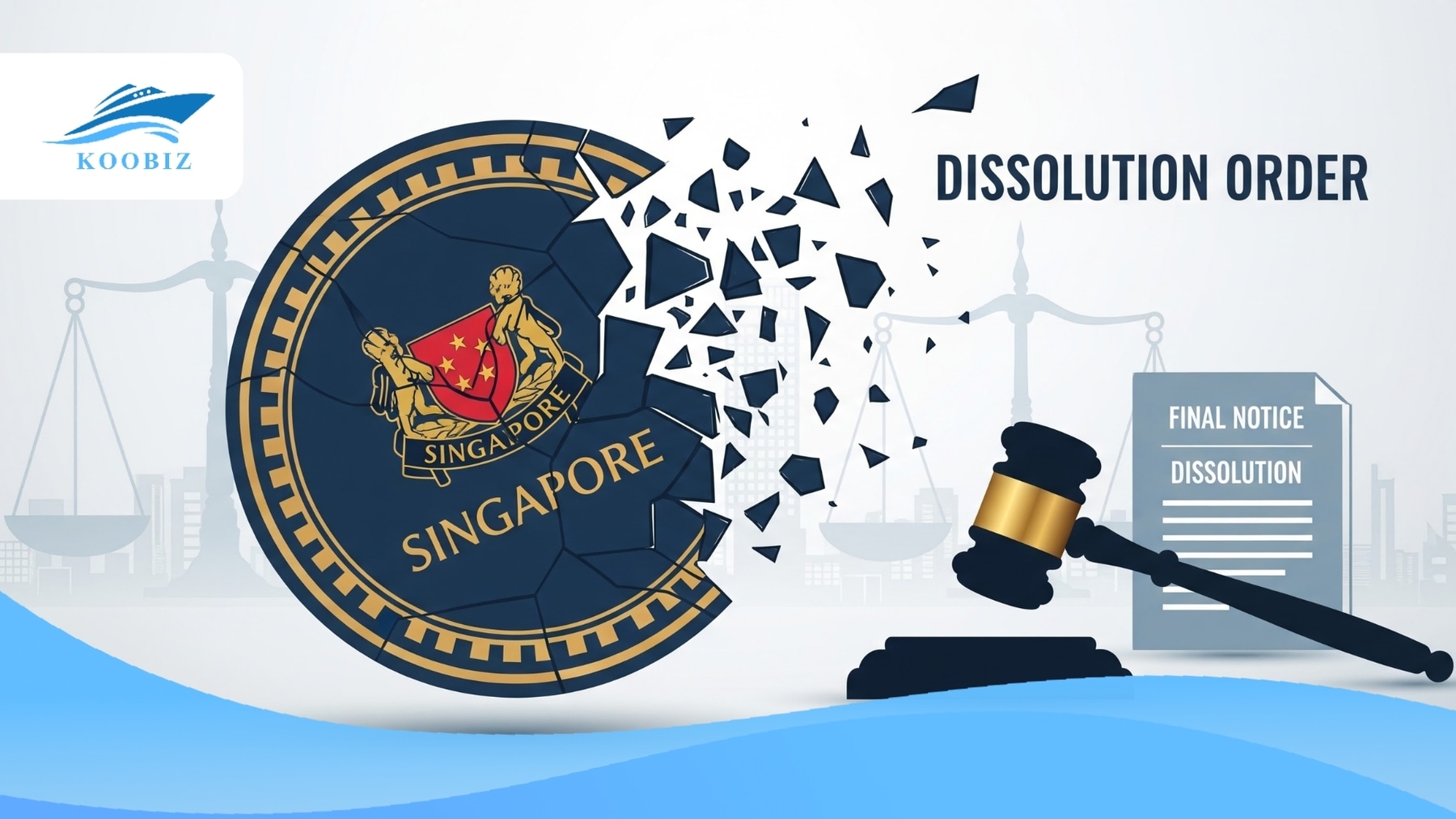
Closing a company in Singapore is the formal legal process of terminating a business entity’s existence and removing it from the Official Register maintained by ACRA. This process ensures all corporate matters are properly settled, assets are distributed, and the company permanently ceases to exist as a legal entity.
To avoid penalties, directors must understand the difference between simply stopping work and a legal exit:
- Ceasing Operations: You stop doing business, but the company still exists. You remain legally liable for filing Annual Returns and holding AGMs, even if the company is dormant.
- Legal Closure (Striking Off/Winding Up): The company is dissolved. This is the only way to permanently end your statutory obligations and liabilities.
Important: Until a company is formally struck off or wound up, ACRA continues to treat it as an active entity. Directors who ignore ongoing obligations because “business has stopped” often face avoidable fines and court summonses.
2 Main Ways to Close a Company: Striking Off vs. Winding Up
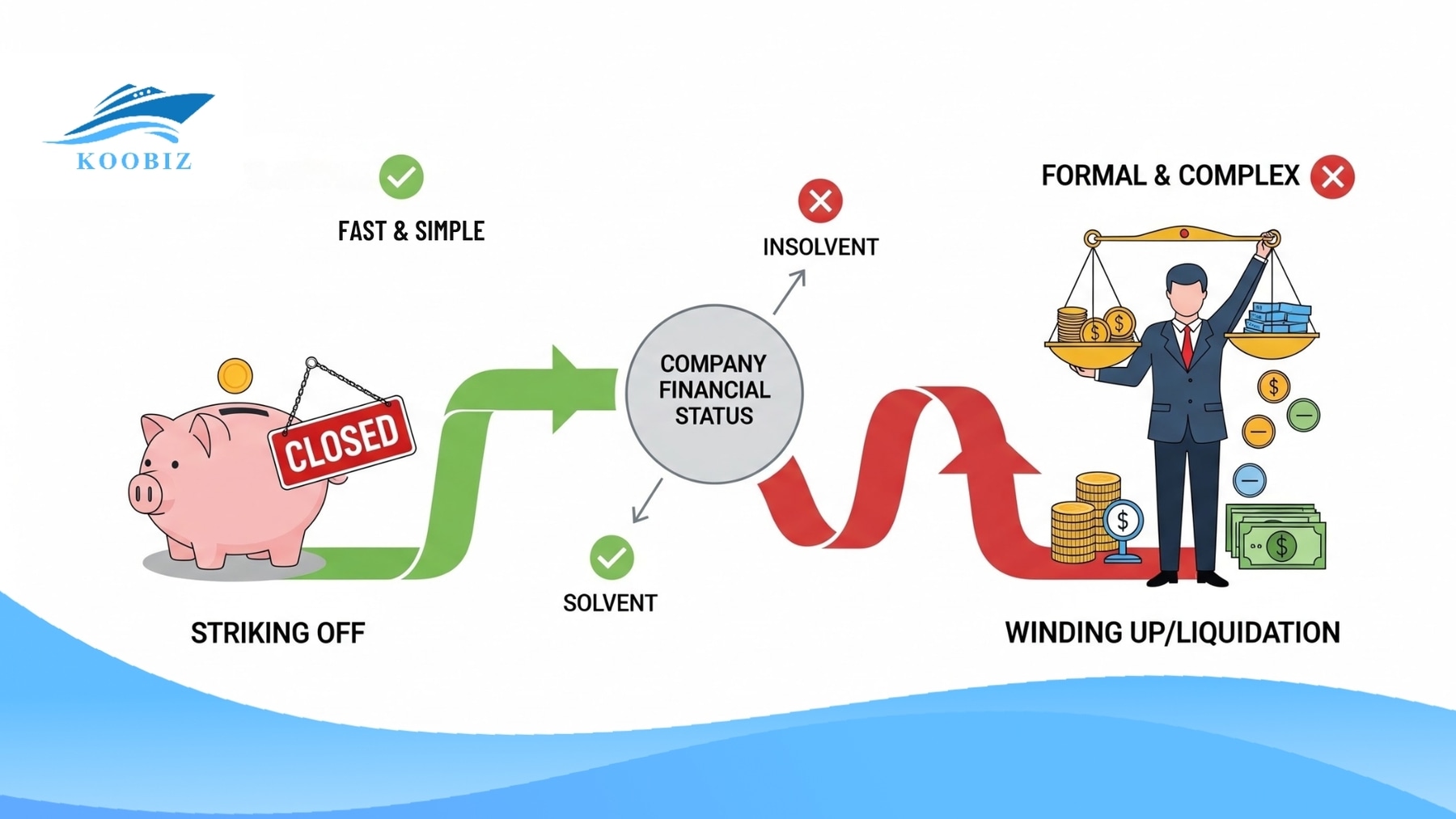
There are two legally recognised methods to close a Singapore company: Striking Off and Winding Up. The appropriate path depends on the company’s financial position and operational status.
To determine which option applies to your situation, directors can follow the decision logic below:
- Scenario A: Clean and straightforward exit
- If the company has ceased operations and has no assets and no liabilities,
- Then choose Striking Off. This is the administrative “fast track” suitable for dormant or clean companies.
- Scenario B: Outstanding assets or liabilities remain
- If the company still holds assets (such as cash or property) that require distribution, or has debts it cannot settle, or has debts it cannot pay…
- Winding Up (Liquidation) is required. This is a formal process requiring a liquidator to manage the complex distribution of assets and settlement of liabilities.
Method 1: Striking Off a Company (The “Fast Track” Process)
Striking off is the administrative process of removing a company’s name from the official register maintained by ACRA, and is suitable for dormant companies with a clean compliance record. Although commonly described as a fast-track process, directors should note that statutory timelines still apply. In practice, striking off typically takes around four to six months to protect creditors’ interests.
Eligibility Criteria
Before reviewing the timeline, directors must ensure the company meets the eligibility criteria imposed by ACRA. If you fail any of these, the application will be rejected or objected to:
- Ceased Trading: The company must have stopped business activities completely.
- Zero Assets & Liabilities: The company must not have any assets (bank accounts must be closed) or contingent liabilities.
- Clean Record: No outstanding penalties, fines, or summonses with ACRA.
- No Tax Issues: No outstanding tax liabilities or unfiled tax returns with IRAS.
- No Legal Issues: The company is not involved in any court proceedings (inside or outside Singapore).
- Stakeholder Agreement: Although the application is submitted by a director or company secretary, it is best practice to obtain written consent from all directors and shareholders to reduce the risk of objections that may halt the process.
The 4-Stage Roadmap to Striking Off
To manage expectations, the striking-off process can be divided into four statutory stages.While the application itself is quick, the statutory waiting periods are mandatory.
Stage 1: Preparation & Tax Verification (Month 0–1)
This is the most critical phase, as ACRA may reject the application if the company’s records are not fully in order.
- Zero Accounts: Distribute all remaining assets to shareholders, settle all liabilities, and close the corporate bank account.
- Tax Verification: File all outstanding tax returns (Form C-S/C) and ensure all tax assessments are paid. Singapore does not issue a physical tax clearance letter for strike-offs; verification is conducted through the IRAS myTax Portal.
- GST Cancellation: If registered, apply to de-register for GST.
Stage 2: The Application (Week 1)
Once the company’s records are fully compliant, the formal application can be submitted.
- Submission: The Company Secretary submits the application via BizFile+.
- ACRA Review: ACRA reviews the application, typically within 5–14 days. If approved, a “Striking Off Notice” is sent to the company’s registered address, directors, and shareholders.
Stage 3: The Gazette Period (Month 2–4)
This is a mandatory statutory waiting period designed to protect creditors and the public.
- First Gazette Notification: ACRA publishes the company’s name in the Government Gazette.
- Objection Period: For the next 60 days, any interested party (e.g., an unpaid vendor or tax authority) can lodge an objection. If a valid objection is received, the entire process stops.
Stage 4: Final Dissolution (Month 5–6)
- Final Notification: If no objections are lodged after 60 days, ACRA publishes a second notification in the Gazette.
- Strike Off: The company is officially struck off the ACRA Register, and ceases to exist as a legal entity.
Method 2: Winding Up / Liquidation (The Formal Process)
While striking off is an administrative process, Winding Up (Liquidation) is a formal legal procedure for terminating a company. This route is mandatory if your company still holds assets that need distributing or has debts it cannot settle immediately.
Unlike striking off, Winding Up involves appointing a licensed Liquidator who takes control of the company’s affairs to ensure a fair distribution of resources.
The winding-up process splits into two distinct paths based on one critical question: Is your company Solvent?
Path A: Members’ Voluntary Winding Up (MVL) – The Solvent Path (Singapore)
Who this applies to: Companies that are profitable or asset-rich but no longer have a commercial purpose (e.g. director retirement or group restructuring).
In an MVL, the directors formally declare that the company is solvent, meaning it is able to pay all its debts in full within 12 months.
- You retain control: As all creditors are paid in full, the winding-up process is initiated and controlled by the directors and shareholders.
- The Goal: To realise company assets (e.g. sale of property, collection of receivables) and distribute any surplus to shareholders in a tax-efficient manner.
- Key requirement: Directors must lodge a Declaration of Solvency with ACRA. Making such a declaration without reasonable grounds constitutes a serious statutory offence.
Path B: Creditors’ Voluntary Winding Up (CVL) – The Insolvent Path (Singapore)
Who this applies to: Companies facing financial distress and unable to pay debts as they fall due.
In a CVL, the company is insolvent and unable to meet its financial obligations. The directors cannot sign a Declaration of Solvency because the company’s liabilities exceed its assets.
- Creditors take priority: The focus shifts from shareholders to creditors, who rank ahead in the distribution of assets. The Liquidator’s primary duty is to recover as much money as possible to pay off the company’s debts.
- Loss of Control: Directors’ powers cease upon the appointment of a liquidator, and control of the company passes to the liquidator.The creditors have the right to vote on who acts as the liquidator.
- Key Step: The company must convene a meeting of its creditors to explain the financial position.
Key Differences: Striking Off vs. Winding Up
Striking Off is generally more cost-effective and faster, while Winding Up provides a formal legal resolution for complex or insolvency cases. To help directors at Koobiz clients make an informed choice, we have summarized the key differences below.
| Feature | Striking Off | Winding Up (Liquidation) |
|---|---|---|
| Primary Use Case | Dormant companies with no assets and no liabilities. | Active companies with assets, liabilities, or insolvency. |
| Cost | Low to none (Government fees + Secretarial fees) | High (liquidator fees and statutory filing costs). |
| Timeframe | Approx. 4–6 months. | 12 months or longer (depending on complexity). |
| Solvency | Must have Zero assets and liabilities. | Can be Solvent (MVL) or Insolvent (CVL). |
| Process Owner | Directors / Corporate Secretary. | Licensed Liquidator. |
| Director Control | High (Directors manage the process). | None/Low (Liquidator takes legal control). |
| Risk of Restoration | Higher (can be restored within 6 years). | Lower (Dissolution is generally final). |
Table: Comparison of Company Closure Methods in Singapore
Critical Requirements Before Closing: Tax and Liabilities
Many directors mistakenly believe that ceasing business operations automatically ends tax obligations. This is incorrect. ACRA will reject a striking-off application if IRAS has not cleared the company’s tax position.
To ensure a successful application, the company must be in a fully compliant clean status with no outstanding regulatory or tax issues.
Clarification on Tax Clearance
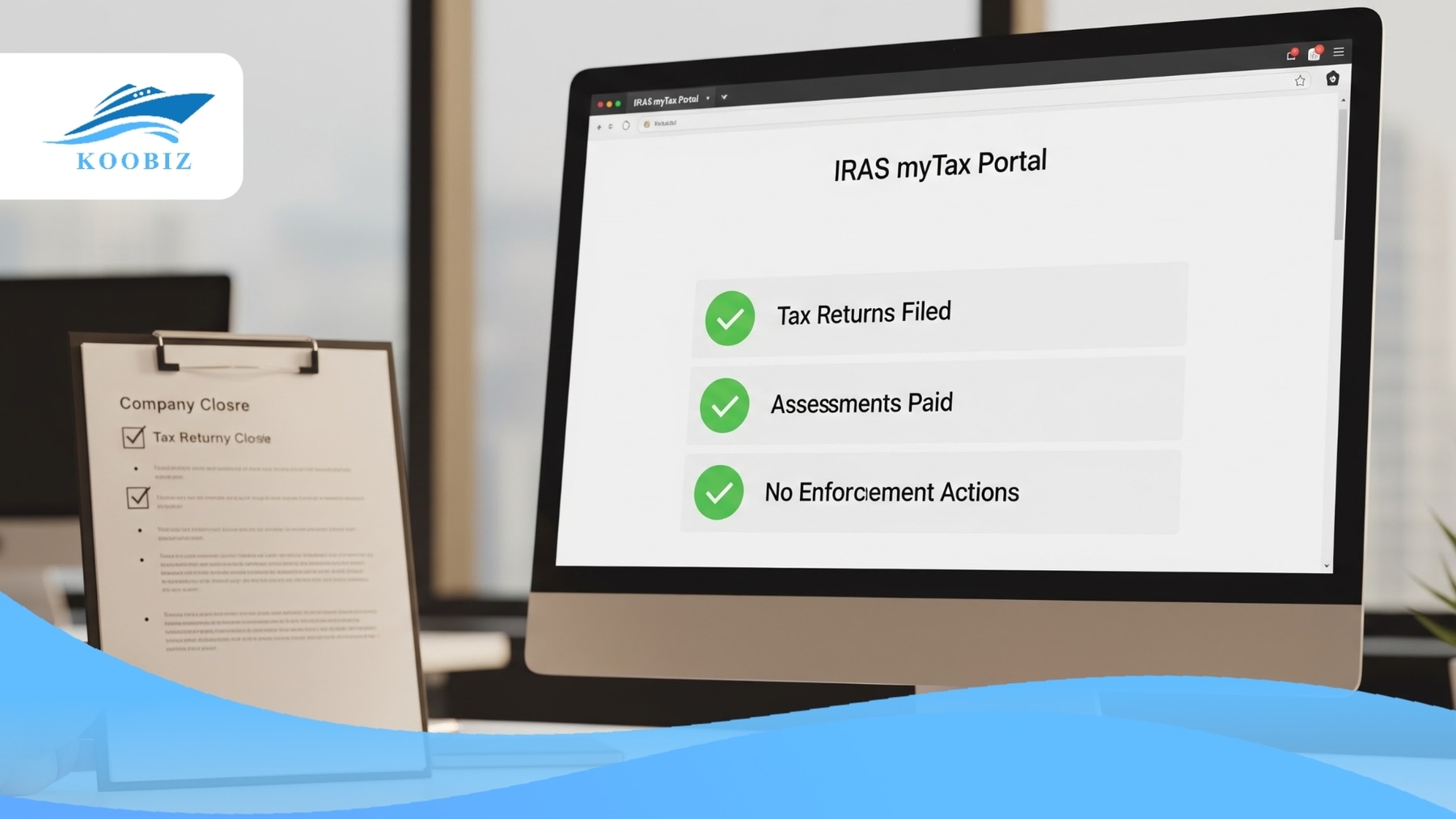
It is a common misconception that IRAS issues a physical tax clearance letter for striking off. This is not true. Instead, tax “clearance” is confirmed through self-verification on the IRAS myTax Portal. You must log in to the IRAS myTax Portal and confirm that:
- All tax returns (Form C-S/C) are filed.
- All assessments are paid.
- There are no outstanding enforcement actions.
If you apply to ACRA while tax matters are pending, IRAS will lodge an objection, halting your application.
The “Clean Slate” Checklist
Use this checklist to ensure you are ready before our team submits your application:
- [ ] Corporate Tax (IRAS): File Income Tax Returns up to the actual date of business cessation. Even if the company had no income, a “Nil” return is required to close the books.
- [ ] GST Cancellation: If your company is GST-registered, apply for cancellation of GST registration. You must account for GST on any assets kept or transferred upon closure.
- [ ] CPF Accounts: Ensure all Central Provident Fund (CPF) contributions are fully paid and the CPF submission number (CSN) account is formally closed.
- [ ] Clear All Debts: The company must not have any outstanding debts to government agencies or private creditors.
Koobiz Pro Tip: Always verify directly via the IRAS myTax Portal that the Statement of Accounts shows a zero balance before instructing a strike-off filing.
Directors’ Responsibilities and Liabilities
Directors have a strict fiduciary duty to ensure the company’s affairs are handled honestly during the closing process. ACRA and the courts take a serious view of directors who use closing procedures to evade debts.
WARNING: The Solvency Trap
Making a Declaration of Solvency in an MVL without reasonable grounds is a criminal offence. If the company later proves insolvent, directors may face fines of up to S$10,000, imprisonment of up to 12 months, or both. Under the Insolvency, Restructuring and Dissolution Act (IRDA), penalties may escalate if fraudulent intent is proven.
When You Become Personally Liable (Piercing the Corporate Veil)
Generally, a company is a separate legal entity. However, in closing scenarios, the law can “pierce the corporate veil,” making directors personally liable for company debts if:
- Fraudulent Trading: Business activities were conducted with intent to defraud creditors (e.g. transferring assets at undervalue prior to liquidation).
- Negligence: You allowed the company to incur debts knowing there was no reasonable prospect of repayment.
The 5-Year Rule: Record Retention
Your job isn’t done when the company closes. Under the Companies Act, directors must retain all company books and records for at least five years from the date of dissolution.
- This requirement ensures that records can be produced if a creditor or tax authority reopens the matter.
Conclusion
Closing one business chapter is often a necessary step before starting the next.While ensuring your company is closed compliantly is vital to avoid liability, your focus should be on what comes next.
At Koobiz, we understand that entrepreneurship is a cycle. We are not just here to help you exit; we are your strategic partner for your next venture. As an established corporate services provider, Koobiz specialises in:
- Singapore Company Incorporation: Setting up your new Private Limited company with the optimal structure for growth.
- Corporate Banking: Consultation and assistance with opening business bank accounts in Singapore.
- Compliance Excellence: Providing top-tier Accounting, Tax, and Audit services to keep your new business in good standing from Day 1.
Whether you are closing a dormant entity to restructure or planning your next big idea, Koobiz provides the foundation for your business success.
Disclaimer: This guide is for informational purposes only and does not constitute legal advice. Laws and regulations regarding company closure in Singapore (including ACRA and IRAS fees) are subject to change. Please consult with a qualified professional or corporate secretary for advice specific to your situation.
Leave a Reply