New EP applications must meet the S$6,000 threshold and S Pass candidates must earn at least S$3,600 starting January 1, 2027, with renewals following on January 1, 2028.
Meeting the minimum salary no longer guarantees approval as the COMPASS C1 criteria mandates your payroll align with the 65th percentile of local PMET wages in your sector.
Failing to recalibrate salaries for key personnel earning near old thresholds will trigger a “talent vacuum” through renewal rejections in 2028, causing severe operational paralysis.
Enterprises with constrained budgets should optimize non-salary COMPASS pillars, such as nationality diversity and local hiring, to secure necessary approval points.
Businesses can leverage the Job Redesign+ grant to receive up to 70% government funding, capped at S$150,000, to boost productivity and offset these mandatory salary hikes.
[/SUMMARIES]
With the Ministry of Manpower (MOM) officially raising the bar for Employment Pass (EP) and S Pass salaries starting in 2027, businesses face a new set of compliance and financial challenges. This update breaks down the essential figures and timelines you need to know to protect your workforce and sustain your growth in a higher-productivity economy.
MOM Update: New Salary Thresholds for EP & S Pass Holders
On March 3, 2026, MOM announced increasedsalary benchmarks to maintain the quality of the foreign workforce. To achieve this, the Ministry has mandated new minimum qualifying salary hikes. These figures serve as the baseline “floor” for eligibility, with higher thresholds applicable to older candidates and those in the Financial Services sector:
Pass Type
Current Minimum Salary
New Minimum Salary (From 2027)
Employment Pass (EP)
S$5,600
S$6,000
S Pass
S$3,300
S$3,600
Proactive Insight: Enterprises should brace for a long-term upward trajectory; the S Pass threshold is projected to reach S$4,000 – S$4,500 by 2030.
Critical Implementation Timeline
MOM has provided a dual-phase “runway” to allow businesses sufficient time for financial and manpower restructuring. Compliance will be assessed based on the following milestones:
New Pass Applications: Effective from January 1, 2027.
Pass Renewals: Effective from January 1, 2028.
This structured implementation means that while new hires will be affected immediately in 2027, companies have an additional year to evaluate and adjust salaries for existing pass holders before their 2028 renewals.
Beyond Payroll: The Strategic Risks to Your Business
Secure your company’s future with our strategic legal risk assessments
For Singapore enterprises, the 2027-2028 salary hike is not a localized payroll issue; it is a fundamental shift in business cost structures.
The “Profit Margin Squeeze” & Budgeting Crisis
Elevating the salary floor to S$6,000 (EP) and S$3,600 (S Pass) directly inflates fixed overheads. For SMEs, these mandatory adjustments can erode projected profit margins if not integrated into 2027-2028 fiscal planning. Furthermore, businesses must navigate the “wage-push” effect: raising salaries for foreign professionals often triggers a ripple effect, necessitating upward adjustments for local staff to maintain internal pay equity.
The COMPASS C1 Benchmark Tension
Under the Complementarity Assessment Framework (COMPASS), meeting the minimum salary is no longer enough. Criterion 1 (C1) benchmarks an applicant’s salary against the 65th percentile of local PMET wages within your specific sector. As the baseline rises, the “market median” shifts. Firms that fail to proactively recalibrate compensation packages risk scoring zero on the C1 pillar, leading to pass rejections even if they technically meet the S$6,000 threshold.
Risk of Key Personnel Loss
The 2028 renewal window represents a critical “talent cliff.” High-value employees currently earning near the current thresholds may suddenly become ineligible for renewal. Losing institutional knowledge and specialized expertise due to a compliance oversight is a strategic failure that can stall long-term projects and weaken market position.
The EP or S Pass Rejection and Non-Renewal Risk: Operational Disruption
In Singapore’s meritocratic labor market, a work pass rejection is a threat to operational continuity. A rejected renewal often grants the holder only a short stay (typically 30 days) to exit the country, creating a “talent vacuum” characterized by:
Project Stagnation: Sudden vacancies in leadership roles halt deliverables and disrupt client commitments.
Inflated Replacement Costs: The cost of urgent headhunting and retraining far exceeds a proactive salary adjustment.
Regulatory Scrutiny: Repeated rejections may flag the company for closer MOM monitoring in future applications.
Expert Strategies to Navigate the 2027-2028 Transition
Proactive compliance ensures business stability during legislative shifts
Preparation is the definitive defense against regulatory shifts. To maintain compliance and operational stability, Koobiz recommends the following strategic steps:
Execute a 360° Workforce Health Audit
The first phase involves a deep-dive review of your current foreign talent pool. Proactivity is key to preventing a “talent cliff” in 2028.
Identify Vulnerabilities: Categorize all EP and S Pass holders whose current compensation falls below the upcoming S$6,000 and S$3,600 thresholds.
Strategic Expiry Mapping: Prioritize passes expiring after January 1, 2028, as these will be the first to require the new benchmarks for successful renewal.
Fiscal Forecasting: Quantify the total cost of aligning “at-risk” personnel with the new standards and integrate these projections into your 2027-2028 manpower budgets.
Optimize COMPASS Scores via Non-Salary Pillars
While Salary (C1) is a primary factor, the COMPASS framework offers multiple pathways to success. If drastic salary hikes are not commercially viable, you must strengthen other pillars to secure the necessary points:
Nationality Diversity (C3): Mitigate concentration risk. A diverse workforce can yield essential bonus points under the Diversity criterion.
Local Employment Support (C4): With the Local Qualifying Salary (LQS) rising to S$1,800 in July 2026, investing in local PMETs not only fulfills corporate responsibility but significantly boosts your COMPASS standing.
Strategic Priority (C5/C6): Leverage bonus points if your enterprise operates within sectors on the Strategic Priorities List or if your employees possess niche skills on the Shortage Occupation List (SOL).
Tactical Salary & Role Re-engineering
Rather than simply inflating payroll, look for strategic ways to restructure compensation and productivity.
Consolidate Fixed Components: Evaluate converting variable allowances into the “Fixed Monthly Salary.” MOM’s assessment primarily hinges on the fixed component for eligibility.
Leverage Enterprise Grants: Capitalize on the Enterprise Workforce Transformation Package (EWTP) and the Job Redesign+ grant (March 2026). By re-engineering roles to improve productivity, you can justify higher salaries while receiving government support of up to 70% (capped at S$150,000).
Phased Incremental Adjustments: Implement a “staircase” approach to salary increases over the next 18 months to mitigate sudden cash flow shocks at the point of renewal.
Secure Your Future in Singapore with Koobiz’s Compliance Shield
Protect your business assets through Koobiz’s trusted Singaporean legal shield
At Koobiz, we understand that these regulatory shifts are more than just figures on a spreadsheet, they are pivotal milestones for your company’s growth and stability in Singapore. As the 2027-2028 deadlines approach, leaving your compliance to chance is a risk your business should not have to take.
Our integrated approach serves as a comprehensive “Compliance Shield” for your enterprise:
Bespoke Visa & Work Pass Advisory: Our specialists go beyond administrative filing. We analyze your workforce data, simulate COMPASS scores, and architect long-term renewal pathways to ensure your key talent remains an integral part of your team.
Strategic Accounting & Payroll Excellence: We assist in recalibrating your payroll structures and manpower budgets. By integrating MOM’s new salary benchmarks into your fiscal planning, we ensure your business remains profitable while meeting every regulatory mandate.
Don’t let the 2027-2028 changes catch you off guard. Secure your operational continuity and talent pipeline today. Contact Koobiz now for a 360° Workforce Health Audit. Let us transform these regulatory challenges into your competitive advantage.
All GST-registered businesses must adopt InvoiceNow for direct IRAS submissions through a phased rollout from Nov 2025 to Apr 2031.
Post-deadline, invoices not transmitted via the Peppol network will be deemed invalid, leading to the rejection of GST input tax claims.
Digital integration enables IRAS to perform instant cross-verification between buyers and sellers, flagging discrepancies immediately instead of during year-end audits.
Early adopters can secure government grants of up to S$1,000 for SMEs and S$5,000 for larger firms, including free software for smaller enterprises.
Adoption of the Peppol standard allows your business to seamlessly integrate with international jurisdictions using similar e-invoicing systems, such as the EU, Australia, and Japan.
[/SUMMARIES]
Following the COS Debate 2026, the Singapore Government is mandating InvoiceNow for all GST-registered businesses to automate tax submissions to IRAS. This shift replaces manual processing with digital efficiency, accelerating payment cycles and streamlining compliance for over 90,000 firms.
Timeline for InvoiceNow Implementation in Singapore
The GST InvoiceNow Requirement is being phased progressively to allow businesses-from SMEs to MNCs-adequate lead time to align their IT refresh cycles with these new compliance standards.
Effective Date
Affected Taxable Entities
1 Nov 2025
Newly incorporated companies opting for voluntary GST registration.
1 Apr 2026
All new voluntary GST registrants, irrespective of incorporation date or legal structure.
1 Apr 2028
All new compulsory GST-registrants AND existing GST-registered businesses with annual supplies <= S$200,000.
1 Apr 2029
Existing GST-registered businesses with annual taxable turnover <= S$1 million.
1 Apr 2030
Existing GST-registered businesses with annual taxable turnover <= S$4 million.
1 Apr 2031
All remaining GST-registered businesses (Annual supplies > S$4 million).
What is InvoiceNow and the Peppol Network?
Managed by the Infocomm Media Development Authority (IMDA), InvoiceNow is Singapore’s nationwide e-invoicing network based on the international Peppol standard.
Unlike legacy methods such as transmitting PDF invoices via email which still necessitate manual data entry, InvoiceNow facilitates the direct exchange of structured digital data between disparate accounting systems. For your organization, this ensures that upon invoice issuance, data is transmitted instantaneously to both the counterparty and IRAS, effectively eliminating human error and accelerating GST audit and refund processes.
Why This Transition Matters for Your Business Compliance
Future-proof your business compliance with our professional InvoiceNow guidance
In Singapore’s evolving landscape, tax compliance is shifting toward real-time transparency. Adopting InvoiceNow is no longer optional; it is a statutory mandate essential for maintaining your company’s standing with IRAS.
Enhanced Audit Scrutiny
Direct data transmission provides IRAS with instantaneous transaction visibility. This enables automated cross-verification between buyers and sellers. Any discrepancies that previously surfaced only during periodic audits will now be flagged immediately, significantly increasing the likelihood of targeted queries for inconsistent data.
Input Tax Claim Risks
The most critical financial risk lies in your GST input tax claims. Beyond the deadlines, invoices not sent via InvoiceNow may be deemed invalid for GST purposes. This could lead to the rejection of tax credits, directly inflating your liabilities and straining your corporate cash flow.
Operational Transition Costs
While grants of up to S$1,000 for SMEs and S$5,000 for larger firms are available, the “cost of delay” is substantial. Waiting until 2031 risks rushed integration, premium vendor rates due to surging demand, and potential operational downtime during the mandatory switch-over.
Proactive Steps to Stay Compliant and Efficient
Implementing InvoiceNow for seamless regulatory compliance in Singapore
To navigate the 2031 mandate effectively, businesses must move beyond reactive compliance. Taking proactive steps now allows you to leverage government support while optimizing your internal financial infrastructure.
Assess System Compatibility
The priority is verifying if your current accounting or ERP solution is “InvoiceNow-ready.” Consult the IMDA-accredited IRSP list to confirm compatibility. If you utilize an in-house enterprise solution, you must engage an accredited Access Point Provider (AP) to establish a secure connection to the Peppol network. Ensuring your software can transmit structured data directly to IRAS is the cornerstone of the new GST requirement.
Early Adoption Strategy
The Singapore government is incentivizing early movers with significant financial support. SMEs can access InvoiceNow-Ready Solutions for free until March 2031 and may be eligible for a new grant of up to S$1,000 to defray operational costs. Larger businesses adopting the system ahead of their 2031 deadline can receive a grant of up to S$5,000. Beyond financial incentives, early adoption allows your team to refine digital workflows in a low-pressure environment, ensuring seamless GST filing long before it becomes mandatory.
Digitalize Bookkeeping Workflows
Seamlessly connect your business with global e-invoicing standards
The transition to InvoiceNow is the perfect opportunity to eliminate manual bottlenecks. By digitalizing your bookkeeping, you automate the reconciliation of purchase and sales invoices. This reduces human error, shortens payment cycles, and positions your business to integrate globally with jurisdictions using similar e-invoicing standards, such as the EU, Australia, and Japan.
Future-Proof Your Business with Koobiz Accounting & Bookkeeping Services
Navigating the 2031 InvoiceNow mandate requires more than just new software; it demands a robust digital accounting strategy. At Koobiz, we provide end-to-end Accounting & Bookkeeping services specifically engineered to align with Singapore’s evolving tax landscape.
Integrated Regulatory Solutions: We deploy IMDA-accredited, InvoiceNow-ready systems to automate your invoicing and GST filings, ensuring 100% compliance with the 2026-2031 roadmap.
Proactive Risk Mitigation: Our experts manage the technical integration with the Peppol network, shielding your business from the risks of rejected input tax claims and costly manual reconciliation errors.
Scalable Strategic Growth: From Company Formation to complex tax management, we streamline your back-office operations, empowering you to scale effectively in Singapore’s digital economy.
Don’t wait for the mandatory deadline. Contact Koobiz today for a Compliance Health Check and secure a seamless digital future for your enterprise.
Starting mid-March 2026, IRAS will issue Direct NOAs to 1 million taxpayers based on employer-submitted AIS data.
Automated billing means any clerical error in your payroll is instantly exposed to employees and tax authorities, triggering immediate audits.
April 18, 2026, is the final cutoff for all tax filings and adjustments; missing this leads to severe statutory penalties.
Inaccurate reporting carries heavy financial penalties and places personal legal accountability on both Directors and Company Secretaries.
Secure your business by auditing Form IR8A/Appendix 8A now and transitioning to monthly digital bookkeeping with Koobiz.
[/SUMMARIES]
The YA 2026 tax season marks a significant milestone in Singapore’s digital tax transformation. While promising a seamless experience for individuals, this shift introduces a new level of transparency and regulatory scrutiny for employers. As the Inland Revenue Authority of Singapore (IRAS) takes the lead in issuing direct bills, the accuracy of your corporate data submission now sits at the very heart of tax compliance.
The Shift to Direct Billing: IRAS Simplifies Taxation for 1 Million Individuals
Starting from mid-March 2026, IRAS will issue direct tax bills-officially known as the Direct Notice of Assessment (Direct NOA) to approximately 1 million taxpayers. This initiative is a major expansion of the No-Filing Service (NFS), designed to automate the tax process for a significant portion of the workforce.
What is Direct Billing?
Tax filing is going automated, accuracy now depends on AIS data
Under this mechanism, eligible taxpayers receive their finalized tax bills directly without having to file a manual return. IRAS calculates these tax liabilities using data-driven automation, transitioning from a “self-declaration” model to a proactive “direct assessment” model.
The Source of Truth: The Auto-Inclusion Scheme (AIS)
The integrity of these direct bills relies entirely on third-party data. For most employees, the “source of truth” is the Auto-Inclusion Scheme (AIS). Consequently, the figures appearing on an employee’s tax bill are a direct reflection of the salary, bonus, and benefits-in-kind submitted by your company to the myTax Portal.
Key Timeline for YA 2026:
1 March – AIS Deadline: All employers under the AIS must submit employee income data to IRAS. This data generates the Direct NOAs.
Mid-March 2026: IRAS commences the issuance of digital and paper NOAs.
Notification: Taxpayers are alerted via SMS or email once their NOA is available for viewing.
The 30-Day Objection Window: Upon receiving the NOA, individuals have 30 days to review the figures. Any discrepancy reported by an employee typically triggers a secondary verification of the employer’s original AIS submission.
18 April 2026 – The Final Filing & Amendment Deadline: This is the critical cutoff for two groups:
NFS Recipients: Must complete any manual adjustments (e.g., adding rental income or tax reliefs) via myTax Portal.
Non-AIS Employees & Self-Employed: Individuals whose employers are not under the AIS must manually file their full tax returns by this date to avoid late filing penalties.
The “Visibility Trap”: Why Direct Billing Increases Scrutiny on Your Business
Direct billing increases transparency and scrutiny on your data
For employees, direct billing is a seamless upgrade. For business owners, however, it functions as a “Visibility Trap.” Because IRAS now leverages your corporate data to bill individuals directly, reporting errors are no longer buried in paperwork – they are delivered straight to your employees’ mobile devices, creating an immediate feedback loop with the tax authorities.
The Risk of Data Mismatch
With 1 million taxpayers receiving their NOAs, every dollar will be scrutinized. If an employee’s tax bill is inflated due to a clerical error in your AIS submission or Form IR8A, they will likely file an immediate objection. In this digital era, a “Data Mismatch” is a high-priority red flag. An employee dispute can trigger IRAS’s automated systems to cross-verify your company’s internal ledgers, often escalating into a comprehensive corporate audit.
Administrative Burden & Reputational Risk
Incorrect filings do more than just invite regulatory heat; they erode your internal corporate culture. Discrepancies lead to employee frustration and a loss of trust in management. In Singapore’s competitive talent landscape, being perceived as a firm that “fails at payroll” is a significant reputational liability that can hamper recruitment and retention.
Compliance Penalties & Director’s Liability
Under the Singapore Income Tax Act, the legal onus for accurate reporting rests squarely on the company’s leadership. IRAS maintains a stringent stance on enforcement, as evidenced by recent data:
Evidence of Enforcement: For YA 2025 alone, IRAS collected over S$5 million in penalties from close to 37,000 taxpayers who failed to pay their income tax on time. This highlights IRAS’s commitment to taking firm action against non-compliance.
Statutory Penalties: Beyond late payment penalties (typically 5% on unpaid tax), IRAS has the authority to impose composition fines for failing to file accurate AIS returns or for late submissions.
Director’s & Secretary’s Liability: Both the Director and Company Secretary are responsible for ensuring rigorous statutory compliance. Failure to maintain accurate records can lead to legal complications, including travel restriction orders or legal action against the company’s officers.
Operational Impacts: Persistent compliance failures can jeopardize Employment Pass (EP) renewals for expatriate talent and negatively affect the company’s standing with government authorities and financial institutions.
Proactive Compliance: 3 Critical Steps for Business Owners This Tax Season
Secure your business growth with expert-led tax compliance strategies
To navigate the YA 2026 tax season without falling into the “Visibility Trap,” business owners must shift from reactive fixes to proactive governance.
Step 1: Conduct a Pre-Submission Payroll & Form IR8A Audit
Do not wait for an IRAS query to review your figures. Perform a rigorous internal audit of your 2025 payroll records before finalizing them in the myTax Portal. Key focus areas include:
Benefits-in-Kind: Ensure housing, car allowances, and insurance premiums are accurately valued and reported under Appendix 8A.
Director’s Fees: Confirm that fees are reported in the correct Year of Assessment (YA), strictly based on the date they were voted and approved.
Stock Options: Properly account for gains from ESOP or ESPP plans as per Appendix 8B.
Step 2: Transition to Monthly Digital Bookkeeping
Manual “shoebox accounting” remains the primary source of clerical errors. Migrating your financial records to a cloud-based digital system allows for real-time reconciliation. Accurate monthly records ensure that your year-end AIS submission is a verified reflection of your actual financial activity.
Step 3: Synchronize with Your Corporate Secretary’s Records
Tax compliance is intrinsically linked to corporate governance. Your Corporate Secretary ensures that all board resolutions-especially those regarding director compensation-are legally documented. Any discrepancy between secretarial records and tax filings is a major “red flag” that may lead IRAS to disallow tax-deductible expenses.
Koobiz – Your Integrated Partner for Accounting & Bookkeeping in Singapore
At Koobiz, we understand that tax compliance is not just about numbers; it’s about protecting your business’s reputation. Our integrated accounting and secretarial services ensure your AIS submissions are audit-ready long before the tax season begins. Let us turn the “Visibility Trap” into a benchmark of your corporate excellence. Contact Koobiz today for a Complimentary Tax Compliance & Payroll Health Check!
Every Singapore company must prepare four mandatory financial reports in strict compliance with SFRS standards.
Private firms qualify for audit exemption if they meet at least two of the ‘Small Company’ criteria, such as capping revenue or total assets at S$10 million.
Non-listed companies are required to hold an AGM within 6 months and file Annual Returns within 7 months of their financial year-end.
Most companies must file in the mandatory XBRL format to avoid ACRA enforcement actions and tiered fines.
Maintaining accurate financial records is a strategic necessity for measuring business performance and securing future funding.
[/SUMMARIES]
Running a business in Singapore requires navigating a robust regulatory landscape governed by ACRA and IRAS. However, maintaining accurate financial statements is more than just a matter of compliance – it is a strategic tool for unlocking your company’s growth potential. From the four essential types of reports to filing deadlines and step-by-step preparation, this guide provides everything you need to stay ahead.
What is a Financial Statement?
A financial statement reflects your company’s true health
A financial statement is a formal record that provides a structured overview of a company’s financial activities and performance over a specific period. In Singapore’s business environment, these statements are far more than mere documentation; they are vital for:
Strategic Management: Monitoring profitability, controlling cash flow, and driving data-backed business decisions.
Securing Funding: Demonstrating financial stability to attract potential investors or secure credit facilities from banks.
Statutory Compliance: Fulfilling mandatory annual filing requirements with ACRA and tax obligations with IRAS.
In short, an accurate financial statement is a non-negotiable asset for measuring success and ensuring your business remains in good standing.
What are the 4 Types of Financial Statements?
The four pillars of financial reporting
Under the Singapore Financial Reporting Standards (SFRS), a complete set of financial statements provides a multi-dimensional view of a company’s financial health. To ensure statutory compliance and facilitate informed decision-making, directors and stakeholders rely on these four primary components:
Statement of Financial Position (Balance Sheet)
The Balance Sheet provides a point-in-time snapshot of a company’s financial standing, typically at the end of the financial year (FYE). It details:
Equity: The shareholders’ residual interest. This statement is essential for evaluating a company’s liquidity, solvency, and overall net worth.
Statement of Comprehensive Income (Profit and Loss Statement)
This statement summarizes revenues, costs, and expenses incurred over a specific reporting period. By deducting total expenses from total revenue, it reveals the net profit or loss. It is the primary tool for assessing a company’s operational efficiency and earnings sustainability.
Statement of Cash Flows
While the income statement tracks profitability, the Cash Flow Statement tracks the actual inflow and outflow of cash. It categorizes movements into:
Operating Activities: Cash from core business functions.
Investing Activities: Cash used for or generated from assets/investments.
Financing Activities: Cash flow related to debt, equity, and dividends. It is a critical indicator of a company’s short-term viability and its ability to fund operations without external capital.
Statement of Changes in Equity
This document outlines the movements in a company’s equity over the reporting period. It reconciles the opening and closing balances by detailing:
Net profits or losses.
Dividend distributions.
Issuance or redemption of shares. It provides transparency into how profits are either distributed to shareholders or reinvested into the business.
Which Accounting Standard is Used in Singapore?
Navigating the SFRS and IFRS frameworks for global comparability
To maintain its status as a leading global financial hub, Singapore enforces a strict, transparent, and internationally recognized accounting framework. All companies incorporated in Singapore are required to prepare their financial statements in accordance with these standards, which are regulated by the Accounting Standards Council (ASC).
Singapore Financial Reporting Standards (SFRS)
The default accounting framework for businesses in Singapore is the SFRS. It is closely modeled after the International Financial Reporting Standards (IFRS), ensuring that financial statements prepared in Singapore are globally comparable, reliable, and transparent. Unless specifically exempted, all Singapore-registered companies must comply with SFRS when preparing their annual financial reports.
SFRS for Small Entities
To reduce the administrative burden and compliance costs for smaller businesses, the ASC introduced the SFRS for Small Entities. This framework offers simplified reporting requirements. A company is eligible to adopt this standard if it meets at least two of the following three criteria for two consecutive financial years:
Total annual revenue is not more than S$10 million.
Total gross assets is not more than S$10 million.
Total number of employees is not more than 50.
Adopting the SFRS for Small Entities is optional. Eligible companies can still choose to file under the full SFRS if preferred by their management or investors.
When IFRS is Applicable
While SFRS is the mandatory domestic standard, the International Financial Reporting Standards (IFRS) may be applicable or preferred in specific corporate scenarios:
Subsidiaries of Foreign Multinationals: If a Singapore company is a subsidiary of an overseas parent company that uses IFRS, it may adopt IFRS to align financial statements for easier group consolidation.
Companies Listed on International Exchanges: Singapore companies seeking to list or already listed on certain foreign stock exchanges may be required to prepare their financial statements under IFRS to satisfy international investors and foreign regulatory bodies.
ACRA Financial Statements Requirements
Understanding ACRA’s mandatory filing criteria
ACRA enforces strict reporting rules to uphold corporate transparency. Mastering these requirements is crucial to avoid severe penalties and streamline your annual filing process.
Who Needs to Prepare vs. File?
While every Singapore-incorporated company must prepare an annual financial statement, the rules for filing differ:
Filing Required: Most public and private companies must submit their financial statements alongside their Annual Return.
Filing Exempted: Solvent Exempt Private Companies (EPCs) (private companies with max 20 individual shareholders) are exempt from filing. However, they must still prepare and retain these records for potential ACRA/IRAS audits.
Audit Exemption Criteria
Statutory audits can be costly. Fortunately, private companies are audit-exempt if they qualify as a “Small Company” by meeting at least two of these three criteria for the past two consecutive financial years:
Annual revenue $\le$ S$10 million.
Total gross assets $\le$ S$10 million.
Full-time employees $\le$ 50.
Note: Audit-exempt companies must still prepare an unaudited financial statement compliant with SFRS.
The XBRL Format Requirement
To facilitate digital data analysis, ACRA requires many companies to file statements in XBRL (eXtensible Business Reporting Language) format:
Full XBRL: Mandatory for public companies and most non-EPCs.
Simplified XBRL: Available for smaller non-EPCs meeting specific financial thresholds.
Exempt from XBRL: Solvent EPCs are generally exempt but may need to submit a PDF copy or Financial Highlights depending on their status.
Deadlines and Penalties for Financial Statements
Timely submission is vital for maintaining your company’s “Good Standing” status. Delayed filings incur unnecessary costs and regulatory scrutiny.
Important Deadlines (AGM & AR)
Compliance timelines depend on your Financial Year End (FYE):
Requirement
Non-Listed Companies
Listed Companies
Annual General Meeting (AGM)
Within 6 months post-FYE
Within 4 months post-FYE
Annual Return (AR) Filing
Within 7 months post-FYE
Within 5 months post-FYE
Note: Financial statements must be approved at the AGM before AR filing with ACRA.
Penalties for Non-Compliance
ACRA enforces strict penalties for late submissions. Directors are personally liable for ensuring statutory obligations are met.
Late Filing Fees: Ranging from S$300 to S$600 per breach.
Enforcement Actions: Unresolved defaults may lead to Composition Sums or Court Summons.
Director Liability: Prosecution, fines up to S$5,000, or disqualification for repeat offenders (3 or more convictions within 5 years).
Striking Off: Persistent non-compliance may result in the company being struck off the register.
A clean compliance record is essential for maintaining business reputation and accessing government grants or credit facilities.
How to Prepare and File Financial Statements in Singapore: Step-by-Step
A clear 6-step roadmap from document collection to successful ACRA and IRAS filing
Navigating the financial reporting process requires precision and a clear understanding of SFRS. Follow these six essential steps to ensure your company remains compliant.
Step 1: Collect Accounting Documents
Gather all supporting financial records for the financial year. This includes sales invoices, purchase receipts, bank statements, payroll records, and loan agreements. Organized documentation is the foundation of an accurate financial statement.
Step 2: Record and Classify Transactions
Enter all gathered data into your accounting system. Transactions must be categorized according to the Singapore Chart of Accounts. Ensure accruals, prepayments, and depreciation are properly adjusted to reflect the true financial position of the business.
Step 3: Prepare Financial Statements
Draft the four core components: the Balance Sheet, Profit and Loss Statement, Cash Flow Statement, and Statement of Changes in Equity. These must include necessary Notes to the Accounts, providing detailed breakdowns of specific line items as required by SFRS.
Step 4: Audit (if required)
If your company does not meet the “Small Company” audit exemption criteria, you must appoint an independent Public Accountant registered with ACRA to audit your financial statements. The auditor will issue an opinion on whether the statements provide a “true and fair” view of the company’s finances.
Step 5: Convert to XBRL
Once finalized, financial data must be mapped and converted into XBRL format. Using ACRA’s BizFinx portal, this digital tagging ensures your data is compatible with regulatory analysis systems.
Step 6: File with ACRA and IRAS
The final step involves two separate submissions:
ACRA: File your financial statements (in XBRL or PDF as required) together with the Annual Return (AR).
IRAS: Submit the financial statements as part of your Corporate Income Tax Return (Form C or C-S) to fulfill your tax obligations.
Common Mistakes When Preparing Financial Statements in Singapore
To ensure seamless compliance and avoid ACRA investigations or tax penalties, directors should avoid these frequent pitfalls:
Data Discrepancies: XBRL data must strictly match the financial statements approved during the AGM.
Wrong Framework: Using “SFRS for Small Entities” without meeting the specific eligibility criteria.
Revenue Misrecognition: Failing to align revenue recognition with SFRS standards for milestones or long-term projects.
Missing Disclosures: Omitting crucial “Notes to the Accounts” such as depreciation policies or related-party transactions.
Cash-based Accounting: Singapore requires the accrual basis of accounting; recording transactions only when cash moves is a common error.
Inaccurate XBRL Mapping: Using generic tags instead of specific concepts from the ACRA taxonomy.
Should You Prepare Financial Statements In-house or Outsource in Singapore?
Choosing between in-house management and professional outsourcing is a strategic decision. Given Singapore’s complex regulatory environment, outsourcing is often the most efficient choice for SMEs and MNC subsidiaries.
The Challenges of In-house Preparation
Maintaining an internal team involves significant overheads, including salaries, training, and software costs. Furthermore, as SFRS and XBRL taxonomy evolve, in-house staff may struggle to maintain compliance, increasing the risk of errors and late-filing penalties.
The Strategic Value of Outsourcing
Partnering with a professional firm offers distinct advantages:
Specialized Expertise: Access to professionals deeply versed in SFRS and ACRA requirements.
Cost Efficiency: Significant reduction in overhead costs compared to a full-time finance department.
Risk Mitigation: Ensure 100% accuracy in XBRL tagging, protecting directors from personal liability.
Partner with Koobiz for Seamless Compliance
At Koobiz, we provide expert accounting and filing services tailored to the Singapore corporate landscape. We ensure your financial statement is fully compliant with ACRA and IRAS, serving as a reliable roadmap for your business growth. Focus on your core operations and let Koobiz handle the complexities of compliance. Contact Koobiz today for a professional consultation and streamline your financial reporting.
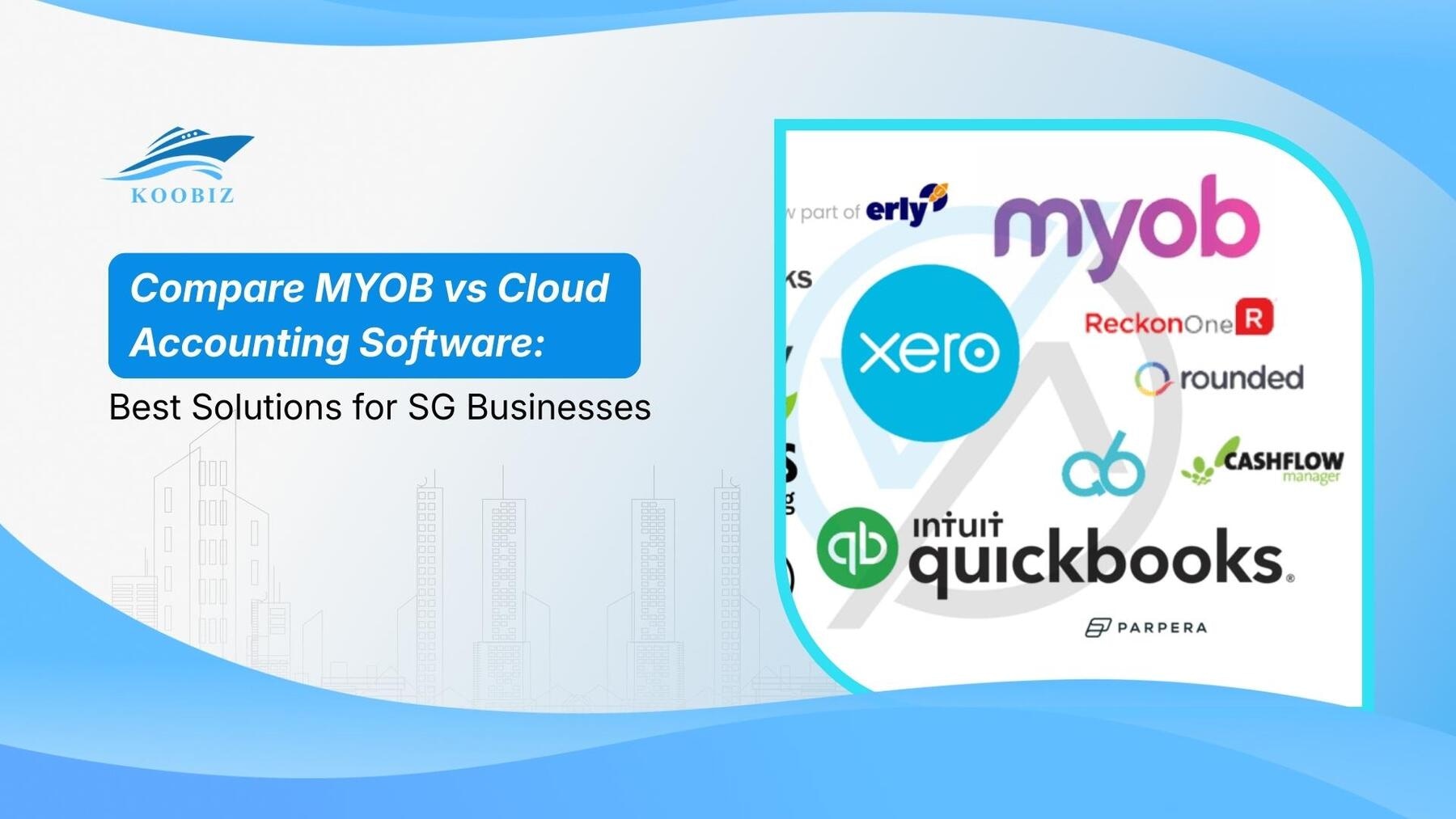
Architecture: MYOB (ABSS) is centered on desktop use with some cloud features, whereas platforms like Xero are built entirely for the cloud.
Compliance: Both solutions support IRAS GST F5 filing, but the process varies greatly between offline and online software.
Cost Efficiency: Both traditional and cloud options typically qualify for up to 50% PSG Grants for Singapore SMEs.
Koobiz Insight: The best choice depends on whether your priority is remote access or having direct control over your data locally.
[/SUMMARIES]
Choosing between the established reliability of MYOB (known as ABSS in Asia) and modern cloud accounting software is a crucial decision for Singapore SMEs seeking digital efficiency. While cloud platforms offer superior mobility and integration, MYOB is valued for its strong compliance features and direct data control. At Koobiz, we help many businesses with company setup and tax compliance, and we frequently see owners weighing this exact technology choice. This article explains the technical setup, grant options, and practical differences to help you select the best fit for your financial management.
Is MYOB a Cloud-Based Software? Understanding the Desktop vs. Cloud Distinction
No, MYOB (specifically the ABSS versions common in Singapore) is not a pure cloud platform. It is primarily desktop software with some cloud-sync functions, which is different from fully cloud-based services like Xero or QuickBooks.
To make this key difference clear, the table below outlines how their core design affects your finance team’s daily work:
Feature
MYOB (ABSS) – “Cloud Enabled”
Cloud Software (Xero/QB) – “Cloud Native”
Installation
Required. Must be installed on a local PC or Office Server.
None. Accessed entirely via a Web Browser (Chrome, Edge).
Offline Access
Full Capability. Works perfectly without internet; data is local.
Zero. Requires active internet connection to function.
Data Location
Your Hard Drive. You own and manage the database file (.myo).
Vendor’s Cloud Server. Data sits on AWS/Azure; you don’t “hold” the file.
Backups
Manual/Local. You are responsible for scheduling backups.
Automated. Vendor handles redundancy and security patches.
Case Study: The “Office-Bound” Logistics Firm vs. The “Remote-First” Agency
To see the architectural difference in action, consider two typical Singaporean businesses: LogiTrans Pte Ltd and CreativeSpark SG.
LogiTrans Pte Ltd (The MYOB User):
Based in a Tuas warehouse, LogiTrans handles many delivery orders daily using ABSS (MYOB) on a local office server.
The Workflow: Their accounts clerk processes invoices quickly using keyboard shortcuts, unaffected by slow or unstable internet since data is stored locally.
The Limitation: The Finance Director cannot easily check reports from home without a complex connection to the office server.
CreativeSpark SG (The Cloud User):
This digital marketing agency in Bugis uses a cloud accounting platform. Their team works flexibly from various locations.
The Workflow: Consultants use a mobile app to snap receipt photos, which sync instantly. The founder can approve invoices from anywhere using a tablet.
The Limitation: All access stops without an internet connection.
Koobiz Insight: This shows that “cloud-enabled” (MYOB) allows for occasional data syncing, while “cloud-native” means operating entirely online. We often recommend MYOB for operation-heavy businesses like LogiTrans that need unwavering stability. Cloud solutions suit service-based firms like CreativeSpark that prioritize mobility.
Key Comparisons: MYOB (ABSS) vs. Leading Cloud Competitors in Singapore
Comparison of MYOB (desktop) and Cloud Accounting software
MYOB stands out for offline reliability and data sovereignty. Cloud competitors like Xero lead in real-time collaboration and connecting with other business apps.
A simple feature list isn’t always helpful. At Koobiz, we base our recommendations on your business’s specific operational style. Here’s which software excels in areas important to Singapore SMEs:
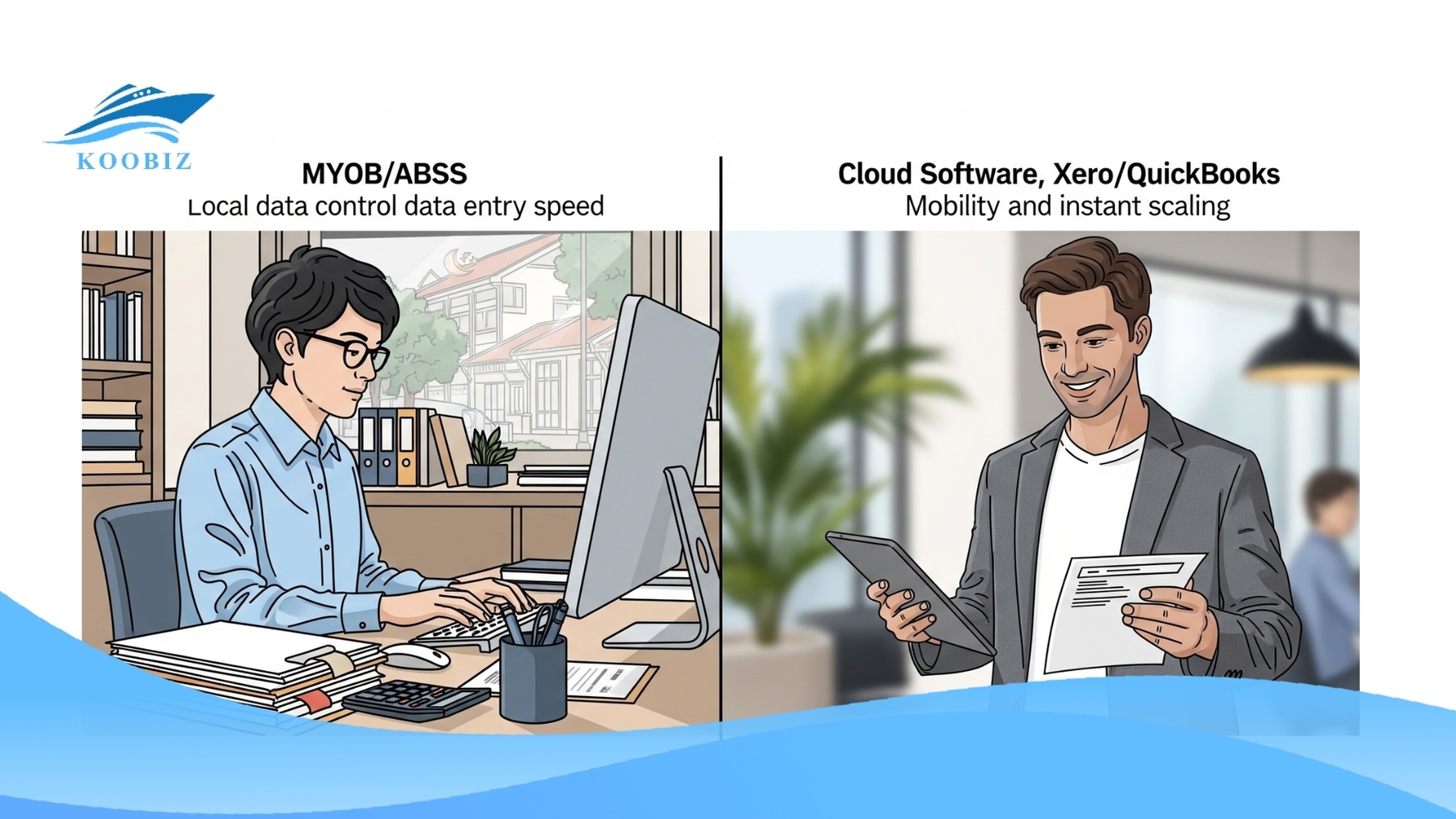
Best for Speed & High-Volume Data Entry: MYOB (ABSS)
Why: The familiar interface lets experienced staff enter data rapidly with keyboard shortcuts, without browser delays.
Verdict: Ideal for trading, manufacturing, or logistics companies processing high volumes of transactions.
Best for Mobility & Modern UX: Cloud Software (Xero/QuickBooks)
Why: Clean, intuitive dashboards are accessible from any internet-connected device, supporting remote work and quick approvals.
Verdict: Perfect for digital agencies, consultants, and startups with distributed teams.
Best for Complex Compliance (GST F5): Draw (Context Dependent)
Why: Both generate compliant GST reports. MYOB allows for manual tweaks before filing (preferred by some auditors), while cloud software often automates direct submission to IRAS (preferred for efficiency).
Scalability and Multi-user Access for Growing SG Firms
For growing companies, the difference is about the ease of expansion.
Scaling with MYOB (The “Logistical” Path): Adding users can involve buying new license packs and configuring your office network. It’s stable but less flexible.
Scaling with Cloud (The “Instant” Path): Growth is instantaneous. Whether you hire one accountant or five, you simply click “Invite User” and the subscription adjusts automatically. For a Koobiz client expanding from Singapore to Vietnam, this friction-less scaling is often the deciding factor.
Data Security and Offline Accessibility: Where MYOB Excels
Each platform has a different approach to security: “Physical Control” vs. “Digital Protection”.
Security with MYOB (The “Physical Vault” Model): You hold your data locally. You’re safe from cloud outages or vendor issues, but you are responsible for protecting against local disasters like hardware failure.
Security with Cloud (The “Bank Vault” Model): The vendor stores your data on enterprise servers (like AWS), protecting it from local crashes. However, you rely on their security and need internet access to work.
Which Software Offers the Best ROI through Singapore Government Grants?
Trợ cấp PSG: So sánh MYOB (CapEx) & Cloud (OpEx)
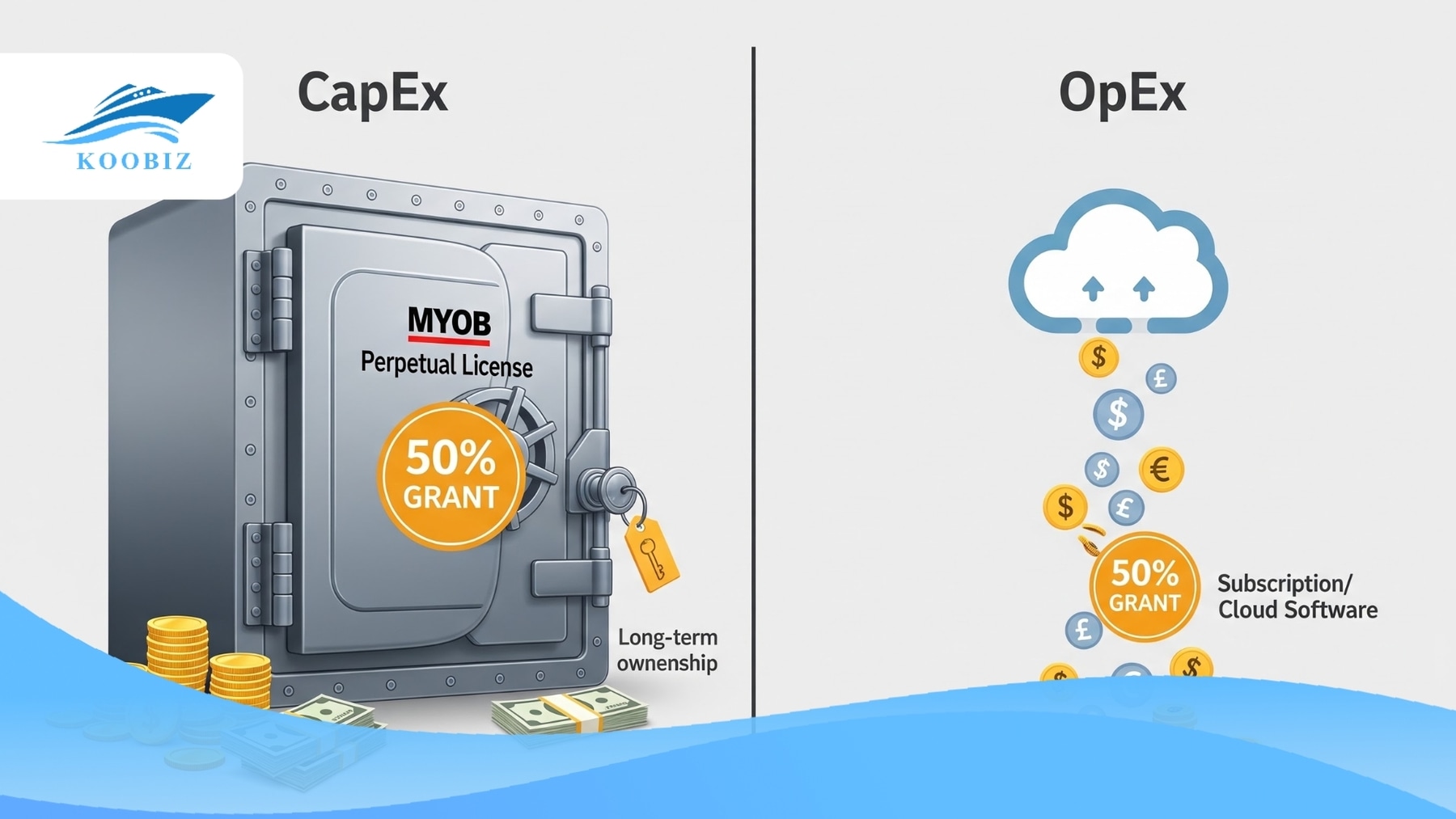
Both ABSS (MYOB) and major cloud platforms qualify for the Productivity Solutions Grant (PSG), offering up to 50% funding for eligible Singapore SMEs. The financial impact differs between buying a license (MYOB) and subscribing to a service (Cloud).
At Koobiz, we advise clients to look at the “Long-Term Cost of Ownership” rather than just the initial price tag.
CapEx vs. OpEx: A Strategic ROI Analysis
The grant supports both capital expenditure (CapEx) and operating expenditure (OpEx) differently.
The Asset Play (MYOB – CapEx):
Strategy: You use the 50% PSG grant to purchase a perpetual license.
ROI Verdict:High Upfront Value. You pay once, get the subsidy, and own the software forever. There are no mandatory monthly fees, making it excellent for long-term cost control.
The Cashflow Play (Cloud – OpEx):
Strategy: You use the grant to subsidize the first 12 months of your subscription.
ROI Verdict:Low Barrier to Entry. The grant protects your cash flow in Year 1. However, once the grant period ends, you must pay the full subscription price indefinitely.
Checklist: Am I Eligible for the PSG Grant?
Before signing any invoice, ensure your business meets these core criteria set by Enterprise Singapore:
Registered & Operating in Singapore: Your company must be incorporated (ACRA registered) and active.
Local Shareholding: You must have at least 30% local shareholding (for specific tiers) or be a valid SME.
Usage Location: The software must be used in Singapore.
Koobiz Tip:Apply for the grant BEFORE you sign the purchase order. Retrospective applications are almost always rejected.
Beyond the Basics: Navigating the Trade-offs of Digital Transformation
Balancing MYOB (Stability) and Cloud (Agility)
Moving to digital tools involves balancing trusted workflows with new automation. It’s important to consider specific operational needs that broad comparisons might miss.
The Koobiz Reality Check:
“In our work incorporating hundreds of Singapore companies, we see businesses sometimes adopt new software too quickly, only to find it disrupts their efficient routines. Digital transformation is about matching technology to your team’s real workflow. ‘Newer’ isn’t automatically ‘better’ if it hinders your core productivity.”
The “Desktop-Cloud Hybrid” Model: A Unique Middle Ground for SG SMEs
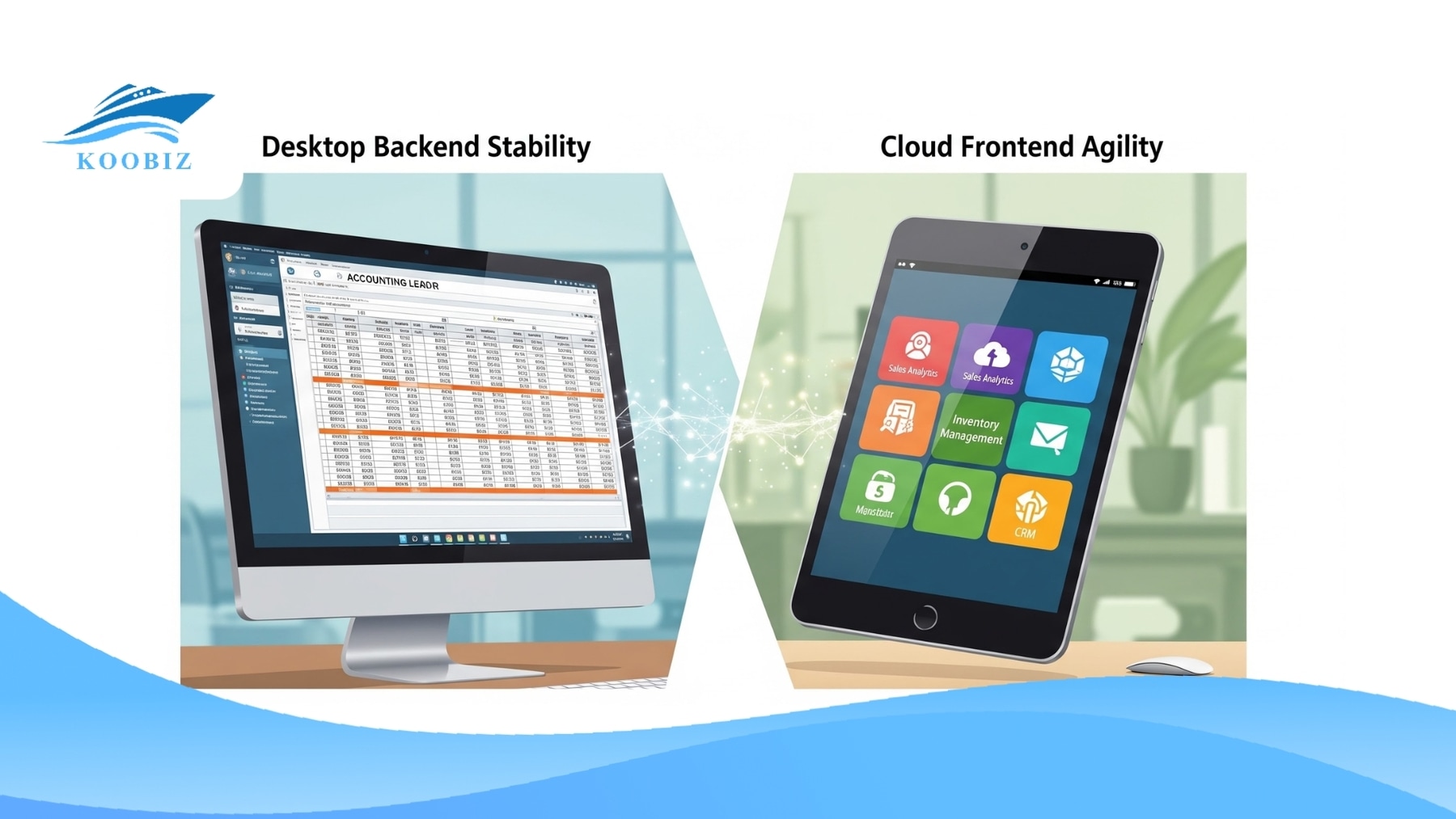
This model uses ABSS for reliable backend accounting and compliance, while adding cloud-based tools for frontend tasks like sales and inventory.
It allows businesses to separate “Agility” from “Stability” by using different software for different needs:
The Frontend Layer (Agility): Handles customer-facing tasks using cloud add-ons.
Benefit: Sales teams get modern tools on their phones.
The Backend Layer (Stability): Handles the “heavy lifting” using the ABSS engine.
Examples: General Ledger, IRAS GST F5 Reporting, Audit Trails.
Benefit: Finance teams keep the rigid compliance structure they need.
Why Traditional Bookkeepers in Singapore Still Prefer MYOB Over Pure Cloud
Many traditional bookkeepers favor MYOB because its keyboard-driven data entry is much faster for high-volume work than the click-heavy navigation of browser-based cloud software.
MYOB Speed (The Keyboard Warrior):
Method: Alt + I + Enter. (Rapid-fire entry).
Load Time: Zero. The interface is instant because it runs locally.
Load Time: Depends on internet speed and server response (often 1-3 seconds per page).
Data Migration Risks: Moving from Legacy MYOB to Cloud-Native Platforms
Switching from MYOB to a cloud platform is not a simple transfer. It can risk losing detailed historical data and disrupting established audit trails needed for compliance.
What Transfers Successfully:
Opening Balances (Asset/Liability values).
Active Contact Lists (Customers/Suppliers).
Chart of Accounts structure.
What is Often Lost:
Closed Invoices from previous years (Granular history).
Detailed Audit Trails (Who edited what before the migration).
Attached Receipts and older operational notes.
About Koobiz
Koobiz is your trusted partner for business expansion in Singapore. We specialize in Singapore company incorporation, corporate bank account opening, and comprehensive tax, accounting, and audit services. Whether you choose MYOB or a Cloud solution, our team of experts is ready to manage your financial compliance, ensuring your business meets all ACRA and IRAS requirements efficiently.
Visit us at:koobiz.com to start your business journey today.
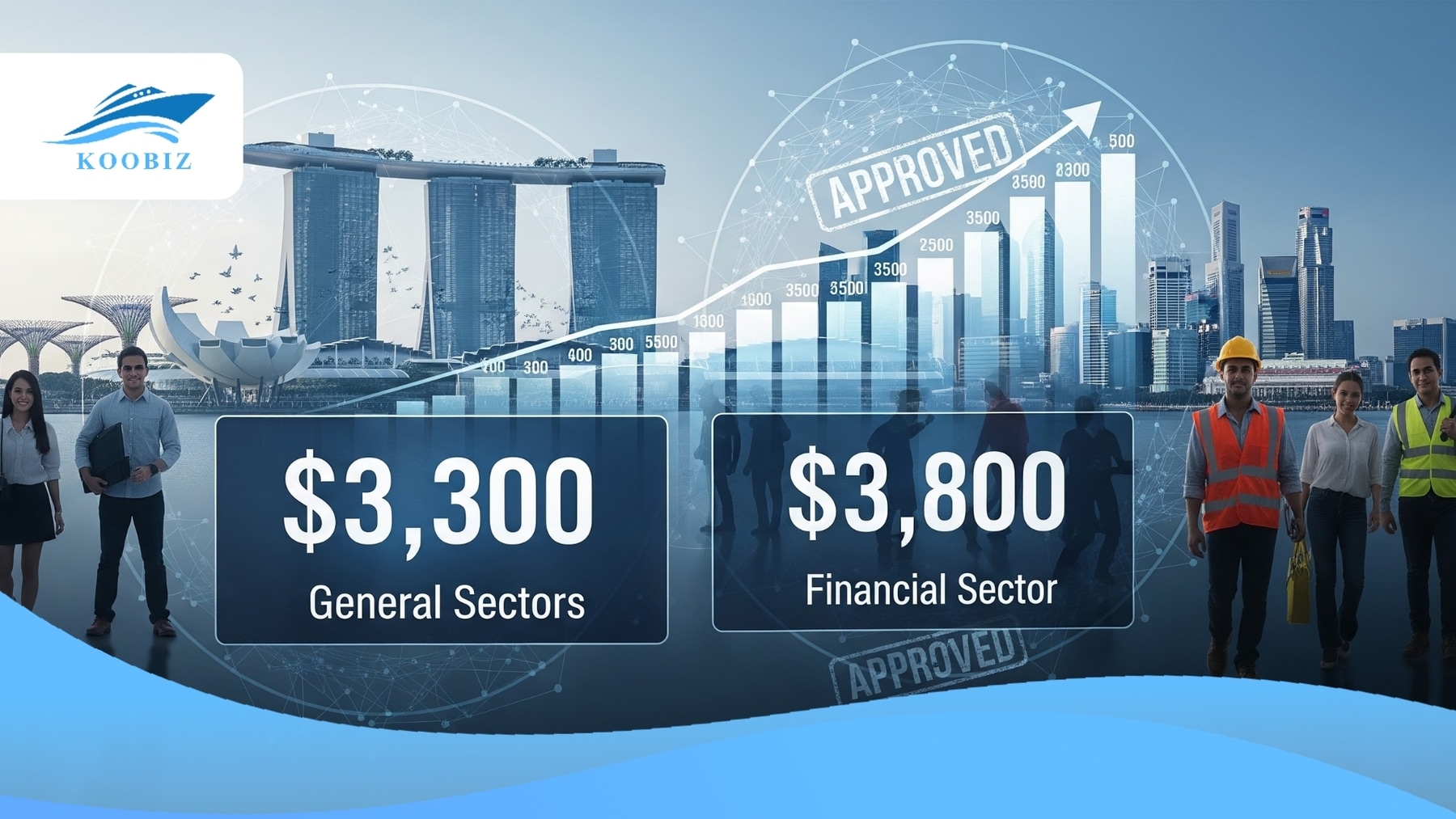
Current Minimum: The qualifying salary for new S Pass applications in 2026 is $3,300 per month.
Financial Sector: Candidates in Financial Services must earn at least $3,800 per month.
Renewal Rule: Existing passes expiring on or after 1 September 2026 must meet the new $3,300 threshold.
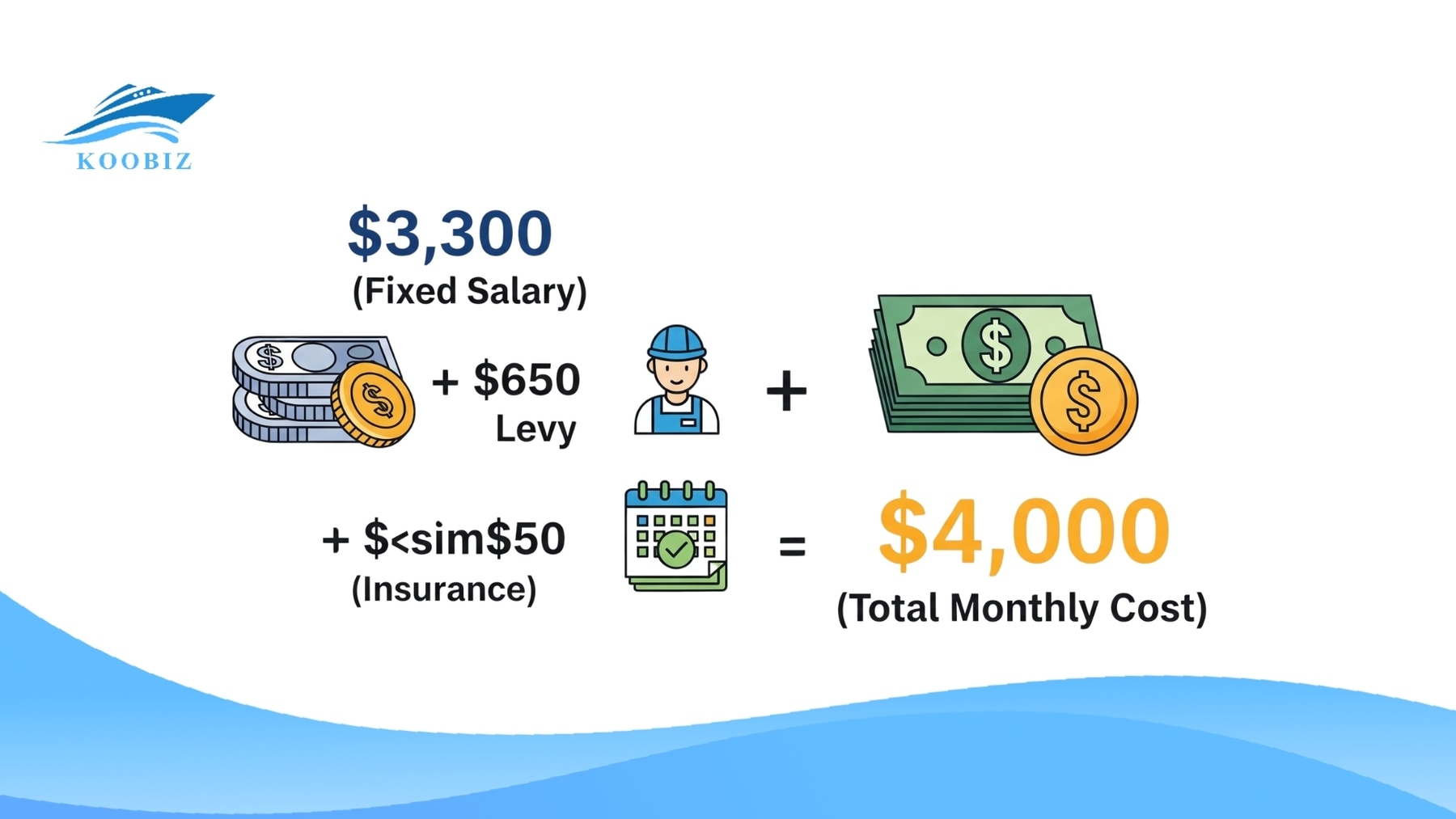
Levy Costs: Employers must pay a monthly levy (standardized at $650) in addition to the salary.
Quota Limits: S Pass holders are capped at 10% (Services) or 15% (Manufacturing/Construction/Marine/Process) of the total workforce.
[/SUMMARIES]
Staying compliant with manpower regulations in Singapore equals keeping up with the Ministry of Manpower’s (MOM) shifting benchmarks-particularly as we move further into 2026. For employers and HR managers, the critical figure to note is the $3,300 minimum qualifying salary, a standard that is now fully effective for all new applications. However, salary is just one component of a complex equation that includes rising levy rates, strict quota caps, and specific renewal timelines that could catch businesses off guard later this year. At Koobiz, we understand that hiring foreign talent is integral to your business growth, which is why we have compiled this essential guide to help you manage compliance and costs effectively.
What is the current S Pass Qualifying Salary in 2026?
The S Pass qualifying salary is a variable benchmark currently set at a minimum of $3,300 per month for new candidates in most sectors, effective from September 2025 .
To understand the full scope of this requirement, we must look beyond the base figure, as the actual required salary often exceeds this minimum depending on the candidate’s profile. The Ministry of Manpower (MOM) applies this threshold to ensure that S Pass holders are comparable in quality to the top one-third of the local Associate Professionals and Technicians (APT) workforce. As such, meeting the minimum salary of $3,300 does not guarantee approval if the candidate possesses significant experience.
S Pass Singapore 2026: Minimum Salary 3,300 SGD
Does the salary threshold differ by sector?
Yes, the Financial Services sector commands a higher qualifying salary of $3,800 per month due to the higher prevailing wage norms in that industry.
While the general sector baseline sits at $3,300, the MOM acknowledges that salaries in banking, insurance, and asset management are consistently higher. Consequently, businesses incorporated under these Standard Industrial Classification (SIC) codes must budget for this premium. For incoming foreign business owners, it is crucial to factor in this higher operational cost when planning your initial headcount.
How does age and experience impact the salary requirement?
The qualifying salary increases progressively with age, reaching up to $4,800 (General) or $5,650 (Financial Services) for candidates in their mid-40s to match local peer income levels.
The “Age-Wage” Trap:
MOM applies a strict “age-wage” curve. A fresh graduate aged 23 might qualify at the base $3,300. However, a 35-year-old applicant with ten years of experience cannot be hired at the minimum floor. They must be paid a salary commensurate with their seniority to be approved.
If an employer submits an application for an experienced professional at the minimum wage, it will likely be rejected on the grounds that the candidate does not command a market rate, implying they may not be a true “mid-skilled” talent.
According to MOM regulations: The specific salary required for each candidate can be checked using the MOM Self-Assessment Tool (SAT), which serves as the definitive calculator for eligibility.
Does the salary threshold differ for renewals in 2026?
Yes, the salary threshold for renewals differs based on the specific expiry date of the pass, especially for passes expiring on or after 1 September 2026.
This creates a “two-tier” renewal system operating throughout 2026. The government provides this buffer to prevent sudden business disruptions, but businesses must act now to review their payroll structures for employees whose passes are due for renewal in the latter half of the year.
Renewal Timelines & Salary Requirements
Pass Expiry Date
Sector
Minimum Qualifying Salary
Before 1 Sep 2026
All Sectors (except Finance)
$3,150
Financial Services
$3,650
On or After 1 Sep 2026
All Sectors (except Finance)
$3,300
Financial Services
$3,800
Koobiz Strategy: If you have valuable staff members whose passes are expiring between January and August 2026, we recommend proceeding with the renewal process as early as possible (up to 6 months in advance). This allows you to lock in the validity under the lower salary criteria ($3,150) for another tenure, buying time for future salary adjustments.
What are the S Pass Levy Rates and Quotas for Employers?
There are two primary S Pass Levy tiers—Tier 1 and Tier 2—which are determined by the percentage of S Pass holders within your total workforce, alongside specific industry quotas.
The levy is a monthly cost mechanism designed to regulate the foreign employment in Singapore. In reality, it acts as a “tax” on hiring foreigners, reinforcing the policy of prioritizing local employment. Understanding the interplay between your quota (Dependency Ratio Ceiling – DRC) and the levy tier is essential for accurate financial forecasting.
S Pass 2026: Levy $650, Quota 10% (Services) – 15% (Manufacturing)
What are the current Levy Rates?
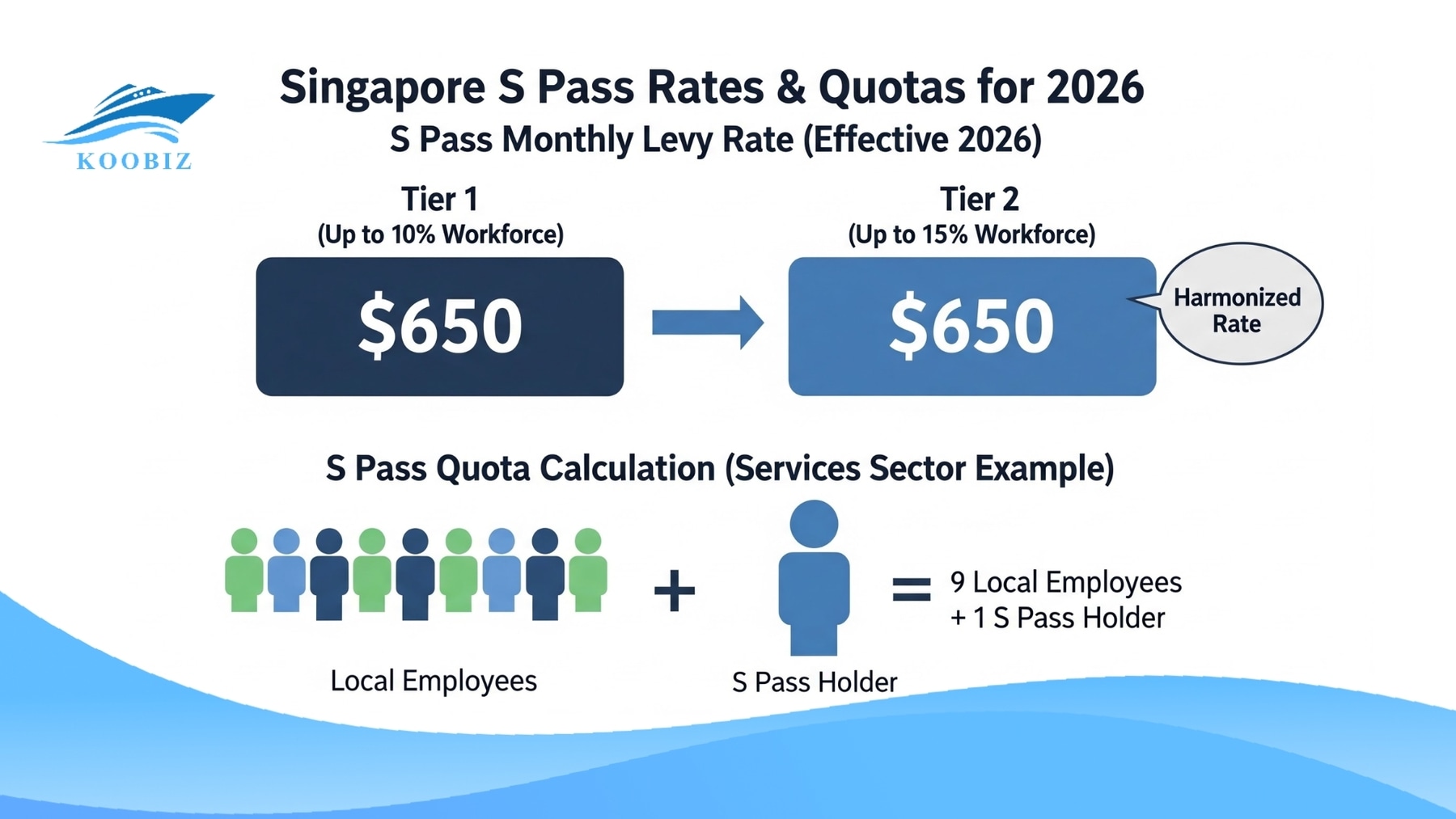
The levy rates for 2026 have been harmonized to $650 for all S Pass holders. The distinction between Tier 1 and Tier 2 now primarily serves to indicate how close you are to your quota limit, rather than a price difference.
Levy Tier
Allowable Workforce %
Monthly Rate (2026)
Tier 1 (Standard)
Up to 10% of total workforce
$650
Tier 2
Above 10% to max cap (15%)
$650
Note: Levy rates are subject to periodic review by the government. Always verify the exact figure on the MOM website as minor adjustments can occur during the annual Budget announcement.
How is the S Pass Quota calculated?
The S Pass quota is capped at 10% for the Services sector and 15% for Manufacturing, Construction, Marine Shipyard, and Process sectors of the total workforce.
To hire one S Pass holder in the Services sector (where most Koobiz clients in consultancy and trading operate), you need a specific number of local employees earning the Local Qualifying Salary (LQS – currently $1,600).
Services Sector: You need roughly 9 local employees to hire 1 S Pass holder (Total workforce = 10; 10% of 10 = 1).
Manufacturing/Process/Other Sectors: You need roughly 6 local employees to hire 1 S Pass holder (Total workforce = 7; ~15% of 7 = 1.05).
Important Calculation: The quota is calculated based on the CPF contributions made to local staff. Without consistent CPF contributions, your local headcount does not count toward the quota.
How to Calculate the Total Cost of Hiring an S Pass Holder?
The total cost involves summing four distinct components: Fixed Monthly Salary + Monthly Foreign Worker Levy + Medical Insurance + Administrative Overheads.
Many new business owners make the mistake of looking only at the $3,300 salary. In reality, the “Total Cost of Employment” is significantly higher.
S Pass: $3300 Salary + $650 Levy = $4000 Total Cost
Is the “Fixed Monthly Salary” defined differently by MOM?
The MOM defines “Fixed Monthly Salary” strictly as the sum of Basic Monthly Salary andFixed Monthly Allowances, excluding any variable components. To meet the $3,300 threshold, the amount must be guaranteed and recurring.
INCLUDED in Qualifying Salary:
Basic Monthly Pay
Fixed Food Allowance
Fixed Transport Allowance
EXCLUDED from Qualifying Salary:
Overtime (OT) Pay
Bonuses or Annual Wage Supplement (AWS)
Sales Commissions
Variable Incentives
Reimbursement for expenses
At Koobiz, when we assist clients with payroll setup and tax structuring, we emphasize that the employment contract must clearly stipulate this fixed amount. If a candidate’s basic pay is $2,500 and they earn $1,000 in commissions, they do not qualify for the S Pass because the fixed component ($2,500) is below the $3,300 threshold.
Real-World Case Studies: Applying the 2026 Rules
To visualize how these numbers impact your business, let’s look at three storytelling scenarios based on common client situations we handle at Koobiz.
Scenario 1: The “Fresh Grad” Hire (Services Sector)
The Story:CreativePulse, a boutique marketing consultancy with 10 local staff, wants to hire Jun, a 24-year-old Data Analyst from Malaysia. To manage costs, they offer him the exact minimum qualifying salary of $3,300.
Salary Check: Since Jun is 24 and fresh out of university, the base $3,300 fits the age-wage curve.
Quota Check: With 10 locals, the company has exactly 1 S Pass slot (10% cap).
Verdict: LIKELY APPROVED
Why: The salary matches the candidate’s lack of experience.
Cost Impact:CreativePulse must budget a total of $3,950/month ($3,300 Salary + $650 Levy).
Scenario 2: The Fintech Miscalculation (Financial Sector)
The Story:AssetFlow, a growing fintech startup, identifies Mark (28) for a Compliance Officer role. They offer him $3,500, thinking it is generous since it is above the national $3,300 minimum.
The Mistake: They forgot they are classified under “Financial Services.”
The Gap: Mark is 28 (mid-career). The base floor is $3,800, but his age likely commands $4,200+.
Verdict: REJECTED
Why: The offer is below the $3,800 sector floor and too low for his age.
The Fix:AssetFlow must raise the offer to at least $4,200 to match market norms before appealing.
Scenario 3: The Renewal “Trap” (Manufacturing)
The Story:LogiTrans Pte Ltd has a loyal warehouse supervisor, Kumar (32), who has been with them for 4 years earning $3,150. His pass expires on 15 October 2026. The HR manager plans to just click “Renew” in September.
The Hidden Danger: Because the pass expires after 1 September 2026, the new rules apply.
The Shortfall: Kumar’s $3,150 salary is now illegal for an S Pass renewal (Minimum is $3,300).
Verdict: RENEWAL AT RISK
Why: The system will auto-reject the renewal due to insufficient salary.
The Fix:LogiTrans must formally increase Kumar’s basic salary to $3,300 immediately to reflect in the CPF records before the renewal application.
Strategic Planning: S Pass vs EP & PR
S Pass vs Employment Pass (EP): Key Salary & Benefit Differences
The S Pass is designed formid-skilled technical staff with a $3,300+ salary floor and quota restrictions. In contrast, the Employment Pass (EP) is intended for professionals with a significantly higher $5,600+ salary benchmark and no levy or quota.
Use this comparison matrix to decide which pass fits your candidate best.
S Pass vs EP Comparison Matrix
Feature
S Pass
Employment Pass (EP)
Target Audience
Mid-skilled technical staff
Professionals, Managers & Executives
Min. Salary (2026)
$3,300 ($3,800 Finance)
$5,600 ($6,200 Finance)
Foreign Worker Levy
Yes (Standardized at $650)
No (Levy-free)
Quota Cap
Yes (Subject to 10-15% limit)
No (No quota limit)
Key Assessment
Salary + Quota availability
COMPASS Scoring Framework
While the EP is often more desirable because it saves the employer the monthly levy cost, the barrier to entry is much higher, especially with the COMPASS scoring framework now fully matured in 2026.
Can S Pass holders apply for Permanent Residency (PR)?
Yes, S Pass holders are eligible to apply for Singapore Permanent Residency (PR); however, approval rates are typically lower compared to EP holders unless they possess specific high-demand skills.
Eligibility does not guarantee approval. The Immigration and Checkpoints Authority (ICA) assesses applicants based on their economic contribution, integration into society, and family profile. Generally, an S Pass holder earning close to the minimum $3,300 may find it challenging to obtain PR. That said, individuals who have accumulated several years of work in Singapore, progressed through salary increments, and are employed in niche industries, may still have a fair chance. Koobiz advises clients to maintain a clean tax record and robust employment history to support their employees’ future PR applications.
What happens if the S Pass application is rejected due to salary?
If an application is rejected, employers can file an appeal within 3 months, provided they can address the specific gap—usually by increasing the offered salary or correcting the experience declaration.
The offered salary is one of the common reasons. While it meets the $3,300 minimum, this level remains too low for the candidate’s university degree and ten years of experience. In this case, the employer must review the Self-Assessment Tool (SAT), determine the correct market rate for that specific profile (e.g., adjusting the offer to $4,200), and submit an appeal with the revised employment contract.
Comparison of S Pass Salary Requirements (2024 vs 2025 vs 2026)
Tracking the historical data helps HR managers forecast future trends.
2024: Minimum qualifying salary was $3,150 ($3,650 for Finance).
Late 2025 (Sep): Increased to $3,300 ($3,800 for Finance).
2026: Full implementation of the Sep 2025 rates for all new passes and renewals (from Sep 1).
This trajectory clearly shows the Singapore government’s intent to continually raise the quality and cost of foreign labor. Businesses must be prepared to pay a premium for global talent.
About Koobiz
Navigating Singapore’s employment laws, tax structures, and corporate compliance can be daunting for international entrepreneurs. Koobiz specializes in simplifying this process. Whether you need assistance with Singapore company incorporation, advice on opening corporate bank accounts, or professional tax, accounting, and auditing services.
Our team provides the expert groundwork so you can focus on building your business. We ensure your hiring strategies align perfectly with MOM regulations and financial planning.
Visit Koobiz.com to learn more about our corporate services packages.
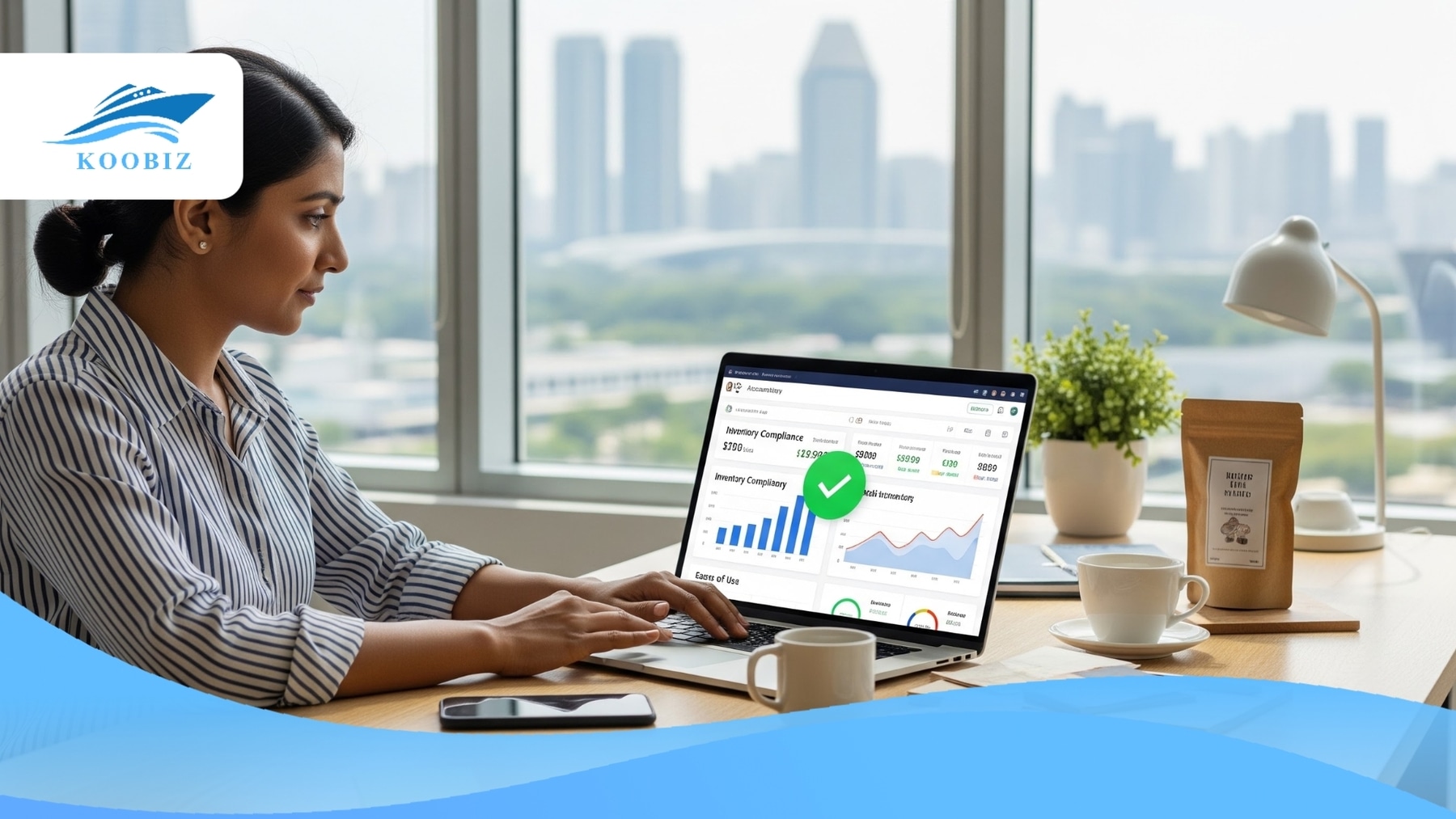
Best For:Singapore-based micro-SMEs, solopreneurs, and retail businesses that require robust inventory tracking on a controlled budget.
Compliance: Fully compliant with IRAS, supports Singapore’s 9% GST, and integrates with InvoiceNow (via the LinkFor partner app).
Financial Aid: Eligible for up to 50% PSG Grant support when purchased through pre-approved vendors (not via the official website).
Main Limitation: Standard plans are capped at five users. Teams with more than five users must upgrade to the Advanced plan (S$124/month) or consider Xero for unlimited users.
Koobiz Verdict: A strong value option for startups prioritizing cost and inventory, but Xero remains the winner for large-scale agencies.
[/SUMMARIES]
Singapore’s 9% GST regime and local compliance requirements mean spreadsheets are no longer sufficient for most growing businesses. As a Singapore-based corporate services firm, Koobiz is frequently asked: Is QuickBooks Online Singapore truly the best option for local entrepreneurs? In this review, we assess its GST compliance, compare it directly with Xero, and explain how eligible businesses can offset costs through the 50% Productivity Solutions Grant (PSG).
Is QuickBooks Online the Right Choice for Your Singapore Business?
Comparison of QBO and Xero for Singapore SMEs
Yes, QuickBooks Online is the right choice for Micro-SMEs, product-based retail businesses, and solopreneurs. However, it is not a one-size-fits-all solution.
✅ Best For
❌ Better Alternatives Exists For
Micro-SMEs & Solopreneurs
Ideal for those prioritizing cash flow and “plug-and-play” simplicity.
Cost-Conscious Large Agencies
Xero allows unlimited users on all plans; QBO requires the S$124/mo “Advanced” plan for >5 users.
Retail/E-commerce (Shopee/Lazada)
Includes built-in inventory tracking in mid-tier plans.
Construction Companies
Standard invoicing lacks complex progress claims and retention sums.
Non-Accountants
Intuitive dashboard using plain English.
Complex Manufacturing
Lacks advanced WIP (Work In Progress) tracking capabilities.
To understand this distinction, it is important to examine how QuickBooks Online balances functionality against cost for Singapore businesses. For a newly incorporated company in Singapore, preserving cash flow is paramount. At Koobiz, we have observed that Singapore business owners who manage their own books often prefer QBO’s intuitive dashboard over traditional accounting-heavy interfaces.
However, if you run a large marketing agency where 15 staff members need access to raise invoices, QBO’s strict user limits on standard plans might force you onto the “Advanced” tier, which is significantly more expensive. Conversely, for a trading company, QBO’s native inventory tracking (on the Plus plan) makes it a superior “all-in-one” choice compared to Xero, which often requires paid add-ons for similar stock management features.
How Does QuickBooks Online Handle Singapore GST and Compliance?
QBO handles GST and IRAS Compliance in Singapore
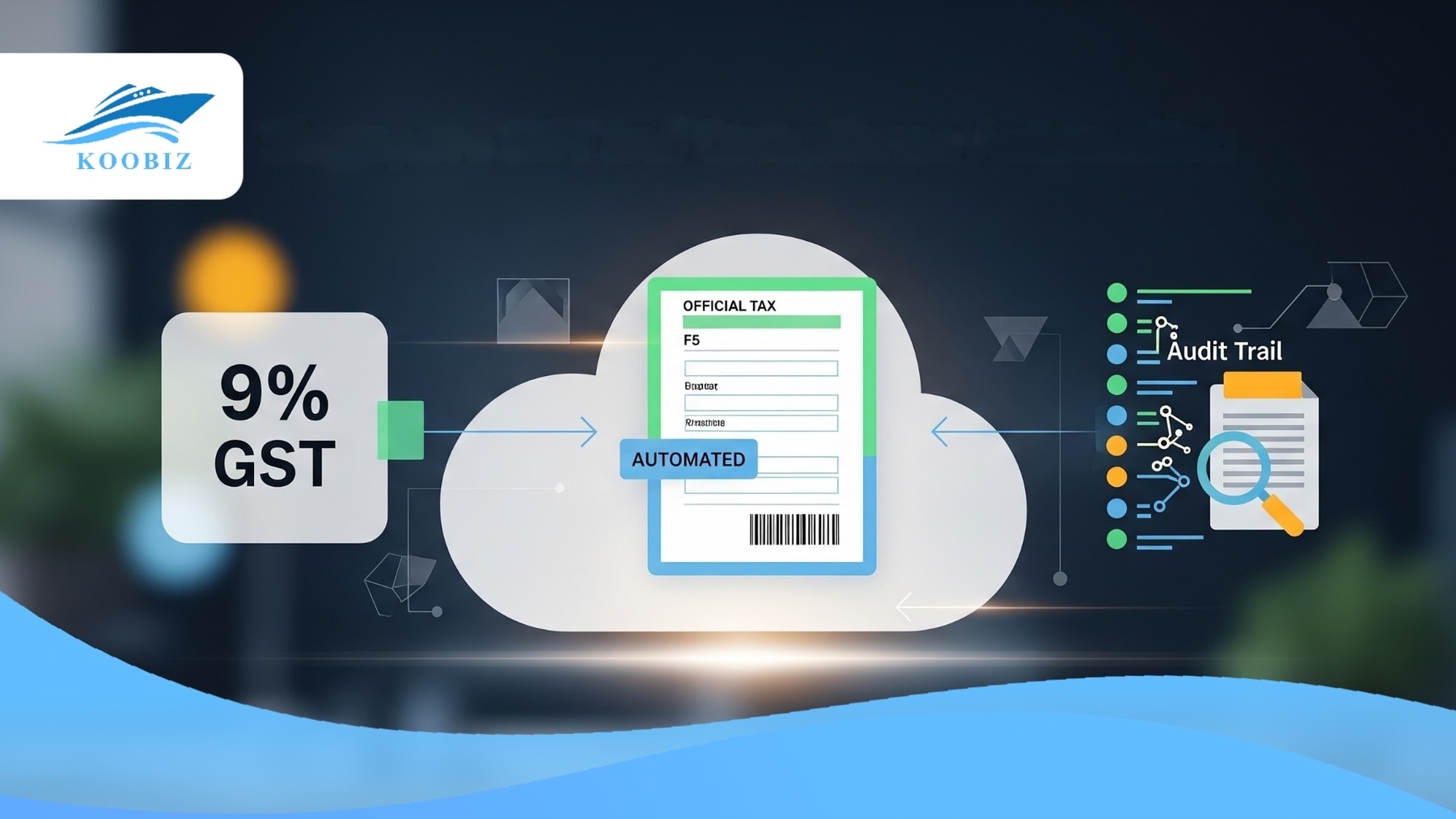
QuickBooks Online Singapore is a fully IRAS-compliant cloud accounting solution designed to automate 9% GST calculations and generate audit files that meet IRAS requirements.
Compliance is non-negotiable in Singapore. To put your mind at ease, here is exactly how the software addresses the strictest requirements set by the Inland Revenue Authority of Singapore (IRAS):
Singapore Compliance Requirement
How QuickBooks Online Solves It
GST Filing (Form F5)
Auto-Generated Reports: Automatically categorizes inputs/outputs (Box 1 vs Box 2) and generates figures that mirror the IRAS F5 form.
IRAS Audit Trail
“Always-On” Activity Log: Tracks every edit or deletion by user and timestamp, meeting strict IRAS audit standards.
E-Invoicing (InvoiceNow)
Partner Integration (LinkFor): Connects to the Peppol network via the LinkFor app. Note: This is not native; it requires setup and potential additional subscription fees.
A common concern among Koobiz clients is that using non-local accounting software may lead to GST or tax filing errors. Fortunately, the Singapore edition of QuickBooks is not just a clone of the US version; it has been significantly localized with these technical capabilities:
IRAS Compliance and Audit Trail
While the audit log tracks user activity, the most critical compliance feature is the IAF Export. QBO allows you to generate the IRAS Audit File (IAF)—a specific text file format mandated by tax authorities for auditing purposes. Note: This requires proper Chart of Accounts mapping during initial setup to ensure the IAF export is accepted by IRAS.
GST F5 Return Automation
QBO automates GST reporting by mapping transactions directly to the GST F5 return boxes. For example, it distinguishes between standard-rated supplies (Box 1) and zero-rated supplies (Box 2). At the end of each GST quarter, you can generate a GST report with figures ready for submission via the IRAS myTax Portal.
InvoiceNow (Peppol) Integration
QuickBooks connects to the InvoiceNow network via third-party access points, most notably LinkFor. This allows businesses to remain compliant and send e-invoices to government agencies (B2G), but it is an integrated solution rather than a native QuickBooks feature. You will need to register a LinkFor account and connect it to your QuickBooks file.
QuickBooks Online vs Xero: Which One Should You Choose?
QuickBooks wins on entry-level pricing and built-in inventory management, while Xero wins on unlimited user access for growing teams.
Choosing between these two giants is the most common dilemma Koobiz clients face. Both are excellent, cloud-based, and bank-compliant. Here is a head-to-head comparison of the critical differences:
Feature
QuickBooks Online (SG)
Xero (SG)
Starting Price (Regular)
S$31/mo (Simple Start)
(Often ~S$15.50 on promo)
S$39/mo (Starter)
(Often ~S$50 for Standard)
User Limits
1–5 users (Standard plans)
Up to 25 users (Advanced – S$124/mo)
Unlimited Users (All Plans)
Inventory
Built-in Robust Tracking (Plus Plan)
Basic (Often needs paid Add-ons)
Support
Live Chat & Phone Callback
Email / Ticket System Only
Ease of Use
High (Non-accountant friendly)
Medium (Accountant preferred)
Pricing Structure
QuickBooks Online is generally more competitively priced for small businesses in Singapore. Their “Simple Start” plan (Regular: S$31/mo) is cheaper than Xero’s “Starter” plan (Regular: ~S$39/mo). Crucially, QBO allows unlimited invoices on all plans, whereas Xero’s entry-level Starter plan limits invoice volumes compared to QuickBooks. For a freelancer or a consultant just starting out, QBO offers a lower barrier to entry.
Inventory Management
Inventory management is a key differentiator between the two platforms. QuickBooks Online includes robust inventory tracking in its “Plus” plan. It calculates Weighted Average Cost, tracks quantity on hand, and alerts you when stock is low. In contrast, Xero’s built-in inventory is basic. Heavy inventory users on Xero often have to subscribe to third-party apps like CIN7 or Unleashed, which can cost hundreds of dollars extra per month.
User Limits & Scalability
This is where QuickBooks Online shows a key limitation in scalability. Standard plans cap users (Simple Start: 1, Essentials: 3, Plus: 5). If your team grows beyond 5 people, you must upgrade to the Advanced Plan (S$124/mo). Xero, on the other hand, allows unlimited users on all plans. For rapidly scaling agencies where 10+ staff require system access, Xero is often more cost-efficient over time due to unlimited users.
What Are the Pricing Plans and PSG Grant Eligibility?
QBO Pricing & PSG Grant (50% Support)
There are four main pricing tiers—Simple Start, Essentials, Plus, and Advanced. Eligible Singaporean SMEs can claim up to 50% funding via the Productivity Solutions Grant (PSG) to cover these costs.
Beyond the monthly subscription fee, the government subsidy significantly changes the total cost of ownership.
PSG Grant (50% Support)
⚠️ CRITICAL KOOBIZ TIP: You cannot claim the 50% PSG Grant if you buy directly from the QuickBooks website. You must purchase via a pre-approved vendor (like an accounting firm or reseller) to qualify for the subsidy.
The Productivity Solutions Grant (PSG) is a Singapore government initiative designed to help local SMEs adopt approved IT solutions. To be eligible, you must purchase the software package through a pre-approved vendor. These packages usually bundle the software subscription with setup, training, and data migration.
Pricing Tiers
Here is a quick breakdown of the Regular Monthly Prices (Note: QuickBooks often runs ~50-70% off promos for the first 3 months):
Plan
Regular Price
User Limit
Best For
Simple Start
S$31/mo
1 User
Solopreneurs & Freelancers
Essentials
S$57/mo
3 Users
Service Businesses (Multi-currency)
Plus
S$78.99/mo
5 Users
Retailers (Inventory Tracking)
Advanced
S$124/mo
25 Users
Growing Teams (Custom Roles, Workflow Automation)
Simple Start is ideal if you are just starting out. Essentials becomes necessary if you deal with foreign suppliers (requiring Multi-currency). Plus is the default choice for anyone selling physical goods. Advanced is the solution for larger teams needing up to 25 seats.
We have established that QuickBooks Online is a compliant, cost-effective, and grant-eligible option for many Singaporean businesses. However, to provide a balanced and authoritative review, it is important to move beyond feature lists and examine the technical limitations and real-world challenges users face after implementation.
Detailed Analysis of QuickBooks Online Features and Limitations
To ensure you make an informed decision, we need to dig deeper into less obvious aspects of the software—migration challenges, mobile usability, and support quality—that often frustrate users post-implementation.
Feature Tested
Rating
Koobiz Verdict
Data Migration
⚠️ Complex
Hard to move historical data; starting fresh is recommended.
Mobile App
⭐ Excellent
Best-in-class for snapping receipts on the go.
Local Support
✅ Good
Phone callback feature beats email tickets.
Scalability
⚠️ Fair
Scalable to 25 users only on expensive “Advanced” plan.
Can You Migrate Data from Excel or Desktop to QuickBooks Online?
Yes, you can migrate data using built-in import tools for Excel, but moving from QuickBooks Desktop to Online often requires professional assistance due to database structure differences.
While QBO supports CSV-based imports, data migration is not always straightforward.
At Koobiz, we categorize the migration process as follows to help you manage expectations:
What You Can Import Yourself (Easy & Low-Risk Data)
What Requires Professional Migration Support (High-Risk Data)
Customer & Supplier Lists
3+ Years of Past Invoices
Chart of Accounts
Custom Invoice Templates
Product/Service Item Lists
Complex Multi-currency History
Recommendation: Rather than forcing 10 years of historical data into QuickBooks Online (which often leads to data integrity and GST reconciliation risks), we recommend setting a clear cut-off date (e.g. the start of the Singapore financial year) and migrating forward cleanly.
How Effective is the Mobile App for Singaporean Entrepreneurs?
The QuickBooks Online mobile app is highly effective for Singapore-based entrepreneurs, functioning as a true “pocket accountant” for receipt capture, invoicing, and mileage tracking.
In Singapore’s fast-paced business environment—whether you’re in a Grab, a co-working space, or a café—the QBO mobile app stands out as one of the most robust accounting apps compared to competitors.
Top 3 Mobile Features:
Receipt Capture (OCR): Simply snap a photo of a local receipt (e.g. café or transport expenses). The app automatically extracts the date, amount, and vendor, then matches it to your bank feed. The app reads the date, amount, and vendor, then matches it to your bank feed automatically.
Instant Invoicing: Create and send professional invoices via WhatsApp or email immediately after leaving a client meeting.
Mileage Tracking: Automatically track your business trips using your phone’s GPS to claim tax deductions later.
Is QuickBooks Support Reliable for Local Users?
Yes, QuickBooks Online support is generally reliable for Singapore users, offering live chat and phone callback options that are often faster than email-based ticket systems.
When your payroll is stuck or GST figures don’t match, you need immediate help. Here is how the support channels stack up for Singaporean users:
Support Channel
Response Speed
Best Used For
“Call Me Back”
Fast
Urgent technical issues or payroll blocks
Live Chat
Medium
Quick navigation or feature questions
Community Forum
Slow
Non-urgent how-to guidance
Note: While support teams are regional (typically Malaysia or the Philippines), they are well-trained on the Singapore edition of QuickBooks, unlike generic US-based support lines.
Who Should Avoid QuickBooks Online?
Businesses requiring complex construction progress claims, large agencies needing many user seats on a limited budget, or companies with highly specialized ERP requirements may find QuickBooks Online unsuitable.
While we rate QBO highly overall, it is not a one-size-fits-all solution. If you fall into the categories below, consider these alternatives:
Industry
Why Avoid QBO?
Recommended Alternative
Construction
Standard invoicing lacks progress billing and retention sums.
Xero + WorkflowMax
Large Agencies
The 25-user Advanced plan is S$124/mo, which is pricey.
Xero (Unlimited Users)
Manufacturing
Cannot track “Raw Materials” vs “Work in Progress” effectively.
NetSuite or SAP Business One
Conclusion
In summary, QuickBooks Online Singapore is a powerful accounting solution for micro-SMEs, retail startups, and service providers looking to automate compliance without high cost. Its ability to handle 9% GST, coupled with the 50% PSG Grant, makes it an incredibly attractive financial proposition. While large teams might find Xero more cost-effective for scaling, QBO’s inventory capabilities and ease of use make it the superior choice for product-based businesses.
At Koobiz, we believe that the best software is the one you actually use. QuickBooks Online makes accounting accessible enough that you will stay on top of your numbers.
Need help setting up your Singapore business foundation? Beyond just choosing software, Koobiz is your trusted partner for Singapore company incorporation, corporate secretary services, and opening corporate bank accounts. We can help you structure your business correctly from Day 1, ensuring you are ready to plug into QuickBooks and start trading immediately.
Visit Koobiz.com today to schedule a consultation with our experts.
Definition & Scope: WHT is a tax collected at source on payments made to non-resident companies or individuals for services derived in Singapore.
Current Rates (2026): Rates vary by payment type, typically 15% for interest, 10% for royalties, and prevailing corporate rates (17%) for technical services.
Filing Deadline: Returns must be filed and paid by the 15th of the month following the date of payment to avoid penalties.
Legal Obligation: Section 45 of the Income Tax Act mandates the payer to withhold a percentage of the payment and remit it to IRAS.
Optimization: Tax liability can often be reduced or exempted through Singapore’s extensive network of Double Taxation Agreements (DTAs).
[/SUMMARIES]
Paying overseas vendors is common for businesses operating in Singapore, but it often triggers Withholding Tax (WHT) obligations that companies only realise when penalties arise. WHT is the mechanism used to tax non-residents on income sourced from Singapore. At Koobiz, we regularly support businesses in managing these cross-border payments, whether for loan interest, software royalties, or management fees to a foreign parent company, ensuring compliance while keeping costs under control. A clear understanding of the applicable WHT rates, filing requirements, and available tax treaty relief for 2026 is essential. This guide outlines the key rules, rates, filing process, and practical considerations for businesses making overseas payments.
What Is Withholding Tax in Singapore?
Withholding Tax in Singapore
Singapore Withholding Tax (WHT) requires a payer to deduct a prescribed percentage from certain payments made to non-resident individuals or companies and remit that amount to the Inland Revenue Authority of Singapore (IRAS).
The purpose is to ensure tax is collected on income sourced in Singapore, even if the recipient has no physical presence here. As IRAS has limited enforcement over foreign entities, the legal obligation falls on the payer.
The Payer (Liable Party): The Singapore tax resident (company or individual) utilizing the service or rights.
The Payee (Recipient): The non-resident entity or individual receiving the income.
The Trigger: Payments for specific categories such as interest, royalties, rent, or technical assistance fees.
In practice, when a Singapore tax resident makes specified payments to a non-resident, part of the payment must be withheld and paid to IRAS. This applies whether or not the recipient has a permanent establishment in Singapore, although the applicable tax rate may vary.
According to IRAS data, Withholding Tax collections contribute significantly to national revenue, underscoring the authority’s strict enforcement of Section 45 compliance.
Withholding Tax Rates by Payment Type 2026
Singapore WHT Rates 2026 Table by Payment Type
Singapore applies different WHT rates depending on the nature of the payment, ranging from 10% to 24%.
To ensure accuracy in your filings, you must first classify the payment correctly. The table below summarizes the key rates applicable for the Year of Assessment 2026.
Nature of Payment
WHT Rate (2026)
Key Notes
Interest, Commissions, Loan Fees
15%
Applies to interest related to any loan or indebtedness.
Royalties & Rights of Use
10%
Reduced rate for intellectual property and movable property usage.
Technical Assistance & Management Fees
17%
(Prevailing Corp Rate). Only applies to services performed in Singapore.
Non-Resident Director’s Remuneration
24%
Applies to salary, bonus, and directors’ fees.
Rent (Movable Property)
15%
Rent for use of equipment, machinery, etc.
Below is a detailed breakdown of the nuances within these categories, as applying the wrong classification is a common compliance error.
Interest, Commissions, and Loan Fees
Although the 15% withholding rate on interest appears straightforward, the key issue is whether the income falls under “deemed source” rules or is attributable to a permanent establishment (PE) in Singapore. The 15% rate is a final tax on gross interest paid to non-residents with no PE in Singapore. However, if the interest is effectively connected to the non-resident’s Singapore branch or office, it is treated as business income and taxed at the prevailing corporate rate of 17% on a net basis. In such cases, the non-resident must file a full tax return instead of relying on a simple Section 45 withholding.
Royalties and Rights of Use
A 10% concessionary rate generally applies to payments for the use of intellectual property. However, under IRAS’ “Rights-Based Approach,” certain software payments may be exempt.
If the payment is for a copyrighted article—such as off-the-shelf software, downloadable applications for internal use, or site licences—and no rights to modify, reproduce, or sublicense are granted, IRAS treats it as a purchase of goods rather than a royalty. In these cases, no Withholding Tax applies, provided the non-resident does not have a permanent establishment in Singapore.
Technical Assistance and Management Fees
For service fees subject to 17% tax, the key consideration is where the services are performed. Withholding Tax applies only if the services are physically carried out in Singapore. If a non-resident consultant provides advice, management input, or technical support entirely from overseas—without entering Singapore—the payment is generally not subject to WHT. To support this position, businesses should keep clear documentation showing the services were performed outside Singapore (e.g. travel records confirming no entry).
Director’s Remuneration
The 24% rate for non-resident directors applies broadly to all remuneration received in their capacity as directors—not just board fees, but also salaries, bonuses, and stock option gains. The rate aligns with Singapore’s top marginal personal income tax rate of 24%.
Unlike other payments where the place of performance may be relevant, directors’ fees are taxable in Singapore if the company is tax resident here, regardless of where board meetings take place.
Does Your Payment Require Withholding Tax?
Yes, your payment requires Withholding Tax if the income is deemed to be sourced in Singapore and is paid to a non-resident for specific services or assets.
Determining liability relies heavily on the concept of “Source of Income” as defined under the Income Tax Act. Simply having a contract isn’t enough; the key is where the work is performed or where the asset is used.
The table below contrasts common business scenarios to help you determine if you must answer “Yes” to WHT liability.
Scenario
WHT Applicable?
Reasoning (The “Source” Rule)
Paying a German firm for software development done entirely in Berlin
NO
The service is performed physically outside Singapore. The income is not sourced here.
Paying the same German firm to send engineers to your SG office
YES
The service is performed physically in Singapore. WHT applies to the portion of work done locally.
Paying a US consultant for market research via email/Zoom
NO
No physical presence in Singapore. The advice is given from abroad, so it is not subject to WHT.
Paying for rental of industrial machinery used in your Tuas factory
YES
The income is derived from the use of movable property located in Singapore.
Reimbursing a vendor for hotel costs incurred in Singapore
YES
IRAS generally treats reimbursements as part of the gross service fee, which is taxable.
If your situation matches the “YES” column, you are legally obligated to withhold the tax before releasing the net amount to your vendor.
IRAS states that the burden of proof regarding where services are performed lies with the Singapore payer. You must maintain flight tickets, passport pages, or detailed work logs to prove work was done overseas.
Filing Deadlines and Payment Methods
Deadline and rules for Withholding Tax Payment Date
Strict adherence to the WHT filing timeline is critical as IRAS imposes immediate penalties for late submissions.
Unlike GST which is quarterly, Withholding Tax is transactional. The golden rule for compliance is that you must file and pay by the 15th of the second month from the date of payment.
The Deadline Calculator (15th of the Second Month Rule)
Use this table to determine your exact filing deadline based on when the payment liability arose.
If the “Date of Payment” falls in…
Your Filing & Payment Deadline is…
January (1st – 31st)
15th March
February (1st – 28th/29th)
15th April
March (1st – 31st)
15th May
…
…
December (1st – 31st)
15th February (of the following year)
Note on GIRO: If you are on a GIRO payment plan, the deduction date is typically the 25th of the month the tax is due (e.g., 25th March for a January payment), giving you an additional 10 days of cash flow.
How to Determine the “Date of Payment”
A common mistake is assuming the “Date of Payment” is simply the day you transfer cash. Under IRAS rules, the “Date of Payment” is the earliest of the following four dates. Whichever happens first triggers the deadline clock:
Contractual Due Date: The date the payment is legally due according to your written agreement (even if you haven’t paid it yet).
Invoice Date: In the absence of a written contract, the date printed on the invoice is deemed the payment date. (Note: Credit terms like “30 days” are ignored; the invoice date stands).
Crediting Date: The date the income is credited to the non-resident’s account or reinvested/offset on their behalf (common in intercompany netting).
Actual Payment Date: The date the cash or cheque is physically transferred.
Example: If you receive an invoice dated 25th January but only pay the vendor on 10th March, your “Date of Payment” is 25th January. Consequently, your tax filing deadline is 15th March. If you wait until the actual payment in March to file, you will already be late and subject to penalties.
How to File Withholding Tax (Section 45)
Filing via the IRAS myTax Portal is mandatory, but session timeouts are a common frustration. To ensure a smooth process, follow this “Prep & Execute” protocol.
Since 2020, paper filings are no longer accepted. The digital process is fast, provided you have the right data on hand before you log in.
Phase 1: Preparation Checklist (Do this BEFORE logging in)
The portal may time out if you spend too long searching for data. Ensure you have these four items ready:
Payee’s Tax Reference ID: If available (or their full registered name and address).
Exact Date of Payment: Determined using the rules above (Earliest of Invoice/Contract/Payment).
Nature of Payment: Know exactly which tax rate applies (e.g., “Royalties” vs “Technical Fees”).
COR File (Optional): If claiming DTA relief, have the scanned Certificate of Residence ready to upload if requested.
Phase 2: Execution (The 3-Step Filing)
myTax Portal
Step 1: Authorization and Login
Ensure your staff (or Corporate Secretary) has the appropriate Corppass authorization for “Withholding Tax (Filing/Applications)”. Log in to the myTax Portal using your Singpass.
Step 2: Submission of S45 Form
Navigate to “Business Tax” > “Withholding Tax” > “File S45”.
Enter the Payee’s details. If you have paid them before, the system might auto-populate.
Select the Nature of Payment. Enter the Gross Amount and the Date of Payment.
Crucial Check: The system often auto-calculates the tax at the standard rate (e.g., 17%). If you are applying a lower DTA rate (e.g., 10%), you must manually override the tax amount and indicate the treaty country.
Step 3: Payment & Acknowledgement
Once submitted, you will receive an Acknowledgement Page.
GIRO: If you have GIRO set up, the deduction will happen automatically on the 25th.
PayNow/Bank Transfer: If not on GIRO, use the Payment Reference Number generated on the screen to pay immediately via PayNow Corporate to avoid late penalties.
How to Reduce WHT with Double Taxation Agreements (DTA)
Double Taxation Agreements (DTAs) can substantially reduce withholding tax exposure, but proper documentation is essential.
Singapore has an extensive DTA network covering more than 90 jurisdictions. At Koobiz, we assist clients in applying treaty benefits correctly to improve cash flow and avoid overpayment.
The Savings Matrix (Standard vs. Treaty Rates)
Many businesses default to domestic rates and end up paying more than necessary. The table below highlights the potential savings when treaty rates are properly applied (illustrative only and subject to treaty conditions):
Treaty Country
Payment Type
Standard Rate
DTA Rate (Typical)
Potential Savings
Japan
Royalties
10%
5% (or lower)
50% Reduction
Malaysia
Technical Fees
17%
5% (often)
~12% Reduction
United Kingdom
Royalties
10%
8%
2% Reduction
Australia
Interest
15%
10%
5% Reduction
Vietnam
Technical Fees
17%
5% – 10%
Significant Savings
Note: Treaty rates vary by specific clauses. Always consult a tax professional at Koobiz to verify the exact rate for your contract.
Mandatory Requirement: The Certificate of Residence (COR)
To legally claim these lower rates, you cannot simply select the option in the portal. You must meet a critical condition.
CRITICAL WARNING: No COR = No Discount
If you apply a reduced DTA tax rate, you MUST hold a valid Certificate of Residence (COR) from the payee for the relevant financial year.
The Risk: If IRAS conducts an audit and you cannot produce the COR, they will revoke the treaty benefit. You will be liable for the back taxes (the difference between the reduced rate and standard rate) plus penalties.
The Best Practice: Make it a company policy to request the COR from your overseas vendor before processing their first payment of the year.
Real-World Case Studies: WHT in Action
To bridge the gap between complex tax rules and daily operations, let’s explore three practical scenarios that Singapore companies often face.
Case Study 1: Buying Software (Royalties vs. Goods)
The Scenario:
TechFlow Pte Ltd, a Singapore software company, purchases 50 licenses of design software from CreativeCorp, a US-based vendor. The total invoice is $20,000.
The Question: Is this a royalty payment subject to 10% WHT?
The Analysis:
Since TechFlow is buying standard “off-the-shelf” licenses (copyrighted articles) for internal use and does not acquire rights to reproduce, modify, or sub-license the source code, IRAS views this as a purchase of goods.
The Verdict:0% Withholding Tax. TechFlow pays the full $20,000 to CreativeCorp without deduction.
Case Study 2: The Remote Consultant (Place of Performance)
The Scenario:
BizSolutions Pte Ltd hires a UK-based marketing expert to develop a strategy for their Singapore launch. The fee is $10,000. The expert does all the work from London via Zoom and email.
The Question: Is this a technical service fee subject to 17% WHT?
The Analysis:
Technical service fees are only taxable if the work is performed physically in Singapore. Since the consultant never entered Singapore, the income is not sourced here.
The Verdict:0% Withholding Tax. However, BizSolutions must keep flight records or a declaration proving the consultant did not travel to Singapore.
Case Study 3: The “Net of Tax” Contract (Re-grossing)
The Scenario:
GlobalTrade SG borrows funds from an Indonesian lender. The contract states: “Interest of $1,000 is payable net of all taxes.” (i.e., the lender wants $1,000 in their pocket).
The Question: How much WHT does GlobalTrade pay?
The Analysis:
Since the lender refuses to suffer the tax deduction, GlobalTrade must bear it. The tax base isn’t $1,000; it must be “re-grossed.”
Even experienced finance teams can stumble on the technical nuances of Withholding Tax, leading to unnecessary fines.
To keep your record clean with IRAS, review this “Pitfall & Prevention” guide before filing.
The “Pitfall & Prevention” Table
The Common Mistake
Why it’s Wrong
The Correct Action
Reimbursing Hotel/Airfare without WHT
IRAS generally views reimbursements as part of the total service fee, not a separate non-taxable item.
Withhold on the Gross: Calculate tax on the total invoice value (Service Fee + Reimbursements).
Not “Regrossing” the Tax
If your contract states the payment is “Net of Tax” (you pay the tax for them), the tax itself is a benefit.
Calculate on Regrossed Amount: Use the formula: (Net Payment / (1 – Tax Rate)) x Tax Rate.
Using the Invoice Date only
The liability arises on the earliest of four dates (Contract, Invoice, Credit, Payment).
Check All Dates: Verify if the contract specified an earlier due date than the invoice.
The Penalty Ladder (Consequences of Non-Compliance)
IRAS enforcement is automated and strict. Penalties escalate rapidly if the 15th-of-the-month deadline is missed.
Level 1 (Immediate): 5% Late Payment Penalty
Applied the moment the deadline passes. Even being one day late triggers this on the unpaid tax amount.
Level 2 (Escalating): 1% Additional Penalty
If the tax remains unpaid, an additional 1% is added for every completed month, up to a maximum of 15% of the unpaid tax.
Level 3 (Severe): Appointment of Agents
For persistent non-payment, IRAS can appoint your bank, tenant, or lawyer as an agent to recover the money directly from your funds.
Frequently Asked Questions about Singapore WHT
Is software payment always subject to withholding tax?
It depends on the rights transferred.
In general, payments for the right to use software are treated as royalties and subject to 10% WHT. However, under the Rights-Based Approach, if you are merely purchasing a copyrighted article—such as off-the-shelf or shrink-wrap software—without any rights to reproduce or modify it, the payment is not subject to WHT, provided the vendor has no permanent establishment in Singapore.
Can I claim a refund if I overpaid WHT?
Yes, but it requires documentation.
If WHT was applied incorrectly, or if a Certificate of Residence (COR) is obtained after filing, a refund may be claimed. The refund application must be submitted to IRAS within four years from the date of payment, together with the COR and proof of the original tax remittance.
What exchange rate should I use if I pay in USD?
Use the spot rate on the date of remittance.
If you pay your vendor in a foreign currency (e.g., USD or EUR), the withholding tax must still be filed in Singapore Dollars (SGD). You should use the exchange rate prevailing on the date of payment to the non-resident. If the exact rate is unavailable, IRAS generally accepts the MAS exchange rate or the internal bank rate used for the transaction.
Who is responsible for paying the tax: Me or the Vendor?
Legally, the Vendor (Payee); Practically, often You (Payer).
Under the law, WHT is a tax on the non-resident’s income, so you should deduct it from their fee (e.g., pay them $85 instead of $100). However, many commercial contracts are signed “Net of Tax,” meaning the vendor expects the full $100. In this case, you must bear the tax cost yourself by re-grossing the amount (paying tax on top of the fee), effectively increasing your cost of business.
Navigating Singapore’s tax landscape requires precision and foresight. Whether you are dealing with complex Section 45 filings, interpreting “Deemed Date of Payment,” or seeking to optimize your cross-border payments through Double Taxation Agreements, Koobiz is here to support you. We specialize in corporate services for the Singapore market, ranging from company incorporation and banking to specialized tax and accounting solutions. Don’t let Withholding Tax become a liability for your business.
Visit Koobiz.com today to consult with our experts and ensure your Singapore operations are fully compliant and tax-efficient.
Digital vs. Traditional: Digital banks such as ANEXT and GXS dominate the micro-loan segment (below S$30,000) due to instant approvals. Traditional banks like DBS and UOB remain the preferred option for larger working capital loans of up to S$500,000.
Interest Rate Reality: In 2026, unsecured business loans in Singapore typically carry effective interest rates (EIR) of 7%–11% p.a. for banks, compared to 12%–24% p.a. for fintech lenders.
Government Support: The Enterprise Financing Scheme (EFS) remains the backbone of SME lending, with the Working Capital Loan (WCL) cap permanently set at S$500,000.
Budget 2026 Focus: Anticipated measures include enhanced support for AI Adoption and Green Financing, building on previous digitalization frameworks.
Approval Speed: InvoiceNow adoption has become a key requirement for SMEs seeking access to fast-track “Green Lane” loan approvals.
[/SUMMARIES]
Securing the right funding is critical for business growth in Singapore in 2026. With options ranging from traditional banks like DBS to digital challengers such as ANEXT, SMEs must balance interest costs with approval speed. At Koobiz, we support Singapore company incorporation and banking setup, helping businesses navigate small business loan options efficiently. This guide compares top 2026 loan options, interest rate trends, and expected Budget 2026 grants to help you make the right choice.
Top SME Business Loans in Singapore (2026): Traditional Banks vs. Digital Banks
There are three main categories of SME lenders in Singapore: traditional banks, digital banks, and private fintech lenders. Choosing the right option requires balancing interest cost, approval speed, and accessibility.
Here is the quick snapshot of the 2026 lending landscape:
Key Feature
Traditional Banks (DBS, UOB)
Digital Banks (ANEXT, GXS)
Fintech Lenders (Funding Societies)
Interest Rate (EIR)
Lowest (7% – 11%)
Moderate (9% – 15%)
High (12% – 24%)
Max Loan Amount
High (Up to S$500k)
Low (S$30k-S$100k)
Variable
Speed to Cash
Slow (1-2 Weeks)
Instant (24 Hours)
Fast (24-48 Hours)
Koobiz Editor’s Choice: Best SME Loan Options in Singapore (2026)
Best for Lowest Rates & High Loan Amounts: Traditional Banks (DBS/UOB).
Why: Competitive rates for established SMEs (2+ years) requiring larger working capital through government-backed schemes.
Best for Startups & Speed:Digital Banks (ANEXT/GXS).
Why: Minimal documentation for micro-loans, making them suitable for new companies (under 2 years) with immediate cash flow needs.
Best for Bad Credit / Flexibility:Fintech Lenders.
Why: Higher approval rates for businesses that do not meet traditional bank credit requirements.
DBS Working Capital Loan and UOB BizMoney continue to be preferred options for mature businesses seeking larger funding amounts at competitive rates.
Specifically, these banks are the main participating financial institutions under the Enterprise Financing Scheme – Working Capital Loan (EFS-WCL). If your company has been incorporated for at least two years and records annual turnover above S$300,000, these banks typically offer the lowest cost of funding. The key advantage is the government risk-sharing mechanism, which co-shares default risk and allows banks to extend loans of up to S$500,000. However, be prepared for a rigorous credit assessment involving detailed financial statements and scrutiny of the directors’ Credit Bureau Singapore (CBS) ratings.
Detailed Review: ANEXT & GXS (Digital Options)
ANEXT Bank (by Ant Group) and GXS Bank (Grab-Singtel) have significantly expanded access to financing for asset-light companies or businesses that are too young for traditional banks.
These digital banks assess creditworthiness using alternative data, such as e-commerce transaction history or real-time Grab platform data, instead of relying solely on audited financial statements. For newly incorporated companies that have opened a digital bank account, these lenders are often the first financing option considered. For instance, the ANEXT Business Loan offers financing up to S$100,000 with no financial documents required for smaller amounts, making it ideal for immediate liquidity needs.
Current SME Loan Interest Rates (2026 Forecast)
SME loan interest rates in Singapore generally consist of a base rate (often SORA) plus a spread, with 2026 Effective Interest Rates (EIR) ranging between 7% and 11% for bank loans.
To understand the true cost of borrowing, business owners must look past the “advertised” rates. The table below illustrates the difference between advertised flat rates and the actual effective interest rate (EIR).
Lender Type
Advertised “Flat” Rate
Real Cost (EIR)*
Notes
Traditional Banks (DBS, UOB)
From ~5.0% p.a.
7% – 11% p.a.
Lowest cost, strict criteria.
Digital Banks (ANEXT, GXS)
From ~6.8% p.a.
9% – 15% p.a.
Higher rate for speed & convenience.
Private Lenders (Fintechs)
From ~1% per month
12% – 24% p.a.
Short-term bridge capital.
*Disclaimer: Rates are estimated as of February 2026 and are subject to change based on market conditions and individual credit assessment. Please verify latest rates directly with the respective financial institutions.
Key Warning:
Flat Rate: This is the rate often advertised. It is calculated on the original principal amount and does not account for repayment reducing the principal.
Effective Interest Rate (EIR): This reflects the true economic cost of the loan, including processing fees (typically 1-2%) and the compounding effect of monthly repayments. Always compare loans based on EIR.
In the current 2026 economic climate, while global central banks have moderated their hiking cycles, rates have not returned to the near-zero levels of the past decade. For unsecured business term loans from major banks, SMEs should expect an EIR of approximately 7% to 10%.
Eligibility Checklist: Government Risk-Sharing Scheme Requirements (EFS)
Yes, your business may qualify for government risk-sharing schemes such as the EFS if it is registered in Singapore and has at least 30% local shareholding.
However, meeting the government’s baseline criteria does not guarantee bank approval. Applicants must satisfy two separate layers of assessment: official government requirements and individual bank credit criteria.
1. The Non-Negotiables (Government Rules)
These are the strict requirements set by Enterprise Singapore. If you miss one, you are automatically disqualified from the EFS scheme.
Business Entity: Must be a Private Limited company registered with ACRA.
Local Equity: Minimum 30% local shareholding (Singapore citizen or PR). Fully foreign-owned companies are generally not eligible and must rely on standard commercial loans.
Group Size: Annual group turnover below S$500 million or group employment size below 200 employees.
2. Bank-Specific Credit Requirements (Preferred)
Even if you meet the government rules above, individual banks may still reject your application based on their own risk assessment.
Operational History: Most banks require at least 6 months of active commercial banking operations. Startups less than six months old are generally better suited to digital banks.
Positive CBS Score: Directors must have a clean personal credit record with the Credit Bureau Singapore (No recent bankruptcy or litigation).
Revenue Trend: Banks prefer to see stable or growing revenue. A sharp decline in recent months can trigger a rejection even if the yearly revenue is high.
Types of Financing: From Working Capital to Green Loans
There are three primary types of business financing available in Singapore: unsecured term loans, invoice financing, and green financing.
Choosing the appropriate financing structure depends on whether the business requires a lump sum for expansion or flexible funding for daily operations.
Unsecured Business Term Loans
Unsecured Business Term Loans
Best for: General business expansion, renovation, or marketing campaigns.
Unsecured term loans are lump-sum cash injections that do not require you to pledge physical assets (like property) as collateral.
This is the most common form of financing for SMEs in Singapore. The “security” is usually in the form of a Personal Guarantee (PG) from the directors. These loans are suitable for investments where returns are realized over time. Repayment is typically structured over 1 to 5 years with fixed monthly installments.
Invoice Financing
Invoice Financing
Best for: B2B companies with slow-paying clients (60-90 day terms) needing immediate cash flow.
Invoice financing (or factoring) allows businesses to borrow money against amounts due from customers, unlocking cash tied up in unpaid invoices.
This is particularly useful for B2B companies with long payment cycles. Instead of waiting for the client to pay, a lender (often a fintech such as Validus or Funding Societies) advances up to 80% of the invoice value immediately. Once the client pays, the remaining balance is released to you minus a fee. This solves cash flow gaps without adding long-term debt to the balance sheet.
Green Financing
Green Financing
Best for: Sustainability projects (Solar, EV fleets) seeking interest rate discounts.
Green Financing refers to loans specifically designed to fund sustainability projects, offering lower interest rates to companies that meet specific environmental criteria.
By 2026, green financing has become a mainstream funding option for SMEs. Banks like OCBC and UOB offer “SME Sustainable Financing” frameworks. If your business is investing in energy-efficient equipment, solar installation, or electric vehicle fleets, you can access “Green Loans” which often come with rate discounts of 0.5% to 1% lower than standard packages.
What’s New in Budget 2026 for SME Financing?
Expected to prioritize AI and sustainability
Singapore Budget 2026 is expected to prioritize AI adoption and sustainability, with targeted enhancements to existing SME grant frameworks.
Based on pre-budget recommendations and market trends, here are the two major areas where we anticipate enhanced support:
1. The AI Boost (Anticipated PSG Enhancements)
Industry analysts expect the Productivity Solutions Grant (PSG) to be expanded to cover more advanced AI applications.
Expected Focus: Funding for AI-driven customer service bots, predictive analytics software, and automated marketing tools.
The Goal: To help SMEs move beyond basic digitalisation and adopt generative AI to reduce manpower costs.
2. The Green Transition (Expanded EEG)
The Energy Efficiency Grant (EEG) is projected to roll out to more sectors beyond manufacturing and food services.
Expected Focus: Upgrading to energy-efficient equipment (LED lighting, air-conditioning, refrigerators) for a wider range of industries.
The Goal: To provide significant subsidies that lower utility bills, often pairing well with Green Loans for the remaining balance.
Businesses should monitor the official Budget announcements in mid-February and assess grant eligibility before applying for SME loans.
Understanding the Enterprise Financing Scheme (EFS) in 2026
The Enterprise Financing Scheme (EFS) is a comprehensive government program that consolidates various financing needs.
It is the backbone of SME lending in Singapore, where Enterprise Singapore shares the default risk with banks to encourage lending. Navigating the specific “EFS Variants” is crucial to getting the right limit for your business.
MYTH: “If I default, the government pays the 70% risk-share portion.”
REALITY: You are 100% liable for the full amount. The “Risk-Share” is an insurance policy for the bank, not you. It encourages banks to lend, but in the event of default, the borrower and guarantors remain fully liable for the outstanding debt, including potential legal action.
Alternatives for Bad Credit or Rejected Applications
Rejection by a major bank does not end the financing process; it indicates the need to explore alternative lenders aligned with the business’s risk profile.
If an application has been declined by DBS, OCBC, or UOB, identifying the underlying reason helps determine the most suitable alternative financing option.
Scenario A: Weak or Limited Credit History
The Solution: Licensed Money Lenders (LMLs)
Why it works: Licensed Moneylenders assess current repayment capacity rather than historical credit records (CBS score).
The Trade-off: Cost. Interest rates are significantly higher (1% – 4% per month). This option is suitable only as a short-term bridge facility (typically 3–6 months) to address immediate cash flow needs, rather than long-term business growth.
Safety Warning: Only borrow from lenders listed in the Ministry of Law’s Registry of Moneylenders.
Scenario B: High-Growth Startup Without Current Profitability
The Solution: Venture Debt
Why it works: Traditional banks require profitability and assets. Venture debt providers, such as Genesis Alternative Ventures or bank innovation units, assess lending risk based on growth metrics and venture capital backing.
The Trade-off: Equity Dilution. These deals often include “warrants,” which grant the lender the right to acquire a small equity stake in the company at a future date.
Scenario C: Outstanding Invoices with Cash Flow Constraints
The Solution: Invoice Factoring (Fintechs)
Why it works: Platforms like Funding Societies or Validus lend against the value of outstanding invoices rather than the company’s balance sheet. If the end client is a reputable counterparty (such as a government agency or multinational corporation), funding may still be available even when the SME’s own credit profile is weak.
The Trade-off: You receive only ~80% of the invoice value upfront, and the fees are deducted from the final payment.
The Role of InvoiceNow in Faster Loan Approvals
InvoiceNow is Singapore’s nationwide E-invoicing network based on Peppol, which allows lenders to verify transaction data instantly, leading to “Green Lane” loan approvals.
In the 2026 lending environment, approval speed has become a critical factor.
Adopting InvoiceNow is not only about paperless invoicing; it significantly reduces manual verification delays at banks.
The Old Way (Manual)
Step 1: Download and print/scan PDF invoices.
Step 2: Email documents to your Relationship Manager.
Step 3: bank teams manually contact customers to verify invoices, increasing processing time and fraud risk.
Step 4:Wait 1-2 Weeks for approval.
The InvoiceNow Way (Digital)
Step 1: Send e-invoice via the Peppol network (using Xero/QuickBooks).
Step 2: Bank system auto-verifies the authentic transaction data.
Step 3:Approved in 24 Hours (Green Lane Processing).
By simply linking your accounting software to the InvoiceNow network, you create a verified digital footprint that banks can readily validate, allowing applications to be prioritised for faster review.
Conclusion
The landscape for Small Business Loans in Singapore in 2026 is diverse, ranging from government-backed schemes offering stability to AI-driven digital banks offering speed. Whether you are an established SME targeting the EFS Working Capital Loan or a startup leveraging GXS or ANEXT for quick liquidity, the key is to align the financing type with your business stage and needs.
However, the foundation of any successful loan application is a properly structured business. This means having your incorporation documents, tax filings, and management accounts in perfect order.
Need help getting your Singapore business loan-ready?
At Koobiz, we specialize in the foundational services that banks require. From seamless Company Incorporation to professional Accounting & Tax filing, we ensure your business credibility is high from day one. We also assist foreign entrepreneurs in navigating the corporate bank account opening process, connecting you with the right bankers at DBS, OCBC, UOB, and digital banks.
Visit Koobiz.com today to build a bankable business in Singapore.
Payroll software helps businesses in Singapore manage salary calculations, CPF contributions, and tax reporting in compliance with MOM and IRAS regulations.
It integrates payroll accounting and payroll management into one workflow, ensuring accurate records and timely payments.
Automation reduces manual errors and improves control over statutory submissions such as CPF and IRAS AIS.
Compared with manual processing or outsourcing, payroll software offers higher accuracy and better scalability.
Choosing the right system supports a compliant and efficient payroll operation.
[/SUMMARIES]
Managing payroll in Singapore requires precision across salary calculation, CPF contributions, and tax reporting while complying with MOM and IRAS regulations. Payroll software centralises payroll accounting and payroll management within a single system. By automating calculations and statutory processes, businesses reduce operational risk and improve efficiency. This ensures accurate, timely salary payments and stronger regulatory compliance.
Understanding Payroll Software in Modern Businesses
Modern businesses need a reliable and efficient way to manage employee salaries and statutory deductions. Manual payroll processing with spreadsheets is slow and prone to errors, especially as workforce size grows. Payroll software solves this by automating payroll tasks and standardizing payroll processes.
What Is Payroll Software?
Basic concept of payroll software
Payroll software is a digital system that automates salary calculations, statutory contributions, and payroll record management. It processes gross wages, overtime, bonuses, and allowances, while automatically applying required deductions such as CPF contributions and IRAS income tax (AIS).
Beyond salary payments, payroll software supports payroll accounting by storing financial data in a structured, audit-ready format. This ensures payroll figures are accurately recorded in the company’s general ledger. In Singapore, most modern payroll solutions are configured to comply with regulations issued by the Ministry of Manpower (MOM) and the Central Provident Fund (CPF) Board.
Role of Payroll Software in Business Operations
Payroll software connects human resources, financial reporting, and regulatory compliance into a single workflow.
Operational efficiency: It streamlines employee data management and ensures salaries are paid accurately and on time, reducing manual work for HR and finance teams.
Risk mitigation: Automated CPF calculations and tax data preparation help minimize errors and lower the risk of non-compliance penalties.
System integration: Most platforms integrate with payroll accounting and HRIS systems, enabling payroll data to flow directly into financial reports and workforce planning. This turns payroll from a routine task into a strategic tool for managing costs and employees.
How Payroll Accounting and Payroll Management Work Together
How payroll accounting supports payroll management
Payroll accounting and payroll management play different roles, yet they work best as a unified system. Payroll accounting ensures financial accuracy and compliance, while payroll management focuses on people, processes, and timely execution. Modern payroll software connects these two functions, creating a synchronized and reliable payroll workflow.
Key Responsibilities of Payroll Accounting
Payroll accounting manages the financial records of employee compensation, with a strong focus on accuracy and accountability:
Financial tracking: Calculating gross-to-net pay and recording payroll expenses correctly in the general ledger.
Liability management: Tracking statutory obligations such as employer and employee CPF contributions, CDAC/SINDA/ECF contributions, and tax provisions.
Audit readiness: Organizing payroll data in a structured format for audits, ensuring that all payroll costs are transparent and traceable.
Core Functions of Payroll Management
Payroll management oversees the operational side of payroll, ensuring that employees are paid correctly and on time:
Employee administration: Managing employee profiles, salary structures, and attendance records.
Workforce updates: Handling changes such as new hires, resignations, no-pay leave, and mid-month salary adjustments.
Payroll scheduling: Running payroll according to schedule to maintain employee confidence and trust.
How Payroll Software Connects Accounting and Management
Modern payroll software removes barriers between HR and Finance by creating a single source of payroll data.
Seamless data flow: Employee information feeds directly into salary calculations. For example, when an employee’s salary is updated, CPF contributions are automatically recalculated and the related accounting entries are generated.
Error reduction: Automated data transfer replaces manual re-entry, reducing the risk of transcription errors and financial mismatches.
By integrating both accounting and management functions, payroll software helps businesses keep payroll operations accurate, consistent, and aligned with financial records and Singapore’s regulatory requirements.
The Payroll Process: From Employee Data to Salary Payment
From data input to salary payout
A digital payroll workflow turns a complex administrative task into a clear, end-to-end process. With payroll software, each stage from onboarding to final payment is handled accurately and efficiently.
Employee Data Collection and Management
The process starts with a single source of truth for employee data, including personal details, bank accounts, and tax residency.
Payroll software centralizes this information and supports real-time updates for new hires, resignations, and role changes. This ensures every payroll run is based on the latest and most accurate workforce data.
Salary Calculation and Deductions
Once data is set, the system automatically calculates gross pay, covering basic salary, prorated wages, overtime, and allowances.
It then applies statutory deductions and contributions, including Employee CPF, Employer CPF, and SDL, based on the latest CPF Board rates. This automation ensures consistent and error-free calculations.
Itemised Payslip Generation
Under Singapore’s Employment Act, itemised payslips are mandatory. Modern payroll systems generate these payslips automatically, showing salary components and all deductions in detail. They are usually delivered through a secure employee self-service portal, reducing manual work and paper usage.
Disbursement: Bank Integration for Salary Payments
After payroll approval, the system creates a bank payment file in formats such as GIRO or FAST.
This file can be uploaded to corporate banking platforms like DBS IDEAL or UOB Infinity for batch salary payments. Bank integration minimizes manual input and ensures employees are paid accurately and on time.
Reporting and Record Keeping
In the final stage, payroll records are stored in an audit-ready format.
Businesses can generate IR8A forms, CPF submission reports, and internal financial summaries with ease. Proper record-keeping is essential for meeting MOM’s compliance requirements on historical employment data.
Together, this structured workflow allows businesses to manage payroll efficiently while maintaining accuracy, transparency, and regulatory compliance.
Must-Have Features of Payroll Software
Essential functions of payroll software
To support both payroll accounting and payroll management at scale, an enterprise-grade payroll system must deliver accuracy, regulatory compliance, and operational efficiency.
Automated Payroll Calculation
A robust payroll platform automates salary computation across fixed pay, hourly wages, overtime, and allowances. This ensures consistent, repeatable outcomes while eliminating dependency on manual spreadsheets.
Tax and Statutory Compliance Management
The system must enforce statutory requirements, including CPF contributions and income tax deductions, using validated formulas and regulatory thresholds.
Automated Regulatory Updates (MOM & IRAS)
Enterprise payroll solutions automatically update compliance logic in response to regulatory changes issued by MOM and IRAS. This reduces compliance risk and removes the need for manual rule maintenance.
Employee Self-Service Portal
A secure employee portal enables staff to access payslips, update personal information, and download tax forms independently. This improves transparency while reducing administrative overhead for HR teams.
Integration with Accounting and HR Systems
Payroll platforms should integrate seamlessly with accounting software and HRIS environments. Payroll results flow directly into financial ledgers, while employee data remains synchronised across systems.
Cloud-Based Access and Mobile App
Cloud deployment ensures availability, scalability, and real-time access. Mobile support enables managers and employees to review payroll information anytime, anywhere.
Data Security and Access Control
Given the sensitivity of payroll data, enterprise systems must provide role-based access controls, encryption, and comprehensive audit trails to protect personal and financial information.
Automated CPF Contributions and Levies
The system automatically calculates CPF contributions and applicable levies based on employee profiles, and generates CPF-ready submission files to streamline monthly statutory reporting.
Simplifying IRAS Tax Submissions (AIS)
Payroll software should support IRAS AIS reporting by producing submission-ready files and statutory reports, reducing preparation effort and minimising filing errors.
Payroll Software vs. Manual Processing vs. Outsourcing
Businesses can manage payroll through three main approaches: manual processing, outsourcing, or payroll software. Each option differs in automation level, data control, and compliance risk. Comparing these models helps organisations choose the solution that best fits their size and growth strategy.
Criteria
Manual Processing (Excel)
Outsourcing
Payroll Software
Accuracy
Low (prone to human error)
High (provider-dependent)
Highest (rule-based automation)
Compliance Management
Manual regulatory updates
Vendor-managed
Auto-synchronised with MOM & IRAS
Data Control
Full internal control
Limited (vendor-dependent)
Full control with real-time access
Cost Structure
Low tool cost, high labour cost
High recurring service fees
Predictable SaaS subscription
Statutory Submissions
Manual and time-consuming
Handled by service provider
One-click CPF & AIS submissions
Scalability
Low
Medium
High
Best Suited For
Micro teams (< 3 employees)
Companies without HR capability
Growing and established businesses
Which Payroll Model Is Right for Your Business?
Manual payroll may work for very small teams, while outsourcing reduces short-term workload but limits transparency and control. Payroll software offers the optimal balance of automation and in-house ownership, enabling businesses to maintain data control while improving accuracy and compliance.
For growing businesses in Singapore, payroll software provides a scalable foundation for managing both payroll accounting and payroll management in the long term.
Why Businesses in Singapore Are Adopting Payroll Software
Reasons companies are switching to payroll software
Operating in Singapore demands strict compliance with payroll and tax regulations. As workforce size and payroll complexity grow, organisations are turning to payroll software to enhance regulatory control and operational efficiency.
Compliance with Local Payroll and Tax Regulations
Payroll software enforces requirements set by MOM, IRAS, and the CPF Board by automatically applying the latest CPF contribution rates and tax rules. This removes the burden of manual regulatory tracking and significantly reduces the risk of non-compliance and financial penalties.
Time and Cost Efficiency
Automation eliminates manual calculations, repetitive data entry, and report preparation. HR and finance teams can process payroll faster and focus on higher-value work, resulting in lower administrative costs and a more agile back-office function.
Accuracy and Risk Reduction
Manual payroll is vulnerable to calculation errors and incorrect statutory deductions. Payroll software applies standardised, rule-based logic with built-in validation checks, ensuring accurate payslips while keeping financial records audit-ready.
Scalability for Business Growth
As organisations expand, payroll operations become more complex due to larger headcounts and diverse pay structures. Payroll software scales with the business, supporting higher data volumes and advanced reporting needs without disrupting payroll cycles.
How to Choose the Right Payroll Software for Your Business
Selecting the right payroll software is a strategic decision that balances regulatory compliance with operational efficiency. To identify the best fit, organisations should prioritise a system that meets four essential criteria:
Local Compliance: The system must support CPF EZPay and IRAS AIS reporting, with automatic updates aligned to MOM regulatory changes.
End-to-End Automation: It should automate the full payroll cycle, from salary calculations and itemised payslips to bank file generation and salary disbursement.
Seamless Integration: The platform must integrate smoothly with accounting and HR systems to ensure data consistency across financial and workforce records.
Data Security: Enterprise-grade encryption and role-based access controls are essential to protect sensitive payroll information.
For businesses operating in Singapore, payroll solutions developed by local providers such as Koobiz are designed to meet statutory requirements. By adopting a dedicated payroll platform from a trusted local vendor, organisations can streamline payroll operations while maintaining full visibility and accuracy in payroll accounting.
The right payroll software does more than calculate salaries; it provides a scalable foundation for long-term compliance and business growth.