Category: Accounting & Bookkeeping

  • Fiscal Year Meaning in Singapore: Fiscal vs Financial Year

    Fiscal Year Meaning in Singapore: Fiscal vs Financial Year

    [SUMMARIES]

    In Singapore, a fiscal year is a 12-month accounting period used to record income, prepare financial statements, and manage taxes.

    “Fiscal year” is commonly used in tax and government contexts, while “financial year” appears in accounting and reporting, though both refer to the same period.

    Choosing the right Financial Year End (FYE) helps businesses optimize reporting, tax planning, and align with their operational cycles efficiently.

    [/SUMMARIES]

    Understanding the fiscal year is essential for businesses in Singapore. While often used interchangeably with the financial year, the terms have subtle differences that affect accounting, tax filing, and business planning. This guide explains what a fiscal year is, how it relates to the Year of Assessment, and why choosing the right Financial Year End (FYE) matters for your company’s compliance and performance.

    What Does Fiscal Year Mean?

    A fiscal year (FY) is a 12-month accounting period that a company uses to record income and expenses, prepare financial statements, and meet its tax obligations.

    Unlike the calendar year, a fiscal year does not need to run from January to December. In Singapore, companies can choose any Financial Year End (FYE) that suits their business operations, as long as it covers a continuous 12-month period and is applied consistently each year.

    Common examples include 31 December, 31 March, and 30 June, but a company may also choose any other suitable date, depending on its business cycle.

    The chosen fiscal year determines the period reported in financial statements, when profits are taxed, and the deadlines for annual filings with IRAS and ACRA.

    Fiscal Year vs Financial Year in Singapore – Are They the Same?

    Differences between fiscal and financial years in Singapore
    Differences between fiscal and financial years in Singapore

    In Singapore, the terms fiscal year and financial year are often used interchangeably. Although they come from different professional contexts, they usually refer to the same accounting period. This can be confusing for new business owners and foreign companies operating in Singapore.

    Understanding how these terms are used helps your business avoid mistakes in accounting, tax filing, and statutory reporting.

    What Is the Financial Year in Singapore?

    In Singapore, the financial year is the accounting period used to prepare a company’s financial statements. It mainly serves financial reporting and auditing purposes and shows how the business performs over a specific period.

    This period ends on a Financial Year End (FYE) chosen by the company. While many businesses use dates such as 31 December, 31 March, or 30 June, the financial year does not need to follow the calendar year and can be set based on the company’s reporting needs.

    The financial year forms the basis for preparing profit and loss statements, balance sheets, and cash flow reports.

    Similarities Between Fiscal Year and Financial Year

    In practice, fiscal year and financial year usually describe the same 12-month accounting period in Singapore. Both terms refer to the period used for:

    • Recording business income and expenses,
    • Preparing financial statements,
    • Calculating taxable profits, and
    • Serving as the reference period for audits and statutory filings.

    For most businesses, there is no practical difference between the two terms in daily operations.

    Key Differences in Usage (Accounting vs Tax vs Legal Context)

    The difference lies mainly in how the terms are used, not in what they mean. Financial year is more commonly used in accounting and financial reporting, while fiscal year is more often seen in tax-related discussions, government references, and international business contexts.

    From a legal and operational perspective in Singapore, both terms usually point to the same accounting period chosen by the company as its FYE.

    Common Misconceptions

    Many businesses assume these two terms must be different, but in Singapore, they are generally based on the same Financial Year End. Another common misunderstanding is that the financial year must follow the calendar year. In reality, companies are free to choose their own year end to suit their business needs.

    Changing the financial year only affects the reporting period. It does not change Singapore’s corporate tax rules or tax rates.

    Table Comparison: Fiscal Year vs Financial Year

    Aspect Financial Year (FY) Fiscal Year
    Primary Context Corporate accounting and auditing Taxation and government budgeting
    Main Usage Preparing Financial Statements (P&L, Balance Sheet) Corporate tax filing and assessments
    Governing Body ACRA IRAS
    Reporting Identifier Determined by the company’s FYE Linked to the Year of Assessment (YA)
    Practical Difference None. For Singapore companies, both terms typically refer to the same 12-month accounting cycle.

    Although “fiscal year” and “financial year” come from different professional contexts, they normally refer to the same accounting period in Singapore. What matters most is understanding how the term is being used – whether for accounting, tax, or legal purposes – so your business can remain compliant and avoid unnecessary errors.

    How to Choose the Best Financial Year End (FYE) for Your Company

    Tips for selecting an optimal financial year end
    Tips for selecting an optimal financial year end

    Choosing the right Financial Year End (FYE) is an important strategic decision because it affects your accounting cycle, tax filing timeline, and overall business planning. In Singapore, companies are free to select any date as their FYE, as long as it covers a 12-month period and is applied consistently from year to year.

    There is no “one-size-fits-all” FYE. The most suitable choice depends on how your business operates, when revenue is generated, and how you manage financial and tax obligations. When deciding on your FYE, consider the following factors.

    Business Cycle and Peak Seasons

    Ideally, your FYE should be set after your main business or peak operating period. This allows you to capture a full business cycle of income and expenses, close your accounts when operations are more stable, and obtain a more accurate view of annual performance.

    For example, if your busiest period falls at the end of the calendar year, selecting an FYE such as 31 March, 30 June, or another suitable date after peak season may be more practical than 31 December.

    Alignment with Tax Planning

    Your chosen FYE determines which Year of Assessment (YA) your profits fall under and when your corporate income tax return is due. A well-planned FYE can help spread accounting and tax workloads more evenly, avoid overlapping with peak business periods, and support better cash flow planning for tax payments.

    Many companies choose an FYE that allows sufficient time after year end to prepare accurate financial statements before tax submission deadlines.

    Group or Parent Company Requirements

    If your company belongs to a corporate group or has a foreign parent company, aligning your FYE with the group’s reporting period can simplify consolidation and internal reporting. This helps improve consistency in financial analysis, performance comparisons, and audit coordination across the group.

    Industry Practice

    Some industries tend to follow similar year-end patterns. Choosing an FYE that aligns with common industry practice can make benchmarking and performance evaluation more meaningful, especially when comparing results with competitors or industry averages.

    Administrative Convenience

    Operational factors should also be considered, such as the availability of accountants and auditors, internal workload during year end, and the scheduling of annual general meetings (AGMs) and statutory filings. A well-chosen FYE can reduce compliance pressure and improve overall administrative efficiency.

    Summary

    The best Financial Year End is one that aligns with your business operations, supports effective tax planning, and provides enough time for proper financial reporting. While many companies choose 31 December for convenience, it is not mandatory. Companies may select any suitable date as their FYE based on operational needs and financial management considerations.

    How Fiscal Year Affects the Year of Assessment (YA)
    Impact of fiscal year on tax assessment periods
    Impact of fiscal year on tax assessment periods

    In Singapore, a company’s fiscal (or financial) year is closely linked to its Year of Assessment (YA) for corporate income tax purposes. The Year of Assessment is the year in which IRAS assesses and taxes a company’s income, based on the profits earned in the preceding financial year.

    In simple terms, the financial year is when income is generated, while the Year of Assessment is when that income is taxed.

    For example, if a company’s financial year runs from 1 January 2025 to 31 December 2025, the profits earned during this period will be taxed under YA 2026.

    This link is important because your chosen fiscal year affects:

    • When your company must file its corporate income tax return
    • Which Year of Assessment your income falls under
    • Whether specific tax exemptions, rebates, or reliefs are available in that YA.

    For newly incorporated companies, the first financial year may be shorter or longer than 12 months. In such cases, the first Year of Assessment may cover income from more than one accounting period, depending on the selected Financial Year End.

    In summary, the fiscal year defines the period in which profits are measured, while the Year of Assessment determines when those profits are taxed. Understanding this relationship helps businesses plan tax deadlines, manage cash flow, and stay compliant with Singapore’s corporate tax regulations.

    Can a Company Change Its Financial Year End (FYE) in Singapore?

    Yes, Singapore companies can adjust their FYE to better align with their business operations. However, the process is regulated by ACRA to ensure compliance with tax and reporting obligations.

    Key requirements and considerations:

    • Regulatory Limits: The revised financial period must not exceed 18 months. Formal approval from ACRA is required if the proposed period is longer than 18 months or if the FYE was already changed within the last 5 years.
    • Filing Deadlines: The change must be submitted before the statutory deadlines for holding the Annual General Meeting (AGM) or filing Annual Returns (AR).
    • Tax Impact: Changing your FYE affects the Basis Period for corporate tax, which may apportion profits across different Years of Assessment (YA) and shift filing deadlines with IRAS.

    Making a well-timed FYE change can help companies optimize reporting cycles, align with group companies, or better match operational and seasonal business cycles.

    Why Understanding Fiscal Year Matters for Businesses

    Importance of fiscal year knowledge for companies
    Importance of fiscal year knowledge for companies

    Knowing your company’s fiscal or financial year is essential for smooth operations, accurate reporting, and effective tax management. The chosen financial period impacts key areas, including corporate tax, financial reporting, and strategic planning.

    Impact on Corporate Tax Filing

    • Determines when profits are assessed under the Year of Assessment (YA).
    • Helps businesses file tax returns accurately and on time, avoid penalties, and manage cash flow efficiently.
    • Choosing the right Financial Year End (FYE) can align tax deadlines with business cycles, reducing administrative pressure during busy periods.

    Impact on Financial Reporting and Audit

    • Defines the period for preparing financial statements used for audits, investor reporting, and regulatory compliance.
    • Ensures accounts reflect the full business cycle, audits are completed smoothly, and reports comply with ACRA and other statutory requirements.
    • Consistent fiscal year management improves transparency and builds stakeholder trust.

    Impact on Business Planning and Performance Review

    • Allows accurate tracking and evaluation of annual performance.
    • Enables meaningful year-over-year comparisons, budgeting, investment planning, and resource allocation.
    • Aligning the fiscal year with business cycles or industry standards supports informed strategic decisions and operational efficiency.

    In short, understanding the fiscal year is more than an accounting formality – it is a vital tool for tax management, accurate reporting, and driving business performance.

    How Koobiz Helps Businesses Manage Their Fiscal and Financial Year

    Managing a company’s fiscal or financial year can be complex, but Koobiz makes it simple and efficient.

    With Koobiz, businesses can:

    • Track Financial Year End (FYE) and accounting periods easily
    • Stay compliant with tax deadlines and IRAS requirements
    • Gain insights for budgeting, planning, and performance review
    • Adjust reporting smoothly if the FYE changes

    In short, Koobiz helps companies manage their fiscal and financial year with confidence, reducing administrative burden and supporting better business decisions. Ready to streamline your financial year management? Get started with Koobiz today!
  • Calculating EBITDA Meaning & Formula: Guide to Core Profitability for Investors

    Calculating EBITDA Meaning & Formula: Guide to Core Profitability for Investors

    [SUMMARIES]

    EBITDA Definition: Stands for Earnings Before Interest, Taxes, Depreciation, and Amortization; commonly used to estimate a company’s operating cash-generating ability.

    Calculation: EBITDA can be calculated using a top-down approach (from revenue) or a bottom-up approach (from net income) to better isolate core operating profitability.

    Strategic Use: Widely used in valuation (EV/EBITDA) and for comparing companies with different capital structures, particularly in markets such as Singapore.

    Limitations: EBITDA is not a substitute for cash flow, as it excludes capital expenditures (CapEx) and changes in working capital.

    [/SUMMARIES]

    Understanding the meaning of EBITDA helps investors look beyond accounting adjustments to better assess a company’s underlying operating performance. This Koobiz guide explains how to calculate EBITDA, outlines the key formulas, and compares related metrics to support a clearer assessment of core profitability.

    What Is the Meaning of EBITDA in Finance? Definition and Practical Use

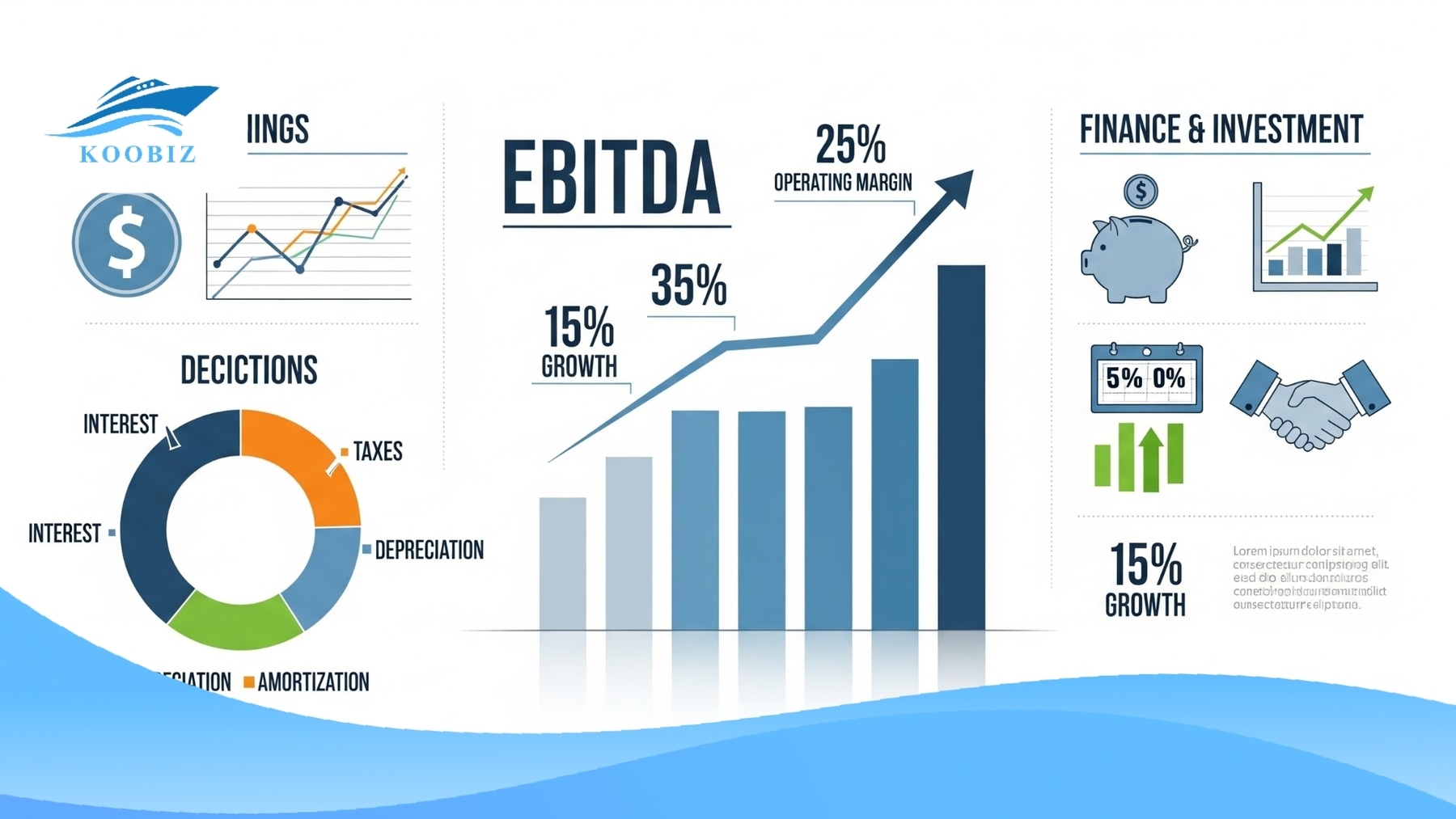
    EBITDA excluding Interest, Taxes, and Depreciation on a chart
    EBITDA excluding Interest, Taxes, and Depreciation on a chart

    EBITDA is a widely used financial metric for evaluating a company’s core operating performance. The acronym stands for:

    • Earnings
    • Before
    • Interest
    • Taxes
    • Depreciation
    • Amortization

    To fully understand EBITDA, it is important to look beyond the acronym itself. EBITDA isolates profits generated from core operations by removing the effects of financing decisions (interest), tax obligations, and accounting treatments such as depreciation and amortization. This allows investors to focus purely on the “business” side of the business, rather than its capital structure or tax jurisdiction. For Koobiz clients expanding into Singapore, understanding this standardized metric is essential for benchmarking against competitors with different tax rates or debt structures.

    Important Note on Non-GAAP Status: It is crucial to recognize that EBITDA is a Non-GAAP (Generally Accepted Accounting Principles) metric. Unlike Net Income, it is not strictly defined by IFRS or US GAAP. Consequently, public companies (especially those listed on the SGX) are typically required to provide a reconciliation of non-GAAP measures to the nearest GAAP equivalent in their financial disclosures to ensure transparency.

    How to Calculate EBITDA: Formula and Components

    EV EBITDA ratio, formula, and signal explanation (low high)
    EV EBITDA ratio, formula, and signal explanation (low high)

    There are two commonly used methods to calculate EBITDA. The method used depends on the available financial data and the starting point on the income statement: either the bottom-up approach (from net income) or the top-down approach (from operating income).

    Method 1: The Bottom-Up Approach (Standard)

    This is the most commonly used method among analysts due to its comprehensive nature. It starts at the very bottom of the income statement (Net Income) and adds back the specific non-operational expenses. It ensures that key non-operating items are properly adjusted.

    EBITDA = Net Income + Interest + Taxes + Depreciation + Amortization

    Method 2: The Top-Down Approach (Shortcut)

    This method is faster and often used when reviewing summarized financial data. It starts with Operating Income (also known as EBIT) and simply adds back the non-cash expenses. It effectively bypasses interest and taxes entirely since they appear below the Operating Income line.

    EBITDA = Operating Income (EBIT) + Depreciation + Amortization

    Understanding the 4 Components

    Regardless of the method used, EBITDA removes the following four elements to standardize profitability comparisons:

    • Interest: Expenses related to debt financing are removed. This allows for a fair comparison between a company funded by equity (investors) and one funded by debt (loans), which is particularly relevant in capital-intensive sectors.
    • Taxes: Tax jurisdictions vary significantly. By removing taxes, investors can compare a company in Singapore (low corporate tax) against one in the US (higher tax) based purely on operating performance.
    • Depreciation: This represents the gradual consumption of tangible assets such as machinery. Since it is a non-cash accounting estimate, adding it back reduces distortions caused by different accounting policies.
    • Amortization: Similar to depreciation, but applied to intangible assets like patents or software.

    EBITDA Calculation Example: A Practical, Real-World Scenario

    To illustrate how EBITDA works in practice, consider a hypothetical Singapore-based logistics company, “Merlion Logistics.”

    Applying the formula to real numbers helps clarify how the calculation works. Suppose “Merlion Logistics” reports net income of $200,000 for the fiscal year. However, to reach that figure, the company paid $30,000 in corporate taxes and $20,000 in interest on fleet financing. Additionally, their financial statement lists $40,000 in depreciation for their trucks and $10,000 in amortization for their logistics software.

    Step-by-Step Calculation (Bottom-Up)

    Using the bottom-up approach, these non-operational expenses are added back to net income to determine EBITDA.

    1. Start with Net Income: $200,000
    2. Add Interest: + $20,000
    3. Add Taxes: + $30,000
    4. Add Depreciation: + $40,000
    5. Add Amortization: + $10,000

    Total EBITDA = $300,000

    Verification (Top-Down Approach)

    To verify the result, we can start from operating income (EBIT). First, calculate EBIT: Net Income ($200k) + Interest ($20k) + Taxes ($30k) = $250,000 (EBIT).

    1. Start with Operating Income (EBIT): $250,000
    2. Add Depreciation: + $40,000
    3. Add Amortization: + $10,000

    Total EBITDA = $300,000

    In this scenario, while the accounting profit (Net Income) is $200,000, the EBITDA of $300,000 shows that the company’s core operations generate higher earnings before financing and non-cash costs are factored in. This figure is commonly used by investors to assess operational efficiency independent of capital structure.

    Is EBITDA the Same as Net Income or Operating Cash Flow?

    No, EBITDA differs from both metrics in several important ways. While they all measure financial performance, they answer different questions about a business and include different cost factors.

    Distinguishing these metrics is important to avoid misinterpreting a company’s financial performance. The table below outlines the key differences at a glance:

    Metric Includes Interest & Taxes? Includes Non-Cash Items (Depreciation)? Best Used For…
    EBITDA No No Comparing operational efficiency across companies with different capital structures
    Net Income Yes Yes Determining the true bottom line profit available to shareholders.
    Operating Cash Flow Yes (Cash Paid) No (Added back) Assessing liquidity and a company’s ability to meet short-term obligations

    EBITDA vs. Net Income: Which Metric Is Better for Investors?

    Net Income includes all costs, making it the most comprehensive measure of profit available to shareholders, while EBITDA is better suited for comparing operational efficiency between firms. For example, a company might have negative Net Income due to high interest payments on a loan but positive EBITDA, indicating that the core business model remains viable. Investors use EBITDA to evaluate performance before financing costs, while Net Income reflects the company’s current, fully burdened profitability.

    EBITDA vs. Operating Cash Flow

    Operating Cash Flow (OCF) reflects the actual cash inflows and outflows of a business, while EBITDA is an accounting calculation that ignores changes in working capital. A company can report high EBITDA while experiencing negative cash flow if its clients aren’t paying their invoices (high Accounts Receivable). For this reason, Koobiz advises clients to review OCF alongside EBITDA to ensure liquidity.

    What is Adjusted EBITDA and Why Do Companies Use It?

    Adjusted EBITDA formula and add-backs
    Adjusted EBITDA formula and add-backs

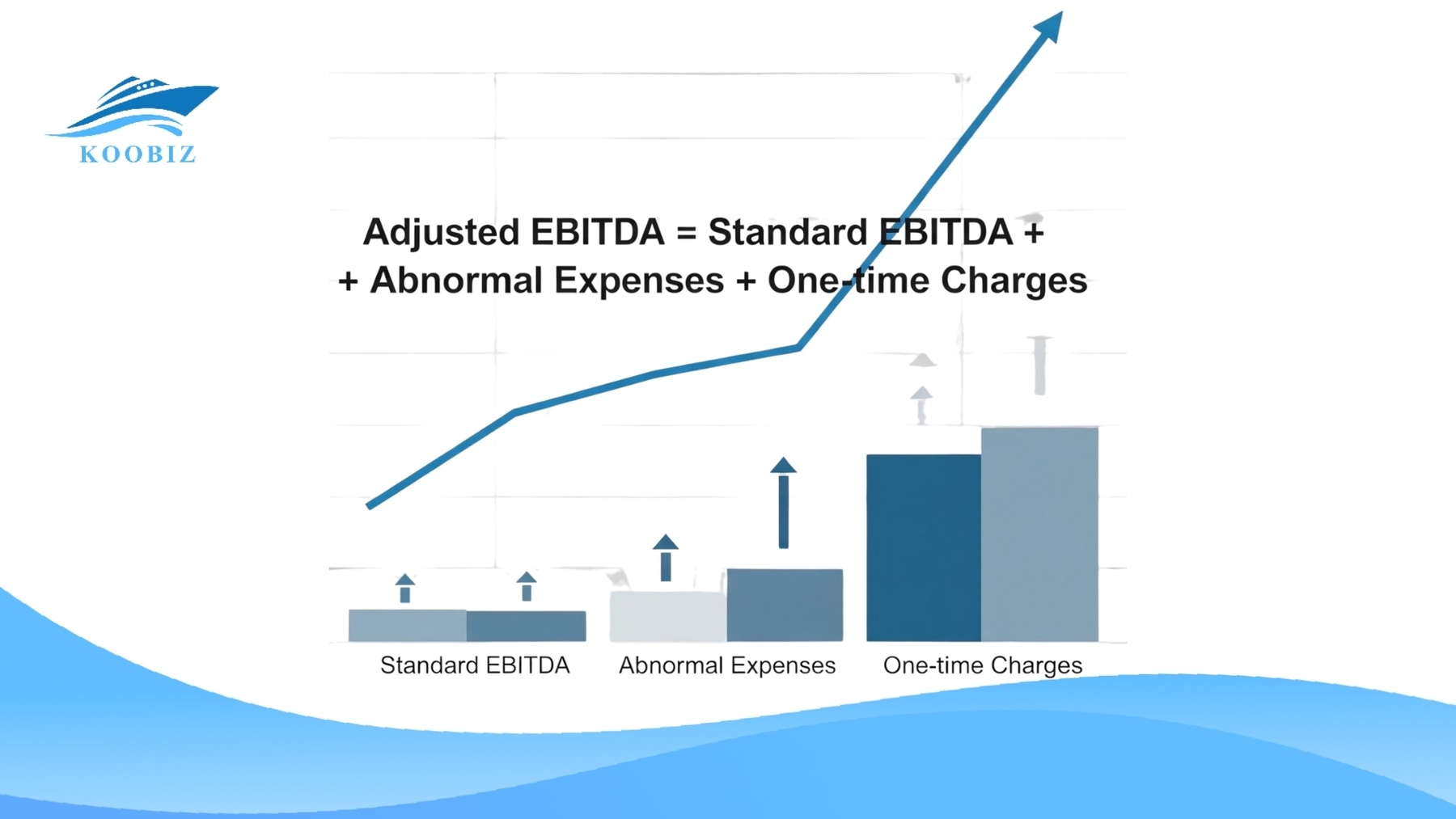
    Adjusted EBITDA is a non-standard performance metric that removes non-recurring, irregular, or one-time items to present a normalized view of a company’s future earnings potential.

    In practice, analysts take the standard EBITDA figure and add back expenses that aren’t part of normal day-to-day operations. This results in the following expanded formula:

    Adjusted EBITDA = Standard EBITDA + Abnormal Expenses + One-time Charges

    Companies argue that standard EBITDA may not fully reflect ongoing operating performance if there was a lawsuit settlement, a natural disaster, or a one-time restructuring cost during the year. By “adjusting” for these anomalies, they aim to show investors what earnings would look like in a normalized operating year.

    Common Adjustments (The “Add-Backs”)

    In the Singapore market, particularly for SGX-listed companies or private firms seeking investment, common add-backs typically include:

    • Unrealized Forex Gains/Losses: Since Singapore is a trade hub, currency fluctuations can affect reported, non-cash profits.
    • Stock-Based Compensation: Tech startups often add this back as it is a non-cash expense.
    • Litigation Costs: Legal fees for non-recurring lawsuits are often excluded to present a clearer view of underlying profitability.

    Investor Warning: Investors should be cautious of excessive add-backs. Since Adjusted EBITDA is not regulated, management can sometimes use it to obscure underlying operating weakness. Always review the footnotes in financial statements to ensure the adjustments are reasonable and truly non-recurring.

    How to Use EBITDA for Business Valuation?

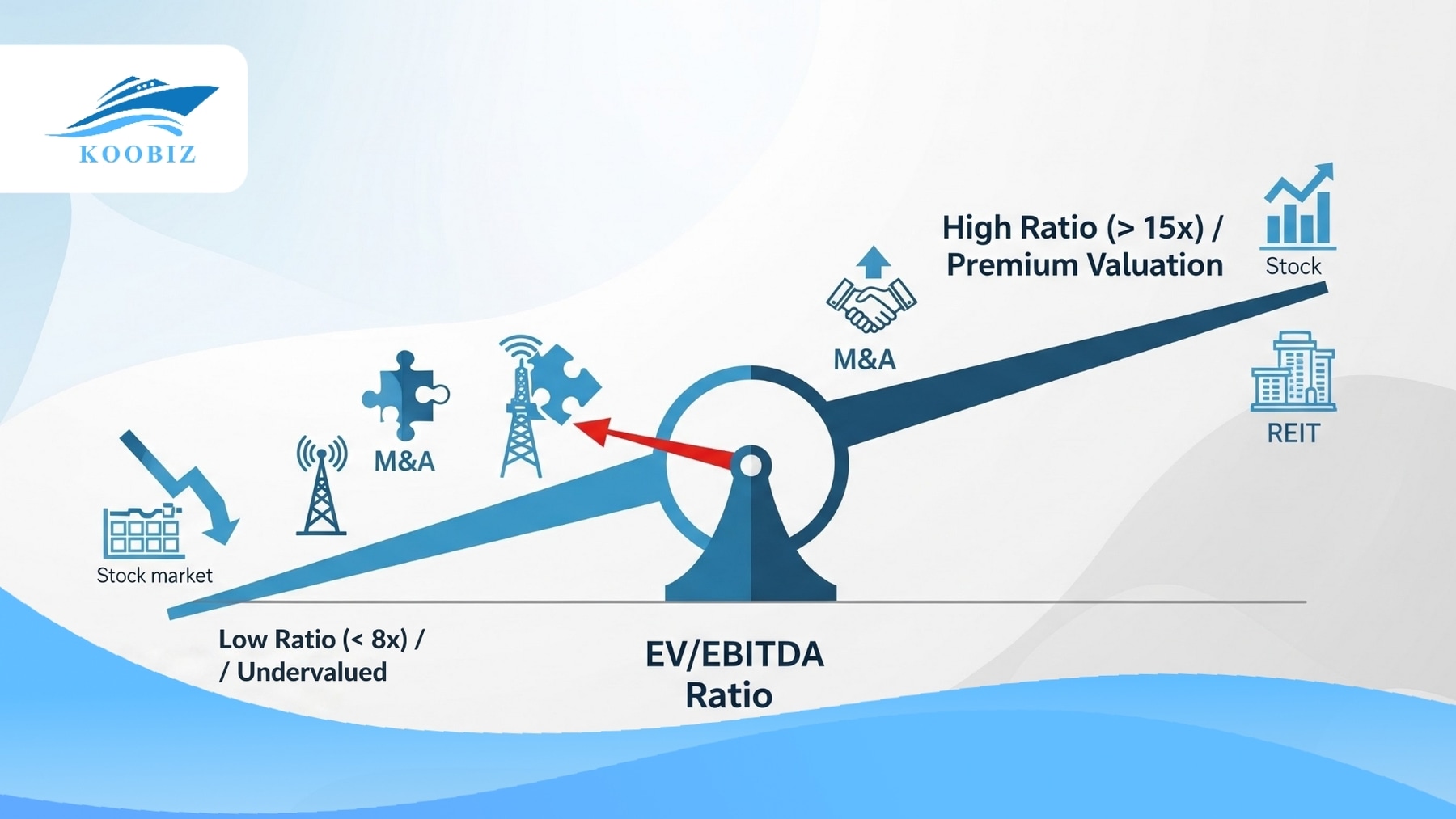
    nvestors primarily use EBITDA through valuation multiples, specifically the Enterprise Value (EV) to EBITDA ratio, to compare companies with different capital structures.

    Moving from calculation to application, the EBITDA multiple is widely used in M&A analysis(Mergers and Acquisitions). It answers the question: How many years of operating earnings are implied by the acquisition price

    Understanding the EV/EBITDA Multiple

    To help you interpret this number instantly, we have broken down the valuation metrics into a “Cheat Sheet” profile:

    The Formula:

    EV / EBITDA = Enterprise Value ÷ EBITDA

    • The Signal (What the number tells you):
      • Low Ratio (< 8x): Suggests the company may be undervalued or potentially a value trap (cheap for a reason, like declining sales).
      • High Ratio (> 15x): Suggests a Premium Valuation, implying investors expect high future growth.
    • Best Used For: Capital-intensive industries like Telecommunications or Real Estate (REITs)—common sectors in Singapore—where high depreciation expenses reduce the usefulness of the P/E ratio. For instance, analysts frequently use EV/EBITDA to value infrastructure-heavy companies such as Singtel, as it accounts for their massive network depreciation costs better than a P/E ratio.

    What Are the Limitations and Dangers of EBITDA?

    EBITDA Blind Spots: Ignoring CapEx, Working Capital, and Interest Payments
    EBITDA Blind Spots: Ignoring CapEx, Working Capital, and Interest Payments

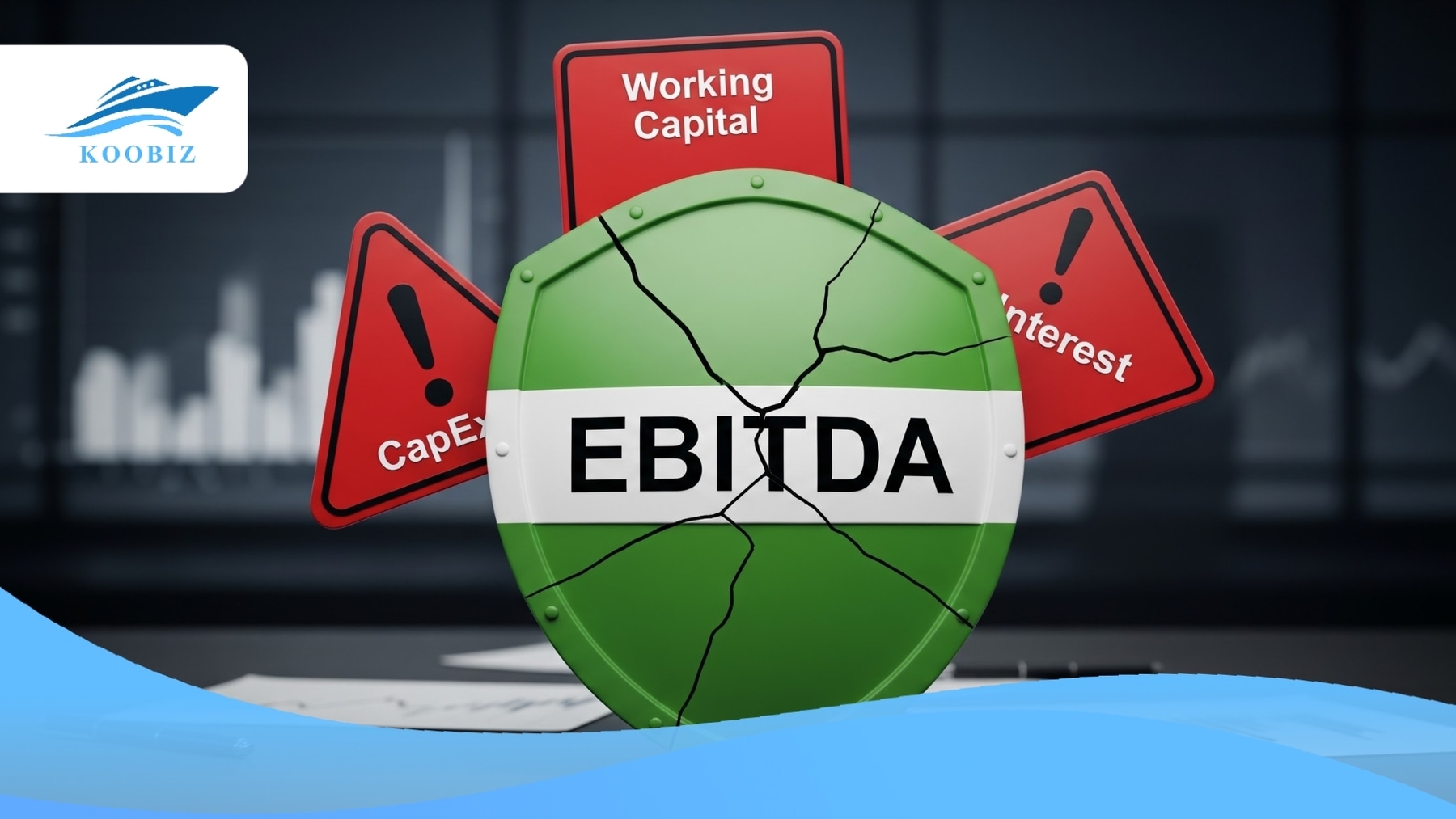
    EBITDA has clear limitations because it ignores capital expenditures (CapEx) and changes in working capital, which can overstate a company’s true cash-generating ability.

    To use this metric effectively, investors must understand its key limitations. It can present a more favorable picture of financial health than reality because it explicitly excludes real cash outflows.

    Blind Spot 1: Capital Expenditures (CapEx)

    EBITDA adds back depreciation, effectively assuming that assets do not require regular replacement. For manufacturing or logistics firms, this can be misleading, as machines wear out and require significant cash to replace, which EBITDA ignores.

    Blind Spot 2: Working Capital Changes

    EBITDA assumes revenue is collected immediately, which is rarely the case in practice. In reality, a company might be booking high sales (high EBITDA) but not collecting the cash (high Accounts Receivable), leading to cash flow pressure that EBITDA does not capture.

    Blind Spot 3: Interest Payments

    By ignoring interest, EBITDA can make a highly indebted company look just as healthy as a debt-free company, masking underlying solvency risk.

    The Warren Buffett Critique: Does EBITDA Overlook Economic Reality?

    Warren Buffett is often quoted as asking, “Does management think the tooth fairy pays for capital expenditures?” His critique centers on the fact that EBITDA adds back depreciation. However, machinery and software do wear out and must be replaced. By ignoring depreciation, EBITDA assumes the assets are free, which can materially inflate the perceived value of asset-heavy businesses.

    When Should Investors Ignore EBITDA?

    Investors should be cautious when relying on EBITDA when analyzing companies with high debt burdens or massive ongoing CapEx requirements. In these cases, Free Cash Flow (FCF) is generally a more appropriate metric If a company boasts high EBITDA but has negative FCF for several years, it may be a warning sign of financial stress that EBITDA alone may obscure.

    Conclusion

    Understanding the meaning of EBITDA and how to calculate it allows investors to look deeper into a company’s financial health. It serves as a powerful lens for assessing core profitability and facilitating valuation, provided its limitations are properly considered. regarding cash flow and capital expenditures.

    At Koobiz, we understand that financial clarity is essential for successful business expansion. Whether you are looking to incorporate a company in Singapore, require assistance with opening a corporate bank account, or need expert tax and accounting services to ensure your EBITDA figures are accurate and compliant, our team is ready to assist. We help translate complex financial requirements into practical business decisions.

    Visit Koobiz.com to learn more about our corporate services and how we can support your growth in the Asian market.

  • Avoid Penalties: Singapore Corporate Tax Deadline 2026 & ECI Guide

    Avoid Penalties: Singapore Corporate Tax Deadline 2026 & ECI Guide

    [SUMMARIES]

    Two Critical Deadlines: Companies must file ECI within 3 months of their Financial Year End (FYE) and Form C-S by 30 November annually.

    Dual Filing Requirement: Most active companies must file both ECI (estimate) and Form C-S (final return); they are not mutually exclusive.

    Severe Penalties: Missing deadlines results in composition fees (up to $1,000+) and can escalate to court summons with fines up to $10,000 for directors.

    Strategic Benefits: Filing ECI early (by the 26th of the qualifying month) unlocks up to 10 interest-free monthly installments via GIRO.

    Koobiz Assistance: Our tax professionals ensure you meet all deadlines and correctly apply for waivers (like the S$5M ECI exemption) to keep your company compliant.

    [/SUMMARIES]

    Disclaimer: This guide is based on IRAS regulations as of 2025/2026. Always verify the latest specific instructions on the IRAS website.

    Navigating the Singapore tax regime is crucial for business continuity, yet many company directors confuse the Estimated Chargeable Income (ECI) window with the final corporate tax filing date. For the Year of Assessment (YA) 2026, missing the Singapore Corporate Tax Deadline can lead to unnecessary financial setbacks, ranging from escalating fines to strict enforcement actions.

    At Koobiz, we understand that compliance is the foundation of a successful business. This guide details exactly when to file, distinguishes between the various tax forms, and explains how to avoid penalties while optimizing your cash flow.

    When are the Corporate Tax Filing Deadlines for Year of Assessment 2026?

    Singapore Corporate Income Tax Deadline 2026: ECI & Form C-S
    Singapore Corporate Income Tax Deadline 2026: ECI & Form C-S

    There are two distinct filing deadlines for Singapore companies in YA 2026: the ECI filing (3 months after Financial Year End) and the Form C-S/C filing (30 November). It is vital to understand that the Year of Assessment (YA) 2026 refers to the income earned in the financial year ending in 2025.

    To simplify the process, use the lookup table below to find your specific deadlines based on your Financial Year End (FYE):

    Financial Year End (FYE) ECI Deadline (3 Months Rule) Form C-S Deadline (Fixed)
    31 January 2025 30 April 2025 30 November 2026
    31 March 2025 30 June 2025 30 November 2026
    30 June 2025 30 September 2025 30 November 2026
    30 September 2025 31 December 2025 30 November 2026
    31 December 2025 31 March 2026 30 November 2026

    General Rule: Your ECI deadline is the last day of the third month following your FYE. The Form C-S deadline is fixed at 30 November for all companies filing electronically.

    The ECI Filing Deadline (3 Months Rule)

    The Estimated Chargeable Income (ECI) must be filed within three months from the end of your company’s financial year. This provides IRAS with an early snapshot of the company’s performance. Failing to meet this “3-month rule” triggers the first layer of non-compliance flags.

    The Form C-S/Form C Deadline (30 November)

    The final deadline for filing the Corporate Income Tax Return (Form C-S, Form C-S (Lite), or Form C) is strictly 30 November 2026. All business entities are required to declare the actual income with a view to identifying all deductible expenses and/or claiming any relevant tax exemptions.

    What is the Difference Between ECI and Form C-S?

    Form C-S and ECI differ fundamentally in purpose: ECI is a preliminary estimate, whereas Form C-S is the final declaration. Many new business owners mistakenly believe that filing one negates the need for the other.

    Feature ECI (Estimated Chargeable Income) Form C-S (Corporate Income Tax Return)
    Purpose Quick forecast of tax revenue for IRAS Final declaration of actual accounts & tax adjustments
    Filing Window Within 3 months of Financial Year End (FYE) Fixed deadline: 30 November annually
    Basis Unaudited / Management Accounts Final / Audited Accounts
    Complexity Simple estimate (Revenue + Taxable Income) Detailed (Expenses, Claims, Capital Allowances)

    What are the Penalties for Late Tax Filing in Singapore?

    Escalation of penalties for late Singapore Corporate Income Tax filing
    Escalation of penalties for late Singapore Corporate Income Tax filing

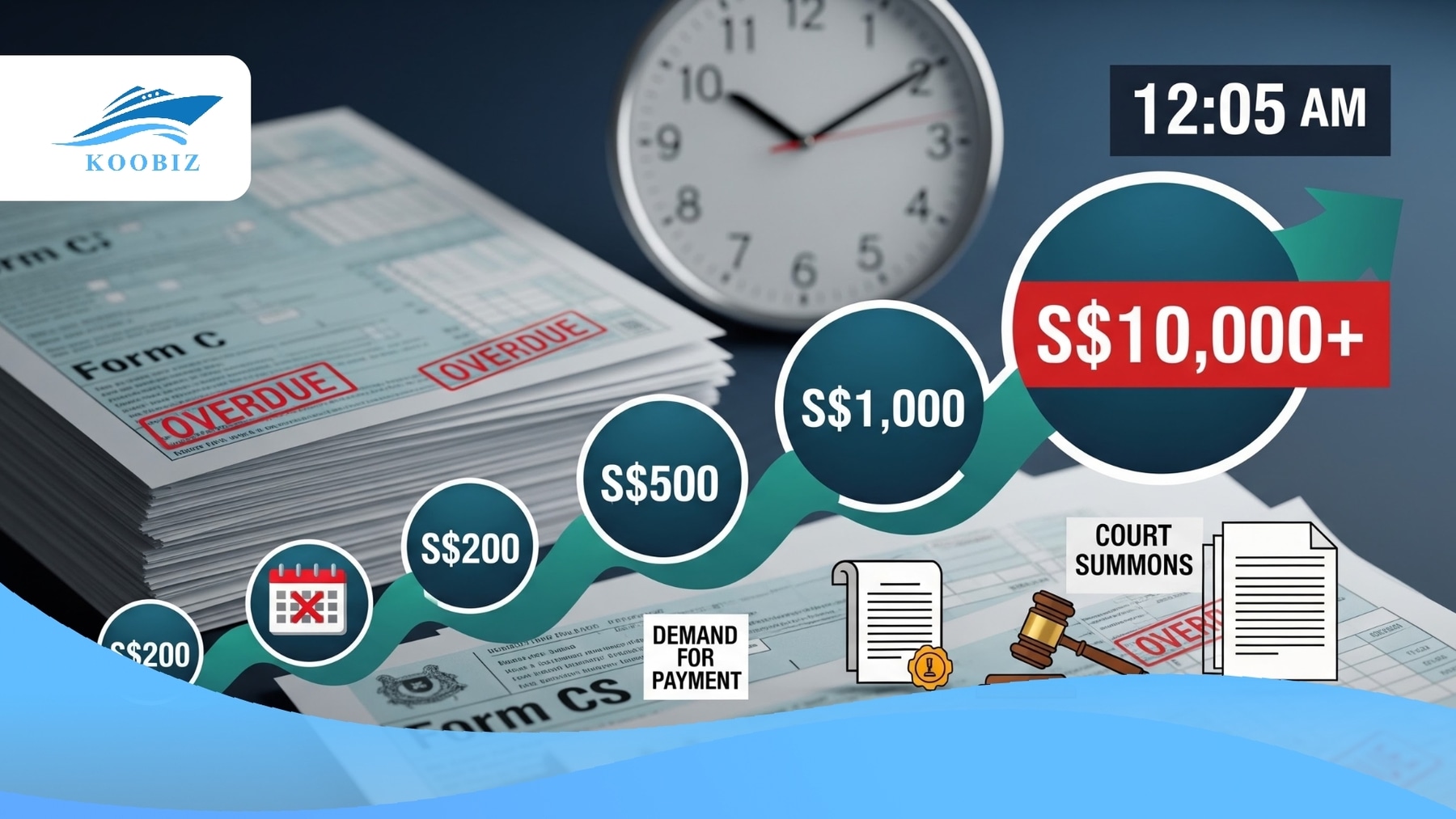
    Failing to file tax returns on time results in immediate financial penalties which escalate to court summons. The penalty structure follows a clear escalation ladder:

    Stage 1: The Composition Fee (Discretionary)

    After missing the deadline, IRAS issued a Notice of Composition.

    • Penalty Amount: Typically 200 SGD to 1,000 SGD for first-time offenses, but this is discretionary and can be higher depending on your compliance history.
    • Action: You must pay the fine AND file the overdue return immediately.

    Stage 2: Late Payment Penalties

    If tax is assessed but remains unpaid by the due date:

    • 5% Penalty: Imposed immediately on the unpaid tax.
    • 1% Additional Penalty: Imposed for each completed month the tax remains unpaid (up to a maximum of 12% total, resulting in a significantly higher debt).

    Stage 3: Court Summons (Severe Escalation)

    If notices are ignored, IRAS will issue a Court Summons.

    • Director Liability: Directors can be fined up to S$10,000 or face imprisonment in extreme cases (e.g., failure to comply with Section 65B).
    • Tax Penalty: Up to double the amount of tax undercharged.
    • Permanent Record: A “Non-Compliance” mark is lodged, potentially affecting future work pass applications (EP/S Pass).

    Who is Eligible for the ECI Filing Waiver?

    Not every company needs to file ECI. If you meet the administrative concession criteria, you can skip this step.

    Correction Note: The revenue threshold is S$5 Million. You must meet both conditions below:

    Annual Revenue (FY) ECI Status (Chargeable Income) Eligibility Result
    Below S$5 Million NIL (Zero or Loss) WAIVER GRANTED (No need to file ECI)
    Below S$5 Million Positive (Profit > $0) MUST FILE ECI
    Above S$5 Million Any (Nil or Positive) MUST FILE ECI

    Tip: “Nil ECI” generally means your company is in a loss position or has zero chargeable income after exemptions.

    How Do Dormant Companies Handle Tax Filing?

    Dormant companies (those with no revenue or income) must still file a tax return unless granted a specific waiver.

    The “One-and-Done” Workflow for Waiver Application

    Note: This applies to Singapore-incorporated companies.

    1. Step 1: Log in to myTax Portal and select “File Form C-S/C”.
    2. Step 2: Select the option for “Dormant Company”.
    3. Step 3: Tick the box: “Apply for Waiver of Income Tax Return Submission.”
    4. Result: Once approved, you are exempt from filing future returns until you recommence business.

    Can Companies Pay Corporate Tax via Installments?

    Yes, companies can pay their corporate tax via interest-free monthly installments, provided they sign up for GIRO and file their ECI on time.

    The “26th of the Month” Rule

    To maximize your installment plan, you should generally file by the 26th of the month. This allows IRAS sufficient time to process the GIRO deduction for the following month.

    ECI Filing Timeline Installment Plan Granted
    By 26th of 1st Month after FYE 10 Months (Maximum)
    By 26th of 2nd Month after FYE 8 Months
    By 26th of 3rd Month after FYE 6 Months
    Late Filing (After 3 Months) No Installments (Lump sum payment required)

    Important: You must set up your GIRO arrangement with IRAS at least 3 weeks before your payment is due to ensure it is active.

    Common Mistakes to Avoid During Tax Season

    As an initial indicator of your compliance health, assess whether you are exposed to any of the following critical errors:

    Common Mistake Audit Risk Koobiz Solution
    Confusing YA with FYE Filing for the wrong basis period leads to re-filing and penalties. Remember: YA 2026 = Income earned in FYE 2025.
    Discarding Records Early Expenses disallowed during IRAS audit; fines imposed. Rule: Maintain all receipts, invoices, and bank statements for 5 years digitally.
    Under-declaring Income Severe penalties (up to 400%) for tax evasion. Rule: Reconcile bank statements with sales invoices monthly.
    Ignoring “Nil” Returns Penalties for non-filing even if the company is dormant. Rule: Apply for the Dormant Company Waiver immediately.

    In conclusion, mastering the Singapore Corporate Tax Deadline 2026 is about maintaining a pristine reputation for your business. From the preliminary ECI filing to the final Form C-S, every step requires attention to detail.

    At Koobiz, we specialize in guiding businesses through the complexities of the Singapore regulatory environment, from incorporation to tax compliance. Don’t let tax season become a burden—contact us today to ensure your filing is seamless and timely.

  • Understand Form IR8A Meaning: Complete Singapore Employer Guide for YA 2026

    Understand Form IR8A Meaning: Complete Singapore Employer Guide for YA 2026

    [SUMMARIES]

    Definition: Form IR8A is a mandatory return for reporting employee remuneration to IRAS under Section 68(2) of the Income Tax Act.

    Key Deadline: Employers must complete and submit IR8A records by 1 March 2026 for the 2025 calendar year.

    AIS Mandate: Participation in the Auto-Inclusion Scheme is compulsory for all Singapore companies with 5 or more employees.

    Critical CPF Update: Ensure compliance with the CPF monthly Ordinary Wage (OW) ceiling of $7,400 for the 2025 reporting year. Note that the ceiling further increases to $8,000 starting Jan 1, 2026.

    Supporting Forms: Additional disclosures may be required via Appendix 8A (benefits), 8B (stock gains), or IR8S (CPF excess).

    [/SUMMARIES]

    For Singapore employers, grasping the ir8a meaning is essential for Year of Assessment (YA) 2026 compliance. Koobiz emphasizes that Form IR8A is more than just a statutory return; it is the primary instrument for reporting employee remuneration to the Inland Revenue Authority of Singapore (IRAS), ensuring accurate tax assessments.

    Beyond the basic form, IR8A is central to the mandatory Auto-Inclusion Scheme (AIS). With stricter thresholds in place, businesses must accurately report for all staff—including directors and resigned employees. This guide covers these legal obligations and the critical appendices (8A, 8B, and IR8S) required for declaring non-cash benefits and stock options.

    Disclaimer: Information is based on IRAS and CPF Board guidelines as of January 2026. Always verify with official sources.

    What is the Meaning of Form IR8A in Singapore?

    Reporting employee income using Form IR8A in Singapore
    Reporting employee income using Form IR8A in Singapore

    Think of Form IR8A as your company’s official annual report to the tax authority (IRAS) detailing what you paid each employee. It’s not optional—it’s a legal requirement under Singapore’s Income Tax Act. For the Year of Assessment 2026 (which covers income earned in 2025), you must report all forms of compensation, including salaries, bonuses, commissions, and director fees.

    Koobiz notes that for most employees, this data is now pre-filled in their electronic tax returns. This automation significantly reduces the margin for manual error during the filing season.

    Legal Basis Under Section 68(2) of the Income Tax Act

    Under Singapore law, specifically the Income Tax Act, preparing Form IR8A is a legal requirement, not just a standard HR duty. When requested, companies must provide complete and accurate details of all employee earnings. The ultimate responsibility for ensuring this information is correct falls on the company’s directors and management.

    IR8A vs. IR21: Understanding the Difference

    Feature Form IR8A Form IR21
    Purpose Annual income reporting for tax assessment. Tax clearance for foreign employees leaving Singapore.
    Frequency Annually (Recurring). Ad-hoc (Upon cessation of employment/departure).
    Deadline By 1 March of the following year. At least 1 month before the employee leaves.
    Coverage Entire calendar year (Jan 1 – Dec 31). Employment period up to the date of departure.
    Who it’s for All employees (Residents, Non-residents, Directors). Non-Singapore Citizen employees (Foreigners) only.

    Note: Even if an employer files an IR21 for a foreign employee leaving in June 2025, they may still need to include that employee’s data in the annual IR8A/AIS submission for YA 2026 if the employee was a tax resident.

    Who Needs to File IR8A in 2026?

    4 categories of individuals who need to file Form IR8A in 2026
    4 categories of individuals who need to file Form IR8A in 2026

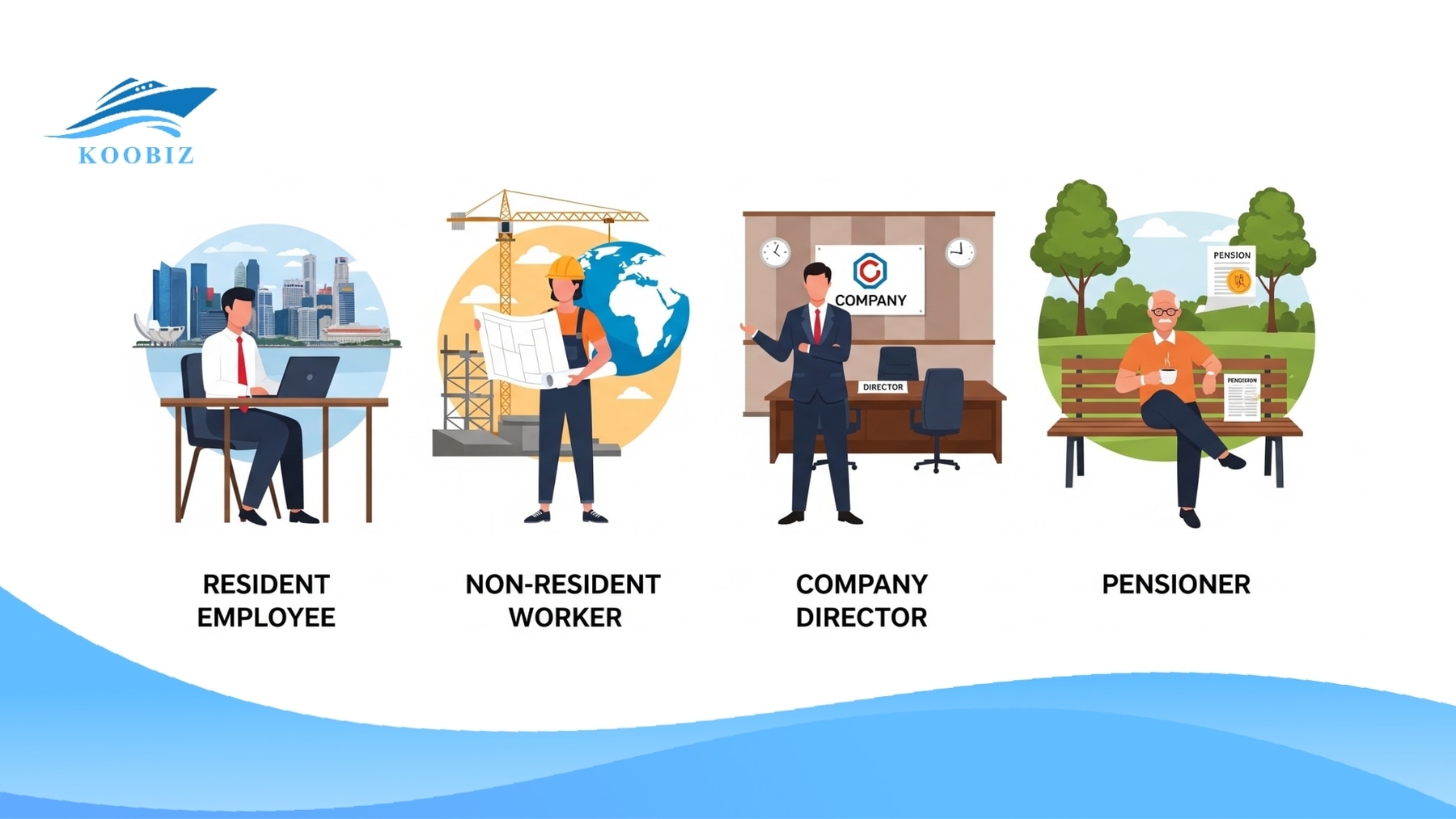
    There are four main categories of individuals for whom an employer must prepare an IR8A. These are classified by their employment relationship and source of income in Singapore:

    1. Full-time and Part-time Resident Employees: Any individual under a contract of service.
    2. Non-resident Employees: Foreigners working in Singapore, even for short-term projects.
    3. Company Directors: Including non-executive directors who receive fees approved in 2025.
    4. Pensioners: Former employees receiving pension payments from the company.

    To ensure all employment income is properly taxed, the IR8A reporting rules are designed to be wide-reaching. The key factor is where the work is physically performed, not where the company is based or where the salary is paid from. For instance, if an employee works remotely from Singapore, their income is subject to Singaporean tax and must be reported on Form IR8A, even if their employer is located overseas. It’s also important to remember that income earned by former employees during the tax year (e.g., in 2025) must still be included in your company’s 2026 filing, regardless of whether they have already left. Koobiz emphasizes that even if an employee has already left the company before the filing period begins, their earnings for the months they worked in 2025 must be accounted for in the 2026 submission.

    Handling Resigned and Rehired Employees

    A common reporting issue occurs when an employee leaves and later returns within the same year. For instance, if someone resigned in March 2025 and was rehired in September 2025, you must combine their earnings from both employment periods into one single IR8A record for the 2026 filing. It’s crucial to configure your payroll system to merge these entries automatically. This ensures the employee isn’t listed twice in the tax system, which could incorrectly increase their total taxable income and lead to them being overtaxed.

    Mandatory Auto-Inclusion Scheme (AIS) for YA 2026

    Reporting employee income using Form IR8A in Singapore
    Reporting employee income using Form IR8A in Singapore

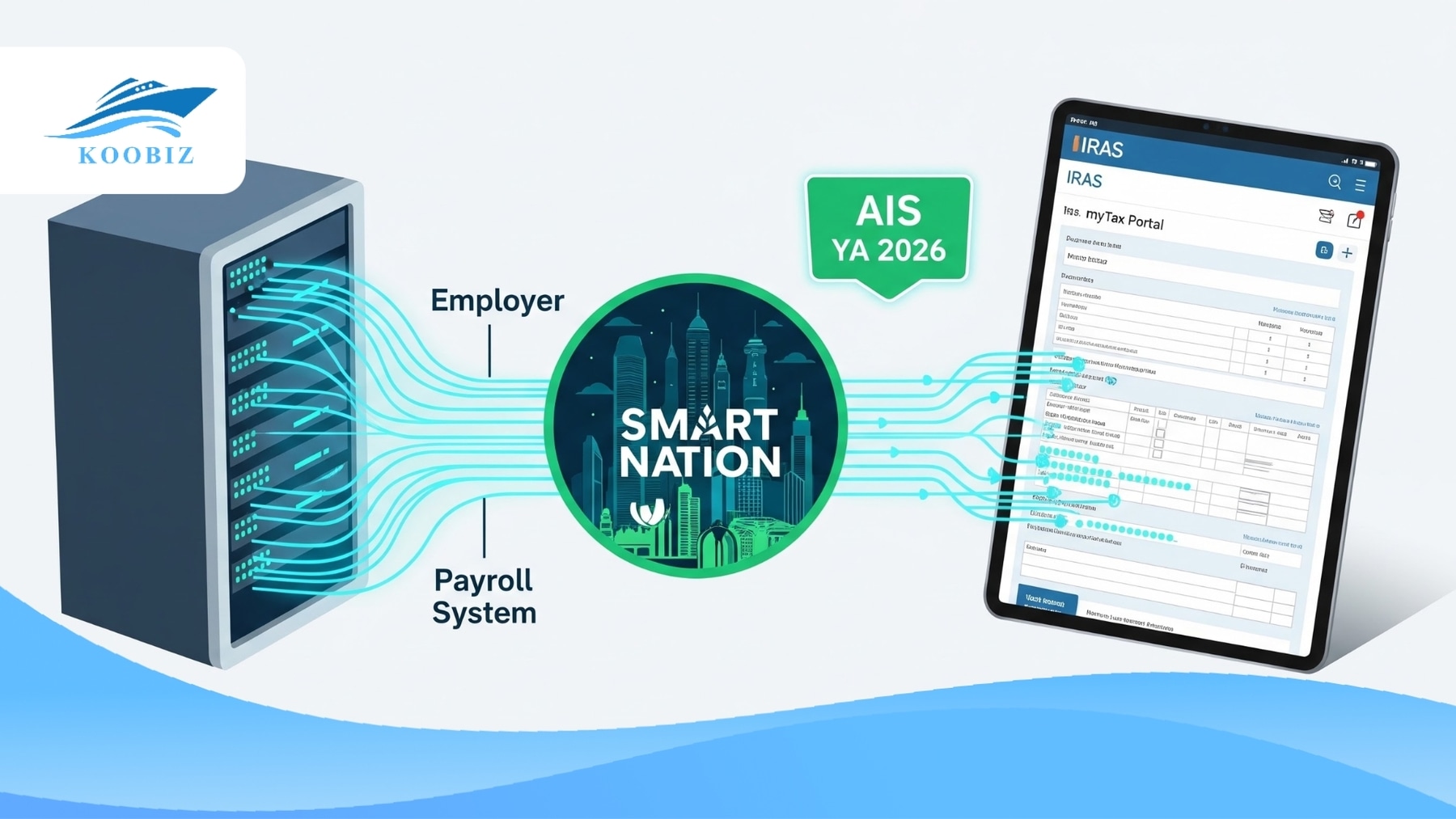
    Most companies operating in Singapore will be required to use the Auto-Inclusion Scheme (AIS) in 2026. This mandate covers the vast majority of businesses under IRAS rules. The AIS is a key part of Singapore’s move towards a fully digital government, known as the “Smart Nation” initiative. Under this scheme, employers electronically submit their employees’ income data. This information then flows directly and automatically into each employee’s pre-filled tax return, ensuring accuracy and consistency..

    According to official IRAS guidelines for the 2026 Year of Assessment, any employer with 5 or more employees (including those who have left during the year) is legally required to join the AIS. Koobiz provides specialized advisory to help firms transition from manual spreadsheets to AIS-integrated payroll systems.

    The “5-Employee Rule”: Is Your Company Included?

    To determine if your company is legally required to use the AIS, you need to count everyone who was paid by your company at any time in 2025. Be sure to include:

    • All active full-time and part-time staff.
    • Company directors, even if they are the only person receiving payment.
    • Any employees who left the company during the year, whether they resigned or were let go.

    If you had 5 or more individuals in this combined group at any point in 2025, you must register for the AIS. Companies with fewer than 5 individuals are exempt from the mandate but are highly encouraged to join voluntarily, as it significantly simplifies the year-end tax filing process.

    Benefits of AIS: Time-Savings and Data Accuracy

    The biggest benefit of the AIS is that it eliminates the time-consuming task of printing and distributing paper IR8A forms to each employee. Instead, employees can securely log into the IRAS myTax Portal, where their income details are already pre-filled for them. This direct digital transfer from your company’s payroll system to IRAS also drastically reduces manual data entry errors. As an employer, this translates to significant time savings and far fewer questions from employees about lost forms or confusing numbers on their tax statements.

    Common Mistakes in IR8A Filing (And How to Avoid Them)

    Even with automated systems, errors can occur. Understanding the nuances of the ir8a meaning includes knowing where most employers trip up during the submission process.

    1. Misreporting Director’s Fees

    A common filing mistake relates to when director’s fees are reported. The key rule is that these fees must be declared for the tax year in which they are approved by the company (typically at the Annual General Meeting), not the year they are actually paid out. For example, if fees for work done in 2024 are formally approved at a 2025 AGM, they belong in your 2026 tax filing (which covers 2025 income).

    2. Overlooking Non-Cash Benefits

    Many SMEs forget to include benefits-in-kind such as gym memberships, dental reimbursements above a certain threshold, or the value of corporate gifts. While small “token” gifts for festive occasions (under $200) are generally exempt, larger benefits must be captured in Appendix 8A.

    3. Incorrect CPF Figures (The $7,400 vs $8,000 Trap)

    For the 2025 income year (reported in 2026), the maximum monthly salary subject to CPF contributions is $7,400. A frequent error is accidentally using last year’s lower limit of $6,800 or next year’s higher limit of $8,000. It’s essential to verify that your 2025 payroll calculations correctly applied this $7,400 ceiling to ensure you report the right taxable income for each employee.

    CPF Ceiling Roadmap

    Year of Income YA Reporting OW Ceiling (Jan-Dec)
    2024 YA 2025 $6,800
    2025 YA 2026 $7,400
    2026 YA 2027 $8,000

    Deadlines and Penalties for Non-Compliance

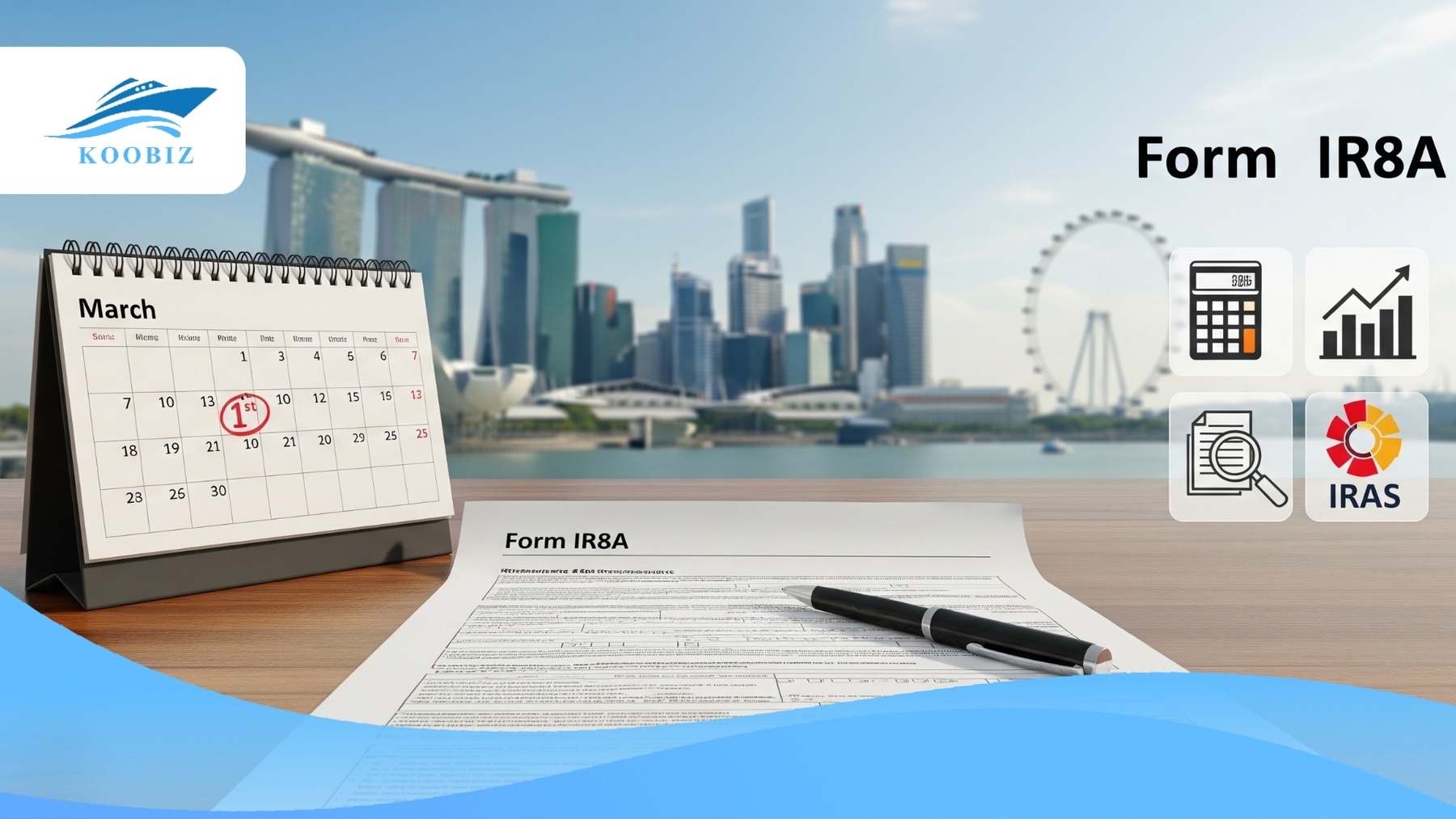
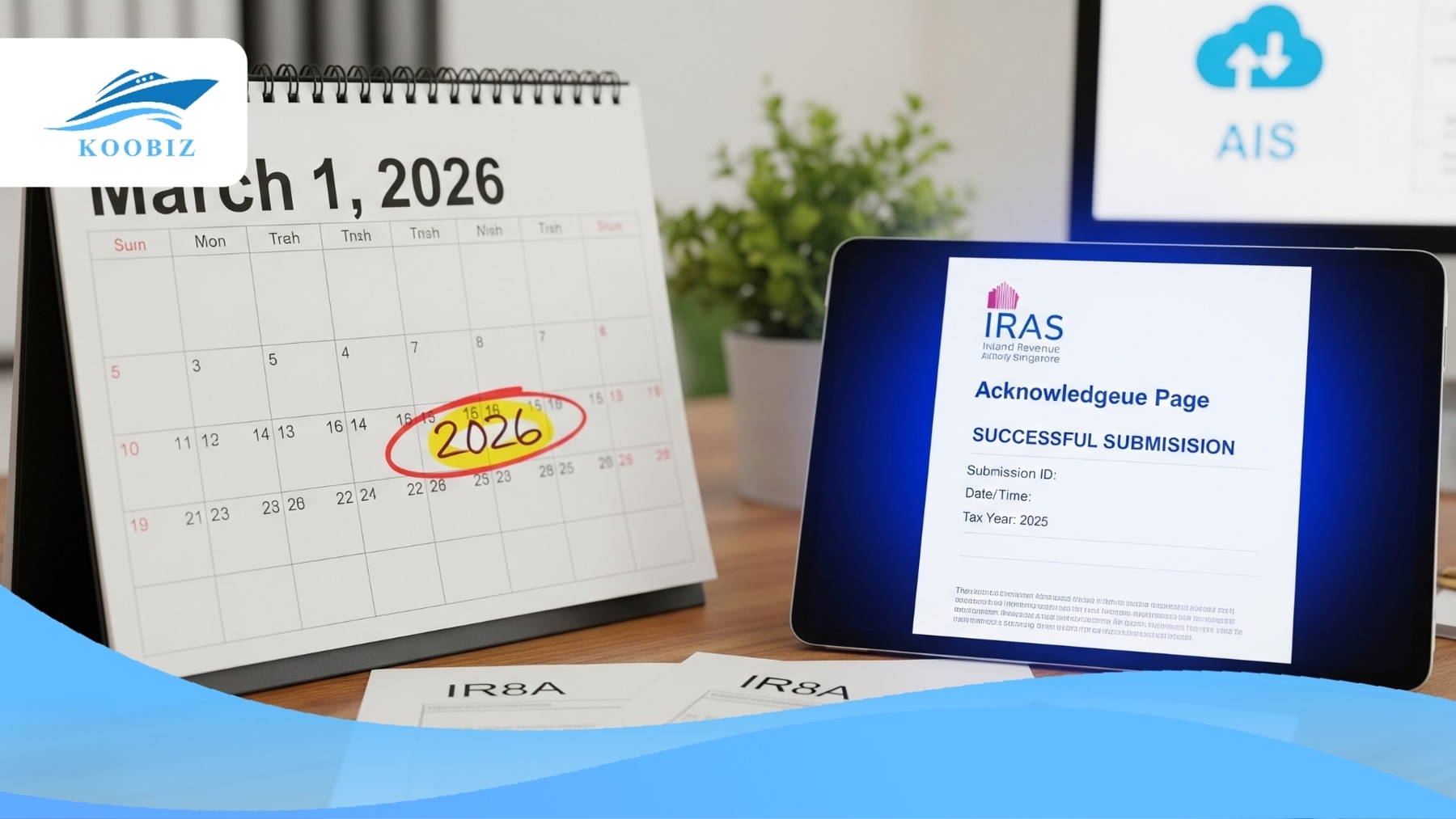
    The deadline to submit IR8A information is 1 March 2026, with no exceptions. IRAS maintains a strict tax calendar and almost never grants extensions for this filing, as delays would disrupt the personal tax filing process for all employees nationwide.

    The Hard Deadline: 1 March 2026

    IR8A deadline & submission confirmation
    IR8A deadline & submission confirmation

    1 March is the absolute final date. You must have either:

    Successfully submitted your data electronically through the AIS system, or

    Provided physical IR8A forms to all employees (if you are not on AIS).

    A submission is only complete when IRAS’s system has received and confirmed your data. You must save the digital “Acknowledgement Page” or receipt you receive as proof that you filed on time.

    Section 94 Penalties: Fines and Court Summons

    Failure to comply with the IR8A reporting requirements is an offense under Section 94 of the Income Tax Act. Per IRAS guidelines, consequences can include:

    1. Composition Fines: Typically ranging from $250 to $1,000 per offense depending on the delay, up to a maximum of $5,000.
    2. Court Summons: For persistent non-compliance or failure to pay fines, directors may be summoned to court.
    3. Severe Offenses: In cases of tax evasion or fraud, penalties can escalate to fines of up to $10,000 and/or imprisonment for up to 3 years.

    The IR8A Family: Understanding Appendices 8A, 8B, and IR8S

    The IR8A is supported by several related forms for specific situations. These include:

    Appendix 8A: Declaring Benefits-in-Kind (BIK)

    Appendix 8A is your declaration for all benefits-in-kind. If you provide an employee with a benefit they could otherwise purchase (like a car allowance or gym membership), you must report its fair market value here.

    Appendix 8B: Reporting Stock Option (ESOP) Gains

    Appendix 8B captures the financial gain an employee realizes from company equity plans. This gain becomes part of their taxable employment income once they exercise their options or their shares vest.

    Form IR8S: When You Overpay CPF

    Form IR8S is a corrective tool. If your payroll system calculated CPF on salary exceeding the annual wage ceiling ($7,400 per month for 2025), you file this form to rectify the error with both CPF Board and IRAS, ensuring the employee’s reported income is accurate.

    Technical Specifications: The IR8A .txt File Format

    For companies using the Auto-Inclusion Scheme, the submission is typically done via a validated .txt file or via API from IRAS-integrated software.

    Feature Specification
    File Extension .txt (Commonly named “IR8A.txt”)
    Encoding UTF-8 or ASCII
    Validation Tool PAT (Payroll Asia Tool) or IRAS Validation Application
    Submission Portal myTax Portal (Employer Login)

    Case Study: Navigating 2026 Compliance

    Scenario: The Growing Fintech Firm

    “FintechSG” expanded from 4 to 12 employees during 2025. Here is how they managed their compliance:

    1. Mandatory AIS: With a headcount exceeding 5, they registered for AIS.
    2. CPF Reconciliation: A Senior Developer was hired at $10,000/month. The HR team ensured CPF was capped at $7,400 for the entire 2025 year.
    3. Future Proofing: In December 2025, they updated their payroll software parameters to the new $8,000 ceiling, effective 1 Jan 2026, to ensure the next cycle (YA 2027) would be accurate.
    4. Appendix 8B: Stock options vested for early employees, requiring an Appendix 8B submission.

    Result: By using AIS-integrated software, FintechSG saved an estimated 20 hours of administrative work compared to manual filing and successfully submitted digital records on February 15, 2026.

    How to Correct Errors: Revised vs. Additional Submissions

    Correcting an IR8A error is done through either a “Revised” submission (complete replacement) or an “Additional” submission (reporting the delta).

    • “Revision” Method: The new file completely supersedes the previous one. If you reported $50,000 but meant $55,000, the Revised file states $55,000.
    • “Additional” Method: Used to report only the “extra” amount missed. If you forgot a $500 bonus, you submit an Additional IR8A for $500.

    About Koobiz Services

    Navigating the complexities of ir8a meaning, AIS mandates, and the 2026 tax landscape can be daunting. Koobiz is a leading corporate service provider in Singapore, dedicated to simplifying compliance. We specialize in:

    • Singapore Company Formation: Expert guidance on setting up your business entity. Learn more at koobiz.com.
    • Corporate Secretarial Services: Ensuring your statutory filings are always on time.
    • Tax and Accounting Advisory: From IR8A preparation to GST filing.
    • Payroll Outsourcing: Handling calculations, CPF contributions, and year-end reporting.

    Trust Koobiz to turn your tax obligations into a seamless process.

  • Understanding the Singapore GST Increase: 9% Rate, History, and Future Outlook (2026)

    Understanding the Singapore GST Increase: 9% Rate, History, and Future Outlook (2026)

    [SUMMARIES]

    Current Reality: Singapore’s Goods and Services Tax (GST) stands at 9% in 2026, following the final rate increase effective from 1 January 2024.

    Future Stability: The Singapore government has indicated that no further GST increases are planned before 2030, offering greater policy certainty for businesses and consumers.

    Economic Rationale: The GST increase is driven mainly by rising healthcare costs linked to Singapore’s ageing population and long-term public spending needs.

    Offset Measures: The Assurance Package and GST Vouchers continue to cushion the impact for the majority of Singaporean households.

    Business Impact: GST compliance requirements, including the Overseas Vendor Registration (OVR) regime for digital services, are fully in force and actively enforced by IRAS.

    [/SUMMARIES]

    Singapore’s GST rate is now established at 9% as of 2026, a new reality for all businesses and consumers. Yet, clarity on compliance, economic drivers, and future projections remains essential. Whether you are managing household expenses or planning to set up a company with Koobiz, this guide explains the history, current implications, and future outlook of Singapore’s GST.

    What is the Current Singapore GST Rate in 2026?

    Singapore GST 9% (Goods and Services Tax)
    Singapore GST 9% (Goods and Services Tax)

    Current Rate: 9%

    Effective Since: January 1, 2024

    Status in 2026: Standard fixed rate (No changes planned)

    The current Singapore GST rate is 9%, applied as a standard consumption tax on most goods and services imported into or supplied within Singapore.

    The stability of this rate is best understood by reviewing its implementation timeline. The rate officially reached 9% on January 1, 2024, marking the completion of the government’s two-step rate hike plan. By 2026, the 9% GST is no longer transitional and is fully established as the standard rate. For businesses, all invoices, accounting systems, and price displays must accurately reflect the 9% GST rate. Non-compliance may result in penalties imposed by the Inland Revenue Authority of Singapore (IRAS).

    At Koobiz, we regularly assist clients in aligning their accounting systems with the 9% GST rate, supporting smooth compliance for newly incorporated companies. For official verification of current rates, refer to the IRAS website.

    The Timeline of GST Hikes: From 3% to 9%

    Singapore’s GST rate has evolved through several key milestones, beginning at 3% in 1994 and increasing gradually over the decades to the current 9%.

    This progression reflects the government’s long-standing approach of implementing tax changes gradually. The government has consistently adopted a staggered approach to allow businesses and the economy time to adapt.

    Effective Date GST Rate Key Context
    1 Apr 1994 3% Introduction of GST
    1 Jan 2003 4% Increased from 3%
    1 Jan 2004 5% Increased from 4%
    1 Jul 2007 7% Remained stable for 15+ years
    1 Jan 2023 8% Phase 1 of the latest hike
    1 Jan 2024 9% Phase 2 (Current Rate)

    This historical context shows that GST increases in Singapore are infrequent and implemented following long-term fiscal planning.

    Why Was the GST Increased to 9%?

    The Challenge: The “Silver Tsunami” (By 2030, 1 in 4 Singaporeans will be ≥65).

    The Solution: A broad-based tax (GST) to generate stable, recurrent revenue for healthcare.

    The primary driver for the increase to 9% is the need to fund rising healthcare costs linked to Singapore’s rapidly ageing population and long-term public spending.

    In particular, the additional revenue addresses what policymakers refer to as the “Silver Tsunami.” By 2030, it is estimated that one in four Singaporeans will be aged 65 or older. This demographic shift places significant pressure on Singapore’s healthcare system. As a broad-based tax, GST is regarded by policymakers as a sustainable source of recurrent revenue, allowing healthcare spending to be funded without heavy reliance on the Net Investment Returns Contribution (NIRC) or higher income taxes.

    According to the Ministry of Finance (MOF), revenue from the GST increase is allocated within the national budget to subsidise healthcare, expand hospital capacity, and strengthen community care facilities. You can read the full rationale on the MOF website.

    Will GST Increase Again Before 2030?

    Verdict: NO

    Government Commitment: No further hikes planned before 2030.

    Implication: Tax stability for the next decade.

    This assurance provides greater certainty for Singapore’s business environment. Deputy Prime Minister Lawrence Wong stated during the initial announcement and subsequent budget debates that the increase to 9% would generate sufficient revenue to address funding needs through the end of the decade. For investors and business owners planning long-term strategies with Koobiz, this commitment to tax stability is an important factor when considering Singapore as a regional hub. This reduces uncertainty around near-term tax changes and supports more accurate financial forecasting over the coming years.

    How Singapore’s GST Compares to Global VAT Rates

    Singapore’s 9% GST remains significantly lower than the global average VAT/GST rate of approximately 19% and is competitive compared with many regional and developed economies.

    When viewed in an international context, Singapore’s tax regime remains competitive.

    Region Country Standard Tax Rate
    Singapore Singapore 9%
    Regional Vietnam 10%
    Philippines 12%
    China 13%
    Global UK / France 20%
    OECD Average ~19%

    This comparative advantage supports Singapore’s position as a leading business and investment destination. Even with the increase, the overall tax burden (including corporate tax) remains lower than in most Western jurisdictions.

    Mitigating the Impact: The Assurance Package and GST Vouchers

    To offset the 9% GST rate, the government introduced the Assurance Package and enhanced GST Vouchers to help reduce the impact on lower-income households.

    How the Government Offsets the Hike:

    • Cash Payouts: For immediate cost-of-living expenses (tiered by income).
    • U-Save Rebates: Directly offsets utility bills for HDB households.
    • MediSave Top-ups: Dedicated support for elderly healthcare costs.

    These measures are structured so that the effective GST burden for low-income households remains minimal or close to zero for several years.

    Who is Eligible for the 2026 GST Voucher Payouts?

    Eligibility for the 2026 payouts is determined by Assessable Income and the Annual Value (AV) of the beneficiary’s residence.

    Note on 2026 Payouts:

    Specific payout amounts are typically finalized during the Singapore Budget announcement in February each year. If no major policy changes are announced, recent payout trends suggest cash amounts may range from $450 to $850, depending on income tier and property value.

    • Income Threshold: typically up to $34,000 for maximum benefits.
    • Age: Singaporeans aged 21 and above.

    How the Permanent GST Voucher Scheme Works

    It is important to distinguish between the temporary Assurance Package (designed to cushion the transition) and the permanent GST Voucher (GSTV) scheme.

    Feature Assurance Package (AP) Permanent GST Voucher (GSTV)
    Purpose Cushion the specific impact of the hike. Ongoing support to offset GST costs for lower-income households.
    Duration Temporary (Ends ~2028). Ongoing (Permanent).
    Key Benefit Cash Payouts, CDC Vouchers. Cash, U-Save, MediSave Top-ups.

    While the Assurance Package payouts are distributed over five years (ending around 2027/2028), the GSTV scheme is a permanent feature of Singapore’s fiscal system. This ensures that after transitional support ends, lower- to middle-income Singaporeans continue to receive ongoing assistance to offset GST costs.

    GST on Digital Services and Imported Low-Value Goods

    9% GST for digital services and online goods under $400
    9% GST for digital services and online goods under $400

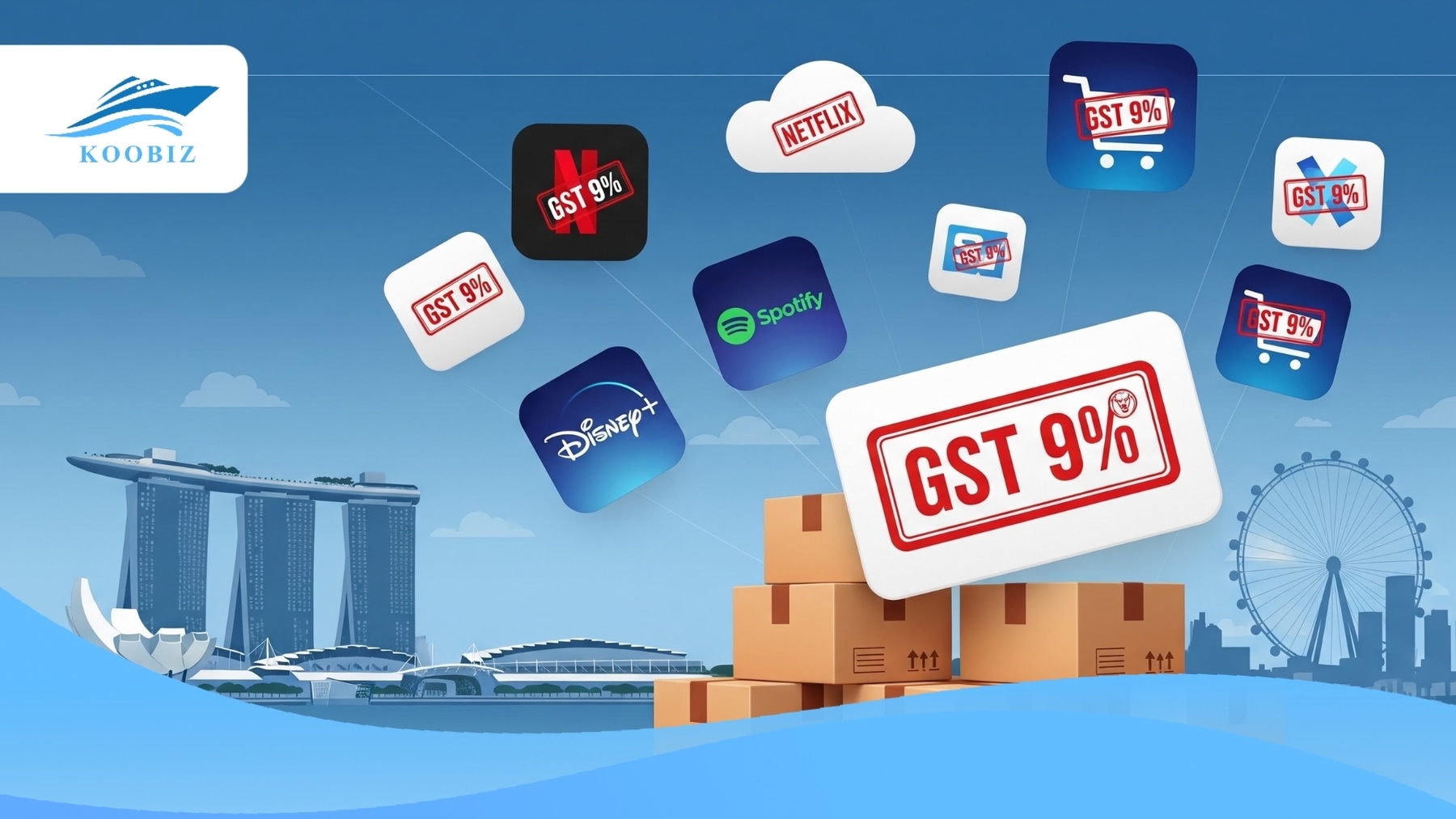
    GST now applies to imported low-value goods under $400 and remote digital services, ensuring consistent tax treatment between local and overseas suppliers.

    What is now subject to 9% GST?

    • Imported Goods (<$400): Items bought online from platforms like Amazon or Taobao.
    • Digital Subscriptions: Netflix, Spotify, Disney+.
    • Digital Services: Software, cloud storage, and downloadable content.

    This regime, known as the Overseas Vendor Registration (OVR), is an important compl

    iance requirement for digital businesses supplying services to Singapore. Previously, goods imported via air or post valued below $400 were GST-exempt, resulting in differential tax treatment between overseas and local sellers. Since 2023/2024, this loophole has been closed.

    Do You Pay 9% GST on Netflix and Spotify?

    Yes, consumers in Singapore are required to pay 9% GST on “remote services,” including digital subscriptions such as Netflix, Spotify, and software-as-a-service (SaaS) products. Overseas providers with a global turnover exceeding $1 million and supplies to Singapore exceeding $100,000 must register for GST under the OVR regime. If you are an international digital service provider looking to enter the Singapore market, Koobiz can assist in assessing your GST registration liability and managing the OVR process.

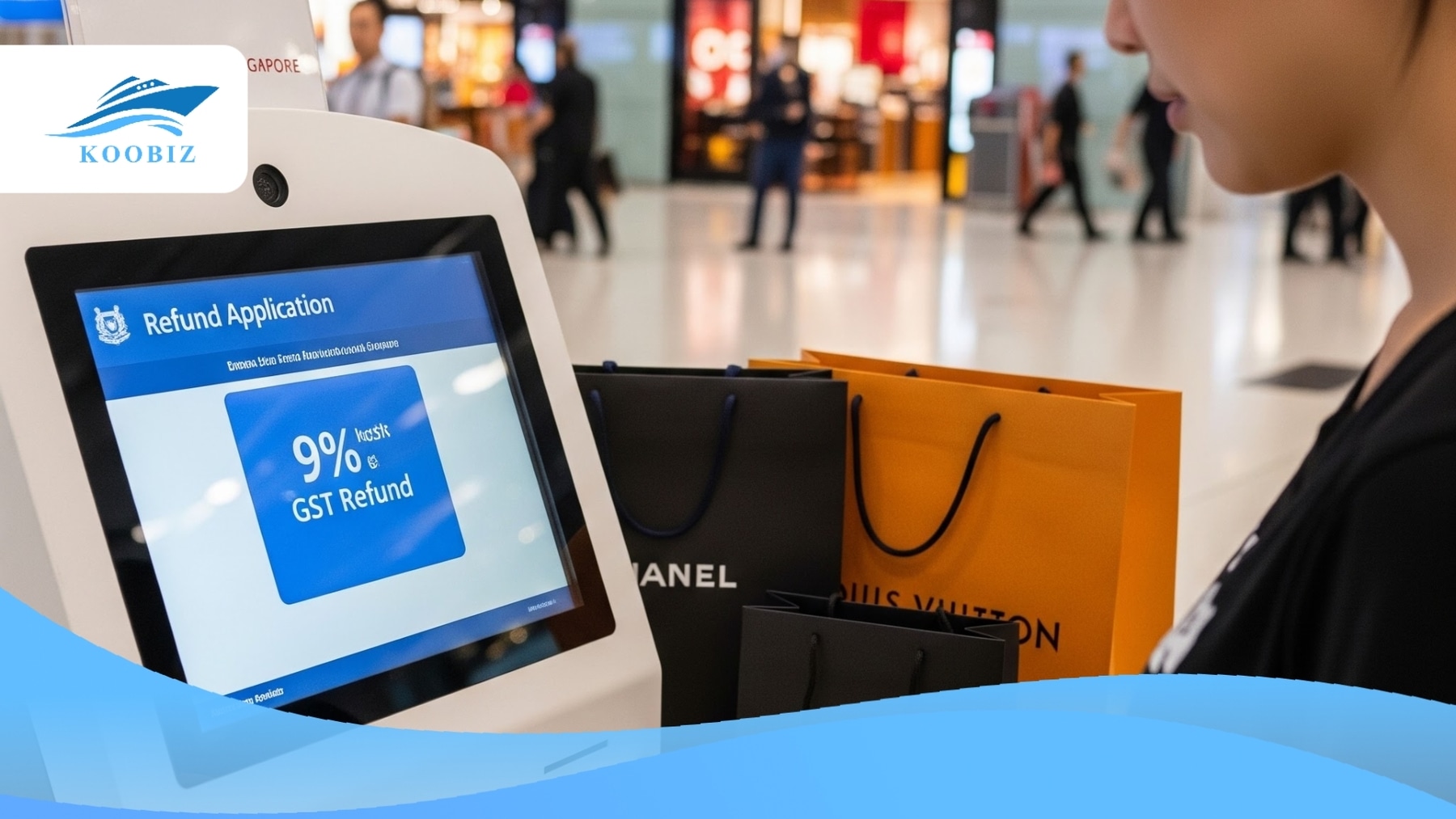
    Tourist Refund Scheme (TRS) with the New Rate

    9% GST refund for tourists at the airport
    9% GST refund for tourists at the airport

    Tourists can claim a refund on the 9% GST paid for goods over $100 via the electronic Tourist Refund Scheme (eTRS) at Changi Airport.

    How to Claim Your 9% Refund:

    1. Shop: Spend at least $100 (incl. GST) at participating stores.
    2. Apply: Show your passport at checkout to capture the transaction digitally.
    3. Claim: Use the eTRS Kiosks at Changi Airport before checking in your luggage.

    Visitors must present their passports at the point of purchase for the transaction to be recorded digitally.While the GST rate is higher, the refund mechanism remains efficient and fully digital. It is worth noting that the refund applies only to goods brought out of the country; services consumed within Singapore (like hotel stays or dining) are not refundable. While the higher GST rate may affect the overall cost of luxury purchases, the efficiency of the eTRS system continues to support a smooth refund process for tourists.

    Common Misconceptions About GST Absorption

    Stores advertising “GST Absorbed” are offering a commercial discount and are not exempt from paying the 9% GST to IRAS.

    How “GST Absorption” Actually Works:

    1. Product Price: $109.00
    2. Discount: -$9.00 (Retailer absorbs cost)
    3. Final Price: $100.00
    4. Taxable Amount: ~$8.26 (Included in the $100 final price and paid to IRAS).

    This is a common marketing practice that often leads to misunderstanding. When a retailer claims to “absorb GST,” it means the 9% tax is paid from the retailer’s profit margin instead of being charged separately to the customer. The receipt must still reflect the GST amount as included in the final price. Businesses cannot legally waive GST; they may only reduce prices to offset the tax amount borne by the consumer.

    Conclusion & Koobiz Services

    Managing the 9% GST framework in Singapore requires a clear understanding of regulatory requirements and their financial implications. This includes understanding the government’s position on future GST rates and the compliance requirements under the OVR regime for digital goods and services.

    For businesses, the shift to 9% involves more than updating invoices; it requires proper compliance processes and sound financial planning.

    Grow Your Business in Singapore with Koobiz

    At Koobiz, we support businesses in navigating Singapore’s regulatory and compliance requirements. Our team provides comprehensive support for:

    • Company Incorporation: Set up your Singapore entity seamlessly.
    • Corporate Banking: Expert consultation to open business bank accounts in Singapore’s top financial institutions.
    • Tax & Accounting: From GST registration and quarterly filing to annual returns and audit services.

    Ensure your business is fully compliant with the latest GST regulations. Visit us at koobiz.com to learn how we can support your growth in Asia’s financial hub.

  • Allowable Business Expenses IRAS 2026 – Ultimate Guide for Businesses in Singapore

    Allowable Business Expenses IRAS 2026 – Ultimate Guide for Businesses in Singapore

    [SUMMARIES]

    The Golden Rule: You can only deduct expenses incurred “wholly and exclusively” for business trade (e.g., rent, staff salaries, marketing).

    Strict “No-Gos”: Personal expenses and private car costs (S-plated) are never deductible, even if used for business meetings.

    Key Limits: Special caps apply to renovations ($300k over 3 years) and employee medical expenses (max 1% of total payroll).

    Audit Safety: You must keep all invoices and receipts (digital accepted) for at least 5 years to satisfy IRAS requirements.

    [/SUMMARIES]

    Discover how Singapore businesses can legally reduce taxable income by claiming allowable business expenses under IRAS. This comprehensive guide explains the critical differences between deductible and non-deductible costs, capital vs. revenue expenses, and special cases like R&D and renovations. Learn about medical expense caps and practical tips to stay compliant while optimizing your tax savings.

    What Are Allowable Business Expenses Under IRAS?

    In Singapore, allowable business expenses are the costs your business needs to pay in order to earn income, and IRAS lets you deduct them from your taxable income. Simply put, these are the everyday costs that keep your business running.

    To qualify:

    • The expense must be directly for your business, not for personal use.
    • It should be necessary to generate business income, like rent for your office or materials for your products.
    • Keep proper receipts and records – IRAS may ask to see them, and you need to keep them for at least five years.

    Typical examples include:

    • Rent and utilities for your office or shop
    • Salaries and wages for employees
    • Professional fees like accountants or consultants
    • Marketing and advertising to promote your business
    • Repairs and maintenance for equipment and premises

    By understanding and claiming these expenses correctly, your business can reduce taxable income legally and stay fully compliant with IRAS rules – all while saving money.

    General Rules for Claiming Allowable Business Expenses

    Maximize deductions with IRAS rules
    Maximize deductions with IRAS rules

    Expenses must be wholly and exclusively for producing business income. To apply this correctly, follow these IRAS guidelines:

    • Follow the ‘Incurred’ Rule (Accrual Basis): Claim expenses in the financial year they are incurred, not when paid.Example: An invoice received in December 2023 but paid in January 2024 belongs to the 2023 Year of Assessment.
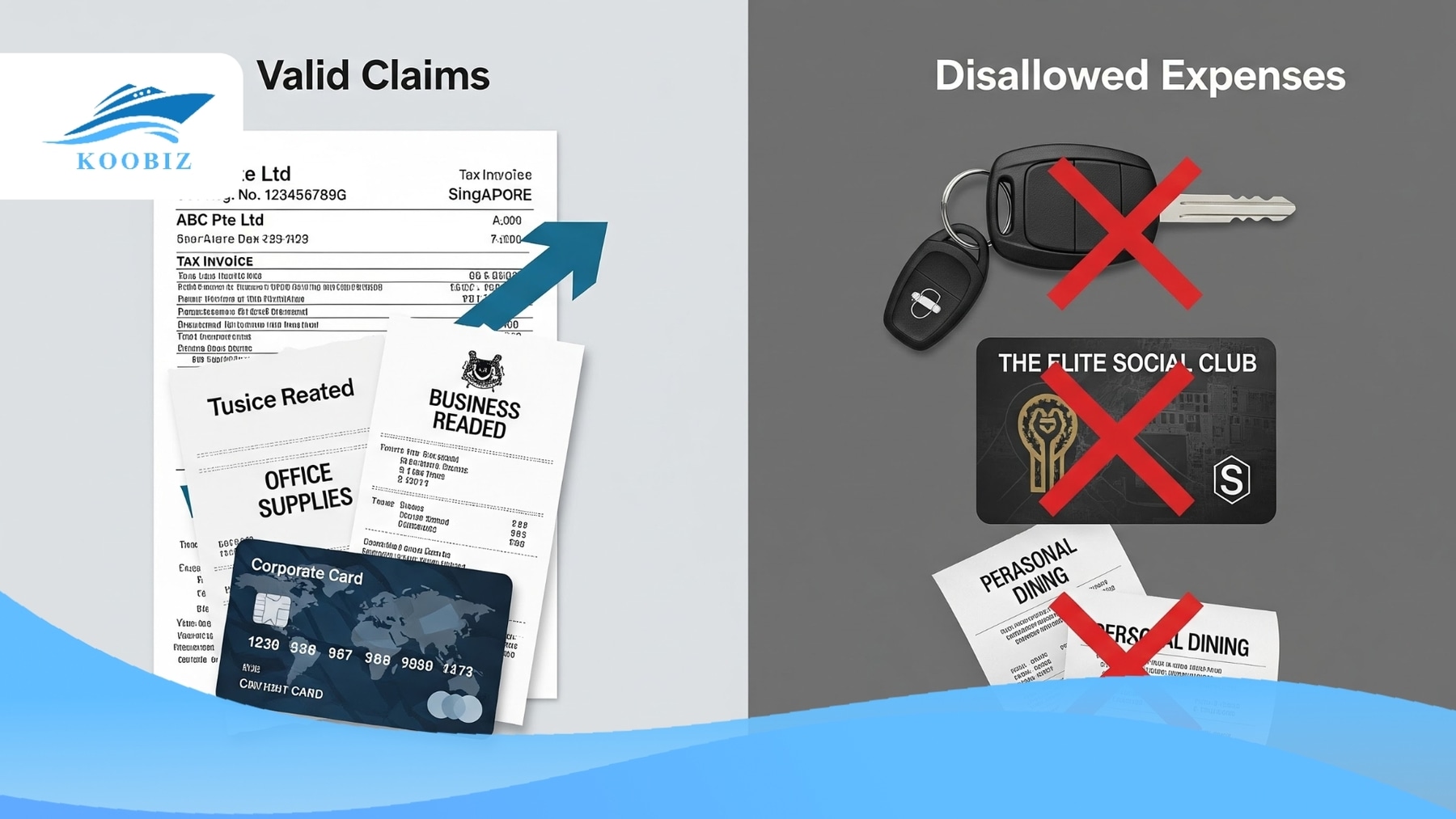
    • Watch Out for Prohibited Expenses (Section 15): Certain costs, like private car expenses (S-plated cars), cannot be claimed, even if used for client meetings. Petrol, parking, or ERP charges for private cars are disallowed.
    • Apportion Mixed Expenses: For costs used partly for business and partly personal (e.g., home electricity bills), claim only the portion strictly for business.
    • Digitize Your Records: Keep records for at least 5 years. Digital copies via accounting software are accepted and prevent fading or loss.
    • Ensure ‘Arm’s Length’ Transactions: Payments to related parties (e.g., spouse) must be reasonable and reflect market rates. Overstated payments can be challenged by IRAS.

    Following these rules protects your business from penalties and makes tax filing easier and more transparent.

    Deductible vs Non-Deductible Business Expenses Under IRAS

    Understanding the difference between deductible and non-deductible expenses is essential for accurate tax filing in Singapore. Under IRAS rules, only expenses wholly and exclusively incurred in the production of business income can be deducted from gross income.

    Correct classification helps businesses reduce taxable income legally while remaining fully compliant with the Singapore Income Tax Act.

    Examples of Deductible Business Expenses

    Deductible expenses are day-to-day operational costs that support business activities.

    Employee-Related Costs

    • Salaries, bonuses, and employer CPF contributions
    • Staff medical expenses (subject to the 1% or 2% remuneration cap)
    • Employee training and skills-upgrading courses

    Operational Overheads

    • Office or shop rent, property tax, and utilities
    • Work-from-Home (WFH) expenses: incremental electricity or telecom costs attributable to business use

    Professional Services

    • Fees paid to accountants, tax agents, and lawyers
    • Company secretarial and statutory audit fees

    Marketing and Finance

    • Advertising and promotion (social media ads, SEO, print ads)
    • Bank charges and interest on business-related loans

    Repairs and Maintenance

    • Repairs to business premises
    • Maintenance of office equipment to keep them operational

    These expenses are deductible provided they are reasonable, business-related, and properly supported by documentation.

    Examples of Non-Deductible Business Expenses

    Non-deductible (disallowable) expenses must be added back when computing taxable income.

    Private and Personal Expenses

    • Personal meals, holidays, or family entertainment
    • Personal life or health insurance premiums
    • Home-to-office commuting costs

    Private Car Expenses (S-Plated Cars)

    • Petrol, parking, ERP, insurance, and maintenance

    IRAS strictly disallows all private car expenses, even if used for client meetings.

    Capital Expenditures

    • Purchase of fixed assets (machinery, vehicles, office furniture) (Claimable via Capital Allowances, not as direct expenses)
    • Trademark or patent registration (unless under approved tax incentive schemes)
    • Office renovation or refurbishment costs (covered under Section 14N)

    Fines and Penalties

    • Traffic fines
    • Late filing penalties imposed by IRAS or ACRA
    • Penalties arising from legal or regulatory breaches

    Prohibited Entertainment

    • Entertainment with no clear business purpose or documented business discussion

    Understanding these distinctions helps businesses avoid over-claiming, reduce audit risk, and maintain clean, compliant tax records.

    Revenue Nature vs Capital Expenditure: How IRAS Determines Deductibility

    Know what expenses are deductible
    Know what expenses are deductible

    IRAS determines whether a business cost is deductible based on its nature—whether it is revenue or capital in nature. Distinguishing between the two is essential for accurate tax filing and compliance with the Singapore Income Tax Act.

    Revenue Nature (Generally Deductible)

    Revenue expenses are recurring, day-to-day operating costs incurred wholly and exclusively to generate business income. Common examples include:

    • Rent, utilities, and office stationery
    • Salaries, bonuses, and employer CPF contributions
    • Marketing, advertising, and professional fees
    • Routine repairs that maintain assets without improving or extending their useful life

    These expenses are generally deductible in the year they are incurred, provided they are reasonable, business-related, and supported by proper records.

    Capital Expenditure (Not Deductible as Expenses)

    Capital expenses relate to long-term assets or expenditures that provide enduring benefits to the business. Typical examples include:

    • Purchase of machinery, office furniture, or IT equipment
    • Incorporation and business setup costs
    • Renovations or improvements that increase an asset’s value or extend its useful life

    Capital expenses cannot be deducted directly from income. Instead, qualifying assets may be claimed over time through Capital Allowances, in accordance with IRAS rules.

    Partial and Special Allowable Business Expenses Under IRAS

    Some business expenses are only partially deductible or subject to specific conditions and limits under IRAS rules. These expenses require extra care to ensure claims are accurate and compliant.

    COE for motor vehicles

    Under IRAS rules, the Certificate of Entitlement (COE) is treated as part of a vehicle’s capital cost rather than an operating expense. Its deductibility depends strictly on the classification of the vehicle:

    • Private Cars (S-plated, RU-plated, and Company Cars): Generally, no Capital Allowance (CA) is allowed for the vehicle or its COE. This remains true even if the car is used for business meetings. The only exceptions are vehicles used for specific trades, such as private hire cars or driving instruction vehicles.
    • Commercial Vehicles (e.g., Vans, Lorries, Motorcycles): If the vehicle is used for business, both the initial COE cost and any subsequent COE renewal costs are qualifying capital expenditures. These costs are claimed through Capital Allowances over the asset’s useful life, rather than being deducted as a one-time business expense.
    • Unused COE: If a COE is purchased but not used to acquire a vehicle (e.g., due to forfeiture or expiration), the cost is not deductible as it is considered a capital loss.

    Private Car / S-Plated Car Expenses

    Under IRAS rules, all expenses relating to private cars (S-plated cars) are not deductible, even if the vehicle is used partly or fully for business purposes.

    Non-deductible expenses include:

    • Petrol or EV charging costs
    • Parking fees and ERP charges
    • Road tax, insurance, and maintenance
    • Repairs, depreciation, and COE costs

    These expenses cannot be claimed, either as business expenses or through Capital Allowances.

    Exception: Only vehicles registered and used as private hire cars (PHV) or driving instruction vehicles may qualify for tax deductions, subject to IRAS conditions.

    Businesses should exclude all private car costs when computing taxable income to avoid disallowed claims and IRAS penalties.

    Renovation & Refurbishment Expenses

    Renovation and refurbishment (R&R) costs can be tax deductible under Section 14N, as long as the works do not affect the building structure (e.g. interior upgrades, fittings, repainting).

    • Tax deduction cap: SGD 300,000 per 3-year period Applicable to SMEs, sole proprietors, and partnerships
    • For sole proprietors: the cap applies per individual, regardless of the number of businesses
    • For partnerships: the cap applies at the partnership level

    Ideal for businesses upgrading offices, shops, or commercial spaces to support daily operations.

    Research & Development (R&D) Expenditure

    R&D expenses are tax deductible only if your business is the beneficiary of the R&D activities. Merely performing R&D work is not sufficient.

    Your business can claim R&D deductions if it:

    • Bears the financial risk of the R&D; and
    • Owns and can commercially use the resulting know-how or intellectual property (IP).

    Key restrictions:

    • Businesses providing R&D services for clients cannot claim R&D deductions, unless the R&D is done for their own business.
    • R&D expenses must be declared under “Allowable Business Expenses” in Form B (Self-Employed) or Form P (Partnership).

    Proper documentation of R&D scope and costs is required to support IRAS claims.

    Medical Expenses Cap

    Medical expenses provided to employees are tax deductible, but they are subject to a strict cap under IRAS rules to ensure the benefits remain reasonable.

    • Standard Cap (1%): Tax deductions for medical costs are generally limited to 1% of the total employee remuneration (including salaries, allowances, bonuses, and CPF contributions) for the relevant Year of Assessment.
    • What’s Included: This cap covers outpatient treatments, hospitalization costs, and medical insurance premiums paid by the employer.
    • Enhanced Cap (2%): The deduction limit can be increased to 2% if the company implements approved schemes like the Portable Medical Benefits Scheme (PMBS) or the Transferable Medical Insurance Scheme (TMIS).
    • Compliance: To be deductible, these benefits must be part of the employment terms and supported by proper documentation, such as original invoices, receipts, and payment records.

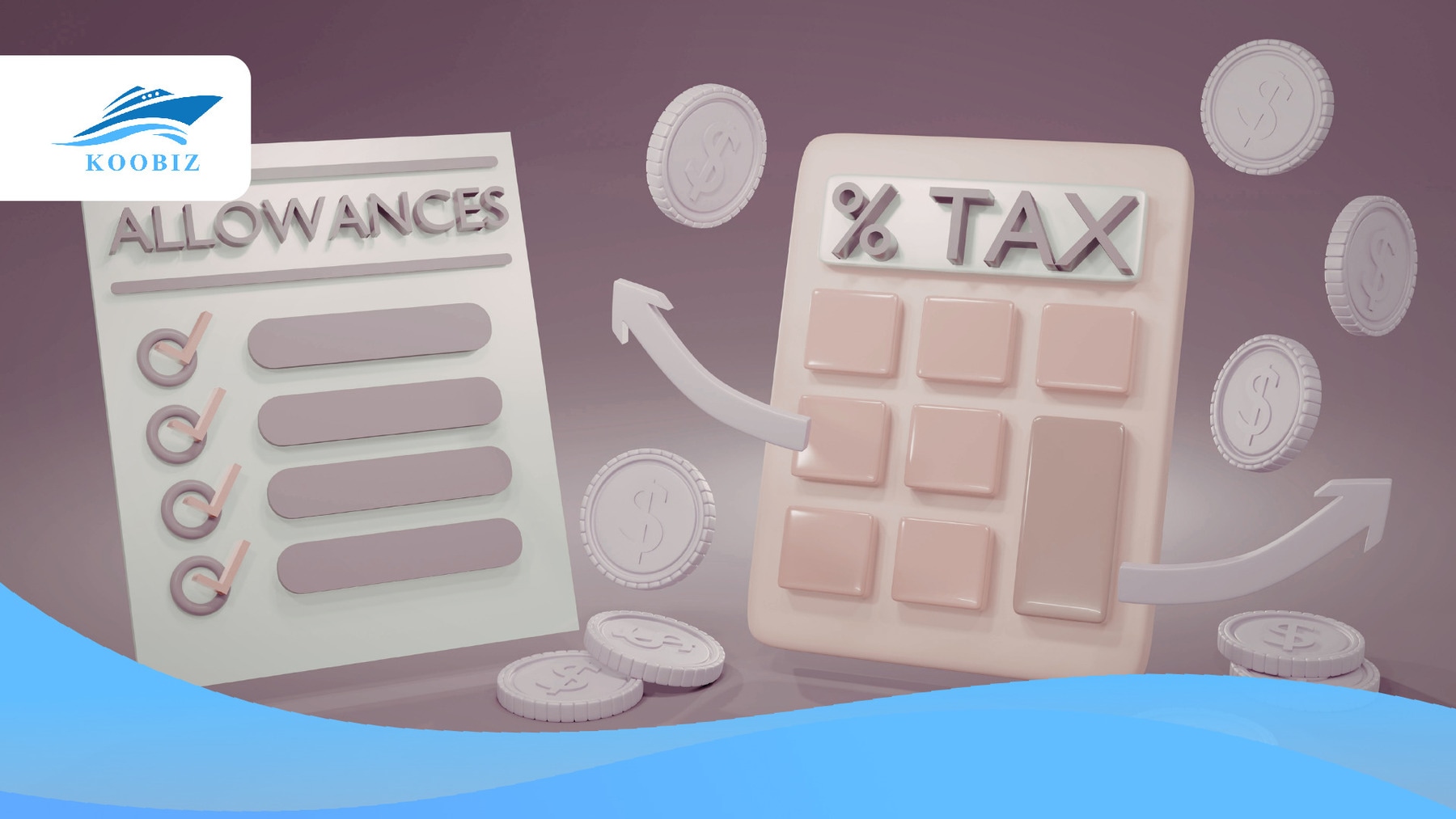
    How Allowable Expenses Reduce Taxable Income

    Lower your taxes with allowable expenses
    Lower your taxes with allowable expenses

    Allowable business expenses help reduce your company’s taxable income, which in turn lowers the amount of corporate tax payable to IRAS.

    In simple terms, tax is calculated on net profit, not total revenue:

    Taxable Income = Gross Income – Allowable Business Expenses

    When eligible expenses such as rent, salaries, utilities, marketing costs, or approved deductions (e.g. R&D, R&R, medical expenses) are properly claimed, your chargeable income decreases, resulting in lower tax liability.

    Why this matters:

    • Reduces corporate tax payable
    • Improves cash flow
    • Ensures compliance with IRAS regulations

    Accurate expense classification and proper documentation are essential to maximise deductions while avoiding IRAS penalties or audits.

    Common Mistakes & IRAS Audit Triggers

    Many businesses unintentionally make errors when claiming allowable expenses, which can increase the risk of an IRAS audit or tax adjustment.

    Common Mistakes Businesses Make:

    • Claiming personal expenses as business costs (e.g. private meals, personal transport)
    • Deducting capital expenses (equipment, renovations, vehicles) as revenue expenses
    • Over-claiming private car or medical expenses beyond IRAS limits
    • Missing or incomplete supporting documents (invoices, receipts, contracts)
    • Claiming expenses that are not wholly and exclusively incurred for business purposes

    Common IRAS Audit Triggers:

    • Unusually high expense ratios compared to revenue
    • Repeated claims for restricted or partially deductible expenses
    • Inconsistent figures across tax filings and financial statements
    • Large deductions without clear business justification

    Proper expense classification, clear documentation, and understanding IRAS rules can significantly reduce audit risks and help your business stay fully compliant.

    How Koobiz Helps Businesses Comply with IRAS Allowable Expense Rules

    Koobiz assists businesses in navigating strict IRAS regulations while maximizing legitimate tax deductions through our specialized solutions:

    • Correct expense classification: Deductible, partially deductible, or non-deductible
    • Audit-ready records: Invoices, receipts, and supporting documents
    • Expert guidance: Private car costs, R&D, renovation, and medical benefits
    • End-to-end support: From bookkeeping to tax filing

    Partner with Koobiz today to ensure your tax filings are accurate, fully compliant, and optimized for maximum savings. Let us handle the complexities while you focus on growing your business.

  • Singapore Corporate Tax Rate (2026): What SMEs and Start-Ups Need to Know

    Singapore Corporate Tax Rate (2026): What SMEs and Start-Ups Need to Know

    [SUMMARIES]

    Singapore applies a flat 17% corporate tax rate, though exemptions like the Start-Up Tax Exemption often significantly lower the effective rate for SMEs.

    All companies must mandatorily file Estimated Chargeable Income and annual tax returns, regardless of profitability or dormant status.

    Tax liability follows a territorial system based on residency and income source, allowing optimization through legitimate business expense deductions.

    [/SUMMARIES]

    Singapore has a flat 17% corporate tax rate, but most SMEs and start-ups pay much less thanks to tax exemptions, deductions, and reliefs. This guide explains how corporate tax works, who needs to pay, and how to optimize your tax legally – so you can focus on growing your business with confidence.

    What Is the Corporate Tax Rate in Singapore?

    Singapore maintains a highly competitive tax environment with a flat corporate tax rate of 17% on a company’s chargeable income. This rate applies universally, regardless of a company’s revenue size or industry.

    However, it is important to distinguish between the headline tax rate and the effective tax rate. Due to Singapore’s territorial tax system, companies are only taxed on:

    • Singapore-sourced income: Profits derived from business activities within the country.
    • Foreign-sourced income: Income received or remitted into Singapore (unless it meets specific exemption criteria under the Income Tax Act).

    To further support business growth, the Inland Revenue Authority of Singapore (IRAS) provides generous tax exemption schemes and annual Corporate Income Tax (CIT) Rebates. For instance, start-ups and SMEs often benefit from significant tax reliefs in their early years, bringing their actual tax liability well below the 17% mark. Understanding these nuances is key to efficient tax planning and maximizing your business’s net profit.

    Who Needs to Pay Corporate Tax in Singapore?

    Find out who must pay corporate tax
    Find out who must pay corporate tax

    Singapore adopts a territorial tax system, meaning corporate tax is primarily imposed based on where the income is sourced, rather than the owner’s nationality. Whether you are a local entrepreneur or a foreign investor, your tax liability is determined by your business activities within the red dot.

    Taxable Entities

    Under the Income Tax Act, any entity carrying on a trade or business in Singapore is subject to corporate tax on its chargeable income. This includes:

    • Local Companies: Entities incorporated in Singapore, such as Private Limited (Pte Ltd) companies and local subsidiaries of foreign groups.
    • Foreign Entities: Singapore branches or foreign corporations that derive profits from activities based in or managed from Singapore.

    Mandatory Filing Obligations: Active vs. Dormant

    A common misconception is that “no profit means no tax filing.” In reality, all companies must maintain their tax compliance with the Inland Revenue Authority of Singapore (IRAS):

    • Active or Loss-Making Companies: Filing is mandatory even if your company is in a loss position. Reporting these losses is actually beneficial, as they can often be carried forward to offset future taxable profits.
    • Dormant Companies: A company is considered dormant if it has no revenue or income. Filing remains compulsory unless you have officially applied for and been granted a Waiver of Income Tax Return by IRAS.

    Critical Update for 2026: Foreign Asset Gains (Section 10L)

    If your company is part of a relevant group (entities with at least one foreign establishment), you must pay attention to Section 10L. Since January 2024, gains from the disposal of foreign assets (e.g., overseas shares or property) are taxable if:

    • Remitted to Singapore: The gains are received in or brought into the country.
    • Lack of Economic Substance: The entity does not meet specific Economic Substance Requirements (ESR), such as having adequate staff, business spending, and strategic management (Control and Management) in Singapore.

    Expert Tip: Purely local SMEs with no foreign presence or complex holding structures are generally safe from Section 10L. However, if you plan to sell overseas assets and bring the funds back to Singapore in 2026, professional tax advice is highly recommended.

    How Corporate Tax Works in Singapore

    Make sense of Singapore corporate tax - simple, clear, actionable
    Make sense of Singapore corporate tax – simple, clear, actionable

    Singapore’s tax framework operates on two core pillars: The Source of Income and Tax Residency Status.

    What Income Is Taxable?

    Singapore levies a flat 17% tax rate on Chargeable Income (net profit after deductible expenses and allowances). This applies to:

    • Singapore-Sourced Income: Profits derived from business activities within Singapore.
    • Foreign-Sourced Income (Remitted): Interest, dividends, or profits earned abroad that are received in a Singapore bank account.
    • The 15% Rule (Foreign-Sourced Income Exemption): Under Section 13(9) of the Income Tax Act, foreign-sourced income received in Singapore may be tax-exempt if it has been subject to tax in the source country and the headline corporate tax rate of that country is at least 15% at the time the income is received in Singapore.

    Tax Resident vs. Non-Resident (YA 2026)

    Tax residency is determined by where the “Control and Management” of the business is actually exercised, rather than just the place of incorporation.

    Criteria Tax Resident Non-Resident
    Strategic Decisions Made within Singapore. Made outside Singapore.
    Board Meetings (BOD) Held in Singapore. For Virtual Meetings: >=

    50% of voting directors OR the Chairman must be in SG.

    Usually held outside Singapore.
    Start-up Exemptions Eligible for SUTE (Tax holiday for first 3 years). Ineligible.
    Tax Treaties (DTA) Eligible (Reduces taxes on cross-border trade). Ineligible for DTA benefits.
    COR Eligibility Yes (Certificate of Residence issued by IRAS). No.

    Tax Exemptions for Start-Ups and New Companies

    Save smart: Start-up tax exemptions & deductions
    Save smart: Start-up tax exemptions & deductions

    Singapore offers one of the most business-friendly corporate tax systems in the world. Through targeted tax exemption schemes, start-ups and SMEs can significantly reduce their actual tax burden – often paying far less than the headline 17% corporate tax rate, especially in the early years.

    Start-Up Tax Exemption (SUTE)

    The Start-Up Tax Exemption (SUTE) scheme supports newly incorporated companies during their first three consecutive Years of Assessment (YAs).

    Under SUTE, qualifying companies enjoy:

    • 75% tax exemption on the first S$100,000 of chargeable income
    • 50% tax exemption on the next S$100,000

    This provides up to S$125,000 of tax-exempt income per year, substantially lowering the effective tax rate for new businesses.

    To qualify, a company must be a Singapore tax resident, have no more than 20 shareholders, and at least one individual shareholder holding 10% or more of the shares. Investment holding and property development companies are excluded from this scheme.

    Partial Tax Exemption (PTE) for Companies

    After the first three YAs, or for companies that do not qualify for SUTE, the Partial Tax Exemption (PTE) scheme applies automatically.

    Under PTE, companies receive:

    • 75% tax exemption on the first S$10,000 of chargeable income
    • 50% tax exemption on the next S$190,000

    This results in up to S$102,500 of tax-exempt income each year, helping businesses maintain a consistently low effective tax rate as they grow.

    Effective Tax Rate: Understanding Your Real Corporate Tax

    Although Singapore’s corporate tax rate is 17%, most SMEs and start-ups pay a much lower effective tax rate. The effective tax rate is the actual percentage of profit a company pays after applying tax exemptions, deductions, and reliefs.

    With schemes such as start-up and partial tax exemptions, only part of a company’s chargeable income is taxed at 17%. As a result, many businesses—especially in their early years—end up with an effective tax rate of around 5% to 8%, rather than the headline rate.

    Understanding your effective tax rate helps you estimate your real tax liability, plan cash flow accurately, and identify legal ways to reduce corporate tax. Since exemptions and deductions differ by company, using a corporate tax calculator is often the simplest way to see how much tax your business actually needs to pay.

    How to Calculate Corporate Tax: Step-by-Step Guide

    Calculating corporate tax in Singapore is straightforward once you understand the process. The key is to work from your company’s profit and apply the relevant tax exemptions and deductions correctly.

    Step 1: Determine Your Accounting Profit

    Start with your net profit based on your financial statements for the year. This is your profit before tax.

    Step 2: Adjust to Arrive at Chargeable Income

    Add back non-deductible expenses and deduct allowable business expenses, capital allowances, and tax reliefs. The result is your chargeable income.

    Step 3: Apply Tax Exemptions

    Check whether your company qualifies for schemes such as the Start-Up Tax Exemption (SUTE) or Partial Tax Exemption (PTE). These exemptions reduce the portion of income subject to tax.

    Step 4: Apply the Corporate Tax Rate

    The remaining chargeable income is taxed at Singapore’s flat 17% corporate tax rate.

    Step 5: Calculate Your Final Tax Payable

    The amount after exemptions multiplied by 17% is your corporate tax payable to IRAS.

    Because exemptions and deductions vary by company, many SMEs use a corporate tax calculator to estimate their tax accurately and avoid surprises during filing. This also helps business owners understand their effective tax rate before submitting their corporate tax return.

    Tax Deductions & Optimization: How to Reduce Your Corporate Tax

    Reduce your tax smartly: Deductions and optimization tips you need!
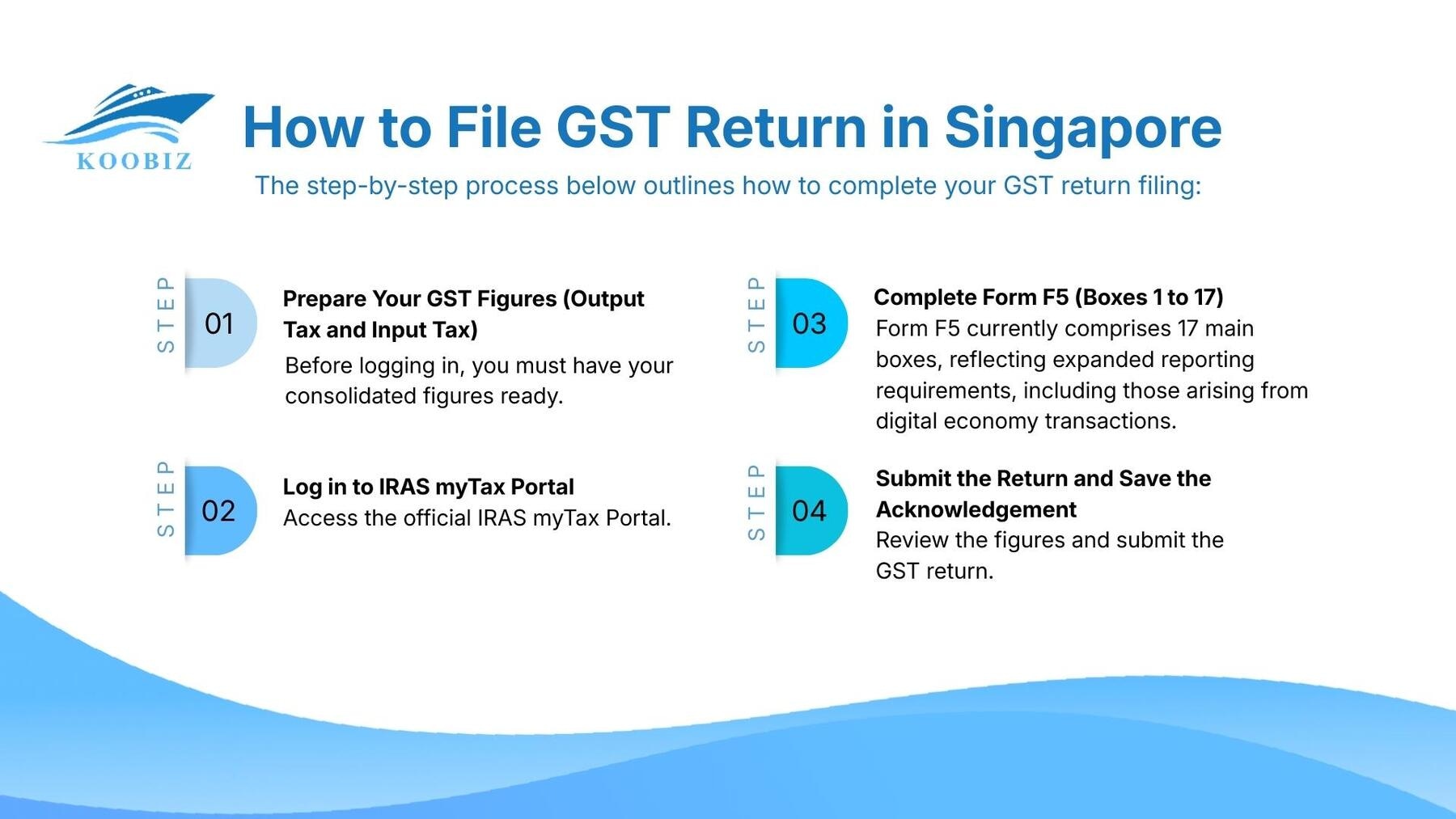
    Reduce your tax smartly: Deductions and optimization tips you need!

    Singapore’s tax system allows businesses to legally reduce corporate tax, as long as expenses are properly claimed and comply with IRAS rules.

    To be tax-deductible, business expenses must:

    • Be incurred solely for business purposes
    • Be directly related to day-to-day business operations
    • Be operating (revenue) expenses, not long-term investments

    Common tax-deductible expenses include:

    • Employee salaries and employer CPF contributions
    • Office rent, utilities, and internet bills
    • Marketing, advertising, and promotional costs
    • Accounting, tax, and legal service fees
    • Business-related travel and operating expenses

    For asset purchases:

    • Items such as equipment, machinery, or IT systems are not deducted immediately
    • These costs are claimed over time through capital allowances

    Simple tax optimization tips for SMEs:

    • Keep clear and organized expense records
    • Separate business expenses from personal spending
    • Classify expenses correctly from the start
    • Apply tax exemptions and reliefs accurately

    With the right deductions and tax planning, many SMEs and start-ups are able to reduce their effective corporate tax rate, while staying fully compliant with Singapore tax regulations.

    Corporate Tax Filing and Compliance for SMEs

    All companies in Singapore must file corporate tax returns with IRAS, even if there is no profit. Staying compliant helps SMEs avoid penalties and unnecessary issues.

    Key filing requirements:

    • Estimated Chargeable Income (ECI): Filed within 3 months after the financial year end (unless exempted)
    • Corporate Income Tax Return (Form C / Form C-S): Filed annually

    To stay compliant, SMEs should:

    • File tax returns on time
    • Keep accurate financial records
    • Claim deductions and exemptions correctly
    • Avoid claiming personal or non-deductible expenses

    With proper planning and timely filing, corporate tax compliance can be simple and stress-free allowing business owners to focus on running and growing their business.

    Simplify Singapore Corporate Tax with Koobiz

    Corporate tax compliance in Singapore doesn’t have to be complicated. Koobiz supports SMEs and start-ups with accurate tax filing, proper use of tax incentives, and full compliance with IRAS regulations.

    By working with Koobiz, businesses can:

    • Minimize tax risks
    • Avoid common filing mistakes
    • Manage corporate tax confidently and efficiently

    This allows you to focus on business growth and daily operations, without worrying about compliance issues.

  • File ECI in Singapore: How to File Estimated Chargeable Income Correctly

    File ECI in Singapore: How to File Estimated Chargeable Income Correctly

    [SUMMARIES]

    Singapore companies must file Estimated Chargeable Income (ECI) within three months of their financial year-end unless eligible for a waiver.

    Early filing secures interest-free payment installments, while late submission triggers penalties and immediate tax demands.

    ECI is a mandatory preliminary tax estimate distinct from the final Corporate Income Tax Return and is vital for compliance.

    [/SUMMARIES]

    Discover how businesses in Singapore can file their Estimated Chargeable Income (ECI) correctly and on time. This guide explains what ECI is, who needs to file, important deadlines, common mistakes to avoid, and how professional support from Koobiz can make the process simple, accurate, and stress-free.

    What Is Estimated Chargeable Income (ECI)?

    Estimated Chargeable Income (ECI) is an estimate of your company’s taxable profits for a specific Year of Assessment (YA) in Singapore. It reflects your projected taxable income after allowable expenses but before applying tax incentives such as Partial Tax Exemption (PTE) or Start-Up Tax Exemption (SUTE).

    ECI is a key part of Singapore’s corporate tax system. It allows the Inland Revenue Authority of Singapore (IRAS) to assess tax liabilities early—well before the final corporate tax return (Form C, C-S, or C-S Lite) is submitted. This helps both the tax authority and businesses manage cash flow and tax obligations efficiently.

    All Singapore-incorporated companies must submit their ECI within 3 months after the end of the financial year, unless they qualify for an ECI filing waiver, regardless of profit or loss.

    Who Needs to File ECI in Singapore?

    Know if your company must file ECI
    Know if your company must file ECI

    Most Singapore-incorporated companies must file their Estimated Chargeable Income (ECI), even if they made no profit. Filing ECI allows IRAS to estimate your tax early and helps you plan cash flow.

    1. Filing Requirement

    • Active companies, including subsidiaries and foreign branches.
    • Dormant companies or those with nil profits, unless granted a waiver.

    2. ECI Filing Waiver

    You do not need to file ECI if both conditions are met:

    • Annual revenue ≤ SGD 5 million.
    • ECI is nil for the Year of Assessment (before exemptions).

    Examples

    Revenue ECI Need to File?
    $5M $100,000 Yes
    $10M Nil Yes
    $5M Nil No

    Key Point: Missing the filing deadline may lead IRAS to estimate your tax, which could be higher. Filing on time ensures compliance and avoids penalties.

    When Do Companies Need to File ECI?

    In Singapore, companies must file their Estimated Chargeable Income (ECI) within three months after the end of their financial year (FYE).

    IRAS usually sends a reminder via the myTax Portal, but the legal responsibility to file on time lies with the company. Even without a notification, submission must be completed by the deadline unless an administrative waiver applies.

    Example: For a FYE of 31 December, the ECI must be filed by 31 March the following year.

    Timely filing keeps your company compliant and prevents IRAS from issuing an estimated Notice of Assessment (NOA), which may result in higher provisional taxes and immediate payment demands.

    Why Companies Should File ECI Early: Benefits and GIRO Installment Plan

    File ECI early for smoother payments
    File ECI early for smoother payments

    Filing your Estimated Chargeable Income (ECI) early is a smart financial strategy. It allows your company to maximize the number of interest-free GIRO installments, spreading your tax payments and improving cash flow predictability.

    GIRO Installments by Filing Timeline

    Filing Timeline (After FYE) Maximum GIRO Installments
    Within 1 month 10
    Within 2 months 8
    Within 3 months 6
    After 3 months 0 (full payment required)

    Note: Minimum monthly deduction is S$50, and a GIRO arrangement with IRAS is required.

    Example: Company A (FYE 31 December, Tax S$10,000)

    Scenario Filing Date Payment Scheme Deduction Details
    Early Filing 26 Jan 10 Installments S$1,000/month (Feb–Nov)
    Standard Filing 26 Mar 6 Installments S$1,666/month (Apr–Sept)
    Late Filing After 31 Mar Lump Sum S$10,000 (full payment)

    Key Takeaways:

    • Filing within 1 month after FYE gives maximum flexibility.
    • Early filing spreads out payments, easing cash flow.
    • Avoids estimated NOA from IRAS, which can result in higher provisional taxes.

    How to File ECI with IRAS

    Filing your Estimated Chargeable Income (ECI) is a streamlined digital process conducted through the IRAS myTax Portal. To ensure a smooth submission, your company must have its digital credentials and financial data prepared in advance.

    Where to File ECI (IRAS myTax Portal)

    All ECI submissions must be completed online. Before logging in, ensure the following:

    • Portal: Access via myTax Portal.
    • Identity: Log in using your Singpass.
    • Authorization: The person filing (Director, Employee, or Tax Agent) must be authorized as a “Corporate Tax (Filing and Applications)” user via the Corppass system.
    • Entity Details: Have your Company UEN (Unique Entity Number) and Entity ID ready.

    Information Required for ECI Filing

    To ensure accuracy and avoid future discrepancies with your final tax return (Form C/C-S), prepare these figures:

    • Revenue: Your gross income from main business activities. For Investment Holding Companies, this includes dividends and interest income.
    • Estimated Chargeable Income: Your projected taxable profit after deducting allowable expenses, but before applying tax exemptions (like SUTE or PTE).
    • Financial Records: While audited accounts are preferred, management accounts are acceptable for estimating ECI.
    • Accounting Period: Ensure the filing corresponds to the correct Year of Assessment (YA) based on your Financial Year End (FYE).

    Who Can Submit ECI on Behalf of the Company

    The company is legally responsible for the accuracy of all ECI information submitted. ECI submissions may be made by:

    • Company Directors or authorized internal staff.
    • Tax Agents / Accounting Firms formally appointed via CorpPass.

    Note: Even when a third party submits on the company’s behalf, the company remains fully accountable for the correctness of the declared figures.

    What Happens If You Fail to File ECI?

    Failing to file ECI brings penalties
    Failing to file ECI brings penalties

    Failing to submit your Estimated Chargeable Income (ECI) within the three-month statutory window is considered non-compliance and may trigger several consequences from IRAS:

    • Estimated Notice of Assessment (NOA): IRAS may issue an automated tax bill based on historical data or industry benchmarks, which could be higher than your actual tax liability.
    • Immediate Payment Obligation: You must pay the tax stated in the Estimated NOA within one month of issuance, even if you plan to file an objection later.
    • Loss of GIRO Installments: Late filers cannot use interest-free monthly payment plans and must pay the full tax in a lump sum, which may strain cash flow.
    • Financial Penalties: IRAS may impose composition fees of up to S$5,000 for late filing. Persistent non-compliance may lead to additional enforcement measures under the Income Tax Act.

    Always file your ECI within three months of your Financial Year-End (FYE) to protect cash flow and ensure accurate tax assessment. If your company qualifies for an administrative waiver (Revenue ≤ S$5M and NIL ECI), maintain proper documentation of your self-assessment to avoid disputes with IRAS.

    Common Mistakes When Filing ECI

    Filing Estimated Chargeable Income (ECI) may seem straightforward, but companies frequently make errors that can lead to penalties, inflated tax assessments, or unnecessary administrative burdens. Avoiding these common pitfalls is essential for seamless compliance:

    • Missing the Filing Deadline: This is the most frequent error. Failing to file within three months after your Financial Year-End (FYE) triggers automated estimated assessments from IRAS and disqualifies your company from interest-free GIRO installment plans.
    • Incorrect Revenue Classification: Companies often mistakenly include non-operating income, such as capital gains from the sale of fixed assets, which should be excluded from ECI. Conversely, investment holding companies sometimes forget to include dividends and interest income as part of their revenue.
    • Misunderstanding ECI Waivers: Many small businesses continue to file ECI despite meeting both waiver criteria (Revenue <=5M and NIL ECI). While not a penalty-bearing mistake, it creates unnecessary administrative work. Always self-assess your eligibility before proceeding with a filing.
    • Inaccurate Taxable Income Estimation: Significant discrepancies between your ECI and the final figures in your Form C/C-S can raise red flags. While it is an “estimate,” it should be based on reliable management accounts to avoid potential queries from IRAS.
    • Unauthorized Portal Access: A common technical hurdle occurs when a staff member attempts to file without the proper “Corporate Tax” role assigned in Corppass. Ensure all filers—whether internal staff or third-party agents—are officially authorized to prevent rejected submissions.

    Key Tip: Before clicking ‘Submit’, double-check that your revenue figures align with your management accounts and confirm that your Year of Assessment (YA) is correct. If you are unsure about your taxable income deductions, consulting a tax professional can prevent costly amendments later.

    ECI Filing vs. Corporate Income Tax Return – What’s the Difference?

    While both ECI filing and the Corporate Income Tax Return relate to your company’s taxable income, they serve different purposes and follow distinct timelines in the Singapore tax cycle. Think of ECI as your “preliminary declaration” and the Tax Return as your “final settlement.”

    Feature ECI (Estimated Chargeable Income) Corporate Income Tax Return (Form C / C-S)
    Primary Purpose Provides an early estimate of taxable income to IRAS. Reports actual taxable income and computes final tax payable.
    Filing Deadline Within 3 months after the Financial Year-End (FYE). By 30 November of the relevant Year of Assessment (YA).
    Basis of Figures Based on estimated figures (projections from management accounts). Based on final financial statements and tax computations.
    Tax Impact Determines provisional installments (GIRO) and early payment. Determines the final tax bill and settles any balance/refund.
    Requirement Mandatory for all companies unless a waiver applies. Mandatory for all companies, even if an ECI has been filed.

    Key Takeaways:

    • Cash Flow Management: ECI filing is primarily about estimating your tax early to qualify for interest-free installments and managing your company’s cash flow.1
    • Final Compliance: The Corporate Income Tax Return (Form C/C-S) is the definitive report of your actual income. Filing an ECI does not replace the need to file your final Tax Return.
    • Accuracy: Both filings are required for full compliance. Any discrepancies between your ECI and your final Tax Return will be adjusted by IRAS in the final Notice of Assessment.

    How Koobiz Can Help with ECI Filing in Singapore

    Koobiz specializes in helping businesses file ECI accurately and on time.

    Why choose Koobiz:

    • Expertise: Years of experience in Singapore corporate tax and ECI filing.
    • Accuracy & Compliance: Avoid penalties and estimated assessments from IRAS.
    • Time-Saving: We handle the filing so your team can focus on growing the business.
    • Stress-Free: Professional guidance ensures smooth and worry-free ECI submission.

    With Koobiz, ECI filing is simple, reliable, and fully compliant, giving your business peace of mind.

  • Maximize Income Tax Relief Singapore 2026: Complete Guide to Deductions & New Rules

    Maximize Income Tax Relief Singapore 2026: Complete Guide to Deductions & New Rules

    [SUMMARIES]

    Total Relief Cap: There is a firm limit on how much total personal tax relief you can claim. For the 2026 tax year, this cap is set at S$80,000 per person.

    Course Fees Relief Cessation: The S$5,500 tax relief for course fees is no longer available for expenses you paid in 2025.

    Updated WMCR: For children born or adopted from January 1, 2024 onwards, the Working Mother’s Child Relief is now a fixed cash amount instead of a percentage of the mother’s income.

    CPF Top-Up Limits: You can get tax relief for topping up your or your loved ones’ CPF accounts, but it’s capped at S$16,000 total (S$8,000 for yourself, S$8,000 for others). Note that top-ups matched by a government grant no longer qualify.

    Donation Multiplier: The 250% tax deduction for qualifying donations to IPCs remains a powerful tool for reducing chargeable income through Dec 31, 2026.

    [/SUMMARIES]

    For the 2026 Year of Assessment (YA), maximizing income tax relief singapore means adapting to new rules. With the removal of the SG60 Rebate and Course Fees Relief, the focus shifts to core strategies like retirement contributions and family support. Koobiz presents this essential guide to help you claim every eligible deduction.

    ⚠️Critical Warning: The S$80,000 Cap

    No matter how many reliefs you qualify for, the total amount you can subtract from your income is capped at S$80,000. If you have a high income, it’s crucial to calculate your total reliefs before making extra voluntary contributions to avoid putting money where it won’t give you a tax benefit.

    Understanding Singapore Personal Income Tax 2026

    Singapore uses a progressive tax system. This means the tax rate you pay increases as your taxable income rises. Tax reliefs are simply tools to lower your “chargeable income”—the final amount the tax authority (IRAS) uses to calculate your tax bill.

    Your residency status is key. If you live in Singapore for 183 days or more in a year, you are taxed at lower resident rates. Effective tax planning starts with knowing your income level and which tax bracket you fall into. Koobiz emphasizes that strategic tax planning begins with knowing exactly where you fall on the income ladder.

    Who Needs to File Tax in 2026?

    Minimum Income & No-Filing Service (NFS
    Minimum Income & No-Filing Service (NFS

    You generally need to file a tax return if your total annual income in 2025 exceeded S$22,000. You must also file if IRAS sends you a notice, or if you need to claim certain reliefs that aren’t applied automatically. According to data from the Singapore Ministry of Finance in 2025, over 60% of taxpayers now benefit from the No-Filing Service (NFS), where their taxes are computed automatically based on data from employers and government agencies. However, individuals with rental income or self-employment earnings must still manually verify their details on the myTax Portal by the April 18 deadline.

    Resident Tax Rates for YA 2026

    The tax rates for residents remain the same. Your first S$20,000 of income is not taxed. The rates then increase step-by-step, with the highest rate applied to income over S$1,000,000.

    Chargeable Income (S$) Tax Rate (%) Gross Tax Payable (S$)
    First 20,000 0% 0
    Next 10,000 2% 200
    Next 10,000 3.5% 350
    Next 40,000 7% 2,800
    Next 40,000 11.5% 4,600
    Next 40,000 15% 6,000
    Next 40,000 18% 7,200
    Next 40,000 19% 7,600
    Next 40,000 19.5% 7,800
    Next 40,000 20% 8,000
    Next 180,000 22% 39,600
    Next 500,000 23% 115,000
    Above 1,000,000 24%

    For example, someone earning S$120,000 would typically owe about S$7,950 in tax before any reliefs. However, by maximizing income tax relief singapore strategies, that same individual could potentially drop into a lower effective tax bracket, saving thousands of dollars in final payments.

    Core Family and Individual Reliefs for YA 2026

    The main personal reliefs fall into categories like Earned Income Relief, Child Reliefs, and Parent Reliefs. These are designed to help with the costs of living and supporting dependents. For many families, these reliefs provide the biggest reduction to their taxable income. Most are applied automatically if IRAS has your updated family details.

    Working Mother’s Child Relief (WMCR) Fixed-Dollar Update

    The relief for working mothers has changed for children born or adopted from January 1, 2024. It is now a fixed amount instead of a percentage of the mother’s salary.

    Child Order Born Before 1 Jan 2024 (Old Scheme) Born On/After 1 Jan 2024 (New Scheme)
    1st Child 15% of mother’s earned income S$8,000
    2nd Child 20% of mother’s earned income S$10,000
    3rd Child + 25% of mother’s earned income S$12,000

    This transition aims to provide more equitable support to lower- and middle-income working mothers. According to the National Population and Talent Division (NPTD) report of 2024, this policy shift was designed to simplify tax planning for young families while ensuring that tax benefits are not disproportionately skewed toward high earners.

    Parent and Handicapped Parent Relief

    You can claim this relief if you support a parent, grandparent, or great-grandparent who earned less than S$8,000 in the previous year. The amount depends on whether you live together:

    • Living Together:
      • S$9,000 per parent
      • S$14,000 per handicapped parent
    • Not Living Together:
      • S$5,500 per parent
      • S$10,000 per handicapped parent

    Only one person can claim relief for a specific dependent, so siblings should agree on who will claim it, especially if one is in a higher tax bracket where the savings are greater. Koobiz advisors often suggest that siblings discuss this early to maximize the household’s total tax savings, especially if one sibling is in a higher tax bracket.

    Retirement Savings: CPF and SRS Strategies

    The primary methods for retirement-based tax reduction are the CPF Cash Top-up and the Supplementary Retirement Scheme (SRS), which together can reduce your chargeable income by up to S$51,700 for Singaporeans. To understand the best path, one must compare the immediate tax savings against the liquidity constraints of these accounts.

    Feature CPF Cash Top-Up (SA/RA) Supplementary Retirement Scheme (SRS)
    Tax Relief Cap Max S$16,000 (S$8k self + S$8k loved ones) Max S$15,300 (Citizens/PR) / S$35,700 (Foreigners)
    Interest Rate ~4.0% p.a. (Risk-free) 0.05% p.a. (Must invest to grow)
    Withdrawal Only at Retirement Age (Age 55/65 rules) Anytime (Subject to penalties if early)
    Tax on Withdrawal Tax-Exempt 50% Tax Concession (at retirement age)
    Penalty N/A (Locked in) 5% penalty + 100% tax (if withdrawn early)

    As we move into 2026, the income tax relief singapore benefits of these schemes are more critical than ever, especially with the $80,000 cap in mind. Koobiz recommends that taxpayers calculate their total family reliefs first before deciding how much to “fill” their retirement accounts to avoid exceeding the cap.

    CPF Cash Top-up Relief (S$16,000 Max)

    You can get tax relief for topping up your own or your loved ones’ CPF Retirement or Special Accounts. The total relief is capped at S$16,000 per year, split equally between yourself and others. Specifically, a major update for YA 2026 is that cash top-ups that receive a matching grant under the Matched Retirement Savings Scheme (MRSS) are no longer eligible for tax relief. This ensures that taxpayers do not “double-dip” by receiving both a government grant and a tax deduction for the same dollar. According to CPF Board statistics from 2025, over 300,000 members utilized the cash top-up scheme to boost their retirement nest egg while simultaneously lowering their tax obligations.

    Maximizing the Supplementary Retirement Scheme (SRS)

    The SRS is a voluntary scheme where every dollar you contribute gives you a dollar of tax deduction. It’s particularly useful for higher earners, as it allows you to defer tax until retirement when your income (and tax rate) may be lower. At retirement, only 50% of the money you withdraw is taxed. For a foreigner earning a high salary, maximizing SRS contributions can lead to significant immediate tax savings. Koobiz highlights that for a foreigner earning S$250,000, a full SRS contribution can result in immediate tax savings of over S$6,000. It is a vital tool in the income tax relief singapore arsenal for those looking to optimize their wealth management.

    Charitable Giving and NSman Benefits

    250% Donation Deduction & NSman Relief
    250% Donation Deduction & NSman Relief

    Donating to approved charities and having served National Service (NS) can also lower your tax bill. The government uses these reliefs to encourage charitable giving and recognize national service. To illustrate this, the 250% donation deduction remains one of the most generous tax incentives in the Singapore system.

    Pro Tip: Always check the Charity Portal before making large donations to ensure the organization is an approved Institution of a Public Character (IPC). Only donations to IPCs qualify for the 250% tax deduction.

    How the 250% Donation Deduction Works

    When you donate to an approved charity, you don’t just subtract the donation amount. You get to subtract 250% of it. So, a S$1,000 donation reduces your taxable income by S$2,500. This scheme is extended until the end of 2026. If your total reliefs hit the S$80,000 cap, the extra benefit from donations can be carried forward to use in future years. According to a Commissioner of Charities report in late 2025, individual donations saw a 12% increase year-on-year, largely driven by taxpayers seeking to offset higher income brackets while supporting local causes.

    NSman Relief for Self, Wife, and Parents

    NSman relief is a unique aspect of income tax relief singapore, providing a token of appreciation for those who have served or support those who serve in the Singapore Armed Forces, Police Force, or Civil Defence. The amounts are:

    • NSman (Self): S$1,500 – S$5,000 (depending on rank & active service status)
    • Wife of NSman: S$750
    • Parent of NSman: S$750

    While the individual amounts are small, they are often automatically credited and provide a steady, reliable reduction in tax for the majority of male Singaporean citizens.

    Important Changes: What You Can No Longer Claim

    The main difference for YA 2026 is the removal of broad-based education reliefs and one-off rebates. Koobiz advises reviewing your tax liability early, as the absence of these credits may result in a higher final bill than expected.

    Benefit YA 2025 (Previous) YA 2026 (Current) Action Required
    Course Fees Relief Claim up to S$5,500 ❌ REMOVED Check for employer training grants or SkillsFuture usage.
    SG60 Tax Rebate 60% Off (Max S$200) ❌ REMOVED Budget for full tax payment; no automatic discount this year.

    Note: The shift in policy moves away from personal tax deductions toward direct subsidies like SkillsFuture and the Enterprise Innovation Scheme.

    Niche Caregiver and Household Reliefs

    Grandparent Caregiver Relief & FDWL Relief Removal
    Grandparent Caregiver Relief & FDWL Relief Removal

    There are specialized reliefs for caregivers and households, though options have narrowed with the removal of the Foreign Domestic Worker Levy (FDWL) Relief. The Grandparent Caregiver Relief remains the primary benefit for working mothers relying on family support.

    Grandparent Caregiver Relief (GCR)

    Grandparent Caregiver Relief allows a working mother to claim S$3,000 if her parent, grandparent, or in-law is looking after her children. Use this checklist to confirm your eligibility:

    GCR Eligibility Checklist:

    • Claimant: Must be a Working Mother (fathers are not eligible).
    • Caregiver: Your parent, grandparent, or parent-in-law (including from spouse’s side).
    • Caregiver Status: Must not be engaged in any trade, business, or employment.
    • Child: Singapore Citizen, aged 12 or below in 2025 (or unmarried/handicapped children).

    Koobiz Note: This relief is “stackable.” A mother of two with a retired mother-in-law providing care can claim this S$3,000 on top of her WMCR and other child reliefs.

    Foreign Domestic Worker Levy (FDWL) Relief Removal

    It is important to remember that the Foreign Domestic Worker Levy (FDWL) Relief was completely removed starting from YA 2025. Specifically, this means for your YA 2026 filing, you can no longer claim a tax deduction for the levies paid for your helper. The government replaced this broad tax relief with more targeted subsidies, such as the Home Caregiving Grant, which provides direct cash assistance to families caring for those with permanent disabilities or frailty. According to the Ministry of Social and Family Development (MSF), this shift ensures that financial support reaches those with the highest caregiving needs, regardless of their income tax bracket.

    Strategic Planning: The S$80,000 Personal Relief Cap

    Tax Strategy: The S$80,000 Personal Relief Cap
    Tax Strategy: The S$80,000 Personal Relief Cap

    The S$80,000 cap is a hard limit on all your personal reliefs combined. If your Earned Income Relief, Child Relief, Parent Relief, CPF, and SRS add up to more than S$80,000, you will only get S$80,000 of benefit. This rule ensures higher earners still pay a fair share of tax.

    A common mistake is making large voluntary CPF or SRS contributions late in the year without realizing you’ve already reached the cap through other reliefs. This results in locking away money without getting the expected tax reduction.

    Case Study: The “Maxed Out” Taxpayer

    Consider a high-earning working mother in 2026 with three children (all born before 2024) and two elderly parents living with her. We assume she has an Annual Earned Income of S$120,000.

    Her reliefs would be calculated as follows:

    • Earned Income Relief: S$1,000
    • WMCR (Percentage based):
      • 1st Child (15% of S$120k): **S$18,000**
      • 2nd Child (20% of S$120k): **S$24,000**
      • 3rd Child (25% of S$120k): **S$30,000**
      • WMCR Subtotal: S$72,000
    • Parent Relief: S$9,000 x 2 (living with her) = **S$18,000**

    Total Relief Calculation:

    S$1,000 + S$72,000 + S$18,000 = **S$91,000**

    In this scenario, she has already exceeded the S$80,000 cap (S$91,000 > S$80,000) before even considering her mandatory CPF contributions or SRS. Specifically, any additional cash top-ups to her CPF or SRS accounts would provide zero tax relief for YA 2026. Koobiz suggests that such individuals should focus on other wealth management strategies, such as tax-efficient investments or corporate structuring, rather than seeking further personal tax reliefs.

    About Koobiz Services

    Navigating the complexities of income tax relief singapore and broader financial regulations requires a partner who understands the local landscape. Koobiz (koobiz.com) is a premier professional services firm specializing in:

    • Company Formation: Seamless incorporation services for entrepreneurs looking to establish a presence in Singapore’s vibrant economy.
    • Banking Account Advisory: Expert guidance on opening corporate and personal bank accounts with leading financial institutions in Singapore.
    • Tax, Accounting, and Audit: Comprehensive compliance services, from GST filing and corporate tax optimization to statutory audits.

    Whether you are an individual taxpayer looking to optimize your personal tax bill for YA 2026 or a business owner seeking to leverage the Enterprise Innovation Scheme, Koobiz provides the expertise needed to navigate Singapore’s regulatory environment with confidence. Visit koobiz.com today to learn how we can support your financial growth.

  • File GST Return Singapore: Essential Form F5 Guide & Input Tax Claims for Businesses

    File GST Return Singapore: Essential Form F5 Guide & Input Tax Claims for Businesses

    [SUMMARIES]

    Mandatory Electronic Filing: All GST returns (Form F5) must be filed electronically via the IRAS myTax Portal, typically on a quarterly basis.

    Net GST Calculation: Your payment or refund depends on the difference between Output Tax (collected from customers) and Input Tax (paid on business purchases).

    Strict Deadlines: Filings are due one month after the end of your prescribed accounting period; late filings incur an immediate $200 penalty plus $200 per outstanding month.

    Claiming Input Tax: Valid tax invoices addressed to your company are required; expenses must be business-related and not explicitly disallowed (e.g., private car usage).

    Error Correction: Errors with a Net GST difference of ≤ S$3,000 can be adjusted in the next return; larger errors require a Form F7.

    2026 Updates: Form F5 now includes boxes for Reverse Charge on Low-Value Goods and Remote Services.

    [/SUMMARIES]

    Managing tax compliance is a priority for every Singapore business for any registered company, and knowing how to accurately file your Singapore GST return is essential. For both new startups and established SMEs, understanding the nuances of Form F5 and maximizing your Input Tax Claims can significantly impact your cash flow and compliance standing. At Koobiz, we understand that tax season can be stressful, which is why we have compiled this comprehensive guide. This article will walk you through the essential steps of filing, clarify the definition of output versus input tax, and explore the crucial conditions for claiming refunds, ensuring your business remains compliant with IRAS regulations while optimizing its tax position.

    Disclaimer: Information is accurate as of January 2026. Please verify the latest updates on the IRAS website.

    What is the Singapore GST Return (Form F5)?

    Form F5 and GST tax for Singapore businesses
    Form F5 and GST tax for Singapore businesses

    The Singapore GST Return, officially known as Form F5, is the mandatory electronic filing used by GST-registered businesses to report their GST transactions to the Inland Revenue Authority of Singapore (IRAS). Below are the key features of Form F5 that every GST-registered business should understand:

    • Electronic Filing: Form F5 must be submitted electronically through the IRAS myTax Portal; paper submissions are not accepted.
    • Summary Declaration: The return consolidates GST collected from customers (output tax) and GST paid to suppliers (input tax) for the relevant accounting period.
    • Net Calculation: Based on the figures reported, Form F5 determines whether the business must pay GST to IRAS or is entitled to a GST refund.
    • Periodic Filing: Unlike corporate income tax, GST returns are filed on a recurring basis, most commonly on a quarterly schedule.
    • Authentication: Submission of Form F5 requires Singpass access with the appropriate Preparer or Approver role assigned.

    For businesses, this document is the “source of truth” regarding their indirect tax liability. Accuracy in Form F5 is essential, as incorrect or inconsistent filings may trigger IRAS reviews, audits, or penalties.

    Who Must File a GST Return in Singapore?

    In Singapore, businesses required to file a GST return generally fall into two categories: those compulsorily registered for GST and those voluntarily registered with IRAS. If your business belongs to either category, the filing of Form F5 is mandatory and required by law, regardless of whether the business records a profit or a loss for the period.

    Detailed breakdown of these categories includes:

    1. Compulsory Registrants: These are businesses whose taxable turnover exceeds S$1 million at the end of the calendar year (Retrospective View) or is expected to exceed S$1 million in the next 12 months (Prospective View). Once GST registration is effective, the business is required to file Form F5 for each assigned accounting period without exception.
    2. Voluntary Registrants: These are businesses that elect to register for GST, often to recover input tax incurred on significant startup or operating costs, despite having annual turnover below S$1 million. Once approved by IRAS, they are bound by the same filing rules as compulsory registrants and usually must remain registered for at least two years.

    When is the GST Return Deadline?

    The GST return deadlines in Singapore
    The GST return deadlines in Singapore

    GST returns in Singapore are subject to strict statutory deadlines and must generally be filed within one month after the end of the prescribed accounting period. For most GST-registered businesses, the standard filing frequency is quarterly, although some businesses may opt for or be assigned a monthly filing cycle by IRAS.

    Here is how the timeline works structurally:

    • Quarterly Filing: This is the default frequency. If your accounting period covers January to March, your Form F5 and the corresponding payment are due by April 30th.
    • Monthly Filing: This filing frequency typically applies to exporters or businesses that regularly receive GST refunds to support cash flow. If the accounting period is January, the Form F5 deadline falls at the end of February.
    • GIRO Deadlines: Although the GST filing deadline remains the end of the following month, businesses enrolled in GIRO enjoy a later payment deduction date, usually on the 15th of the month following the filing deadline, which provides a modest cash flow benefit.

    Failure to meet these dates triggers immediate compliance actions from IRAS. Accordingly, it is essential for businesses to closely monitor their assigned accounting period end dates to ensure timely GST compliance.

    How to File GST Return in Singapore: Step-by-Step Guide

    How to File GST Return in Singapore
    How to File GST Return in Singapore

    Filing a GST return in Singapore follows a standardized digital process on the IRAS myTax Portal and requires Singpass authentication together with accurate data entry. The process is designed to allow businesses to meet their GST compliance obligations efficiently, provided that their accounting records are properly maintained. The step-by-step process below outlines how to complete your GST return filing:

    Step 1: Prepare Your GST Figures (Output Tax and Input Tax)

    Before logging in, you must have your consolidated figures ready. The difference between what you collect and what you pay determines your liability.

    • Output Tax: This refers to the 9% GST charged on taxable supplies made to customers. This GST is collected on behalf of IRAS and does not form part of business income.
    • Input Tax: This is the GST paid on business-related purchases such as rent, utilities, and inventory, which may be claimed to offset output tax, subject to IRAS rules.

    Ensuring these figures are backed by valid tax invoices and proper listing is the foundation of a correct return. In practice, many businesses reconcile these figures before logging into the portal to avoid delays or session timeouts during submission.

    Step 2: Log in to IRAS myTax Portal

    • Access the official IRAS myTax Portal.
    • Log in using your Singpass (ensure you are authorized as an “Approver” or “Preparer” in CorpPass).
    • From the main menu, select “GST” and then choose “File GST Return / Edit Past Return.”
    • The system will display the relevant Form F5 for the current filing period.

    Step 3: Complete Form F5 (Boxes 1 to 17)

    Form F5 currently comprises 17 main boxes, reflecting expanded reporting requirements, including those arising from digital economy transactions. Accurate completion of these boxes is a key compliance requirement.The table below summarises the purpose of each box and the information to be reported.

    Box No. Description What to Enter
    1 Total Value of Standard-rated Supplies Value of standard-rated supplies subject to 9% GST, including applicable reverse charge supplies.
    2 Total Value of Zero-rated Supplies Value of exported goods and international services (0%).
    3 Total Value of Exempt Supplies Value of financial services, residential property sales/rentals.
    4 Total Value of Supplies Automatically calculated (Sum of Boxes 1, 2, and 3).
    5 Total Value of Taxable Purchases Value of taxable purchases supported by valid tax invoices, including purchases subject to reverse charge.
    6 Output Tax Due GST collected on sales + GST accounted for under Reverse Charge.
    7 Input Tax and Refunds Claimed Input tax claimed, including GST paid to suppliers and GST claimable under reverse charge, subject to IRAS conditions.
    8 Net GST to be Paid/Claimed Automatically calculated (Box 6 – Box 7).
    9-12 Special Scheme/Refunds Boxes relating to special GST schemes and refunds, such as the Major Exporter Scheme (MES) and Tourist Refund Scheme, where applicable.
    13 Revenue from Remote Services For Overseas Vendors: Value of digital services supplied.
    14 Imported Services & Low-Value Goods Reverse Charge: Declare value of imported services and low-value goods (LVG) subject to RC.
    15-17 Electronic Marketplace Marketplace Operators: Declaration for supplying/redelivering low-value goods.

    Note: Boxes 18-21 may appear for businesses approved under the Import GST Deferment Scheme (IGDS).

    Step 4: Submit the Return and Save the Acknowledgement

    • Review all entered figures against your source documents.
    • Submit the GST return once all figures have been reviewed and confirmed.

    Important: Once verified and submitted, proceed to the acknowledgement page. Koobiz advises saving a PDF copy of this acknowledgement immediately for your audit trail.

    What are the Conditions for Claiming Input Tax?

    Conditions and disallowed input tax expenses
    Conditions and disallowed input tax expenses

    Input tax may be claimed, provided that the expenses are incurred strictly for business purposes and are supported by valid tax invoices issued to the company. The input tax credit mechanism prevents the cascading of GST; however, IRAS applies strict conditions on which expenses qualify for input tax claims.

    To be eligible for an input tax claim, all of the following conditions must be met:

    1. You must be GST-registered at the time the tax was incurred.
    2. The goods or services must have been supplied directly to the GST-registered business and not to a third party.
    3. The goods or services are used for the purpose of your business.
    4. The business must hold a valid tax invoice or simplified tax invoice at the time the input tax is claimed.

    Common Disallowed Input Tax Expenses

    Certain categories of expenses are specifically blocked from input tax claims under GST regulations. Even where such expenses are incurred for business-related purposes, GST claims are disallowed to prevent misuse.

    • Private Passenger Cars: GST incurred on the purchase, repair, or rental of private cars (S-plated) is disallowed, even if used for client meetings.
    • Medical and Accident Insurance: Expenses relating to medical and accident insurance for staff are generally disallowed, unless the insurance is compulsory under WICA or a collective agreement.
    • Club Subscription Fees: Entrance and subscription fees to recreation clubs are blocked.
    • Family Benefits: Benefits provided to the family members of employees are not eligible for input tax claims.

    Can You Claim Input Tax Without a Tax Invoice?

    A valid tax invoice is mandatory evidence required under GST legislation to support any input tax claim. A receipt or a credit card slip is often insufficient if it does not contain the supplier’s GST registration number, the tax amount, and the breakdown of the supply.

    For amounts not exceeding S$1,000, a simplified tax invoice is acceptable. For amounts exceeding S$1,000, a full tax invoice stating the company’s name and address is required. If an original tax invoice is lost, a certified true copy must be obtained from the supplier before the input tax is claimed in Form F5.

    How to Calculate Net GST Payable or Refundable in Singapore?

    Net GST is calculated by subtracting total input tax claimed (Box 7) from total output tax due (Box 6). This calculation determines whether GST is payable to IRAS or refundable to the business.

    • Net GST Payable: If Box 6 > Box 7, you owe IRAS the difference. Any GST payable must be settled by the filing deadline using approved payment methods such as GIRO, PayNow Corporate, or AXS.
    • Net GST Refundable: If Box 7 > Box 6, IRAS owes you money. This situation commonly arises for exporters who make zero-rated supplies but incur GST on local purchases. Refunds are usually credited directly into your bank account, provided you have no other outstanding tax liabilities.

    With the standard filing process covered, it is crucial to understand that not all business models fit the generic mold. GST reporting may become more complex as businesses expand or engage in cross-border transactions.

    Special GST Schemes and Complex Filing Scenarios

    Special GST schemes, such as the Major Exporter Scheme (MES) and the Reverse Charge mechanism, modify standard GST reporting to support cash flow management and maintain tax neutrality.

    How to File Under the Major Exporter Scheme (MES) in Singapore?

    The Major Exporter Scheme (MES) suspends the payment of GST at the point of importation to improve cash flow.

    • Do not claim input tax on such imports, as GST was not paid at the point of importation.
    • Declare the value of imported goods under MES in Box 9 of Form F5.This confirms the goods have entered the GST chain without immediate tax payment.

    What is the Reverse Charge Mechanism in Singapore?

    The reverse charge mechanism applies to imported services and low-value goods (LVG) to ensure tax parity between local and overseas suppliers.This applies to businesses not entitled to full input tax credit (e.g., banks, developers, charities) or those exceeding import thresholds.

    • Scope: Imported services and imported low-value goods (not exceeding S$400 per item and delivered via air or post).
    • Filing: The business accounts for GST as both supplier and customer by reporting the value of the supply in Box 1 and Box 14 of Form F5, while claiming the corresponding input tax in Box 7, subject to eligibility.

    Handling Pre-registration Input Tax Claims in Singapore

    Newly GST-registered businesses may recover GST incurred on pre-registration setup costs, subject to specific consumption and eligibility rules imposed by IRAS.

    • Goods: Claimable only if the goods are held by the business at the effective date of GST registration. Goods acquired more than six months before registration must not have been consumed or supplied prior to the effective registration date.
    • Services: Claimable if incurred up to 6 months prior to registration (e.g., rental, legal fees).

    In practice, businesses are required to prepare a pre-registration GST checklist and supporting apportionment calculations to substantiate such claims.

    Managing GST Errors and Compliance Issues in Singapore

    GST compliance requires distinguishing between minor administrative errors that may be adjusted in a subsequent return and material errors that require formal disclosure to IRAS.

    Form F5 vs. Form F7: How to Correct Mistakes in Your Return

    Form F7 is the prescribed mechanism for correcting errors in a previously filed GST return, effectively amending the original Form F5.

    • Administrative Concession (Revised): Under the administrative concession, errors may be adjusted in the next GST return only if the net GST difference does not exceed S$3,000, regardless of the total value of supplies. The 5% rule applies only to non-GST errors.
    • Mandatory F7: Any error exceeding the S$3,000 net GST threshold must be corrected immediately via Form F7.
    • Tip: The GST F7 Calculator available on the IRAS website may be used to assess eligibility for the administrative concession.

    What Happens If You File Late? (Penalties & Composition Fines)

    Late GST compliance results in a cumulative penalty regime that escalates over time.

    • Late Submission Fee: An immediate S$200 penalty is imposed once the deadline passes. An additional S$200 is added for every completed month the return remains outstanding, capped at S$10,000.
    • Late Payment Penalty: A 5% penalty is imposed immediately on unpaid GST. If the tax remains unpaid after 60 days, an additional 2% penalty is charged for each completed month, capped at 50% of the unpaid tax.

    How to File a Nil GST Return in Singapore

    Even where no GST transactions occurred, a nil return must still be filed to avoid late filing penalties.

    1. Log in to myTax Portal.
    2. Select the ‘Nil Return’ option.
    3. Declare zero supplies and zero claims, then submit the return.

    Managing Singapore’s GST obligations requires careful compliance with statutory rules and filing requirements.From determining your filing liability to maximizing your input tax claims and avoiding the pitfalls of late submission, every step in the File GST Return Singapore process impacts your business’s bottom line.

    Koobiz specializes in simplifying these corporate complexities for you. Whether you need assistance with company incorporation in Singapore, opening a corporate bank account, or managing your ongoing tax, accounting, and audit obligations, our team of experts is ready to assist. We ensure that your GST returns are filed accurately and on time, allowing you to focus on growing your business.

    Visit us at koobiz.com to learn more about how we can support your business journey in Singapore.