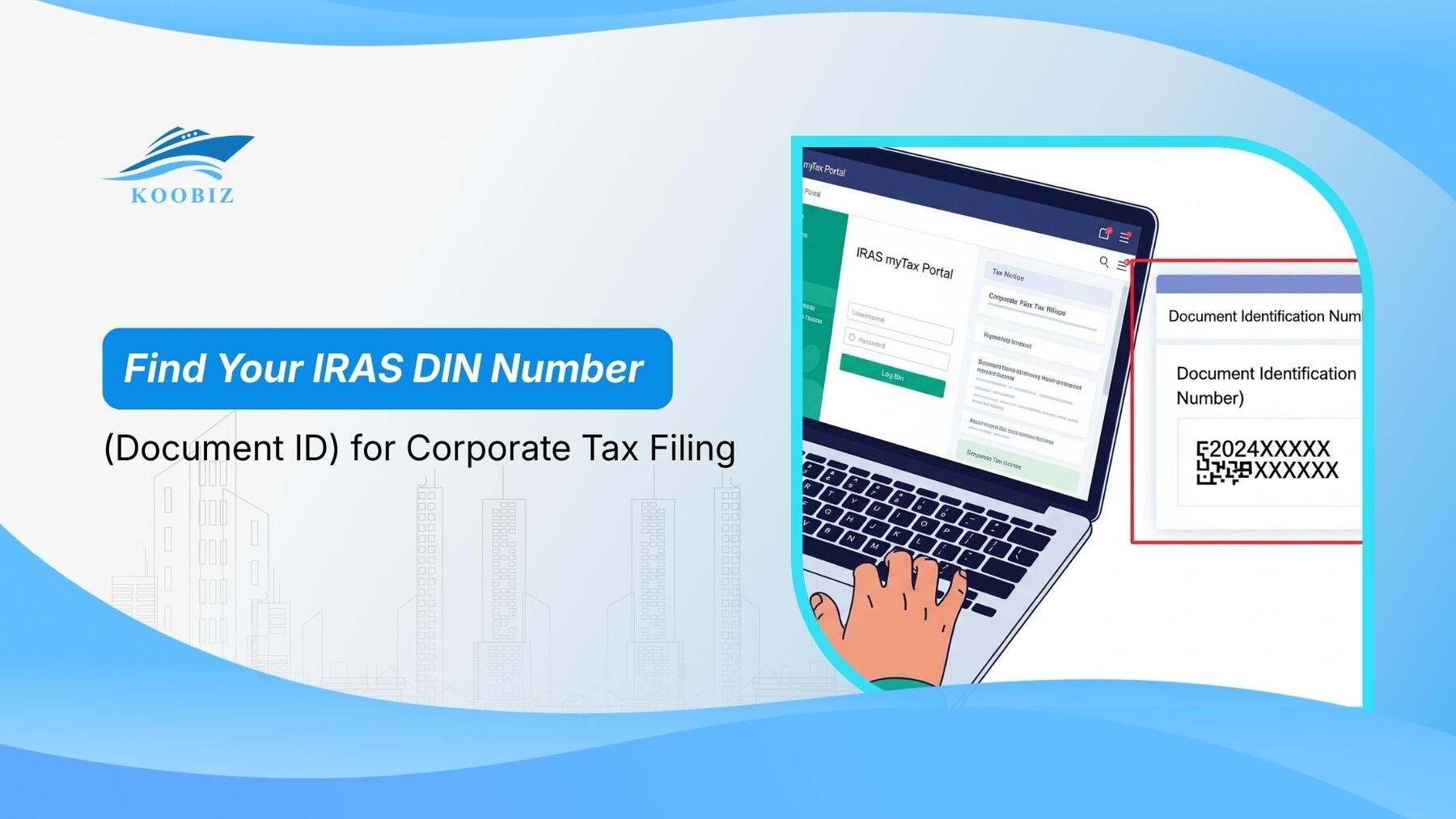
Category: Accounting & Bookkeeping

  • Find Your IRAS DIN Number (Document ID) for Corporate Tax Filing

    Find Your IRAS DIN Number (Document ID) for Corporate Tax Filing

    [SUMMARIES]

    Definition: The DIN is a unique reference number tied to a specific tax return type and Year of Assessment (YA), used to identify outstanding returns.

    Retrieval: You can view it via the myTax Portal (using Corppass) or on the Notice to File letter, if your company still receives paper mail.

    Crucial Distinction: Never use the DIN for making payments; use the Payment Reference Number (usually your UEN) to avoid transaction errors.

    Access: Corporate tax e-filing is based on Corppass authorization, not the DIN. You usually do not need to enter the DIN to access the filing wizard manually.

    Dormant Companies: Companies granted a waiver of Income Tax Return submission do not require a DIN, as they are not required to file Form C-S/C for that YA.

    [/SUMMARIES]

    Having trouble locating your IRAS DIN number during tax season? This is a common issue for many companies. At Koobiz, we often help clients who hit a roadblock because they cannot find their Document Identification Number (DIN) or confuse it with other tax references. This guide addresses that issue clearly and directly. We will show you exactly what the DIN is, how to quickly find it on the myTax Portal, and why you must distinguish it from your Payment Reference Number to ensure a seamless filing for Form C-S/C.

    What is the Document Identification Number (DIN) issued by IRAS?

    DIN IRAS: unique tax identification code
    DIN IRAS: unique tax identification code

    The Document Identification Number (DIN) is a unique alphanumeric code issued by the Inland Revenue Authority of Singapore (IRAS) to identify a particular tax return document for a specific Year of Assessment (YA).

    The DIN functions as a reference key that links a company to its tax filing obligation for a specific Year of Assessment. Its core characteristics include:

    • Dynamic & Unique: Unlike your company’s Unique Entity Number (UEN), which never changes, a new DIN is generated for every specific tax form and financial year.
    • Identifier (Not Password): Since e-filing became mandatory in 2020, the DIN is no longer used as a portal access credential. However, it remains the unique identifier for the specific return in the IRAS backend system.
    • Error Prevention: It acts as a coordinate in the IRAS database, ensuring your submission lands in the correct assessment period (e.g., preventing a YA 2026 filing from overwriting YA 2025 data).

    Therefore, while you may not always be required to enter the DIN to initiate e-filing, possessing the correct DIN (or knowing where to find it) is essential for verifying your filing status and communicating with IRAS.

    How to Find Your DIN for Corporate Tax Filing: A Step-by-Step Guide

    There are two primary methods to retrieve your DIN: accessing it digitally through the myTax Portal or locating it physically on the hard-copy Notice to File sent by IRAS.

    Using the correct retrieval method helps ensure that you reference the valid DIN for the relevant Year of Assessment.
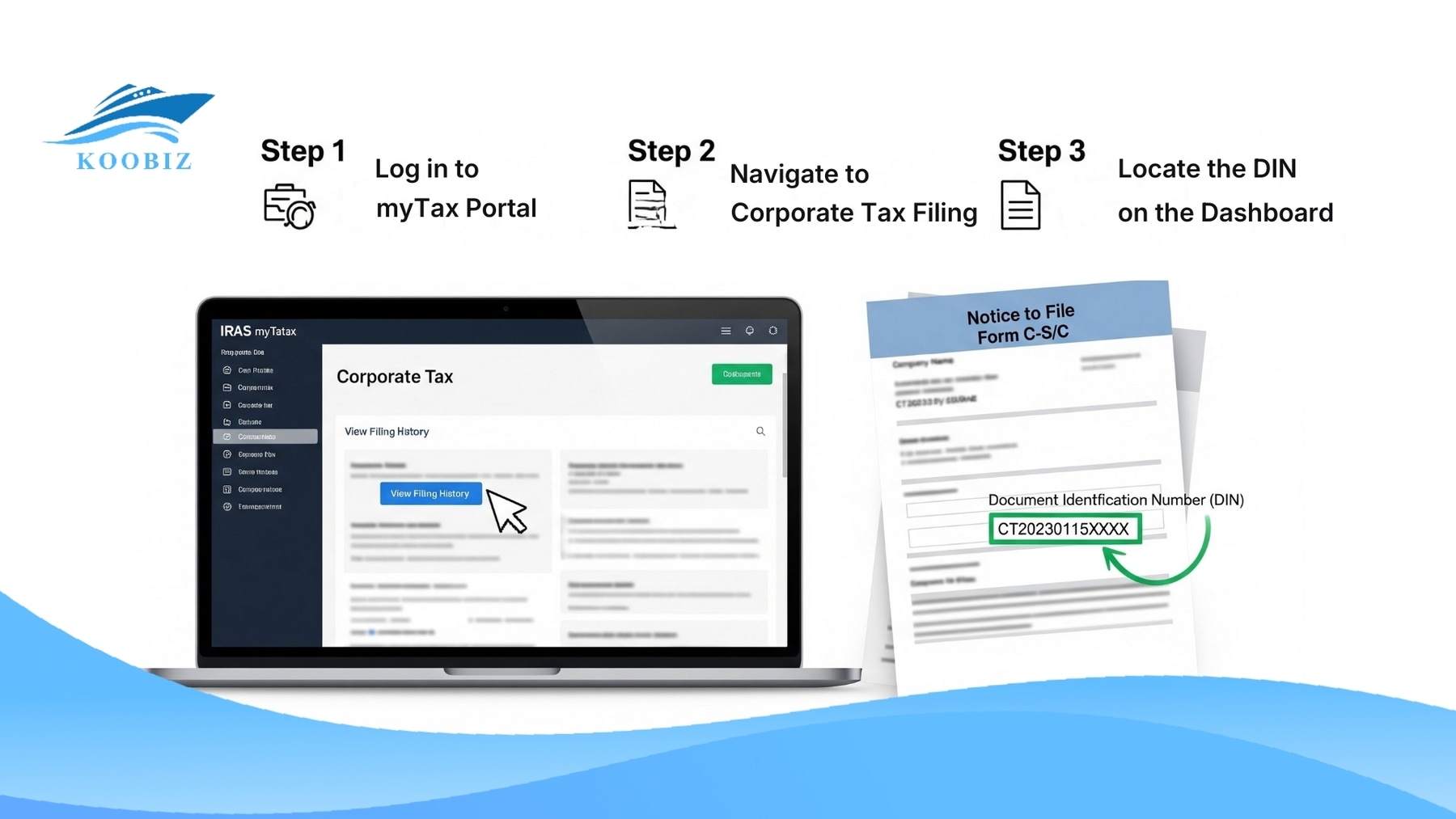
    Find IRAS DIN on myTax Portal Notice
    Find IRAS DIN on myTax Portal Notice

    Viewing DIN via the myTax Portal (Digital Method)

    As part of Singapore’s digital tax administration framework, the digital retrieval method is the most reliable and immediate way to find your DIN, especially if physical mail has been misplaced.

    1. Log in to myTax PortalNavigate to the official IRAS myTax Portal. You must select “Business” and log in using your Corppass. Ensure that the user logging in has been authorized for “IRAS (Corporate Tax)” digital services within the Corppass system. Without this specific authorization, the relevant menus will not appear.
    2. Navigate to Corporate Tax FilingOnce logged in, look for the menu bar at the top. Hover over “Corporate Tax” and select “File Form C-S/C”. This is the specific section where the filing process begins.
    3. Locate the DIN on the DashboardUpon entering the filing section, the system will display a list of outstanding tax returns for various Years of Assessment. Look for the row corresponding to the current YA (e.g., YA 2026). The Document Identification Number (DIN) will be clearly displayed in that row.

    Note: In most cases, you can click the “File” button to launch the wizard without manually typing this number.

    It is important to note that if the status shows “Filed” or “Processed,” the DIN may still be visible for reference, but the action required has already been completed.

    Locating the DIN on Physical Tax Notices (Paper Notice to File)

    IRAS has largely transitioned to digital correspondence, and most tax notices are now issued electronically. However, if your company still receives paper mail, the hard-copy Notice to File remains the authoritative reference.

    When IRAS sends out the filing notification (usually between January and May, depending on the company’s financial year-end), it arrives as a formal letter titled “Notice to File Form C-S/C”.

    Where to look:

    1. Check the top-right corner: On the very first page of the letter, locate the box containing key details.
    2. Verify the Year: Ensure the Year of Assessment matches the tax year you intend to file for.
    3. Identify the DIN: Look for the Document ID (DIN) printed in bold text. It is typically a long string of numbers (e.g., 20268888888).

    This physical document is valuable for record-keeping. At Koobiz, we advise clients to scan this document immediately upon receipt and save it in their cloud storage, ensuring the DIN is accessible to their accountant or tax agent even if the physical paper is misplaced later.

    Difference Between DIN and Payment Reference Number

    The DIN is used to identify specific tax returns, while the Payment Reference Number is the only reference that should be used for tax payments.

    Distinguishing between these two numbers is important, as using the wrong reference is a common cause of “payment not received” errors in Singapore’s corporate tax system.

    Feature Document Identification Number (DIN) Payment Reference Number
    Primary Purpose Identification: Used to identify a specific tax return document, such as Form C-S for YA 2026. Payment: Identifies the payer and allocates funds to the correct tax account.
    When to Use Reference only. Displayed on the filing dashboard and used when referring to or requesting copies of filed returns. Used for GIRO, PayNow, AXS, or Internet Banking transfers.
    Structure Dynamic: A new DIN is issued for each Year of Assessment (YA) and for each specific tax form. Static: Usually your company’s Unique Entity Number (UEN), which remains constant across years.
    IRAS Destination Returns Processing Branch. Collections Branch.

    Important Warning: If you attempt to enter the DIN into your bank’s “Bill Reference” field when paying tax, the transaction will likely fail, or worse, the payment may be held in a suspense account by IRAS because the banking system does not recognize the DIN format as a valid payment account. IRAS places the responsibility on taxpayers to ensure the correct Payment Reference Number is used for all payments.

    Troubleshooting Common Issues with IRAS DIN Retrieval

    Troubleshooting Common Issues with IRAS DIN Retrieval
    Troubleshooting Common Issues with IRAS DIN Retrieval

    In practice, locating a DIN may not always be straightforward, especially for back-dated filings or when access to the myTax Portal is restricted.

    Resolving these issues requires an understanding of how IRAS archives past records and controls Corppass user access.

    Can You Retrieve a DIN for Previous Years of Assessment?

    Yes, DINs for previous Years of Assessment can still be retrieved, but the retrieval method depends on whether the return is outstanding or already processed.

    If a filing deadline for a previous YA (for example, YA 2024) was missed, the return is classified as “Outstanding. When you log into the myTax Portal and navigate to “File Form C-S/ C”, the system will usually display all outstanding returns, including those from prior years. The DIN for that specific past year will be listed there.

    If you need a DIN for a Year of Assessment that has already been filed, purely for record-keeping or verification purposes, you may need to navigate to the “View Correspondence/Notices” section of the portal. Here, you can download digital copies of past “Notices to File,” which will show the DIN as it appeared on the original digital Notice to File.

    What Should You Do If You Cannot Access myTax Portal?

    If you cannot log in to retrieve your DIN, the issue usually lies with Corppass authorization, not the IRAS system itself.

    1. Check Corppass Account: Confirm that your Corppass account is active and has not been suspended.
    2. Verify Assigned e-Services: The company’s Corppass Administrator (usually the business owner or Company Secretary) must assign the “IRAS (Corporate Tax)” e-Service to your user ID.
    3. Browser Compatibility: Sometimes, simply clearing the cache or switching to a private/incognito window resolves display issues where the dashboard fails to load.

    If these steps fail, you can contact IRAS directly via their helpline. IRAS will conduct strict identity verification before releasing any DIN-related information over the phone, in line with security protocols.

    Do Dormant Companies Need a DIN for Tax Filing?

    No. Dormant companies that have been granted a Waiver of Income Tax Return Submission generally do not receive a DIN, as they are not required to file an income tax return for that Year of Assessment.

    This exemption is commonly used when business operations are temporarily suspended, and Koobiz regularly assists clients in applying for this waiver.

    Waiver of Income Tax Return Submission

    A dormant company is one that has no revenue or income for the entire financial period. However, being dormant does not automatically exempt you from filing. A formal application for a Waiver of Income Tax Return Submission must be made to IRAS.

    Once IRAS approves this waiver:

    • IRAS will stop issuing the “Notice to File” (Form C-S/C) for the approved waiver period.
    • As a result, no DIN is generated for that Year of Assessment.
    • You do not need to log in and file anything.

    If you have not applied for the waiver, IRAS will still treat you as an active filer, issue a Notice to File, generate a DIN, and expect a submission (even if it is a “Nil” return). Accordingly, if you cannot locate a DIN, the first step is to check whether an active waiver is in place. If you don’t have a waiver and didn’t receive a DIN, you might be non-compliant and should contact a professional immediately.

    Authorising Third-Party Agents to Use Your DIN

    Authorising a third-party agent involves formally delegating access to the myTax Portal so the agent can manage filings associated with your company’s DIN.

    This is standard practice for most SMEs in Singapore that engage licensed corporate service providers such as Koobiz.

    Setting up Corppass for Tax Agents

    You do not need to give your personal Singpass or the company’s DIN directly to your accountant. Instead, authorization should be granted securely through the Corppass system.

    1. Identify the Agent: You will need the Tax Agent’s UEN (Unique Entity Number).
    2. Authorize in Corppass: The company’s Corppass Admin logs in and selects “Authorize Third Party Entity.”
    3. Select Services: Check the box for “IRAS (Corporate Tax) – Filing and Applications.”

    Once this digital handshake is complete, the Tax Agent can log in using their own credentials. They will see your company in their client list and will have access to your DIN and filing dashboard automatically. This is the most secure method of handling your corporate tax data, as it maintains a clear digital audit trail of who performed the filing.

    Navigating the nuances of IRAS compliance, from retrieving a simple DIN number to filing complex tax computations, is crucial for the longevity of your Singapore business. A missing DIN is often just a symptom of a larger administrative hurdle.

    At Koobiz, we specialize in smoothing out these operational wrinkles. Whether you need assistance with Singapore company incorporation, opening a corporate bank account, or managing your annual tax and accounting obligations, our team ensures ongoing compliance while minimizing administrative burden.

    Visit Koobiz.com today to learn more about our comprehensive corporate services.
  • Apply for Singapore Certificate of Residence (COR): Claim DTA Tax Benefits

    Apply for Singapore Certificate of Residence (COR): Claim DTA Tax Benefits

    [SUMMARIES]

    Purpose: The Certificate of Residence (COR) is essential for Singapore tax-resident companies to claim tax exemptions or reduced rates under Double Taxation Agreements (DTA).

    Key Criterion: Incorporation alone is insufficient; companies must prove “Control and Management” is exercised within Singapore (e.g., Board meetings held locally).

    Process: Applications are submitted via the IRAS myTax Portal. Standard cases are often instant, while complex cases take up to 14 working days.

    Exclusions: Dormant companies and Singapore branches of foreign companies are generally ineligible.

    Support: Koobiz assists companies in establishing economic substance and navigating complex COR applications to ensure tax compliance.

    [/SUMMARIES]

    Double taxation can significantly erode global profits. For Singapore companies, the Certificate of Residence (COR) is key to accessing Double Taxation Agreement (DTA) benefits. However, obtaining a COR involves more than simply incorporating a company – it requires demonstrating that strategic control and management are exercised in Singapore.

    This Koobiz guide breaks down IRAS requirements in a clear and practical way, covering everything from the “Control and Management” test to the step-by-step application process on the myTax Portal. Whether you operate a trading business or an investment holding company, we guide you through each stage to help you secure your entitled tax relief.

    What is a Singapore Certificate of Residence (COR)?

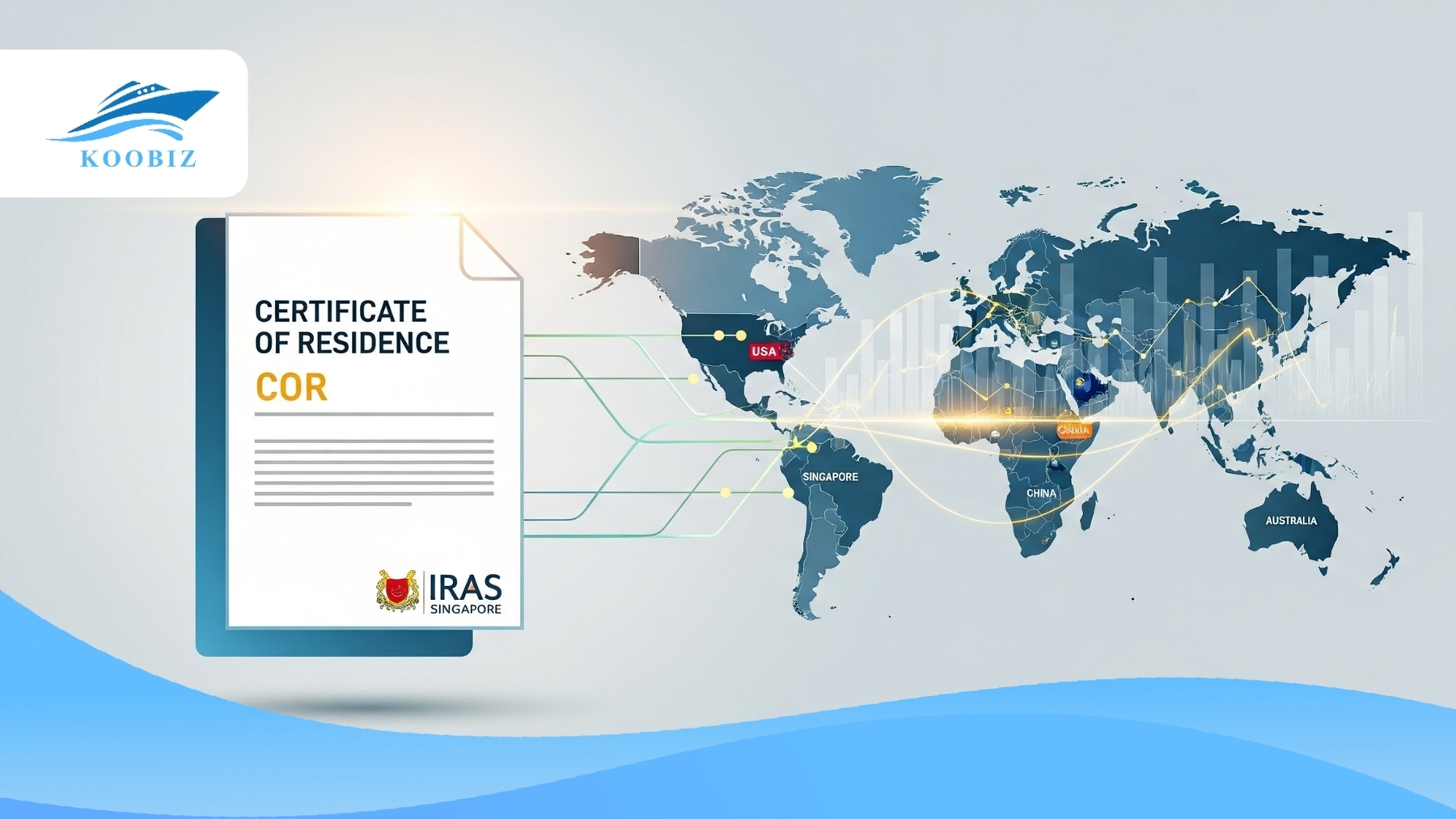
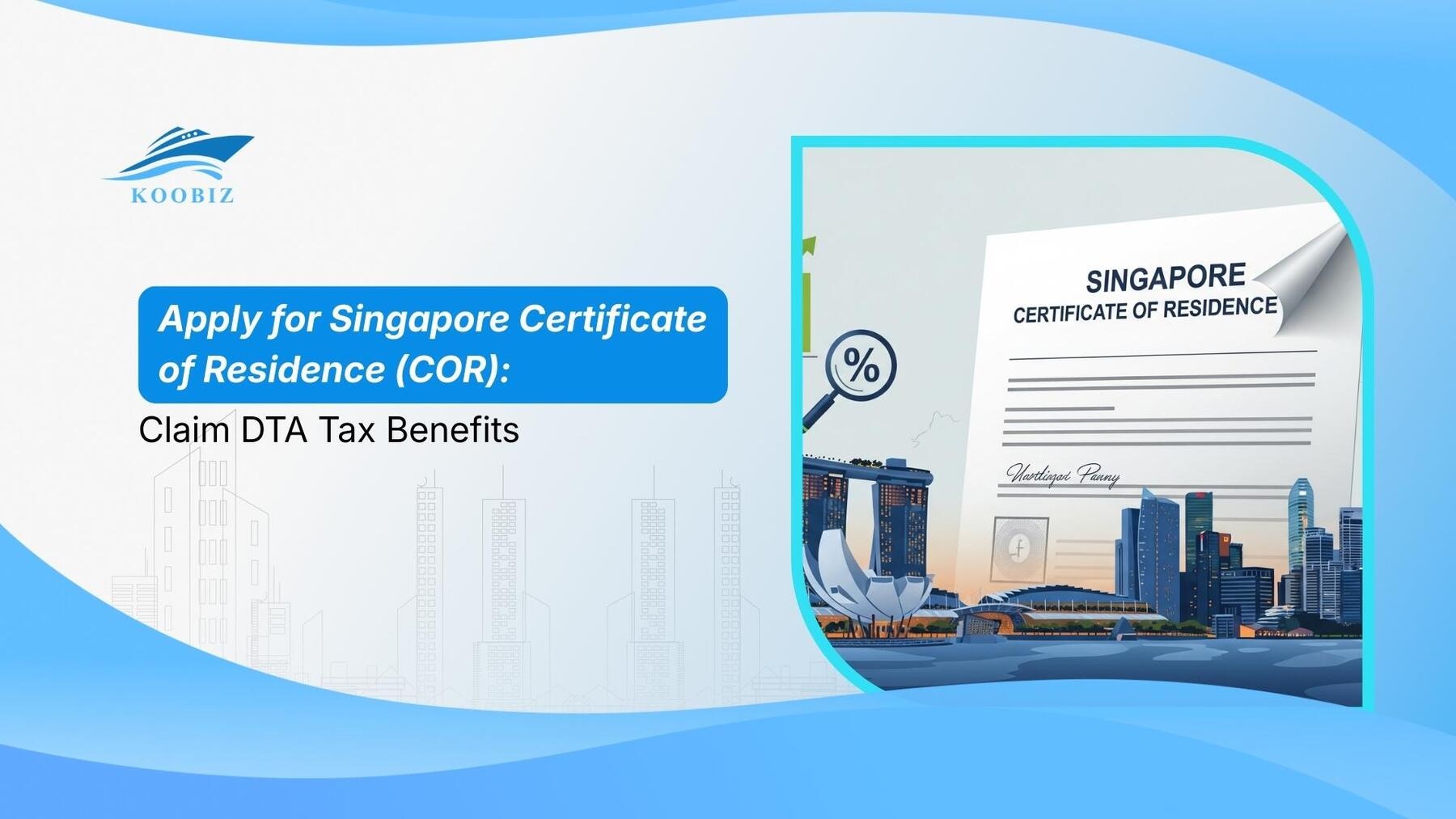
    Illustration of the Singapore Certificate of Residence and DTA benefits
    Illustration of the Singapore Certificate of Residence and DTA benefits

    The Singapore Certificate of Residence (COR) is an official document issued by the Inland Revenue Authority of Singapore (IRAS) confirming that a company is a tax resident of Singapore for a specific Year of Assessment (YA).

    Beyond its formal definition, the COR plays a critical role in international transactions. It is the key evidence required by foreign tax authorities to grant tax relief under Double Taxation Agreements (DTAs). Without a COR, income earned overseas—such as dividends, royalties, or interest—may be taxed in the foreign jurisdiction and again in Singapore. By serving as proof of Singapore tax residency, the COR enables companies to benefit from reduced withholding tax rates or full exemptions in treaty partner countries, helping to optimize their overall tax position.

    Which Types of Companies Are Eligible for a COR?

    Two main categories of companies may qualify for a Certificate of Residence (COR): Singapore-incorporated trading companies and foreign-owned investment holding companies, provided they satisfy IRAS’s strict “Control and Management” requirement.

    While incorporation in Singapore is only the first step, the key determining factor is where the company’s strategic decisions are made. In practice, this means that Board of Directors meetings, where major policies and directions are decided, must be conducted in Singapore.

    1. Singapore Incorporated Companies (Standard Trading Companies)

    Types of companies and eligibility criteria for COR
    Types of companies and eligibility criteria for COR

    This is the most common category eligible for a COR. It includes companies that are incorporated in Singapore and are actively trading or providing services.
    • Criteria: The company must hold its Board of Directors meetings in Singapore.
    • Key Requirement: Even if the company has foreign directors, the strategic authority must be demonstrated to exist in Singapore. If the Board meets locally to approve financial statements and business strategies, the company is eligible.

    2. Foreign-Owned Investment Holding Companies (2025 Updates)

    Companies that are 50% or more owned by foreign entities/individuals and function purely as investment vehicles face the strictest scrutiny.

    New 2025/2026 Requirements:

    As of 2025, IRAS has tightened the rules. To demonstrate valid commercial reasons for setting up in Singapore, these companies generally must meet one of the following enhanced substance requirements:

    • Key Personnel: Employ at least one Executive Director or Key Employee (e.g., CEO, CFO, COO) based in Singapore.
    • Active Management: Demonstrate that the company is actively managed by a related company based in Singapore (passive reliance on a related company is no longer sufficient).

    Eligibility Checklist:

    • Valid commercial reasons for setting up in Singapore.
    • Local business spending (beyond just statutory fees).
    • A physical office presence.
    • Note: Purely passive entities without local executive staff may face rejection.

    3. Types of Companies That Are NOT Eligible

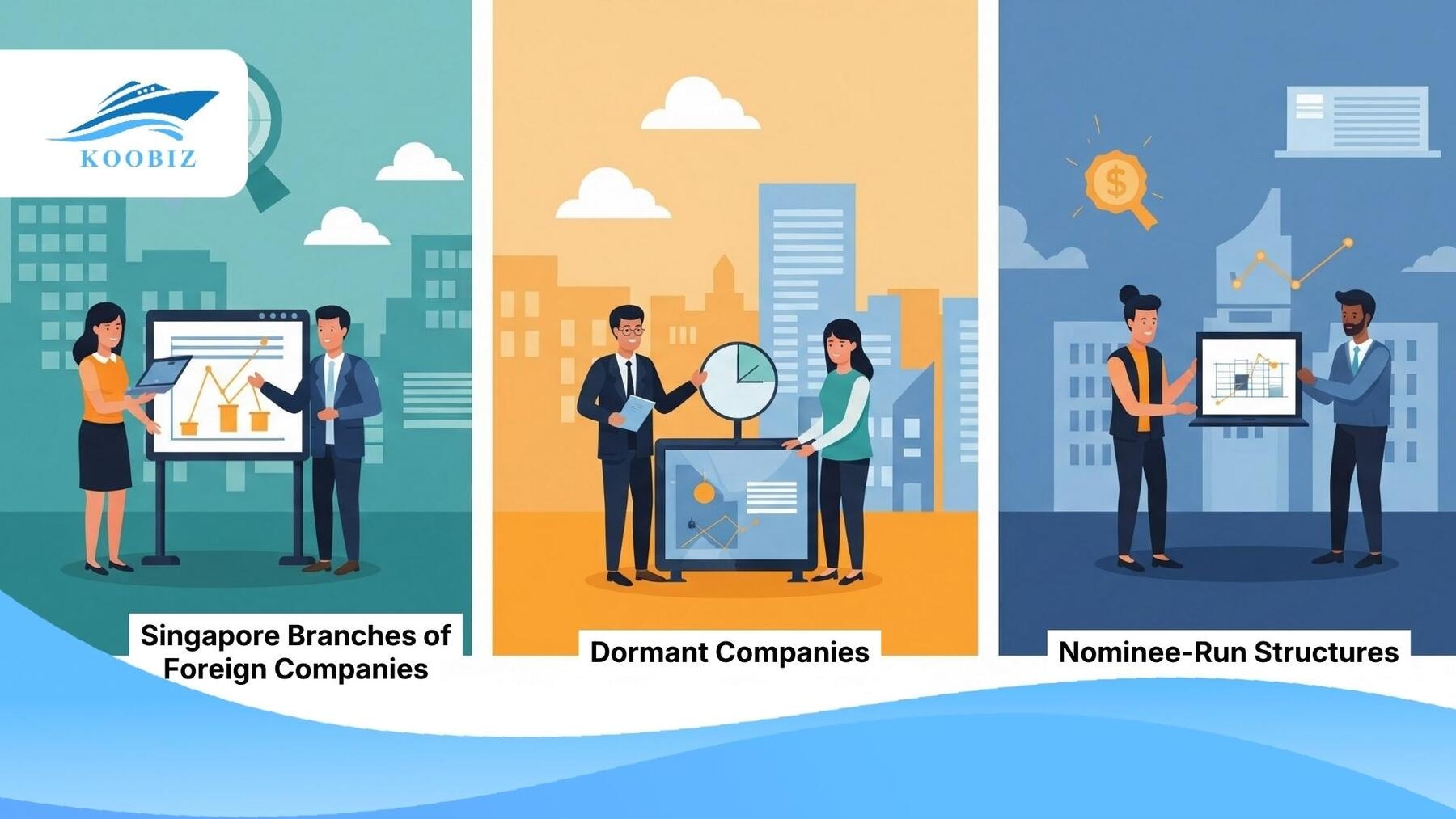
    Types of Companies That Are NOT Eligible for a COR
    Types of Companies That Are NOT Eligible for a COR
    • Singapore Branches of Foreign Companies: Since control is vested in the overseas head office, branches are generally not considered tax residents.
    • Dormant Companies: While not explicitly banned by definition, dormant companies almost always fail the “Control and Management” test because they conduct no business activity. Thus, they are practically ineligible.
    • Nominee-Run Structures: Companies run solely by nominee directors without real local discretion will likely fail the eligibility test.

    Koobiz Insight: For foreign investors, distinguishing between a “Standard Company” and an “Investment Holding Company” is vital. If your goal is to utilize DTAs, you must structure your Board and operations to meet these specific eligibility requirements from Day 1.

    How to Apply for COR via IRAS myTax Portal

    The application is a digital process via the IRAS myTax Portal. Companies (or their appointed tax agents like Koobiz) must use their CorpPass to access the system.

    Step 1: Login and Navigation

    Log in to myTax Portal using CorpPass. From the menu, select “Corporate Tax” > “Apply for Certificate of Residence (COR)”.

    Step 2: Enter Details

    Select the Treaty Country and the Year of Assessment.

    • Advance Year: From October onwards, you can apply for a COR for the upcoming calendar year.
    • Past Years: You can apply for up to 4 back calendar years retrospectively.

    Step 3: Declaration

    Confirm that the control and management of the business are exercised in Singapore for the specified period.

    Step 4: Confirmation

    Once submitted, standard applications are often approved instantly. Complex cases (e.g., investment holding companies) may flag for manual review (“Pending”).

    What are the Validity and Processing Times?

    • Processing Time:
      • Standard Cases: Instant or within 7 working days.
      • Complex Cases: Up to 14 working days (often requires submitting Board minutes or travel records).
      • Tax Reclaim Forms: Up to 1 month if manual certification is needed.
    • Validity Period: A COR is valid for one specific calendar year. You must ensure the COR year matches the year the income was received.

    Comparison: Standard COR vs. Tax Reclaim Form

    While the COR is the standard proof of residency, some countries historically required their own specific forms.

    Aspect Standard COR Tax Reclaim Form
    Format IRAS computer-generated PDF letter Country-specific form (e.g., Form DGT)
    Acceptance Accepted by most treaty partners (UK, Australia, Vietnam, Indonesia) Required by very few specific partners (e.g., Japan)
    Process Digital via myTax Portal Manual submission to IRAS for physical stamp
    Processing Time Instant to 14 days Up to 1 month

    Important Note for Indonesia:

    Previously, Indonesia required the “Form DGT” to be certified by IRAS. Under current guidelines, however, Indonesia now accepts the standard Singapore Certificate of Residence (COR) as adequate proof of tax residency. As a result, there is no longer a need to submit Form DGT to IRAS for physical endorsement—the standard COR attached to your filing is sufficient.

    Navigating Complex Scenarios and Rejections

    Complex business structures, particularly Foreign-Owned Investment Holding Companies, face stricter scrutiny.

    • Letter of Clarification: If IRAS is unsure about your status, they will issue a query letter. You must provide minutes of Board Meetings held in Singapore, travel records of directors, and proof of local business expenditure.
    • The “Edge Cases”: Koobiz often assists clients who fall into “edge cases.” For example, if a company is non-Singapore incorporated but effectively managed here, it may be eligible in exceptional circumstances, though this is rare.

    Can You Apply for COR for Past Years?

    Yes, companies can apply for a COR for past years (Back Years), provided they can prove they met the residency criteria during those specific periods.

    • Retrospective Limit: You can apply for the current year plus up to 4 preceding calendar years via the portal.
    • Compliance Check: IRAS will review the company’s tax filings for that historical period. If the company was dormant or managed overseas during that year, the application will be rejected.

    Distinguishing Tax Residency from Citizenship

    • Place of Incorporation (Legal): Where the company is born (e.g., registered with ACRA).
    • Place of Management (Tax): Where the company “lives and thinks.” A company can be incorporated in Singapore but be a tax resident of another country if its control is exercised there.

    Optimize Your Tax Strategy with Koobiz

    Obtaining a Certificate of Residence is a critical step in optimizing your international tax strategy. However, the nuances of the “Control and Management” test—especially with the new 2025 substance requirements—can be daunting.

    At Koobiz, we specialize in helping foreign and local entrepreneurs navigate the Singapore corporate landscape. From company incorporation to opening bank accounts and managing tax compliance, our team ensures your business meets all economic substance requirements to successfully obtain your COR.

    Ready to claim your DTA benefits? Visit Koobiz.com to consult with our tax specialists today. We help you build a compliant, tax-efficient structure right from the start.

    Disclaimer: Guidelines are based on IRAS rules as of early 2026. Tax regulations can change; always check iras.gov.sg or consult a professional for the latest updates.

  • Is Dividend Income Taxable in Singapore? A Corporate Guide to Tax-Exempt & One-Tier Rules

    Is Dividend Income Taxable in Singapore? A Corporate Guide to Tax-Exempt & One-Tier Rules

    [SUMMARIES]

    General Rule: Dividend income paid by Singapore-resident companies is tax-exempt for shareholders under the One-Tier System.

    Foreign Dividends: Foreign-sourced dividends remitted to Singapore are taxable unless they meet the three conditions of the Foreign-Sourced Income Exemption (FSIE) scheme.

    Compliance: Even tax-exempt dividends must be declared in Form C or Form C-S for administrative purposes.

    No Withholding Tax: Singapore does not levy withholding tax on dividend payments to non-residents.

    Exceptions: Dividends from co-operatives or certain REIT distributions may be subject to different tax treatments.

    [/SUMMARIES]

    Business owners often ask Koobiz: “Is dividend income taxable in Singapore?” The short answer is generally No, due to Singapore’s One-Tier Corporate Tax System, under which dividends paid by Singapore companies are generally tax-exempt in the hands of shareholders. That said, not all dividends are treated equally. While locally sourced dividends enjoy automatic exemption, foreign-sourced dividends are subject to specific remittance and exemption rules. This guide breaks down how dividend taxation works in practice, outlines the FSIE exemption framework, and highlights the key compliance steps your company must follow to remain fully aligned with IRAS requirements.

    Is Dividend Income Taxable in Singapore for Companies?

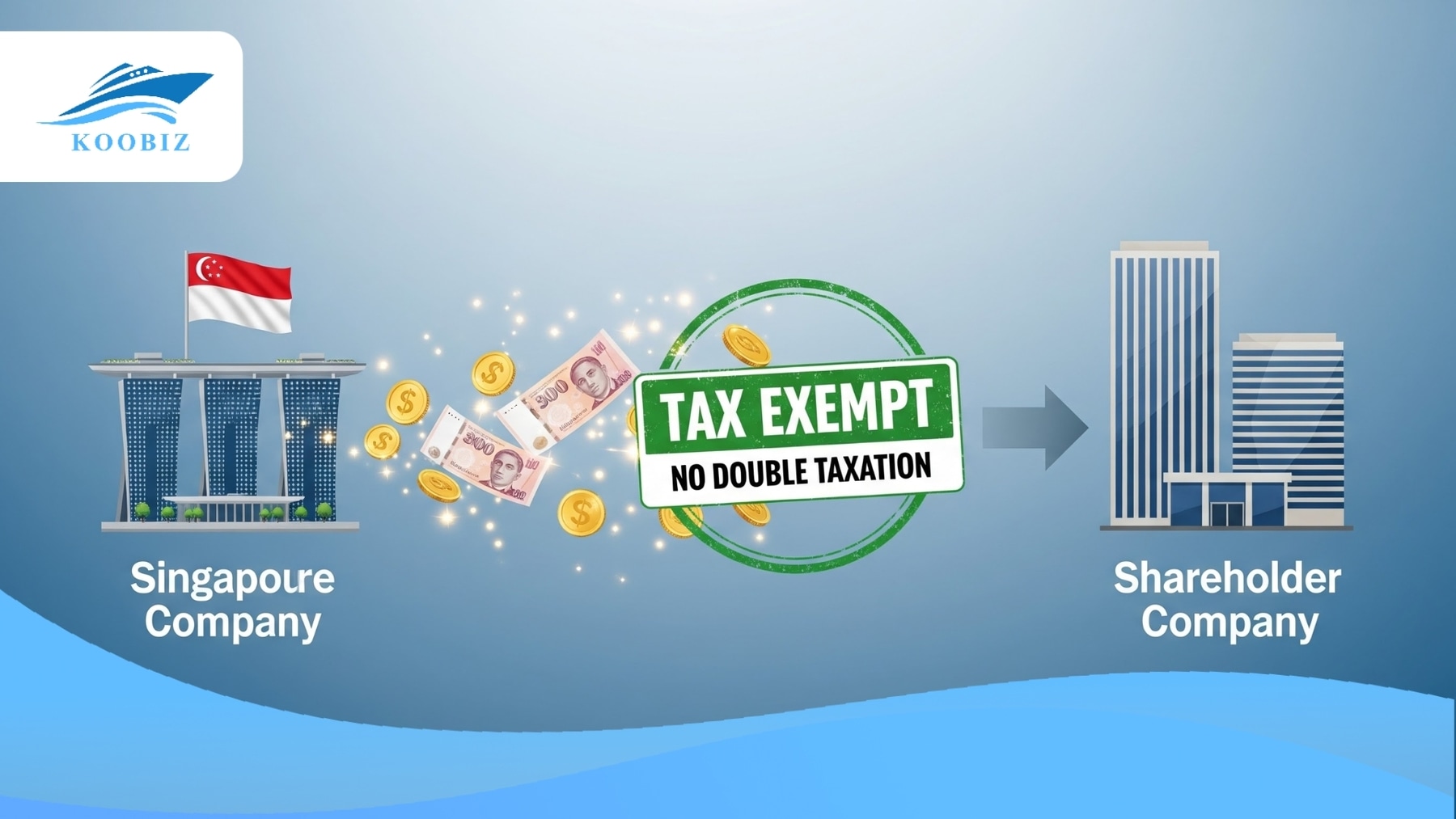
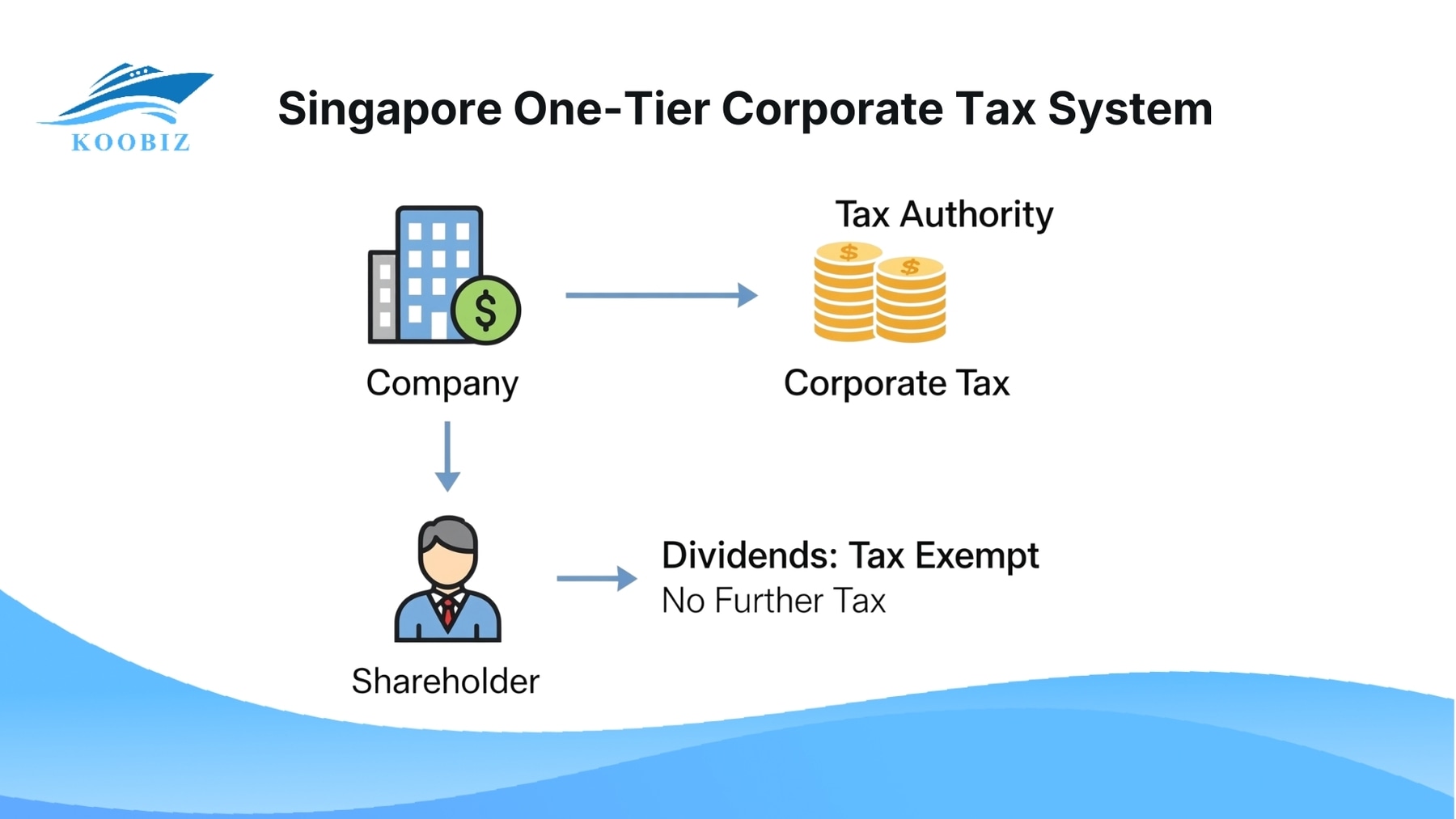
    Singapore One-Tier Tax System Diagram
    Singapore One-Tier Tax System Diagram

    No. Generally, dividend income is tax-exempt for companies in Singapore, provided it is paid by a local tax-resident company under the One-Tier Corporate Tax System.

    Key details:

    • Final Tax: The tax paid by the paying company on its profits is considered the final tax.
    • No Double Taxation: Shareholders (companies) are exempt from paying further tax on the dividends received.
    • Universal Application: This exemption applies to all shareholders, regardless of whether they are Singapore tax residents or non-residents.
    • Exception: This rule applies to local dividends. Foreign-sourced dividends remitted to Singapore may be taxable unless specific exemptions (FSIE) apply.

    What is the One-Tier Corporate Tax System?

    Singapore One-Tier Corporate Tax System
    Singapore One-Tier Corporate Tax System

    Since January 1, 2003, Singapore has utilized the One-Tier Corporate Tax System. Under this regime, the tax payable on a company’s chargeable income (currently capped at 17%) is the final tax.

    As a result, dividends distributed to shareholders are not taxed again, significantly simplifying compliance and lowering overall administrative burdens.

    Core Attributes of the One-Tier System:

    • Final Tax: Corporate tax paid by the company is final; no further tax is levied on the distribution.
    • No Tax Credits: Shareholders do not claim tax credits attached to dividends.
    • Unlimited Distribution: Companies can pay dividends out of all accounting profits.

    Tax Treatment of Local vs. Foreign-Sourced Dividends

    The tax treatment differs significantly depending on the source of the dividend. Local dividends are automatically exempt, whereas foreign dividends require specific conditions to be met.

    Quick Comparison: Local vs. Foreign Dividends

    Feature Local Dividends Foreign-Sourced Dividends
    Source Paid by a Singapore Tax Resident Company Paid by a Non-Singapore Resident Company
    Tax Status Tax-Exempt Prima facie Taxable (when remitted to Singapore)
    Key Condition None (Automatic under One-Tier System) Must meet FSIE conditions (see below) to be exempt
    Double Taxation Avoided via One-Tier System Avoided via FSIE or Unilateral Tax Credit (UTC)

    To prevent double taxation on foreign income, companies must utilize the Foreign-Sourced Income Exemption (FSIE) scheme.

    Requirements for Foreign-Sourced Income Exemption (FSIE)

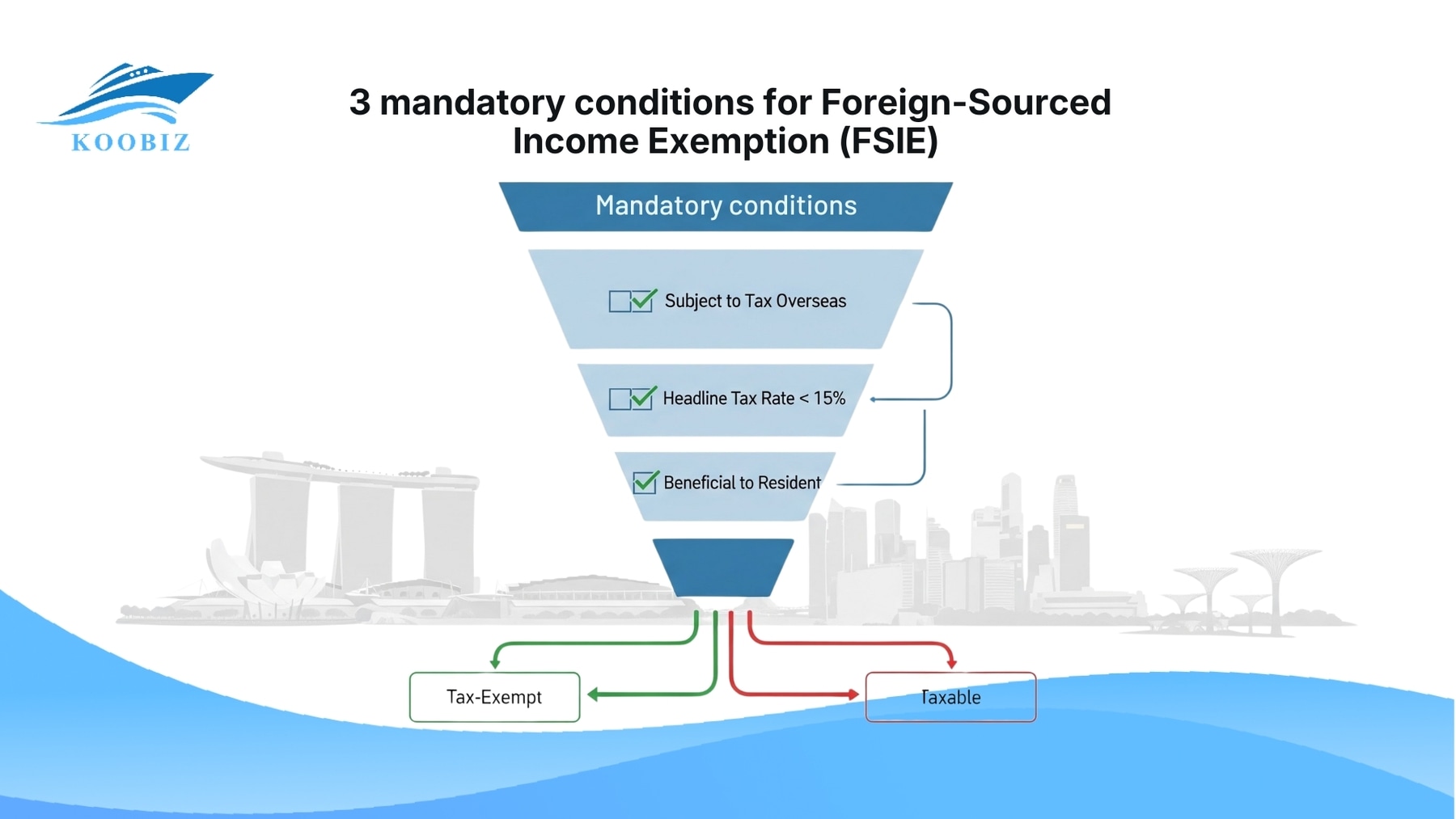
    3 mandatory conditions for Foreign-Sourced Income Exemption (FSIE)
    3 mandatory conditions for Foreign-Sourced Income Exemption (FSIE)

    To qualify for tax exemption under Section 13(8) of the Income Tax Act, foreign-sourced dividends must meet three mandatory conditions. If even one condition is missing, the dividend is taxable upon remittance.

    The FSIE Checklist:

    “Subject to Tax” Condition

    The foreign-sourced dividend must have been taxed in the overseas jurisdiction. This can take the form of corporate income tax imposed on the underlying profits or withholding tax levied on the dividend distribution itself.

    Note: If tax was not paid due to a substantive business incentive in the foreign country, you may apply to IRAS for a waiver.

    “Headline Tax Rate” Condition

    The country from which the dividend originates must have a headline (statutory) corporate income tax rate of at least 15% at the point the income is received in Singapore.

    Clarification: This refers to the statutory tax rate, not the effective rate actually paid.

    “Beneficial to Resident” Condition

    The Comptroller of Income Tax must be satisfied that granting the exemption is beneficial to the Singapore tax resident company.

    Context: Exemption is generally beneficial unless the company is in a loss position and prefers to pay tax to utilize foreign tax credits.

    Case Studies: Applying the Rules in Practice

    Visualizing these rules helps clarify the distinction between taxable and tax-exempt scenarios. Here are three typical examples for Koobiz Holdings Pte Ltd (a Singapore tax resident company).

    Scenario A: Local Dividend (Tax-Exempt)

    • Source: Koobiz Holdings receives dividends from a local subsidiary, SingTech Pte Ltd.
    • Outcome: Not Taxable.
    • Reason: Under the One-Tier System, dividends from Singapore resident companies are strictly tax-exempt.

    Scenario B: Qualified Foreign Dividend (Tax-Exempt)

    • Source: Dividends received from a subsidiary in Japan (Headline Tax Rate ~23%). The Japanese subsidiary paid corporate tax on its earnings.
    • Outcome: Not Taxable.
    • Reason: It meets FSIE conditions:
      1. Subject to tax in Japan? Yes.
      2. Headline rate ≥ 15%? Yes (23%).
      3. Beneficial to Singapore resident? Yes.

    Scenario C: Non-Qualified Foreign Dividend (Taxable)

    • Source: Dividends received from a subsidiary in the Cayman Islands (Headline Tax Rate 0%).
    • Outcome: Taxable at 17%.
    • Reason: It fails FSIE conditions. The headline tax rate is below 15%, and no foreign tax was paid. Koobiz Holdings must declare this as taxable income in Form C-S.

    While local dividends are fully exempt and foreign-sourced dividends may qualify for exemption under the FSIE regime, real-world cases are often less straightforward. In practice, Koobiz advisors frequently deal with situations where the usual rules break down due to jurisdictional nuances, incentive regimes, or structural complexities. The next section therefore explores key exceptions, proper reporting treatment, and lesser-known attributes within Singapore’s tax framework that businesses should be aware of.

    Exceptions: When is Dividend Income Taxable?

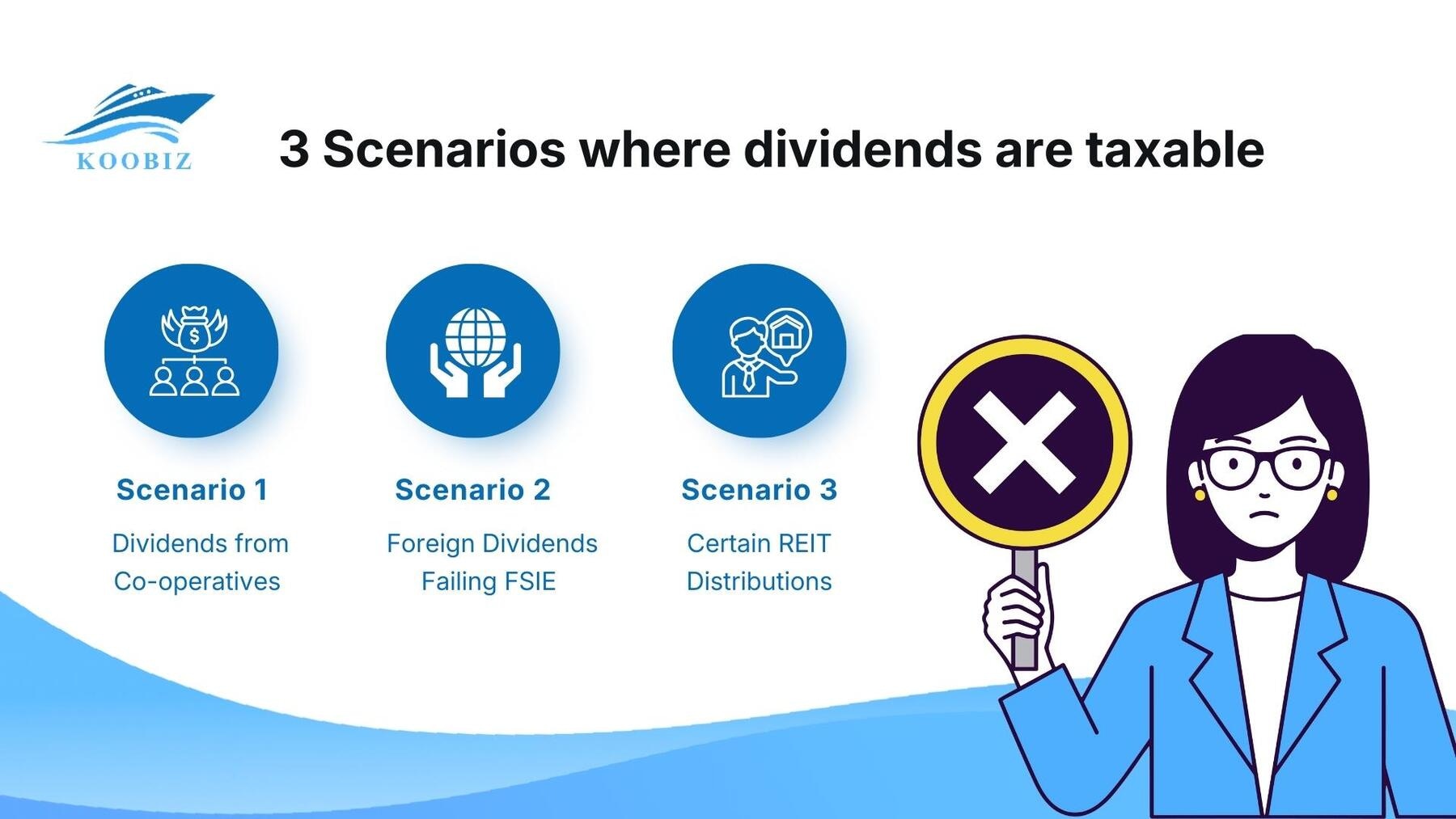
    3 Scenarios where dividends are taxable
    3 Scenarios where dividends are taxable

    While exemption is the norm, business owners must be aware of specific scenarios where tax liability arises.

    Alert: 3 Scenarios Where Dividends Are Taxable

    1. Dividends from Co-operatives:

    Co-operatives often receive entity-level tax concessions, so their dividends do not fall under the One-Tier system and are generally taxable for the shareholder.

    2. Foreign Dividends Failing FSIE:

    If dividends come from a jurisdiction with a headline tax rate below 15% (e.g., certain tax havens) or where no tax was paid, they are fully taxable. In this case, claim Unilateral Tax Credit (UTC) to mitigate double tax.

    3. Certain REIT Distributions:

    Although many REIT distributions are exempt for individual investors, distributions derived from taxable income are usually taxable for corporate unitholders unless specific tax transparency treatment applies. For foreign investors, such distributions may also be subject to a final withholding tax, commonly at a rate of around 10%.

    How to Report Dividend Income in Tax Returns (Form C/C-S)

    Even though dividend income is often tax-exempt, it must be reported in your annual tax return for reconciliation purposes.

    Step-by-Step Reporting Guide:

    Step 1: Identify

    Separate “Singapore Dividends” from “Foreign Dividends.”

    Step 2: Verify

    Confirm local dividends are One-Tier and foreign dividends meet FSIE.

    Step 3: File

    Form C-S / C-S (Lite): Enter the total amount in the “Tax-Exempt Income” declaration section.

    Form C: List dividends under “Non-Taxable/Exempt Income” in your tax computation to deduct them from net profit.

    Step 4: Retain

    Keep dividend vouchers and proof of foreign tax paid for 5 years.

    ? Koobiz Pro Tip: Accurately categorizing this income prevents unnecessary queries from IRAS. Ensure your financial statements clearly distinguish between “tax-exempt dividends” and other income sources before filing.

    Withholding Tax on Dividends: Does it Apply?

    No. Singapore does not impose withholding tax on dividends paid to non-resident shareholders.

    This zero-tax policy significantly boosts ROI for international investors compared to other jurisdictions.

    Global Comparison:

    • ?? Singapore: 0%
    • ?? USA: 30% (Standard rate)
    • ?? Indonesia: 20% (Standard rate)

    This eliminates complex treaty relief applications for dividends, ensuring smooth cross-border cash flows.

    Conclusion

    Overall, Singapore offers one of the most business-friendly dividend tax frameworks globally. Dividends from Singapore-resident companies are fully tax-exempt under the One-Tier Corporate Tax System, while foreign-sourced dividends can often be brought into Singapore tax-free if they qualify under the FSIE rules. However, the nuances of compliance—reporting correctly on Form C-S and ensuring foreign dividends meet the 15% headline tax rate test—require diligence.

    At Koobiz, we specialize in helping businesses navigate the Singapore corporate landscape. Whether you need assistance with incorporating a Singapore company, opening a corporate bank account, or managing your tax and accounting compliance, our team of experts is ready to assist. We ensure your financial structures are optimized so you can focus on growth while we handle the regulatory complexities.

    Visit Koobiz.com today to schedule a consultation regarding your dividend tax planning.

  • What is ECI? Filing Requirements and Waivers for Singapore SMEs in 2026

    What is ECI? Filing Requirements and Waivers for Singapore SMEs in 2026

    [SUMMARIES]

    Mandatory Estimate: ECI stands for Estimated Chargeable Income, a preliminary report of a company’s taxable profit required by IRAS within 3 months of the financial year-end.

    Waiver Eligibility: Companies are exempt from filing if their annual revenue is S$5 million or less AND their ECI is NIL.

    Cash Flow Benefit: Early e-filers can access up to 10 interest-free GIRO installments to settle their tax liabilities.

    Contextual Variety: While primarily a tax term in Singapore, ECI also refers to Early Childhood Intervention in healthcare and Electronic Commerce Indicators in digital payments.

    [/SUMMARIES]

    Understanding ECI is essential for staying compliant with Singapore tax regulations. At Koobiz, we support SMEs in navigating IRAS requirements accurately, helping them stay compliant and avoid unnecessary penalties. This article breaks down what ECI means for tax purposes, who is required to file, and how early submission can improve cash flow. To avoid confusion, we also clarify how tax ECI differs from other common uses of the term, such as Early Childhood Intervention and Electronic Commerce Indicators.

    What is Estimated Chargeable Income (ECI)?

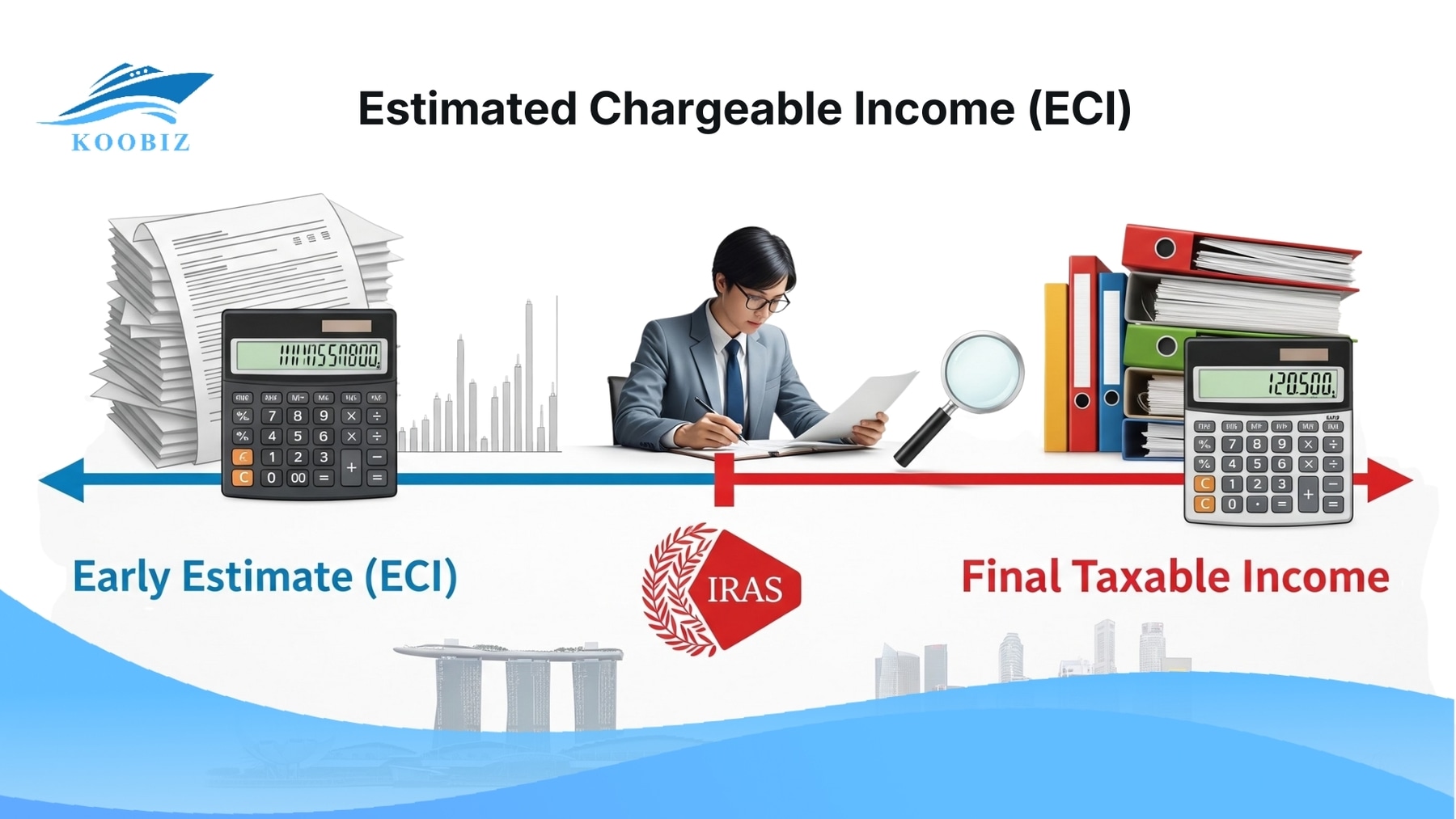
    ECI: Early estimated income submitted to IRAS
    ECI: Early estimated income submitted to IRAS

    Estimated Chargeable Income (ECI) is essentially an early snapshot of a company’s taxable income for a particular Year of Assessment (YA) that must be submitted to IRAS. In simple terms, it reflects the company’s taxable profit—after deducting allowable expenses—before the final corporate tax return (Form C-S, Form C-S (Lite), or Form C) is filed.

    The purpose of this requirement is to give the Singapore authorities an early view of a company’s earnings. At Koobiz, our experts often stress that although ECI is only an estimate, it should be prepared using the most up-to-date and accurate management accounts available, so as to minimize discrepancies when the final tax assessment is completed.

    Why IRAS Mandates ECI Filing for Singapore Companies

    The main purpose of mandatory ECI filing is to support efficient tax collection and give the authorities a timely picture of the overall economic performance across different industries. By asking companies to submit an estimate of their earnings within a short timeframe, IRAS is better able to forecast tax revenue and offer installment payment arrangements that help ease short-term cash flow pressure for businesses.

    Beyond revenue planning, this requirement also encourages companies to keep their management accounts up to date throughout the year. In practice, jurisdictions that adopt early income estimation systems tend to achieve higher levels of on-time tax compliance, and IRAS leverages this information to monitor and analyse sector-specific economic trends.

    ECI vs. Actual Taxable Income: Key Differences

    It is important to clearly differentiate ECI from the actual taxable income declared later in the year. ECI is a forward-looking estimate prepared using provisional figures, while actual taxable income is backward-looking and only finalised after the financial year has been fully closed and, where applicable, audited.

    Feature ECI (Estimated Chargeable Income) Actual Taxable Income
    Basis Forward-looking estimate (provisional figures) Backward-looking final figure (audited/finalized)
    Deadline Within 3 months of Financial Year End (FYE) By Nov 30th of the Assessment Year
    Form Type ECI Filing Form C-S, Form C-S (Lite), or Form C
    Adjustment Subject to revision if actuals differ Final declaration (unless amended later)

    If there is any variance between the ECI submitted and the figures in the final tax return, IRAS will address this through the Notice of Assessment (NOA). Where the ECI exceeds the final taxable income, the excess tax paid will be refunded; conversely, if the ECI is lower, the company will be required to make an additional tax payment.

    Which company types need to file ECI?

    In general, all companies in Singapore – including newly incorporated startups and foreign entities with income sourced locally are required to file Estimated Chargeable Income (ECI), unless they qualify for specific administrative concessions set out by IRAS. The obligation is firm: eligible companies must submit an ECI return, even if it is a “NIL” return, unless they fully meet the prescribed revenue and income thresholds for a waiver.

    The S$5 million revenue waiver Criteria

    Under the current framework, a company is exempt from filing ECI for a specific Year of Assessment only when both of the following conditions are met. You can view this as a straightforward checklist:

    • Condition 1: Annual revenue does not exceed S$5 million; and
    • Condition 2: The ECI is strictly NIL (S$0).

    Only when both conditions are satisfied can the ECI filing be waived.

    It is a common misconception that making no profit automatically removes the filing obligation. For example, a company with S$6 million in revenue but a loss of S$500,000 is still required to submit a “NIL” ECI.

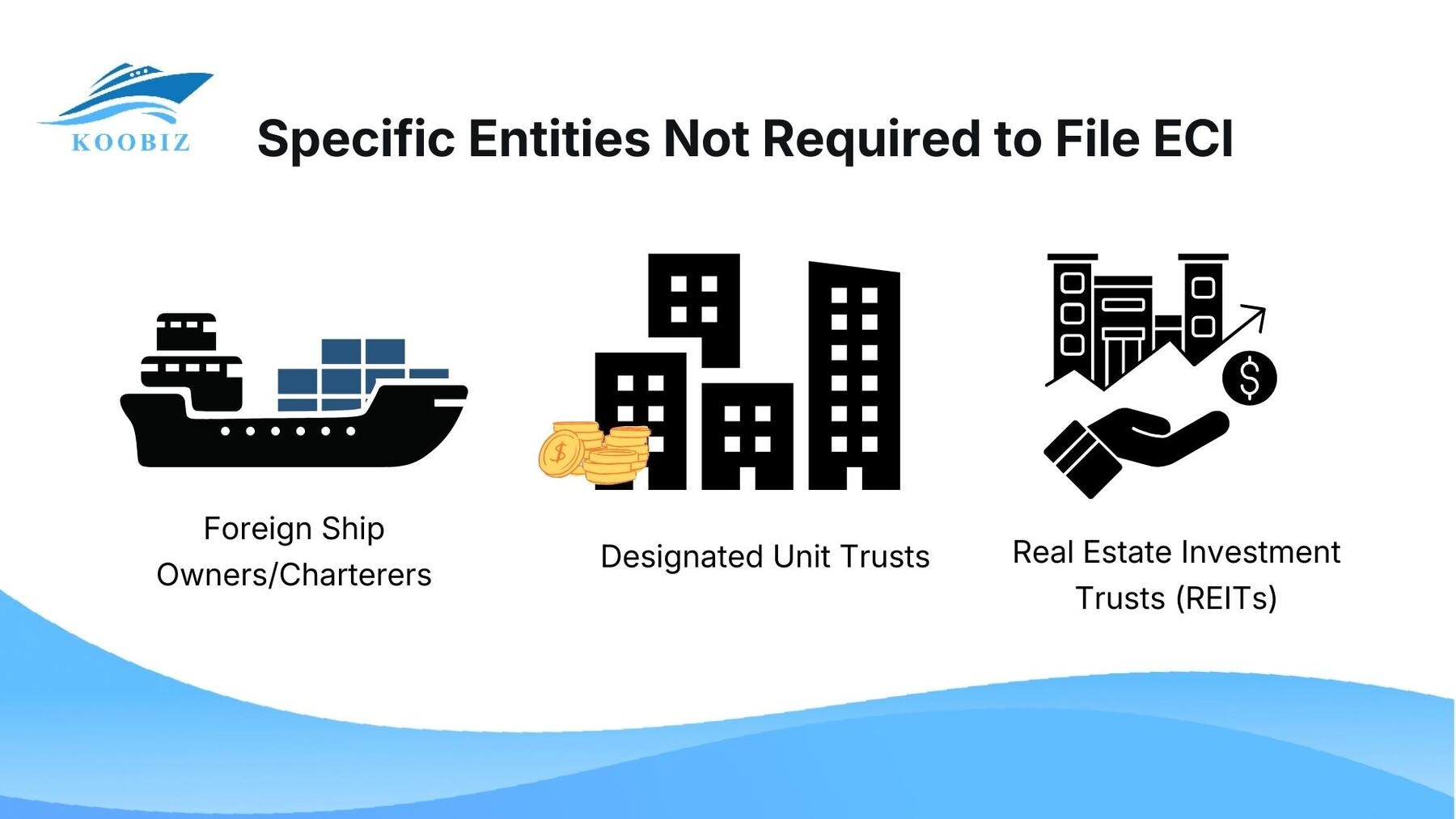
    Specific Entities Not Required to File ECI

    Specific Entities Not Required to File ECI
    Specific Entities Not Required to File ECI

    Beyond the revenue-based waiver, certain entities are granted administrative concessions by IRAS. These include:

    • Foreign Ship Owners/Charterers: Specifically those who have submitted a “Shipping Return.”
    • Designated Unit Trusts: Entities that meet specific tax transparency requirements.
    • Real Estate Investment Trusts (REITs): Provided they meet the distribution conditions for tax transparency.

    How to calculate and file your ECI in 2026

    There are three main ways to determine your ECI: preparing it based on management accounts, using accounting software that integrates with IRAS, or engaging a professional advisor. For most SMEs, this typically involves a structured review of the Profit and Loss statement, with adjustments made for expenses that are not tax-deductible.

    Digital Tax Filing Tools

    IRAS continues to enhance the digital filing experience to improve accuracy and convenience.

    • Seamless Integration: Many approved accounting software platforms now allow you to transmit ECI data directly to IRAS, reducing manual entry errors.
    • Pre-Filling: The myTax Portal may pre-fill certain data fields based on prior records or other government sources to streamline the submission process.
    • Digital Reminders: Companies subscribed to digital notices receive timely SMS or email alerts when their filing window opens, ensuring deadlines are not missed.

    Seamless E-Filing: A Step-by-Step Walkthrough

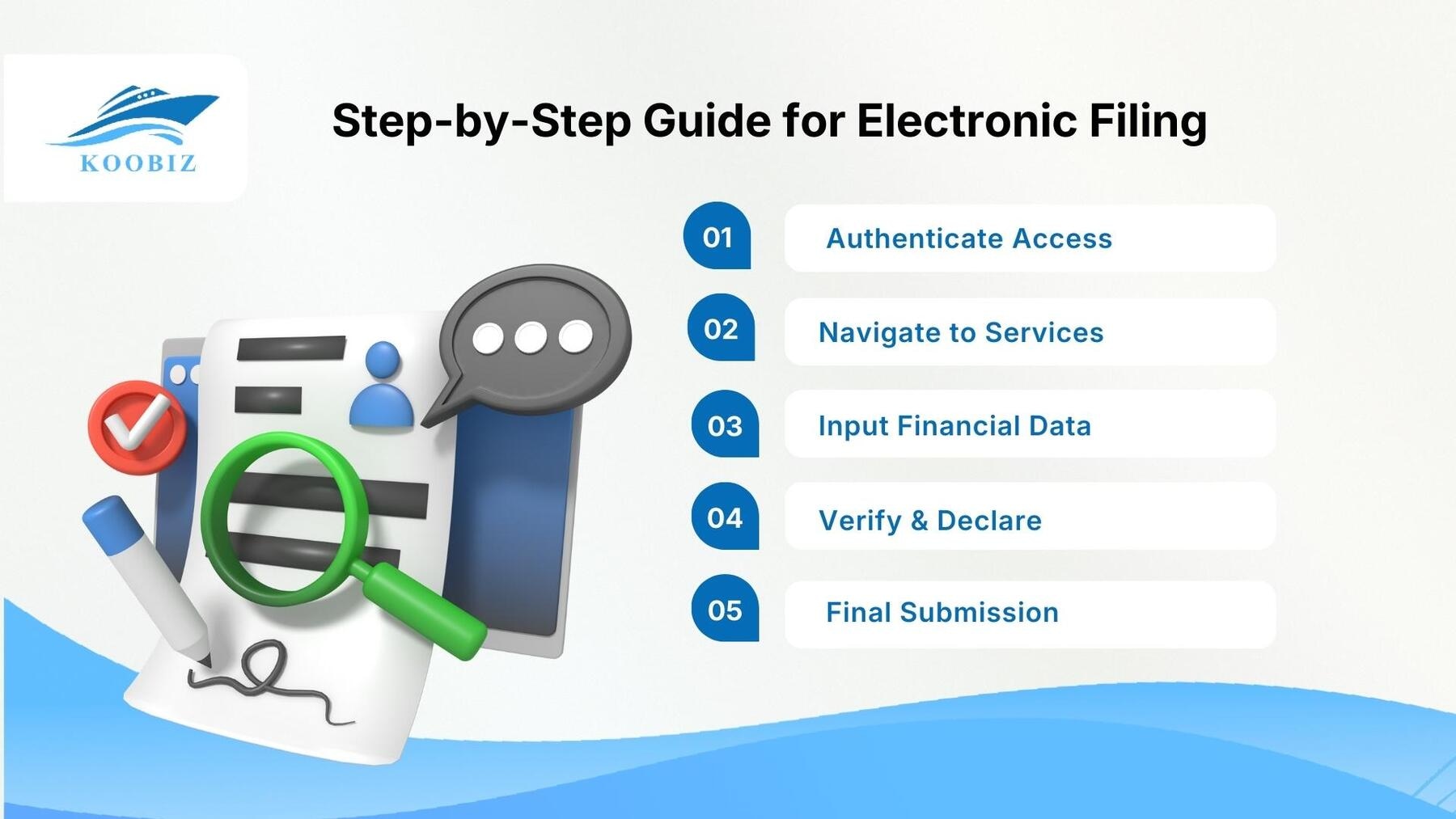
    Step-by-Step Guide for Electronic Filing
    Step-by-Step Guide for Electronic Filing

    Navigating the IRAS system is efficient when you know the correct path. Follow this streamlined guide to ensure your ECI is filed correctly via the myTax Portal.

    Before You Start:

    • Ensure you have your Singpass ready.
    • Verify your Corppass is authorized as an “Approver” or “Preparer” for Corporate Tax.
    • Have your Management Accounts (Revenue & Expense figures) on hand.

    Step 1: Authenticate Access

    Begin by securely logging into the myTax Portal using your corporate Singpass.

    Step 2: Navigate to Services

    Once on the dashboard, locate the menu bar. Select “Corporate Tax” and subsequently click on “File ECI” from the drop-down options to initiate the return.

    Step 3: Input Financial Data

    Proceed to enter your company’s Gross Revenue and the Estimated Chargeable Income figures derived from your management accounts.

    • Guidance: If your revenue varies significantly from the previous year, be prepared to provide a brief explanation in the optional remarks field.

    Step 4: Verify & Declare

    Review the auto-populated details carefully. Confirm your eligibility for any tax exemptions, such as the Tax Exemption Scheme for New Start-Up Companies, and declare that the information provided is accurate.

    Step 5: Final Submission

    Click the “Submit” button to finalize the process.

    • Crucial Step: Wait for the confirmation screen and download the Acknowledgment Page immediately. This document serves as your official proof of timely submission.

    Benefits of Early ECI Filing: Installment Plans

    Filing ECI early offers a clear cash flow advantage. To encourage timely submission, IRAS provides a tiered instalment payment scheme – the sooner you file after your Financial Year End (FYE), the greater the number of instalments you may qualify for.

    10-Month vs. 6-Month GIRO Installment Tables

    The number of installments is determined by the date of filing.

    Filing Date (After FYE) Number of Installments (GIRO)
    Within 1 Month 10 Installments
    Within 2 Months 8 Installments
    Within 3 Months 6 Installments
    After 3 Months 0 (Full payment required)

    Alternative Meanings of ECI: Healthcare, Fintech, and Economics

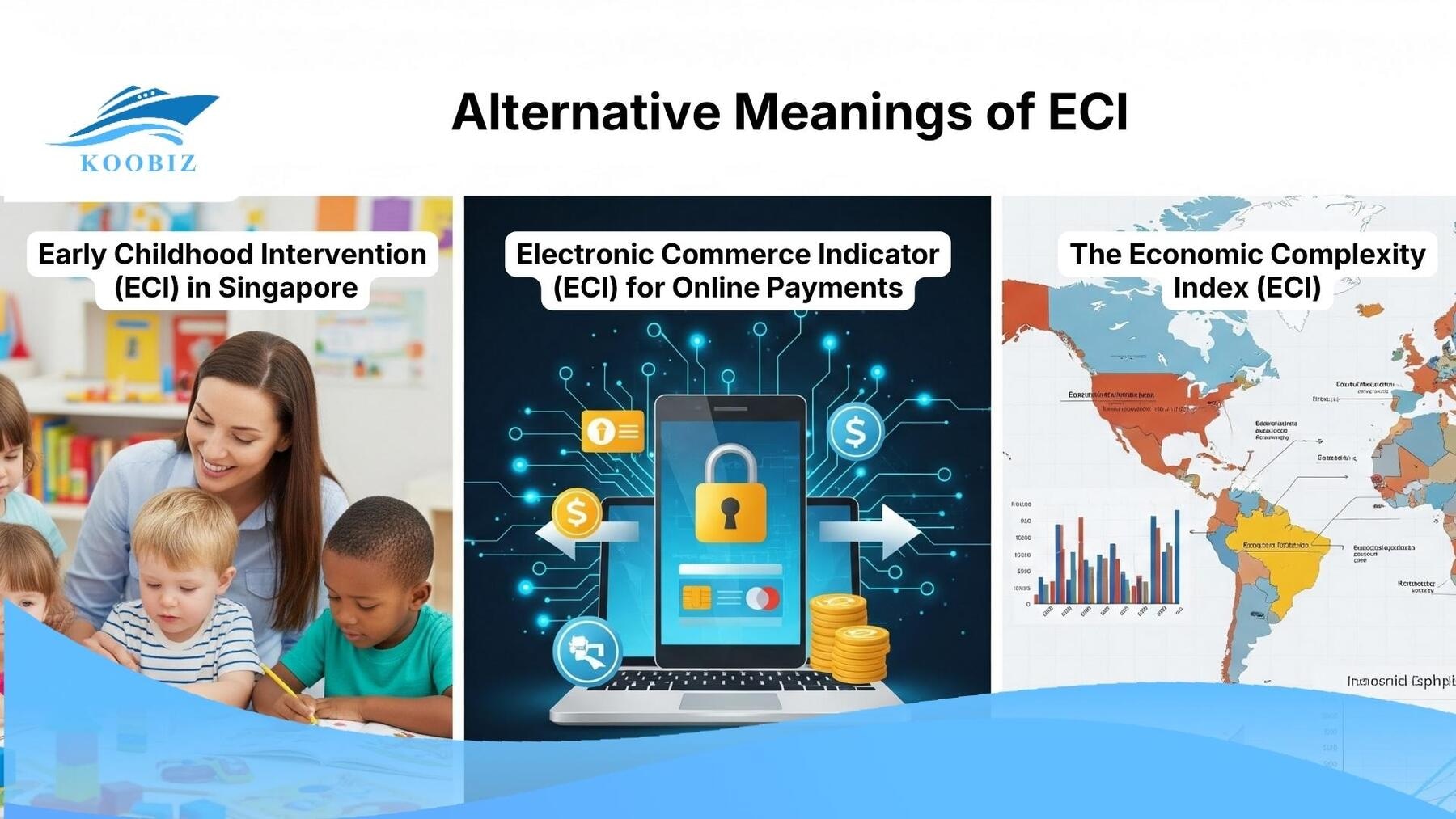
    Alternative Meanings of ECI
    Alternative Meanings of ECI

    The term “ECI” is frequently used in other high-impact industries.

    Early Childhood Intervention (ECI) in Singapore

    In the healthcare context, ECI stands for Early Childhood Intervention, which focuses on providing specialised support to children with developmental delays. In Singapore, the government, through ECDA, continues to support programmes such as EIPIC (Early Intervention Programme for Infants & Children), enabling children with developmental needs to learn and develop alongside their peers.

    Electronic Commerce Indicator (ECI) for Online Payments

    In fintech, ECI stands for Electronic Commerce Indicator, a value used in 3D Secure transactions to indicate the level of security used.

    • ECI 05: Fully Authenticated Transaction.
    • ECI 06: Attempted Authentication (Issuer not participating).
    • ECI 07: Non-Authenticated Transaction (Standard SSL).

    Note: Transactions flagged as ECI 07 (non-authenticated) typically carry a higher risk of fraud and liability chargebacks for merchants.

    The Economic Complexity Index (ECI)

    In macroeconomics, the Economic Complexity Index measures a country’s industrial “sophistication” and knowledge intensity. Singapore consistently ranks highly on this index due to its diverse and complex export capabilities. Researchers are also increasingly discussing “Green ECI” as a measure of a country’s ability to export green technologies.

    About Koobiz Services

    Navigating the complexities of what is ECI doesn’t have to be a solo journey. Koobiz (koobiz.com) is a premier professional services provider.

    • Company Formation: Seamlessly register your Singapore company.
    • Tax & Accounting: We handle your ECI and Form C-S/C filings with 100% accuracy.
    • Banking: Expert advisory on corporate account openings.
  • Claim Your 2026 Working Mother Relief: Guide to WMCR Amounts, Eligibility & Tax CapsQuick Summary

    Claim Your 2026 Working Mother Relief: Guide to WMCR Amounts, Eligibility & Tax CapsQuick Summary

    [SUMMARIES]

    Two-Tier System: Children born before 2024 qualify for percentage-based relief; those born on or after Jan 1, 2024, receive fixed-dollar relief.

    2026 Relief Amounts: Fixed rates for new children are $8,000 (1st), $10,000 (2nd), and $12,000 (3rd+).

    Critical Limits: Combined QCR/HCR and WMCR are capped at $50,000 per child, while the total personal relief cap remains $80,000.

    Eligibility: Available to working mothers who are married, divorced, or widowed with Singapore citizen children.

    Koobiz Support: Koobiz provides expert tax advisory to help working mothers navigate complex filing requirements in Singapore.

    [/SUMMARIES]

    The Working Mother’s Child Relief (WMCR) rewards women who stay in the workforce. As we approach the 2026 Year of Assessment (YA), the transition from percentage-based to fixed-dollar claims—originally announced in Budget 2024 and effective from YA 2025—is now fully integrated. Feeling unsure about how tax relief works for working mothers? You’re not alone. This guide explains the Working Mother’s Child Relief (WMCR) in simple terms. Whether you’re planning for your first child or have several, we’ll break down the 2026 rules—what you can claim, who is eligible, and how to get the most out of this benefit with help from Koobiz.

    What is the Working Mother’s Child Relief (WMCR) in 2026?

    Think of WMCR as a thank-you from the tax system. It’s a special deduction for working mums with Singaporean children. This deduction directly lowers the amount of your salary that gets taxed, which means you pay less tax overall. It’s designed to support mothers who balance a career and family.

    Working mother, children, Singapore
    Working mother, children, Singapore

    Eligibility Criteria: Who Can Claim in YA 2026?

    To qualify for Working Mother’s Child Relief (WMCR), you must meet these conditions:

    • Mother’s Status: You must be a working mother who is married, divorced, or widowed (single, never-married mothers do not qualify).
    • Child’s Citizenship: Your child must be a Singapore Citizen as of 31 December 2025.
      • Note: If your child was born before 1 Jan 2024 but only became a citizen on or after 1 Jan 2024, they qualify for the Fixed Dollar relief, not the percentage system.
    • Child’s Age & Education: Your child must be under 16 years old in 2025. If the child is 16 or older, they must be studying full-time at an approved educational institution.
    • Child’s Income: Your child’s annual income in 2025 must not exceed $8,000.
      • Note: This income limit excludes scholarships, bursaries, and internships compulsory for their course.

    Understanding the “Earned Income” Requirement

    A key element of the working mother relief is the “earned income” clause, which requires the mother to have earned taxable income from work, a trade, a business, or a profession in the previous year. Passive earnings—such as stock dividends, rental income, or interest from savings—do not count toward WMCR eligibility. Koobiz often tells clients that “earned income” is calculated after allowable expenses but before applying any personal reliefs.

    For example, if a mother is a freelancer or runs a business, the qualifying amount is her net trade income. This distinction matters because if a mother’s only income comes from investments, she cannot claim WMCR even if all other family criteria are met. More precisely, the “earned income” must be positive; if the business incurs a loss in that year, the relief cannot be used.

    How Much Can You Claim? (Fixed vs. Percentage Rates)

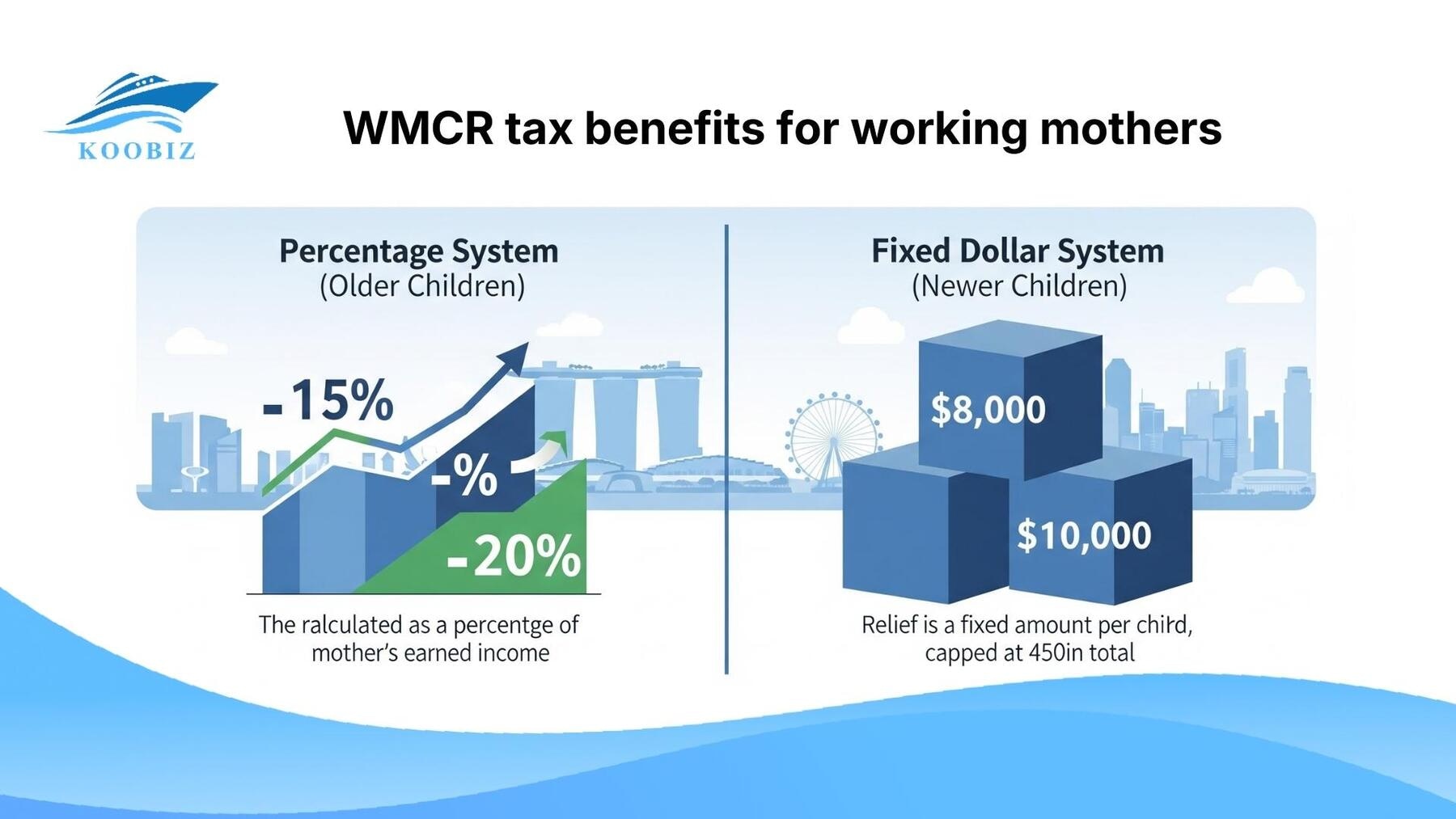
    In 2026, there are two primary methods for calculating the working mother relief: a percentage-based system for children born before 2024 and a fixed-dollar system for children born on or after January 1, 2024. This two-track design aims to create a more progressive tax framework by delivering larger benefits to lower- and middle-income families while limiting the relief available to ultra-high earners.

    Because the policy shift, parents with multiple children need to identify which child falls into which category, since the resulting tax savings can differ markedly between the two systems.

    WMCR tax benefits for working mothers
    WMCR tax benefits for working mothers

    For Children Born/Adopted Before 1 Jan 2024 (Percentage System)

    For children who were born or adopted prior to the 2024 pivot (and were citizens at birth or before 2024), the “Old WMCR” rules apply. In this system, the amount of working mother relief you can claim is a direct percentage of your earned income based on the child’s order:

    • 1st Child: 15% of the mother’s earned income.
    • 2nd Child: 20% of the mother’s earned income.
    • 3rd Child and beyond: 25% of the mother’s earned income.
    • Cap Note: The total WMCR claim across all children is capped at 100% of the mother’s earned income.

    For instance, a mother earning $100,000 with a child born in 2022 would claim $15,000 in relief. This percentage-based approach remains quite advantageous for mothers in the upper-middle-income range, but it is still limited by an $80,000 total personal relief cap and a $50,000 cap per child.

    For Children Born/Adopted On or After 1 Jan 2024 (Fixed Dollar System)

    The biggest reform starting in YA 2025 affects children born on or after January 1, 2024 (or those who become citizens after that date). Under the new regime, the working mother relief is a fixed dollar amount, independent of the mother’s income. This means that two mothers with the same eligible child—one earning $5,000 per month and the other $20,000 per month—would receive the same tax deduction for that child.

    Child Order Relief Amount (Fixed)
    1st Child $8,000
    2nd Child $10,000
    3rd Child & Beyond $12,000

    Specifically, this change was designed to be more equitable. For a first child born in 2025, the mother will claim a flat $8,000 in her 2026 tax filing. To begin the comparison, a mother earning $40,000 a year actually benefits more from the fixed $8,000 than she would have from the 15% ($6,000) under the old system.

    Step-by-Step: How to Claim WMCR on myTax Portal

    Step-by-Step: How to Claim WMCR on myTax Portal
    Step-by-Step: How to Claim WMCR on myTax Portal

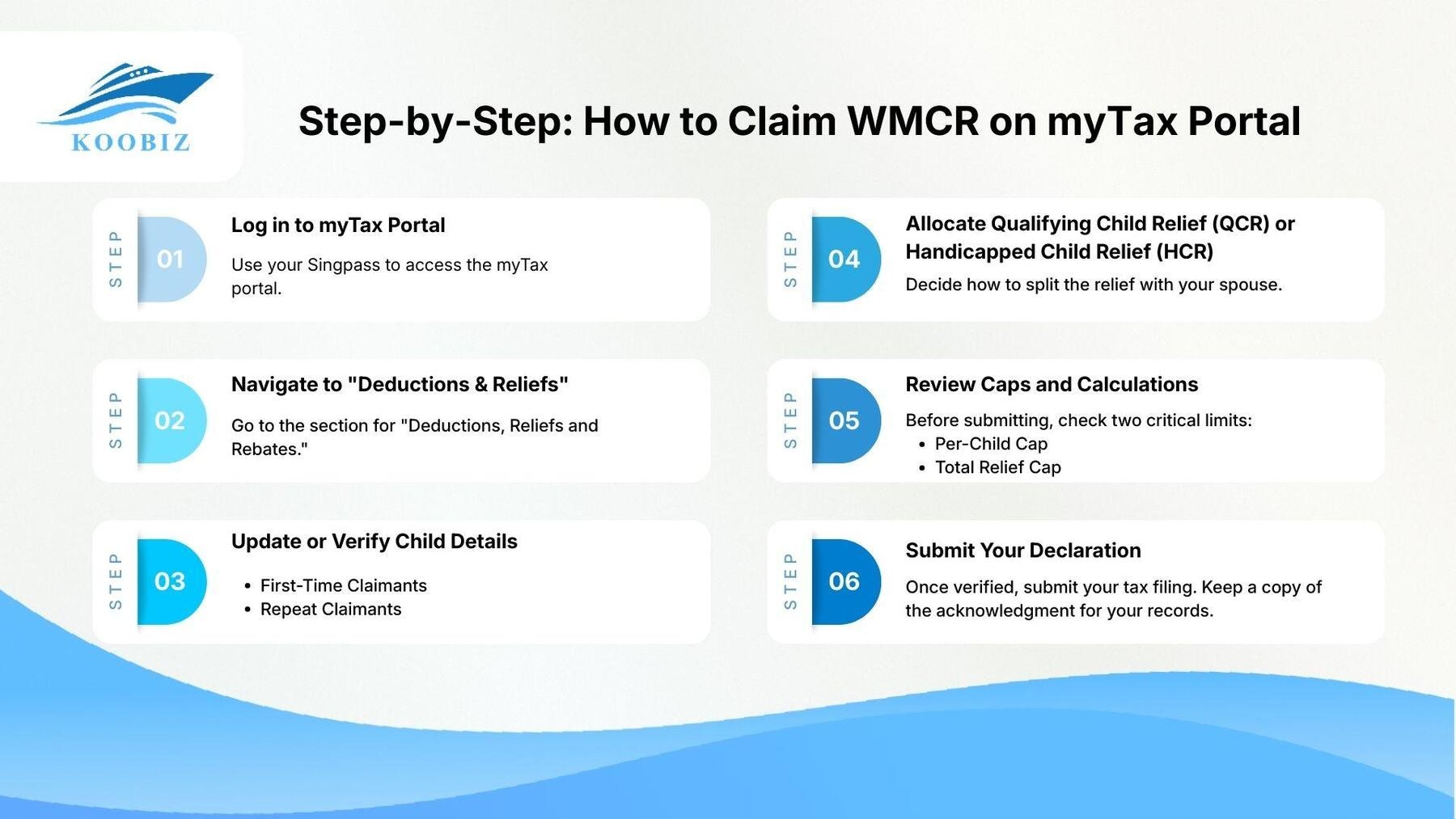
    Claiming is done online through the IRAS myTax portal. Follow this simple process to ensure your working mother relief is accurately reflected in your 2026 tax bill:

    1. Log in to myTax PortalUse your Singpass to access the myTax portal.
    2. Navigate to “Deductions & Reliefs”Go to the section for “Deductions, Reliefs and Rebates.” If you are a repeat claimant, your WMCR claims from the previous year should be pre-filled.
    3. Update or Verify Child Details
      • First-Time Claimants: If you had a child in late 2025, verify their details are listed. If not, manually enter their name, ID, and Date of Birth.
      • Repeat Claimants: Ensure all eligible children are still listed. The system will automatically apply the new Fixed Dollar rates for children born on or after 1 Jan 2024.
    4. Allocate Qualifying Child Relief (QCR) or Handicapped Child Relief (HCR)Decide how to split the relief with your spouse.
      • QCR: $4,000 per child.
      • HCR: $7,500 per child (if the child has a disability).Use the portal’s “Relief Checker” to see if it is better for the higher earner to claim the QCR/HCR or to share it. Note that WMCR is exclusive to the mother and cannot be transferred.
    5. Review Caps and CalculationsBefore submitting, check two critical limits:
      • Per-Child Cap: Ensure QCR/HCR + WMCR does not exceed $50,000 per child.
      • Total Relief Cap: Ensure your total personal reliefs do not exceed $80,000.
    6. Submit Your DeclarationOnce verified, submit your tax filing. Keep a copy of the acknowledgment for your records.

    Common Filing Errors to Avoid

    • Income Thresholds: Ensure your child did not earn more than $8,000 in 2025 (excluding scholarships).
    • Double Claims: Check that you are not double-claiming relief if you changed employers; “earned income” is the total from all sources.

    The $80,000 Cap: Is Your Tax Relief Being “Squeezed”?

    Tax reliefs stacking up to the $80,000 cap
    Tax reliefs stacking up to the $80,000 cap

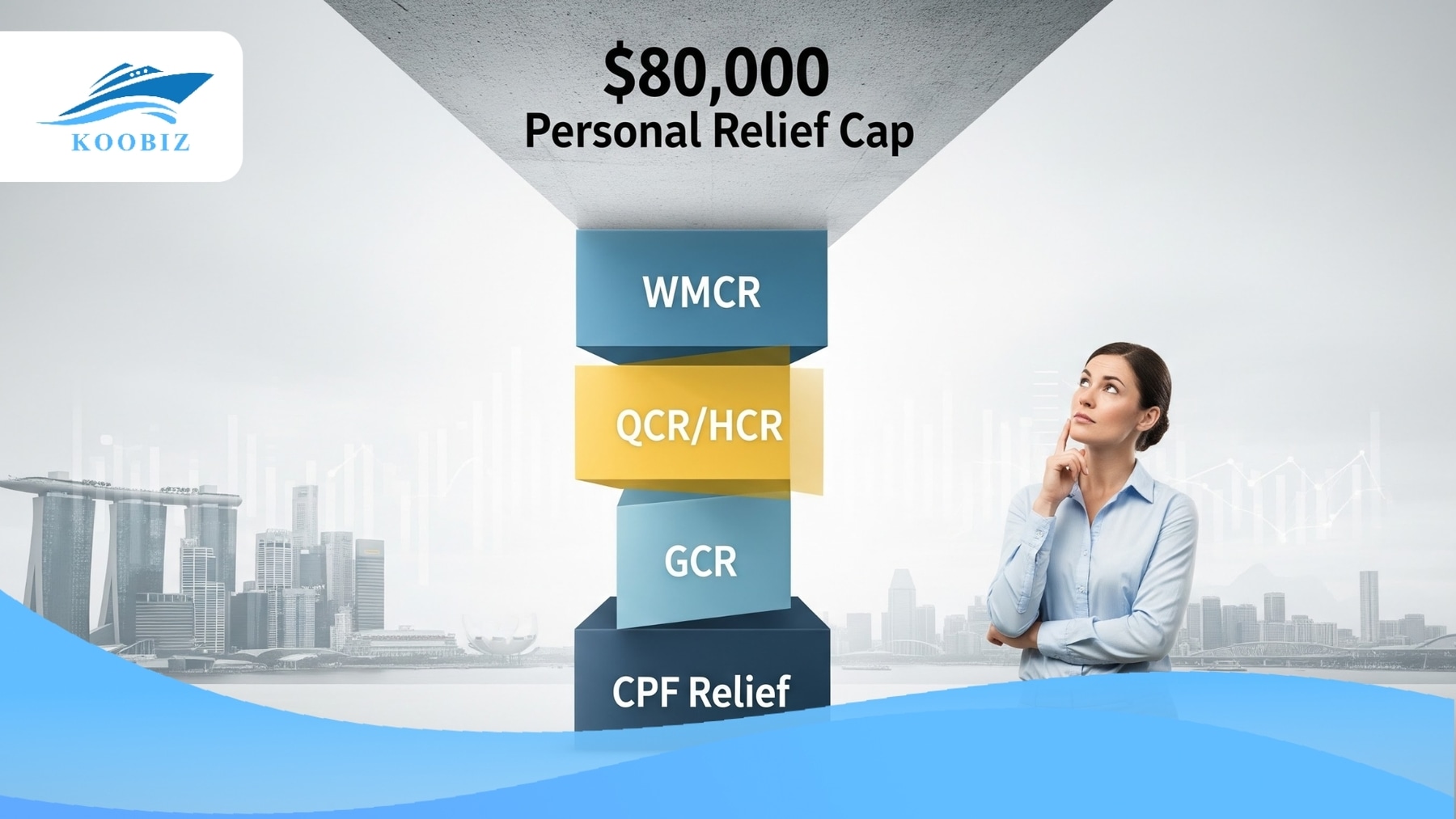
    Yes, the working mother relief is often constrained by the $80,000 personal relief cap, especially for high-earning mothers or those with several children. This cap sets the maximum total of all personal reliefs—such as CPF relief, Earned Income Relief, Life Insurance Relief, and WMCR—that a person may claim in a single Year of Assessment.

    How to “Stack” WMCR with QCR/HCR and GCR

    To start the sequence, you first apply the Qualifying Child Relief (QCR) or Handicapped Child Relief (HCR). After that, you add the working mother relief (WMCR) on top. If you are a working mother whose parents or grandparents help care for your children, you may also claim the Grandparent Caregiver Relief (GCR). In short, the stacking order is: QCR/HCR first, WMCR next, and GCR last (where eligible).

    1. QCR or HCR: $4,000 (QCR) or $7,500 (Handicapped Child Relief).
    2. WMCR: $8,000 to $12,000 (Fixed) or % based.
    3. GCR: $3,000.
      • Requirement: Caregiver must be a non-working grandparent, parent, parent-in-law, or grandparent-in-law providing full-time care.
    4. CPF Relief: (Up to $20,400 for most employees).

    If the total of QCR (or HCR) plus WMCR and other personal reliefs reaches $80,000, any additional deductions are forfeited. Tax specialists at Koobiz typically advise that, in such scenarios, the husband should claim the full QCR to preserve the mother’s WMCR relief for her own use.

    Strategies for High-Earners

    For high-earning mothers, the 2024 shift to fixed-dollar WMCR amounts was effectively a government move to reduce “tax shielding” for those in the 22% or 24% tax brackets. In response, these mothers need to be more strategic with other deductions. For example, if WMCR plus CPF contributions already hit the $80,000 cap, making voluntary CPF top-ups or SRS (Supplementary Retirement Scheme) contributions offers no additional tax relief.

    Real-Life Scenarios: WMCR in Action

    To better understand how these rules affect your wallet, let’s look at two realistic examples comparing the percentage-based and fixed-dollar systems.

    Case Study A: The “Mixed System” Family

    Profile: Sarah earns $96,000 annually ($8,000/month). She has two Singapore Citizen children:

    • Lucas (Born 2021): 1st Child (Percentage System)
    • Chloe (Born 2025): 2nd Child (Fixed Dollar System)

    Her Relief Calculation:

    1. Lucas (15% of $96,000): $14,400
    2. Chloe (Fixed Rate for 2nd Child): $10,000
    3. Total WMCR Claim: $24,400

    Analysis: Sarah benefits from a hybrid approach: since Lucas was born before 2024, she retains the higher deduction percentage for him. For Chloe, she receives a flat $10,000 regardless of her income.

    Case Study B: The High Earner Hitting the Cap

    Profile: Linda earns $200,000 annually. She has one child born in 2025 (1st Child).

    Her Relief Calculation:

    • CPF Relief (Approx Max): $20,400
    • Earned Income Relief: $1,000
    • QCR: $4,000
    • WMCR (Fixed Rate for 1st Child): $8,000

    Total Reliefs: $33,400

    Analysis: Linda is well below the $80,000 cap and can claim her full relief amount. However, notice the difference: Under the old system, 15% of her $200,000 salary would have been a $30,000 deduction. The new fixed system ($8,000) significantly reduces her tax savings, which is the intended policy shift for higher income brackets.

    New for 2026: Shared Parental Leave and Your Career

    The April 2026 expansion of the Shared Parental Leave (SPL) scheme represents a major shift in the working mother relief landscape by allowing up to 10 weeks of leave to be shared between both parents. This initiative has indirect but significant implications for a mother’s taxable “earned income.”

    Impact of 10-Week SPL on Taxable Income

    If a mother takes Government-Paid Parental Leave (GPPL) funding, that income is still treated as part of her earned income for tax purposes. More importantly, if she shares 10 weeks of leave with the father, her total time away from work decreases, which could allow her to earn more performance-based bonuses or commissions. This increase in earned income would raise the base used for the percentage-based WMCR (for older children).

    About Koobiz Service

    Singapore’s tax system—especially with the 2026 updates—can be overwhelming for busy working mothers and business owners. Our mission is to provide seamless, professional support to help you maximize your financial potential.

    Our core services include:

    • Company Formation: Expert guidance on setting up your business in Singapore.
    • Tax & Accounting: Specialized tax planning, including optimization of working mother relief.
    • Audit Services: Comprehensive audit solutions to ensure regulatory compliance.

    Visit us at koobiz.com to schedule a consultation with our tax specialists today.

  • How to Register for GST in Singapore: A Step-by-Step Guide (Updated for 2026)

    How to Register for GST in Singapore: A Step-by-Step Guide (Updated for 2026)

    [SUMMARIES]

    Mandatory Threshold: Registration is required if your business’s taxable turnover exceeds S$1 million. This is assessed either by looking back at the past calendar year or by forecasting the next 12 months.

    Voluntary Option: Businesses below the threshold can register voluntarily to reclaim GST on expenses. This requires a two-year commitment and the use of InvoiceNow-compatible software.

    Digital Process: Applications are submitted online through the myTax Portal using CorpPass. You’ll need documents like your ACRA business profile and bank details.

    Pre-Registration Claims: You may reclaim GST paid on certain business costs incurred up to 6 months before your registration date.

    Strict Compliance: Once registered, you must show prices inclusive of GST, file returns on time, and set up GIRO for payments (mandatory for voluntary registrants) to avoid penalties.

    [/SUMMARIES]

    Successfully registering for Goods and Services Tax (GST) is a key step for growing businesses in Singapore. The process can seem complex due to strict rules and compliance needs. At Koobiz, we understand that whether you are scaling up to meet the mandatory S$1 million turnover requirement or strategically opting for voluntary registration to optimize your tax position, getting the registration right is paramount.

    To help you manage this transition smoothly, this guide provides a comprehensive walkthrough on how to register for GST in Singapore, covering the latest 2026 updates including the InvoiceNow mandate and annual assessment rules.

    IMPORTANT UPDATES FOR 2026

    Before proceeding, be aware of two critical changes to the GST regime:

    InvoiceNow Mandate for Voluntary Registration:

    • From 1 November 2025: New companies (applying within 6 months of setup) that register voluntarily must use InvoiceNow-ready software to send invoice data to IRAS.
    • From 1 April 2026: All new voluntary registrants must use InvoiceNow solutions. Applications may be rejected without this.

    Grace Period for Prospective Registration: For registration liabilities arising on or after 1 July 2025, IRAS offers a 2-month grace period for the registration effective date, giving you more time to prepare.

    Do You Need to Register for GST?

    Financial report exceeding the S$1 million threshold
    Financial report exceeding the S$1 million threshold

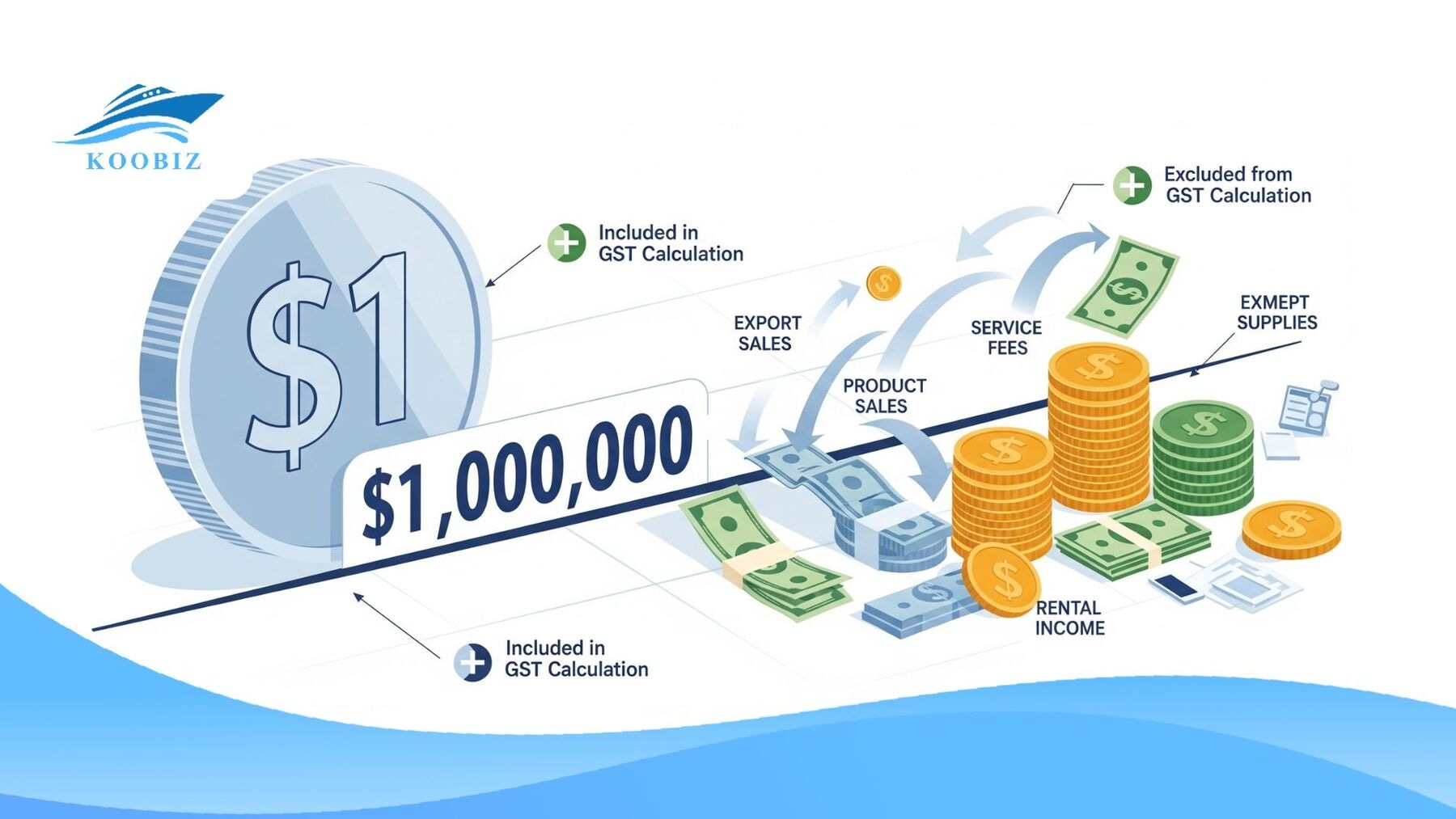
    Yes, you must register for GST if your business’s taxable turnover exceeds S$1 million under either the retrospective or prospective view.

    Accurate liability assessment requires calculating your “Taxable Turnover,” not merely reviewing total bank deposits. This figure is defined by the specific inclusion of certain revenue streams and the exclusion of others.

    What Counts Towards Taxable Turnover?

    IRAS requires you to sum up the following income sources to see if you hit the S$1 million threshold:

    • Standard-Rated Supplies (9%): Most local sales of goods and services in Singapore (for example, retail purchases and consultancy fees).
    • Zero-Rated Supplies (0%): Goods exported overseas and international services provided to foreign clients.

    What is EXCLUDED from Taxable Turnover?

    Do not include these when calculating your S$1 million turnover:

    • Exempt Supplies: Financial services (such as interest income or share issues) and the sale or lease of residential properties.
    • Out-of-Scope Supplies: Sales where goods are delivered from outside Singapore to another place outside Singapore (third-country sales).
    • Sale of Capital Assets: Proceeds from selling major business assets like machinery or furniture.

    To determine whether you’ve crossed the S$1 million mark, you need precise calculations of these revenue streams. At Koobiz, we frequently help clients audit their revenue sources to avoid accidentally triggering a GST registration requirement.

    Why that registration matters: Failing to register when required is a serious offense in Singapore (penalty up to S$10,000 and 10% additional penalty). If you’re liable but don’t apply, IRAS may backdate your registration, forcing you to pay GST on past sales out of your own pocket.

    Compulsory vs. Voluntary Registration

    Compulsory registration is mandated by law based on revenue milestones, whereas voluntary registration is a strategic choice for businesses earning under the threshold.

    To help you decide or determine your obligation, here is a direct comparison of the two paths:

    Feature Compulsory Registration Voluntary Registration
    Who is it for? Businesses with taxable turnover > S$1 million. Businesses with taxable turnover < S$1 million.
    Trigger Mandated by law under the Retrospective (Annual) or Prospective view. Strategic choice by the business owner.
    Key Benefit Compliance with the law (avoids penalties). Ability to claim input tax (refunds) on business expenses.
    Key Obligation Must register within 30 days of liability notification date. Must commit to remaining registered for at least 2 years.
    New Requirement Must be ready to charge GST. Must use InvoiceNow solutions (phased implementation).
    Risk Late registration attracts backdated taxes and fines. Administrative costs and GIRO requirement.

    Retrospective View vs. Prospective View (Compulsory)

    If you’re under the compulsory regime, you use one of these tests to determine when to register:

    1. Retrospective View (Annual Assessment): You must register if your taxable turnover for the calendar year (1 Jan to 31 Dec) exceeds S$1 million.
      • Deadline: You have until 30 January of the following year to apply.
      • Effective Date: You will be registered for GST on 1 March of that year.
    2. Prospective View: You must register if you reasonably expect your taxable turnover to exceed S$1 million in the next 12 months. This typically applies if you have signed a large sales contract.
      • Deadline: You must apply within 30 days of the date of your forecast/signed contract.

    Businesses can now monitor compliance more easily by reviewing the past calendar year (retrospective). For future-looking assessments (prospective), IRAS requires formal documentation like purchase orders or signed contracts to support your forecasted figures.

    Voluntary Registration Considerations

    If you’re not required to register, the decision often comes down to cost versus benefit. Voluntary registration is especially advantageous for exporters (who sell zero-rated goods but incur GST on local costs) or start-ups with significant upfront capex.

    However, voluntary registration comes with conditions: you must stay GST-registered for at least two years, comply with all filing requirements, and set up GIRO payments for taxes and refunds. Also, with the InvoiceNow mandate starting November 2025 for new companies, you’ll need a compatible accounting system to transmit invoice data to IRAS as part of your application.

    Practical Case Studies: Determining Your Liability

    Applying the abstract rules of registration to concrete business scenarios helps clarify exactly when you need to act.

    To help you visualize whether your business falls under the mandatory or voluntary brackets, let’s examine three updated scenarios based on 2026 rules.

    Scenario 1: The Retrospective Trigger (Mandatory)

    Situation: TechFlow Solutions, a software consultancy, had steady revenue. By 31 December 2025, their accumulated revenue for the calendar year reached S$1.2 million.

    Verdict: They have triggered the Retrospective View.

    Action: TechFlow must apply for GST registration by 30 January 2026. Their GST registration will be effective from 1 March 2026.

    Note: They do not need to check their turnover at the end of every quarter, only at the end of the calendar year.

    Scenario 2: The Prospective Trigger (Mandatory)

    Situation: BuildStrong Construction is a new company. On 15 July 2025, they secure a confirmed contract worth S$1.5 million.

    Verdict: They have triggered the Prospective View.

    Action: They must apply within 30 days. Under the new rules for liabilities arising after 1 July 2025, IRAS allows a grace period. While they apply in August, their effective date might be set to 1 October 2025 (approx. 2 months later), giving them time to set up their invoicing systems.

    Scenario 3: The Strategic Choice (Voluntary)

    Situation: PureExport Trading (incorporated in Jan 2026) buys goods locally and exports them to Europe. Their annual turnover is only S$800,000.

    Verdict: They are not required to register.

    Action: However, they choose Voluntary Registration in April 2026 to claim input tax refunds. Because they are applying after 1 April 2026, they must adopt an InvoiceNow-ready solution to transmit invoice data to IRAS as part of their application approval conditions.

    Prerequisites for GST Registration

    Prerequisites for GST Registration Singapore
    Prerequisites for GST Registration Singapore

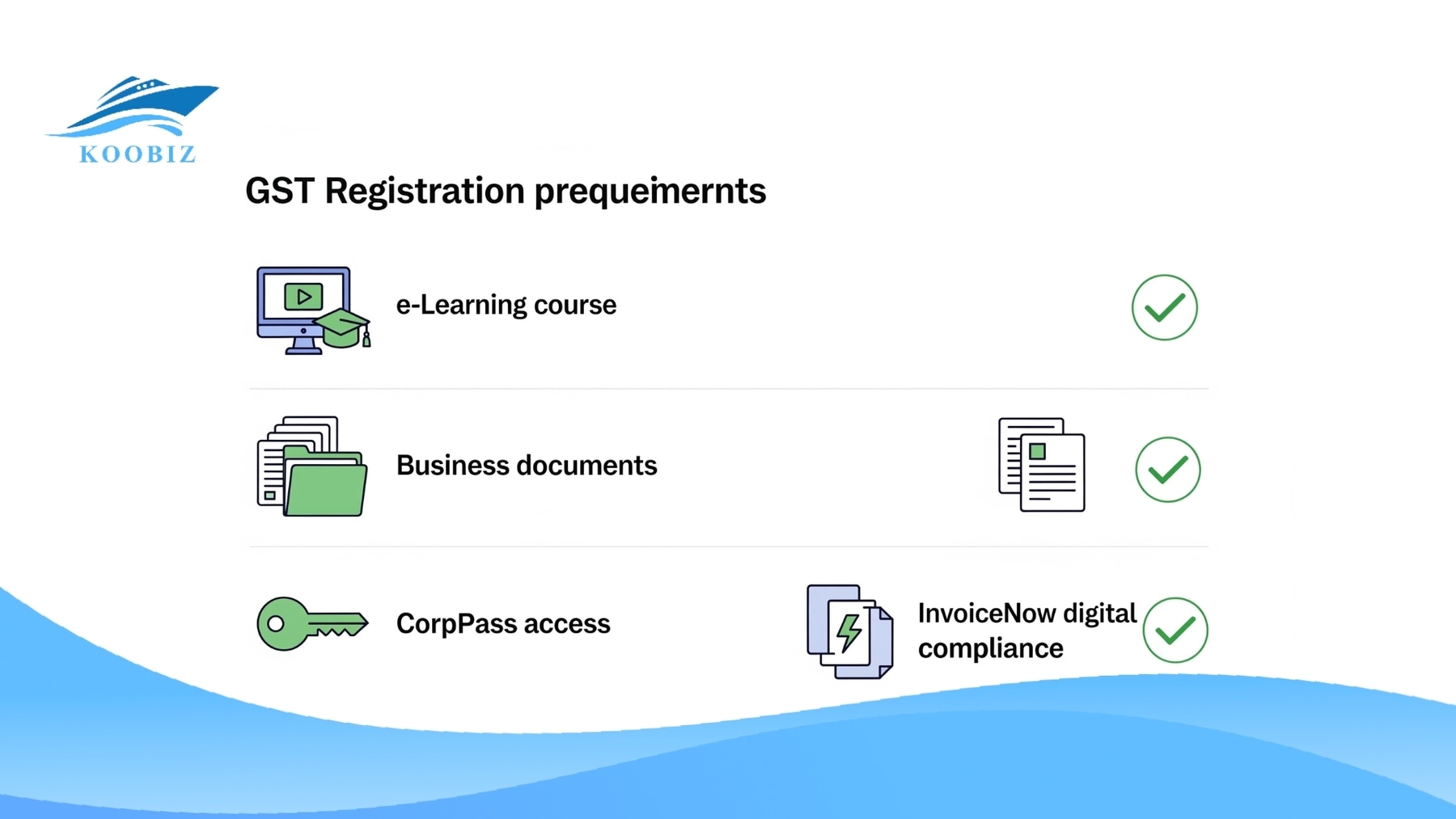
    There are three main categories of prerequisites: administrative access, business documentation, and educational requirements.

    Before logging into the portal, ensuring you have these elements ready will streamline the application process and prevent session timeouts.

    The e-Learning Course Requirement

    The most overlooked prerequisite is the “Overview of GST” e-Learning course. Business owners (sole proprietors, partners, or directors) applying under the Voluntary Registration scheme are generally required to complete this course.

    Exemptions apply if:

    • Your director/partner has already managed other GST-registered businesses, or
    • You engage a professional tax agent (like Koobiz) to handle your GST matters. Our affiliation can reassure IRAS of your compliance.

    Additional Voluntary Requirements (2026)

    • GIRO Account: You must have a GIRO application form processed or pending.
    • InvoiceNow: You must be prepared to declare your InvoiceNow-ready software details.

    By preparing your CorpPass (with “IRAS Digital Services” authorized), your ACRA Business Profile, and your bank account details for GIRO setup beforehand, you ensure a frictionless application experience.

    How to Submit Your Application via myTax Portal

    The standard method involves a digital submission via the myTax Portal, which typically takes about 15 to 20 minutes to complete if all documents are prepared.

    To guide you through the technical interface, here is the exact workflow you will encounter.

    Step 1: Logging in with CorpPass

    To begin, visit the IRAS myTax Portal (mytax.iras.gov.sg) and select “Business Tax.” You must log in using your CorpPass credentials.

    Specifically, ensure that the person logging in has been assigned the “Approver” or “Preparer” role for GST (Filing and Applications) within the CorpPass system. Without this authorization, the relevant menus will not appear. Once logged in, navigate to the menu bar, select “GST”, and then click on “Apply for GST Registration”.

    Step 2: Completing Form GST F1

    Once inside the module, you will likely be filling out Form GST F1 (Application for GST Registration). The form acts as a dynamic interview, asking for details regarding your financial year-end, turnover figures, and business activities.

    Detailed inputs required include:

    • Turnover Details: You must declare your taxable turnover.
    • Financial Year End (FYE): This determines your filing cycle (usually quarterly).
    • Industry Code (SSIC): Ensure this matches your ACRA profile.

    If you are a professional service provider or a consultant, be precise about your business description. For Koobiz clients, we handle this data entry meticulously to prevent discrepancies that could trigger an IRAS audit query.

    Step 3: Processing Time and Notification

    After submission, the standard processing time is approximately 10 working days.

    During this period, IRAS may contact you for additional information or clarification regarding your business model. Upon approval, you will receive a notification via the portal and a physical letter containing your GST Registration Number and the effective date. It is crucial to monitor your email and portal inbox during this window so you do not miss the approval notice.

    What is the Effective Date of Registration?

    Prerequisites for GST Registration and timelines
    Prerequisites for GST Registration and timelines

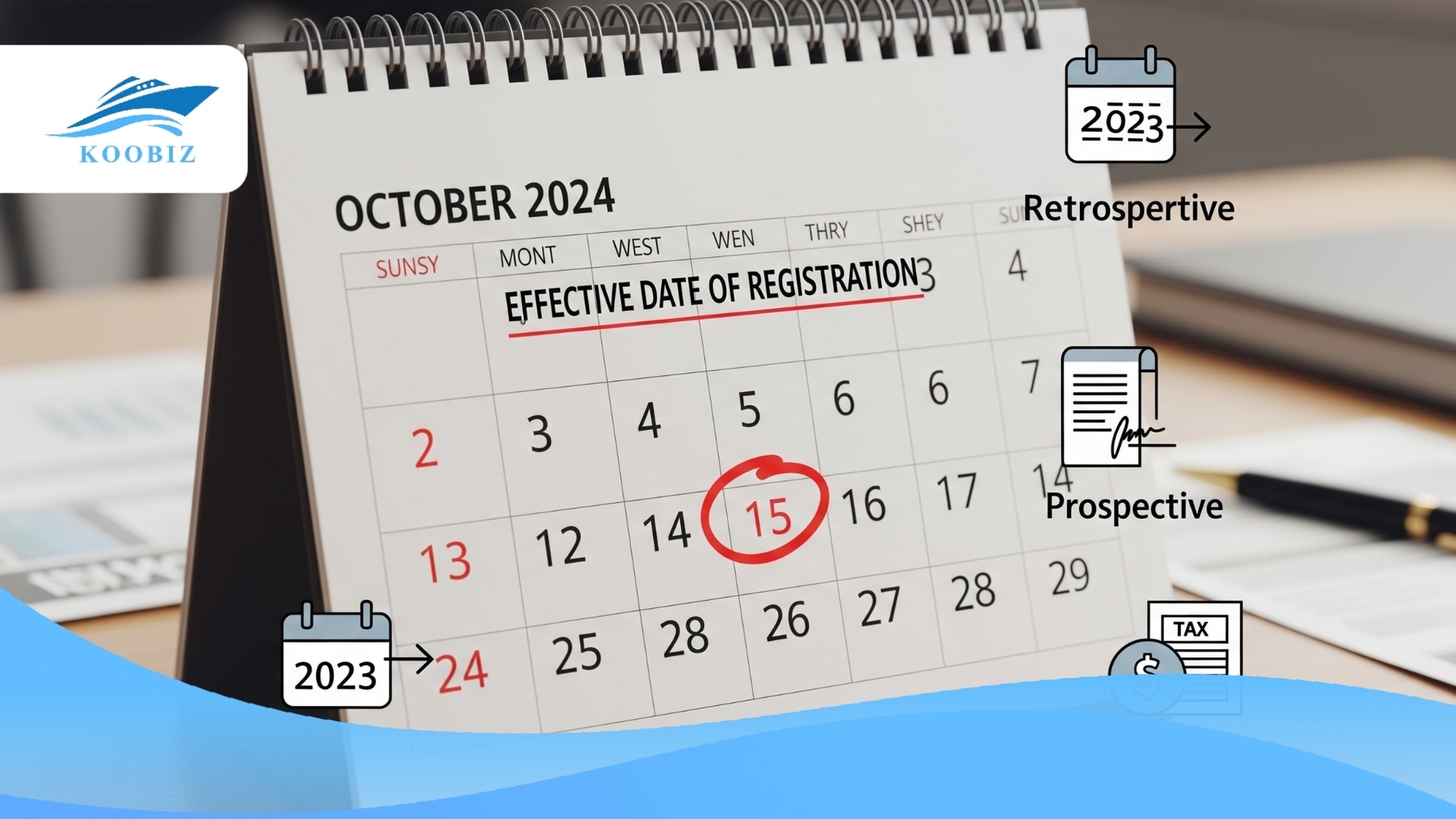
    The Effective Date of Registration is the specific date from which you become a taxable person and must strictly start charging GST.

    This date is legally binding and marks the boundary between your non-GST and GST eras.

    • Retrospective: Usually 1 March following the end of the calendar year.
    • Prospective: Typically the date requested, or approximately 2 months after the liability trigger date (post-July 2025 rules).
    • Voluntary: Typically the date requested or a date assigned by IRAS upon approval.

    From this exact date onwards, you must charge GST (currently 9%) on your standard-rated supplies. If you issue an invoice on the effective date without GST, you will have to absorb that tax amount yourself and pay it to IRAS.

    Claiming Pre-registration Input Tax

    GST-registered businesses can claim input tax on qualifying expenses incurred before their effective registration date.

    IRAS allows claims on:

    • Goods: Held on hand at the effective date (e.g., inventory).
    • Services: Purchased within 6 months prior to the effective date (e.g., consultancy, renovation).

    Strict documentation is required, including original tax invoices. Koobiz assists clients with these retrospective audits to maximize refunds, provided the goods haven’t been sold or consumed prior to registration.
    Special Registration Cases

    Specialized schemes exist for specific business models to simplify compliance.

    Exemption from Registration

    If your turnover exceeds S$1 million but supplies are wholly (or substantially) zero-rated (exports), you may apply for exemption. This saves administrative effort but disqualifies you from claiming input tax refunds.

    Overseas Vendor Registration (OVR)

    Overseas suppliers with global turnover >S$1 million selling >S$100,000 of digital services to Singapore consumers must register under this simplified pay-only regime.

    GST Group Registration

    Related companies can register as a single taxable group. This eliminates the need to account for GST on intra-group transactions, significantly reducing paperwork and cash flow constraints.

    Responsibilities After Registration

    Compliance involves immediate operational adjustments regarding pricing and payments.

    GST-Inclusive Pricing

    All public price displays (tags, menus, websites) must be GST-inclusive (e.g., S$109, not S$100++). Showing the breakdown is optional, but the final payable price must be clear.

    GIRO Payment Setup

    IRAS mandates GIRO for GST payments and refunds for all voluntary registrants, and strongly recommends it for compulsory registrants. Failure to set up GIRO when required can lead to penalties or cancellation of voluntary registration. Koobiz handles this setup immediately upon registration.

    Conclusion

    Registering for GST in Singapore is more than ticking a box. It’s a transition to a stricter regulatory environment that requires precise bookkeeping and timely compliance. Whether you’re compelled to register due to growing revenue or choosing voluntary registration to optimize your tax position, accuracy is essential.

    At Koobiz, we specialize in simplifying Singapore’s corporate landscape for entrepreneurs. From determining your exact liability to handling the Form GST F1 submission and managing ongoing quarterly filings, our team ensures your business remains compliant while you focus on growth.

    Ready to streamline your GST application? Visit Koobiz.com today to consult with our tax specialists about your Singapore incorporation and GST registration needs.

    Disclaimer: This guide is based on IRAS regulations as of January 2026. Tax laws are subject to change. Readers are advised to consult with professional tax advisors or refer to the latest IRAS publications before taking action.

  • Filing Financial Statements in XBRL Format: Full vs. Simplified Taxonomy for SG Companies

    Filing Financial Statements in XBRL Format: Full vs. Simplified Taxonomy for SG Companies

    [SUMMARIES]

    Mandatory Requirement: Most Singapore-incorporated companies must file financial statements in XBRL format with ACRA, except for specific exemptions, such as solvent Exempt Private Companies (EPCs) that choose to file their financial statements in PDF format.

    Two Taxonomies: Companies must choose between ‘Full XBRL’ and ‘Simplified XBRL’ based on their company type and whether they are required to file a full set of financial statements with ACRA, rather than on revenue or asset thresholds.

    BizFinx Tool: Companies may use ACRA’s BizFinx Preparation Tool or other ACRA-compatible accounting software to prepare, validate, and submit XBRL financial statements.

    Compliance is Key: Errors in XBRL mapping or applying an incorrect taxonomy may result in resubmission requests or filing delays. Engaging professional assistance, such as Koobiz, helps ensure accuracy and regulatory compliance

    [/SUMMARIES]

    Navigating the regulatory landscape of Singapore can be daunting for business owners, particularly when it comes to the technicalities of filing financial statements in XBRL format. Whether you are a newly incorporated startup or an established enterprise, understanding ACRA’s digital reporting requirements is crucial for maintaining good standing.

    At Koobiz, we often encounter clients confused about whether they should file under the ‘Simplified XBRL’ or are required to adopt the ‘Full XBRL’ taxonomy. This comprehensive guide will demystify the XBRL mandate, helping you determine exactly which template applies to your business, how to execute the filing process using BizFinx or other ACRA-compatible tools, and how to avoid common compliance pitfalls in the evolving 2025 landscape.

    What is XBRL Filing?

    XBRL Filing refers to the mandatory process for most Singapore-incorporated companies to convert and submit their financial statements to ACRA in a machine-readable format.

    While XBRL (eXtensible Business Reporting Language) is the global standard technology used to tag financial data (like revenue, assets, and liabilities), XBRL Filing refers to the specific compliance action Singapore companies must take. Instead of just uploading a static PDF of your accounts, companies required to file in XBRL must use the ACRA-approved taxonomy to map their financial figures into this digital format and submit them as part of their Annual Return. This ensures that the data is not just stored, but is ready for analysis and comparison by regulators and investors.

    Why Does ACRA Require It?

    To understand why this matters to your business, we must look at the objective behind the mandate: transparency and efficiency.

    ACRA's requirements
    ACRA’s requirements

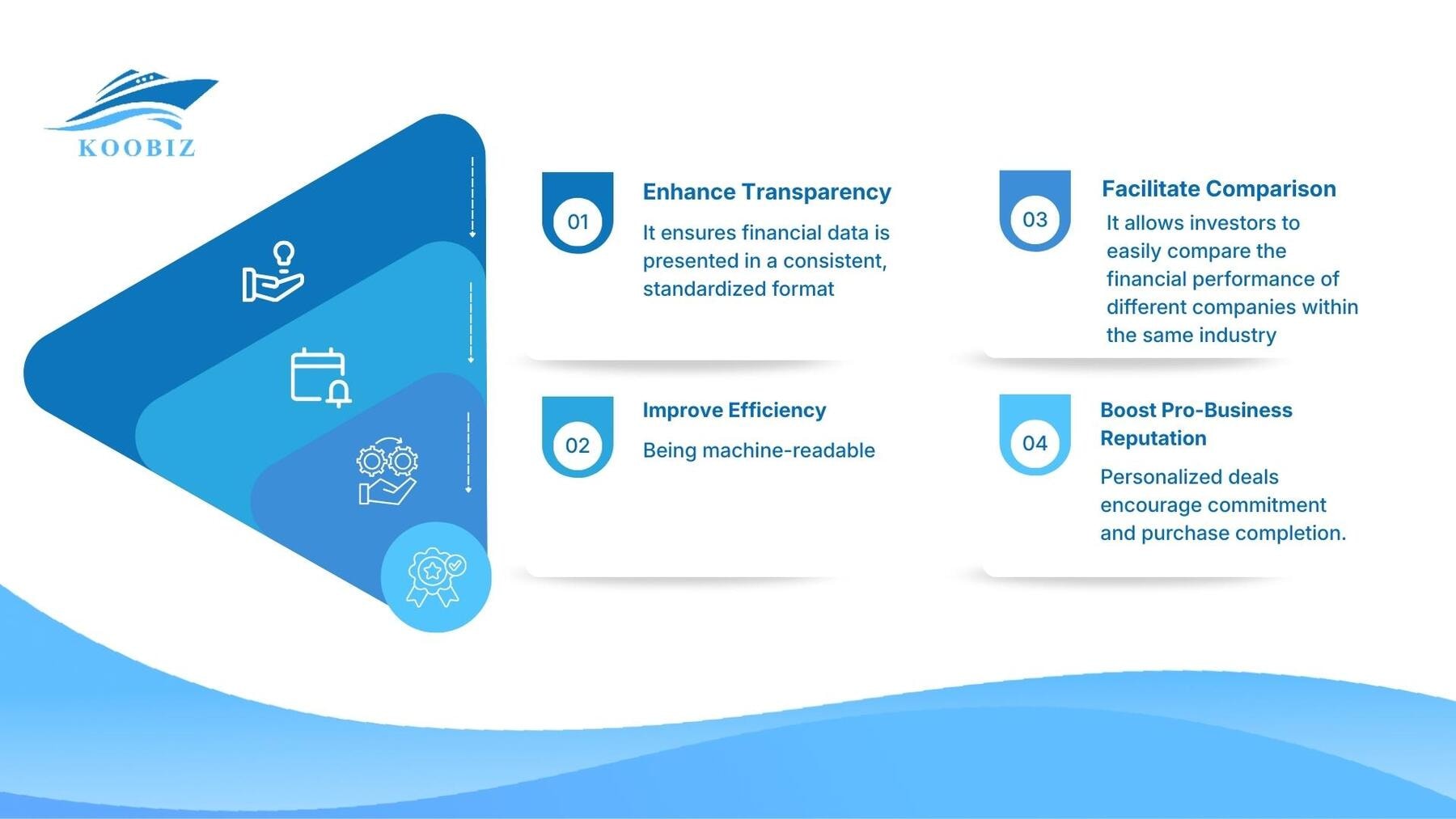
    ACRA requires most Singapore-incorporated companies to file financial statements in XBRL format to achieve several key objectives:

    • Enhance Transparency: It ensures financial data is presented in a consistent, standardized format, making the marketplace more transparent for all stakeholders.
    • Improve Efficiency: Being machine-readable, XBRL allows regulators and auditors to analyze vast amounts of data instantly without manual processing.
    • Facilitate Comparison: It allows investors to easily compare the financial performance of different companies within the same industry (comparing apples to apples).
    • Boost Pro-Business Reputation: A transparent corporate environment builds trust with international investors and strengthens Singapore’s status as a trusted global business hub.

    For companies working with Koobiz, this transition to digital reporting is not just a compliance hurdle but a step towards better financial visibility and governance.

    Who Must File Financial Statements in XBRL Format?

    The majority of Singapore-incorporated companies are required to file their financial statements in XBRL format with ACRA.

    However, the scope of this requirement depends on the specific type of business entity you operate. Generally, the mandate applies primarily to companies limited by shares, while companies limited by guarantee may be subject to different filing requirements depending on their regulatory status. Specifically, if your company is Singapore-incorporated (unlimited or limited by shares), you are legally obliged to file your financial statements in XBRL format, using either the Full or Simplified taxonomy, unless you fall into a specific exempted category.

    The Primary Groups That Must Comply
    The Primary Groups That Must Comply

    The primary groups that must comply include:

    • Public Companies: All public companies listed or unlisted.
    • Private Companies: Most private limited companies, unless they are exempted (such as Solvent Exempt Private Companies or EPCs).
    • Insolvent EPCs: Even if a company is an Exempt Private Company, if it is insolvent, it loses the privilege of filing financial statements in PDF format and must instead file its financial statements in XBRL.

    Understanding these distinctions is the first step in compliance. If your company falls within the mandatory group, the next critical decision is determining the depth of data you need to report—whether to use the Full or Simplified taxonomy.

    Full vs. Simplified XBRL: Which Taxonomy Applies to You?

    The Full and Simplified XBRL taxonomies are applied based on a company’s filing obligations with ACRA, rather than its size or public accountability.

    Choosing the correct XBRL taxonomy is important, as using the wrong one may result in your Annual Return being rejected or delayed. The table below outlines the key differences between Full XBRL and Simplified XBRL to help you determine which option applies to your company.

    Feature Full XBRL Taxonomy Simplified XBRL Taxonomy
    Applicable Companies Publicly accountable or larger entities Smaller, privately held companies (SMEs)
    Revenue Criteria Exceeds SGD 500,000 SGD 500,000 or less
    Total Assets Criteria Exceeds SGD 500,000 SGD 500,000 or less
    Data Elements (Tags) ~210 elements (High granularity) ~120 elements (Key highlights only)
    Notes to Accounts Comprehensive disclosure required Limited disclosure required

    Companies with revenue or total assets above SGD 500,000 are required by ACRA to file financial statements using the Full XBRL taxonomy. In contrast, Simplified XBRL is designed for smaller companies, allowing startups and SMEs to meet ACRA’s filing requirements with fewer disclosures and lower compliance effort.

    How to Prepare and File XBRL Financial Statements

    Preparing XBRL financial statements generally follows three main steps: preparing the source documents, mapping data in BizFinx, and validating the file before submission.

    ACRA provides a free tool called BizFinx to help companies prepare and file XBRL financial statements. Although BizFinx is free to use, accurately interpreting financial figures and mapping them to the correct XBRL tags requires technical knowledge. Whether the filing is handled internally or outsourced to a professional service provider, the overall workflow remains the same.

    How to Prepare and File XBRL Financial Statements
    How to Prepare and File XBRL Financial Statements

    Step 1: Preparing Source Documents (Excel/PDF)

    Before using BizFinx, ensure that your financial statements approved for the AGM are finalised.

    • The Directors’ Statement and Auditors’ Report (if applicable) should also be completed at this stage.
    • If you intend to import data into BizFinx, preparing an Excel template in advance can help reduce manual data entry.

    Step 2: Using the BizFinx Preparation Tool

    Once the source documents are ready, you can proceed to the BizFinx preparation tool.

    • Input Basic Data: Enter the company UEN and financial period.
    • Select Template: Choose “Full” or “Simplified” based on the criteria discussed in the previous section.
    • Mapping (Tagging): Mapping (tagging) is the key step in the XBRL process, where figures from the financial statements are mapped to the relevant XBRL tags within BizFinx. For example, “Cash at Bank” in your balance sheet must be mapped to the “Cash and Cash Equivalents” tag in the taxonomy.

    Step 3: Validating and Uploading the XBRL File

    After completing the mapping process, the XBRL file must be validated before submission.

    • Validation: Use the ‘Validate’ function in BizFinx to run system checks on the XBRL file.BizFinx checks for common issues such as arithmetic inconsistencies (for example, Assets not equalling Liabilities plus Equity) and missing mandatory disclosures.
    • Generation: After all validation errors have been resolved, the system will allow you to generate the XBRL (.xml) file.
    • Upload: Log in to the BizFile+ portal to file your Annual Return and upload this generated .xml file as the financial statement component.

    We have covered the standard procedures and definitions. Now, we will delve into the exceptions and common challenges that specific business models might face.

    Exemptions and Special Cases in XBRL Filing

    There are specific exemptions for Solvent Exempt Private Companies (EPCs) and certain other entities, allowing them to bypass full XBRL filing under strict conditions.

    Although ACRA prioritizes a ‘digital-first’ approach, the agency understands that for some business models, the cost outweighs the benefit. Knowing whether you qualify for these exemptions can save your business significant time and budget.

    Filing Requirements for Solvent vs. Insolvent EPCs

    A frequent question we handle at Koobiz revolves around Exempt Private Companies (EPCs).

    • Solvent EPCs: If your EPC is solvent (able to pay its debts), you are exempt from filing financial statements with ACRA entirely. You only need to make a solvency declaration during the Annual Return. The bottom line: You are completely exempt from XBRL filing.
    • Insolvent EPCs: If an EPC is insolvent, it must file financial statements. If this happens, you are required to file in XBRL format (usually Simplified, assuming revenue criteria are met).
    • Voluntary Filing: A solvent EPC may choose to file financial statements voluntarily. If they do, they can choose to file in either PDF or XBRL format.

    Exemptions for CLGs and Foreign Companies

    ACRA recognizes that not every entity fits the standard commercial mold.

    • Companies Limited by Guarantee (CLGs): Commonly used for non-profits and charities, CLGs get a pass on the complex data entry. They are only required to file a PDF copy of their financial statements.
    • Foreign Companies (Singapore Branch): Singapore branches of foreign companies verify their accounts based on the laws of their home country. They are exempt from XBRL filing and you only need to file a PDF copy of their financial statements.

    Common Challenges and Best Practices for XBRL Mapping

    Misunderstanding the Scope / The Expert Fix

    XBRL is not just data entry; it is a translation of financial concepts. A mismatch between a line item in your PDF report and the ACRA taxonomy tag creates a misleading public record.

    Avoiding Common Validation Errors in BizFinx

    Validation errors often occur due to arithmetic imbalances or missing mandatory tags.

    • Rounding Off: A common issue is rounding discrepancies where the total assets do not match the sum of individual components due to decimal rounding.
    • Negative Values: Some tags expect positive values (e.g., “Less: Expenses”), while others expect negative values. Getting the sign wrong is a classic error.
    • Unmapped Data: Leaving mandatory fields blank because the specific line item doesn’t exist in your accounts (you should enter “0” rather than leaving it null if mandatory).

    In-House Preparation vs. Outsourcing to Corporate Services

    Given these complexities, businesses face a choice:

    • In-House: Requires training staff on BizFinx and accounting standards. It is cost-effective for simple accounts but risky if staff are inexperienced.
    • Outsourcing: Outsourcing to Koobiz (The Expert Route). This ensures that the mapping is done by accountants who understand both the financial standards (FRS) and the technical taxonomy.

    Emerging Trends in 2025: ESG and Enhanced Data

    ACRA is no longer satisfied with just ‘balancing the books.’ In 2025, the agency is tightening its lens.

    The compliance landscape is evolving. Beyond basic financial data, moving beyond basic financial figures to demand a 360-degree view of corporate health and sustainability.

    • Mandatory Climate Reporting: Starting FY2025, listed issuers are required to report climate-related disclosures (Scope 1 and Scope 2 greenhouse gas emissions). While this currently targets public companies, it is the ‘canary in the coal mine’ for private enterprises.
    • Enhanced Data Granularity: The latest taxonomies require more precise tagging of revenue streams and expenses. The days of using ‘Other Expenses’ as a catch-all bucket are over. Relying on vague tags is now a compliance red flag that invites unnecessary scrutiny.

    Conclusion

    XBRL is more than just a regulatory checkbox; it is your company’s digital financial footprint. Whether you are navigating the nuances of the Full vs. Simplified taxonomy or troubleshooting BizFinx validation errors, precision is paramount.

    At Koobiz, we specialize in decoding the complex corporate landscape of Singapore for international and local entrepreneurs. From company incorporation to tax, accounting, and audit services, we ensure your business remains compliant so you can focus on growth. If you are unsure about your XBRL obligations or need assistance with your Annual Return, our team of experts is ready to help.

    Visit Koobiz.com today for professional assistance with your Singapore corporate filing needs.

  • Avoid Late Filing Penalties: Adhere to 2026 XBRL Deadlines for SG Directors

    Avoid Late Filing Penalties: Adhere to 2026 XBRL Deadlines for SG Directors

    [SUMMARIES]

    Mandatory Compliance: Most Singapore companies must file financial statements in XBRL format via BizFile+ in 2026 based on their FYE.

    The 7-Month Rule: Private Limited companies generally have 7 months from their Financial Year End to file Annual Returns.

    High Stakes: Late filing results in escalating fees ($300–$600) and potential director debarment for chronic non-compliance.

    Exemptions Exist: Solvent Exempt Private Companies (EPCs) and Dormant companies have simplified filing options.

    Recovery Options: Extensions of Time (EOT) can be applied for before the deadline to avoid immediate penalties.

    [/SUMMARIES]

    In 2026, Singapore’s regulatory regime remains strict, with ACRA enforcing firm deadlines for Annual Return and XBRL filings. For directors, meeting these timelines is not merely administrative – it is essential to avoid penalties and preserve a strong compliance record. Whether you operate a Private Limited Company or a Solvent EPC, missed deadlines can result in substantial financial consequences.
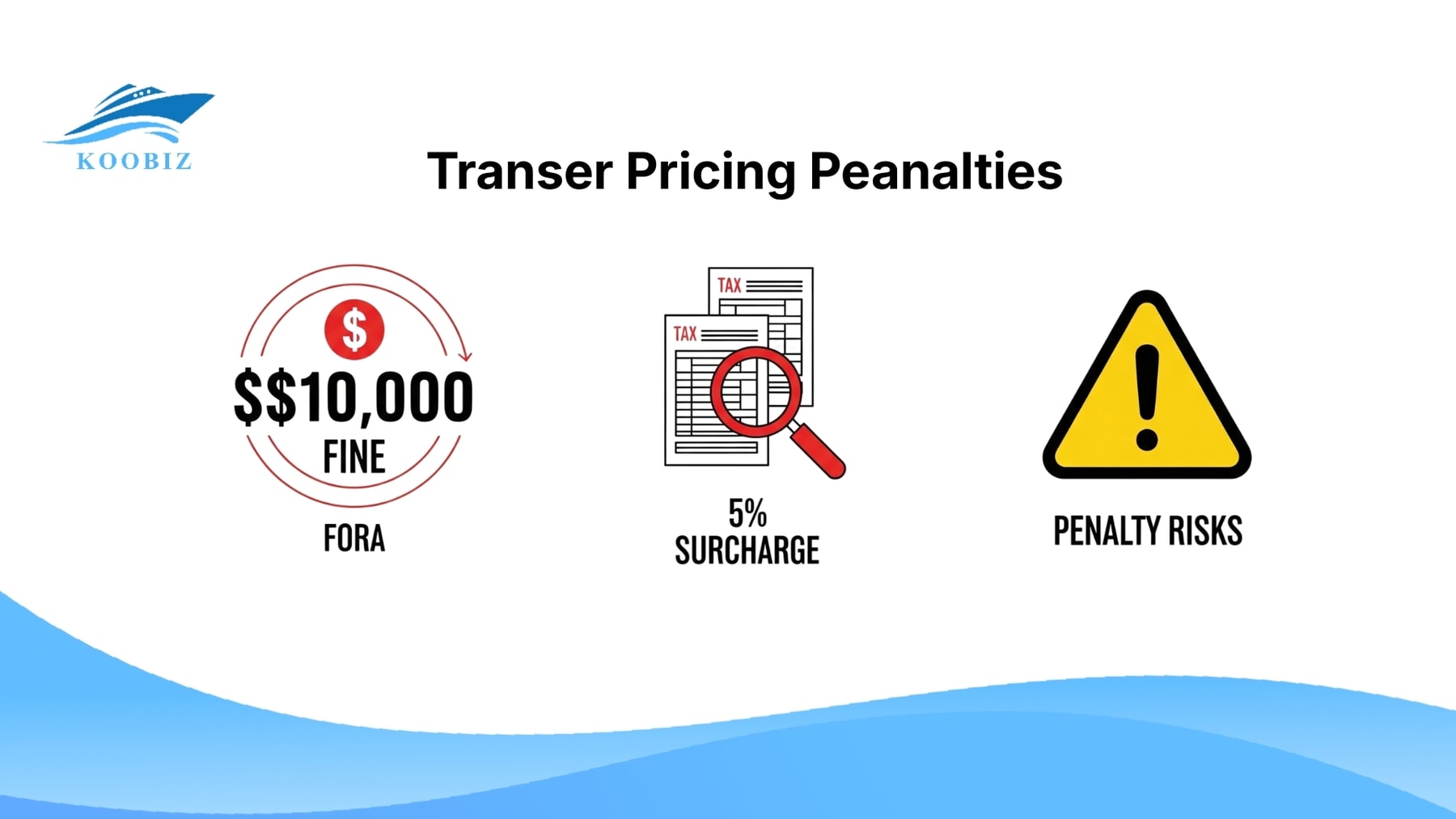
    At Koobiz, we’ve prepared this practical guide to help you determine your exact filing deadline, understand applicable fines, and assess available exemptions.

    Is XBRL filing mandatory for Singapore Companies in 2026?

    Yes. In 2026, most Singapore-incorporated companies are required to file financial statements in XBRL format unless they qualify for a specific exemption. ACRA mandates XBRL to enhance transparency and enable efficient financial analysis.

    This requirement applies to both unlimited and limited-by-shares companies. If your company is insolvent or does not qualify as a Solvent Exempt Private Company (EPC), a full set of XBRL financial statements must be lodged via ACRA BizFile+ portal. Even where the FYE falls in late 2025, the filing obligation typically arises in 2026. Failure to submit the correct XBRL file with the Annual Return will result in immediate rejection and non-compliance.
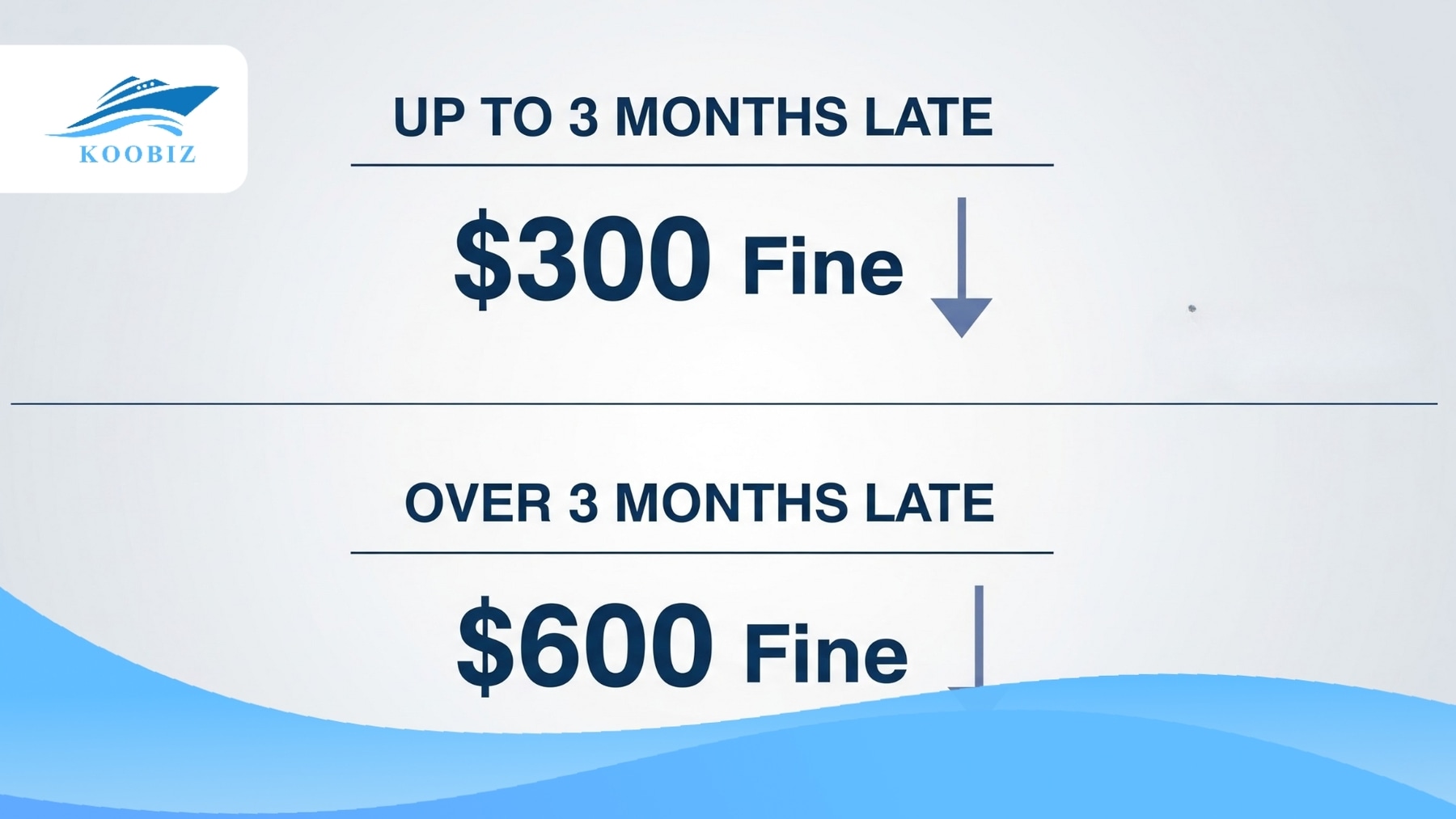
    XBRL filing
    XBRL filing

    2026 XBRL Filing Schedule: Deadlines Based on FYE

    In 2026, Annual Return filing deadlines (including XBRL) fall into two separate timelines, depending on whether the company is listed or non-listed.

    To avoid missing the deadline, directors must determine the filing date based on the company’s Financial Year End (FYE), applying the standard rule that combines the permitted AGM period with the statutory filing window.

    Deadlines Based on FYE
    Deadlines Based on FYE
    Company Type AGM Deadline (from FYE) Annual Return Deadline (from FYE) Example (FYE 31 Dec 2025)
    Private Limited (Non-listed) 6 months 7 months AGM by 30 Jun 2026

    File by 30 Jul 2026

    Listed Company 4 months 5 months AGM by 30 Apr 2026

    File by 30 May 2026

    Private Limited Companies: The 7-Month Rule Explained

    Private Limited Companies must complete their Annual Return filing within 7 months from the Financial Year End. This period covers two statutory steps: holding the AGM within 6 months of the FYE, followed by filing the Annual Return (including XBRL) within 30 days after the AGM.

    For instance, with an FYE of 31 December 2025, the AGM must be held by 30 June 2026, and the final filing deadline falls on 30 July 2026. Koobiz recommends preparing the XBRL conversion at least one month before the AGM to ensure accuracy ahead of directors’ approval.

    Listed Companies: Stricter timelines for 2026

    Listed companies in Singapore operate under a shorter timeline, with only 5 months from the Financial Year End to complete their filings. They must hold the AGM within 4 months of the FYE and lodge the Annual Return, including XBRL, within 30 days thereafter.

    For example, with an FYE of 31 December 2025, the AGM must be held by 30 April 2026 and the XBRL filing completed by 30 May 2026. This compressed timeline requires efficient reporting processes to meet the heightened compliance expectations of public entities.

    Updated ACRA penalties for late lodgment in 2026

    In 2026, ACRA enforces a tiered penalty regime for late filings, ranging from monetary fines to serious administrative sanctions on directors. While an initial late fee may appear minor, repeated non-compliance can severely damage a company’s compliance record and reputation. Notably, these penalties are automatically triggered by the BizFile+ system upon late submission.

    ACRA Tiered Penalty Regime (2026)
    ACRA Tiered Penalty Regime (2026)

    How late fees accumulate: Tiered penalty Structure

    Late lodgment fees are capped based on the length of the delay, typically ranging from $300 to $600 per statutory breach. Filing the Annual Return within three months of the deadline usually incurs a $300 penalty, increasing to $600 if the delay exceeds three months.

    Importantly, penalties are imposed separately for the AGM and the Annual Return. Missing both deadlines can therefore double the total fines – an avoidable cost that services like Koobiz help mitigate through proactive compliance reminders.

    Directors’ Liability: Can you be disqualified?

    Yes. Directors may be disqualified or debarred for persistent breaches of the Companies Act. Under the enhanced enforcement regime, a director with three or more companies struck off by ACRA within five years may be barred from holding directorships. In addition, ACRA now displays a public compliance rating on the Business Profile, meaning repeated late XBRL filings can directly undermine a company’s credibility with banks and investors.

    Real-World Scenarios: 2026 compliance in action

    To put these deadlines into perspective, the following three scenarios for the 2025/2026 financial year show how the rules apply across different business structures and the real cost of missing them.

    Scenario 1: The Standard Private Company

    Company Profile: TechStart Pte. Ltd. (Private Company)

    • FYE: 31 December 2025.
    • Deadline Calculation:
      • AGM: Must be held by 30 June 2026 (within 6 months).
      • Filing: Must file Annual Return by 30 July 2026 (within 7 months).
    • Outcome: The director approves the Financial Statements in June, and the Corporate Secretary files the XBRL via BizFile+ in July. The company remains compliant with zero penalties.

    Scenario 2: The Listed Entity

    Company Profile: Global Trade Holdings Ltd (Public Listed)

    • FYE: 31 March 2026.
    • Deadline Calculation:
      • AGM: Must be held by 31 July 2026 (within 4 months).
      • Filing: Must file Annual Return by 31 August 2026 (within 5 months).
    • Outcome: Due to the tighter timeline, the company completes its audit by early July to meet the accelerated deadline.

    Scenario 3: The Cost of Delay

    Company Profile: LateBloomer Services Pte. Ltd.

    • FYE: 31 December 2025.
    • Filing Date: The company misses the 30 July 2026 deadline and finally files on 15 November 2026 (3.5 months late).
    • Consequence:
      • Late Lodgment Fee: $600 (imposed immediately because the delay exceeded 3 months).
      • Composition Sum: ACRA may also offer a separate composition sum (minimum $500) for the breach of Section 197 (Annual Return) or Section 175 (AGM).
      • Total Risk: The company faces a potential total of $1,100+ in fines and a permanent “Late” remark on the director’s compliance history for that year.

    With the key deadlines and penalties established, we now turn to the finer details of the filing requirements. Not all companies are subject to the same obligations, and understanding the applicable exemptions and variations can save substantial time and resources in 2026.

    Understanding Revisions: Revised XBRL Requirements in 2026

    The Revised XBRL Filing Requirements are now the authoritative standard for financial reporting in Singapore. Designed to streamline data elements, this framework reduces compliance burden while still capturing the key financial information required by ACRA.

    To navigate these requirements effectively in 2026, directors should note the following key changes:

    • Elimination of Old Options: Companies are no longer permitted to use the obsolete “Option A” or “Option B” formats, which have been fully phased out.
    • The Single Template Approach: Most companies must now file using the Revised XBRL Filing Requirements template. This unified template focuses on capturing approximately 100+ data elements that allow ACRA to benchmark industry performance.
    • Simplified vs. Full IFRS: While less exhaustive than the full IFRS taxonomy, the revised template still requires precise mapping of financial line items to ensure accuracy.

    Understanding these specific data entry points is where the professional corporate secretaries at Koobiz add immense value, ensuring your financial mapping complies strictly with the latest taxonomy revisions.

    Exemptions and Special Cases for 2026 Filing

    Certain categories of companies are exempted from filing a full set of XBRL financial statements based on their solvency or level of activity. Determining whether your entity falls within these “unique” or “rare” classifications is key to optimizing your compliance approach.

    Solvent EPCs: Do you need to convert financials to XBRL?

    No. Solvent Exempt Private Companies (EPCs) are not required to file financial statements in XBRL, provided they make the necessary solvency declarations. An EPC is a private company with no more than 20 shareholders and no corporate shareholders. If solvent, it may file a simplified Annual Return without financial statements or attach them in PDF format. While XBRL filing is optional, voluntary submission may enhance the company’s credit profile. By contrast, insolvent EPCs must file a full set of XBRL financial statements.

    Filing for dormant companies: Simplified process

    Dormant companies enjoy a much simpler filing regime than active entities. A company is considered dormant if it has no accounting transactions during the financial year. In 2026, a dormant non-listed company that meets the substantial assets test (total assets ≤ S$500,000) is exempt from preparing financial statements and filing XBRL.

    Such companies may submit a simplified Annual Return via BizFile+ to confirm their dormant status. While this exemption can significantly reduce compliance costs, directors must ensure no unintended transactions (such as bank charges) have occurred that would negate dormancy.

    What to Do If You Miss the 2026 Deadline?

    If your company is unable to meet the XBRL filing deadline, the appropriate step is to apply for an Extension of Time (EOT) instead of filing late. Proactive action signals to ACRA that the board is managing the issue responsibly.

    Step-by-Step Guide to Applying for an Extension of Time (EOT)

    Applying for an EOT involves a formal request via the BizFile+ portal, which must be submitted before the statutory deadline expires.

    1. Log in to BizFile+: Use your Corppass to access the portal at www.bizfile.gov.sg.
    2. Select EOT Service: Navigate to “Annual Filing” and select “Application for Extension of Time for Holding AGM/Filing AR”.
    3. Provide Justification: You must state a valid reason (e.g., delay in audit, change of financial year).
    4. Pay the Fee: The fee is $200 per application (covering up to 60 days extension).

    Approvals are generally granted if the application is made early. However, relying on EOTs annually is not sustainable. For a long-term solution, partnering with a corporate service provider like Koobiz ensures that your accounts are prepared and converted to XBRL well ahead of schedule, keeping your company in good standing.

  • Master Transfer Pricing Compliance in Singapore for MNCs: The Arm’s Length Guide

    Master Transfer Pricing Compliance in Singapore for MNCs: The Arm’s Length Guide

    [SUMMARIES]

    Mandatory Compliance: Singapore tax law (Section 34D) requires all related party transactions to strictly adhere to the Arm’s Length Principle.

    Documentation Threshold: Businesses with gross revenue exceeding S$10 million must prepare contemporaneous Transfer Pricing Documentation (TPD).

    3-Step Approach: IRAS mandates a specific three-step process: Comparability Analysis, Method Selection, and Determining Results.

    Penalty Risks: Non-compliance can result in a fine of up to S$10,000 and a 5% surcharge on any tax adjustments made by IRAS.

    Strategic Support: Koobiz assists MNCs in navigating complex TP rules, including the latest 8th Edition guidelines on intercompany loans.

    [/SUMMARIES]

    For Multinational Corporations (MNCs) expanding into Asia, Singapore offers an attractive tax regime, yet it demands rigorous adherence to regulatory standards, particularly regarding cross-border transactions. Transfer Pricing Compliance in Singapore has moved from being a supplementary reporting requirement to a central focus of the Inland Revenue Authority of Singapore (IRAS), especially with the enforcement of the 8th Edition Guidelines.

    At Koobiz, we recognize that the technical requirements under Section 34D of the Income Tax Act can be challenging for both foreign investors and established MNCs. This guide is designed to help you clearly understand and apply the Arm’s Length Principle, assess when transfer pricing documentation becomes mandatory, and navigate the IRAS-mandated three-step approach. Whether you are reviewing intercompany financing arrangements or preparing for a potential tax audit, a solid grasp of these rules is essential to mitigate surcharge risks and protect your company’s standing in Singapore.

    What constitutes Transfer Pricing under Singapore Tax Law?

    Transfer Pricing
    Transfer Pricing

    Transfer Pricing is the pricing mechanism used for transactions between related parties, such as the sale of goods, provision of services, or transfer of intangible assets, which must strictly reflect market conditions.

    To delve deeper, transfer pricing is a neutral accounting term, not an illegal practice. However, under Section 34D of the Income Tax Act, IRAS scrutinizes these prices to prevent profit shifting and ensure profits reflect true economic value in Singapore.

    Defining “Related Party” & Scope

    IRAS defines related parties broadly, generally where there is control, significant influence, or a shared holding company. As a result, the scope of transfer pricing is wide and includes:

    • Operational Activities: Management fees, royalties, and intercompany loans.
    • Audit Scope: Every internal invoice is a potential subject of scrutiny.

    Koobiz Advice: Transparency and consistency in these definitions are your first line of defense against tax adjustments.

    According to IRAS e-Tax Guide (Eighth Edition), the authority explicitly states that taxpayers are expected to apply the arm’s length principle to ensure that their pricing with related parties reflects independent pricing behavior.

    How is Compliance with the Arm’s Length Principle Determined?

    Compliance is achieved when related party pricing matches what independent parties would agree to under similar circumstances. This must be backed by robust documentation and comparable market data.

    To determine compliance, IRAS applies the Arm’s Length Principle (the international standard). If your internal pricing deviates significantly from market rates—either artificially inflating costs or suppressing revenue—IRAS will deem it non-compliant.

    Compliance with ALP: Documentation, Data & 3 Factors
    Compliance with ALP: Documentation, Data & 3 Factors

    The Core Test: “Would independent parties agree?”

    To pass this test, businesses must analyze three key factors:

    • Contractual Terms: Are the terms standard for the industry?
    • Economic Circumstances: Do the prices reflect current market realities?
    • Business Strategies: Is the pricing commercially rational?

    At Koobiz,we assist companies in stress-testing their intercompany pricing against this “independent party” benchmark, identifying exposure early and rectifying gaps before an audit arises.

    Research by the OECD confirms that the Arm’s Length Principle remains the global standard for ensuring fair tax bases across jurisdictions.

    What are the Mandatory Requirements for Transfer Pricing Documentation (TPD)?

    There are two specific mandatory conditions that trigger the requirement for TPD: having gross revenue exceeding S$10 million for the basis period, or being explicitly required by IRAS to prepare such documentation.

    Beyond applying the arm’s length principle in theory, Singapore law imposes strict documentation standards to ensure pricing can be properly substantiated. It is important to distinguish routine bookkeeping from Qualifying Transfer Pricing Documentation, which must meet specific regulatory criteria.

    1. Gross Revenue Threshold: If your company’s gross revenue (not just profit) exceeds S$10 million in the basis period concerned, you are legally required to prepare contemporaneous TPD.
    2. Specific Requirement: Regardless of revenue, if IRAS issues a specific direction to your company to prepare TPD for a previous basis period, you must comply.

    Exemptions from TPD

    Even where the S$10 million revenue threshold is met, IRAS grants transaction-level exemptions to ease the compliance burden for lower-value dealings between related parties.

    • Purchase/Sale of Goods: Exemption applies if the total value is below S$15 million.
    • Loans: Exemption applies if the loan value is below S$15 million (applicable where the IRAS Indicative Margin is applied).
    • Services, Royalties, and Others:
      • For YA 2025 and prior: Exemption applies if the total value is below S$1 million.
      • For YA 2026 onwards: The threshold increases to S$2 million, providing greater relief for businesses.

    TPD must be prepared on a contemporaneous basis, meaning it should be completed before the due date of filing the corporate income tax return. The documentation must cover, among others, the group structure, business activities, intercompany transactions, and a defensible pricing analysis. Failure to produce adequate TPD upon IRAS’ request exposes the company to immediate penalties and potential tax adjustments.

    At Koobiz, we support clients in preparing robust, compliant TPD that aligns with the detailed content requirements set out in the Second Schedule of the Income Tax (Transfer Pricing Documentation) Rules 2018, helping businesses mitigate risk and withstand IRAS scrutiny.

    The IRAS 3-Step Approach to Applying the Arm’s Length Principle

    The IRAS 3-Step Approach to Applying the Arm's Length Principle
    The IRAS 3-Step Approach to Applying the Arm’s Length Principle

    To justify pricing to tax authorities, MNCs are expected to apply a structured three-step methodology prescribed by IRAS. Transfer pricing is not a matter of estimation or intuition; it must be supported by a disciplined and evidence-based approach.

    Step 1: Comparability Analysis

    The foundation of transfer pricing lies in comparing your related party transaction with independent ones. This analysis must examine:

    • Characteristics: What goods or services are being traded?
    • Functional Analysis (FAR): Who performs the Functions, owns the Assets, and assumes the Risks?
    • Economic Circumstances: What are the market conditions?

    Step 2: Identification of the Most Appropriate TP Method

    IRAS requires the “most appropriate” method from the five internationally accepted options:

    • CUP Method: Compares specific prices (ideal for commodities).
    • Resale Price Method: Focuses on gross margins (for distributors).
    • Cost Plus Method: Focuses on mark-ups (for manufacturers/service providers).
    • TNMM: Compares net profit margins (most common for complex operations).
    • Profit Split: Splits profits based on contribution (for highly integrated value chains).

    Step 3: Determination of the Arm’s Length Results

    Apply the selected method to your data to derive an interquartile range.

    • Within Range: Compliant.
    • Outside Range: Adjustment required to the median.

    Real-world Impact: A Koobiz client in logistics used the TNMM to successfully justify their operating margin against competitors, eliminating subjectivity in their IRAS filings.

    Case Studies: Transfer Pricing in Action

    Real-world examples demonstrate the practical application of the Arm’s Length Principle and the potential pitfalls of incorrect pricing.

    To clarify how these rules affect daily operations, consider these two common scenarios that often trigger IRAS scrutiny.

    Scenario A: The Limited Risk Distributor (Tangible Goods)

    • Context: TechGlobal SG is a Singapore subsidiary acting as a distributor for its US parent. It purchases electronic components from the parent at S$80 per unit and resells them to local customers at S$100.
    • The Issue: After deducting local operating expenses (marketing, staff, rent), TechGlobal SG reports a Net Operating Margin of 1%.
    • IRAS Analysis: Using the TNMM (Transactional Net Margin Method),IRAS benchmarks TechGlobal SG against comparable independent distributors operating in Singapore. The benchmarking analysis shows that similar distributors typically earn an arm’s length operating margin of 3% to 5%.
    • Outcome: The adjustment leads to additional taxable income in Singapore, along with a 5% surcharge imposed on the transfer pricing adjustment, highlighting how even routine distribution models can result in costly exposure if pricing is not properly supported.

    Scenario B: Intercompany Management Fees (Services)

    • Context: SingHQ Pte Ltd acts as a regional hub, providing HR and IT support services to its subsidiaries in Vietnam and Thailand. Each subsidiary is charged a flat management fee of S$1 million per year, without detailed invoices or service breakdowns.
    • The Issue: The subsidiaries cannot verify the specific services received or the basis of the cost.
    • IRAS Analysis: IRAS applies the “Benefit Test”. Did the subsidiaries actually need and receive these services? Is the fee based on Cost + Mark-up (e.g., Cost + 5%)?

    IRAS will expect formal intercompany agreements and contemporaneous evidence, such as timesheets, service reports, email correspondence, or cost allocation schedules, to substantiate the charges.

    • Outcome: The deduction may be denied at the subsidiary level, or the income reclassified at SingHQ, potentially triggering double taxation disputes and additional tax exposure across multiple jurisdictions.

    What are the Penalties for Non-Compliance with Transfer Pricing Rules?

    Non-compliance with Transfer Pricing rules triggers severe financial consequences, including a fine of up to S$10,000, a 5% surcharge on adjustments, and potential interest on underpaid taxes.

    The consequences of ignoring these rules are not just administrative but financially punitive. IRAS has taken a stricter stance on enforcement to deter profit shifting.

    Transfer Pricing Penalties: Fine, 5% Surcharge, No Safe Harbour
    Transfer Pricing Penalties: Fine, 5% Surcharge, No Safe Harbour
    1. Fine for Non-Documentation: Failure to prepare or submit TPD upon request can result in a fine not exceeding S$10,000. This applies even if the pricing itself was correct but the documentation was missing.
    2. 5% Surcharge on Adjustments: If IRAS reviews your accounts and decides to adjust your transfer price (increasing your taxable income), a 5% surcharge is imposed on the amount of the adjustment, regardless of whether there is additional tax payable. This surcharge is not tax-deductible.
    3. No Safe Harbour from Penalties: Unlike some jurisdictions where having documentation provides penalty protection, in Singapore, the 5% surcharge is strictly applied on adjustments.

    Note on Remission: While strict, IRAS may consider remitting part or all of the surcharge in cases where taxpayers are cooperative or voluntarily initiate a retrospective adjustment within two years (provided no audit has commenced). Proactive correction is key.

    Beyond immediate penalties, repeated non-compliance can trigger wider tax audits, including reviews of GST and withholding tax positions, and may result in reputational harm with regulators and counterparties. In practice, investing in robust transfer pricing compliance upfront is significantly more cost-effective than dealing with escalating penalties and enforcement actions later.

    Contextual Border:

    Having covered the “What” (definitions), the “Why” (compliance rationale), and the “Consequences” (penalties), we now turn to the “How.” The next section examines complex, real-world applications, such as intercompany financing arrangements and dispute resolution mechanisms, that sophisticated MNCs commonly encounter as their operations scale.

    Handling Specific Related Party Transactions and Dispute Resolutions

    MNCs face specific compliance requirements for intercompany loans and services, alongside mechanisms for resolving cross-border disputes.

    How are Intercompany Loans Treated under the 8th Edition Guidelines?

    Rule: Loans must be priced using a Base Reference Rate + Arm’s Length Spread or the IRAS Indicative Margin.

    • 8th Edition Update: Benchmarking must strictly match the loan tenure.
    • Domestic Loans (New Jan 2025 Rule): For domestic loans entered into from 1 Jan 2025, if neither party is in the business of lending, taxpayers can choose to apply the IRAS Indicative Margin.
      • Key Benefit: Doing so exempts the transaction from TPD and, crucially, IRAS will not make Section 34D adjustments on these specific loans.
    • Interest-Free Loans: From 2025 onwards, interest-free domestic intercompany loans are generally not acceptable unless supported by strong commercial justification. For cross-border loans, IRAS typically does not adjust interest-free arrangements where the Singapore entity is the lender, largely due to Singapore’s remittance-based taxation system. However, documentation and rationale remain important to mitigate audit risk.

    In practice, intercompany financing has become a high-focus area under the 8th Edition, and structuring loans correctly from inception is critical to avoid unnecessary adjustments and penalties.

    What is the Safe Harbour Rule for Routine Support Services?

    Rule: Taxpayers can apply a fixed 5% cost mark-up on routine support services (e.g., HR, IT listed in Annex C).

    • Benefit: No detailed benchmarking study is required.
    • Condition: Costs must be strictly pooled and correctly allocated.

    What is the Difference Between Advance Pricing Arrangements (APA) and Mutual Agreement Procedures (MAP)?

    APA is proactive; MAP is reactive. Use APAs for certainty and MAPs to resolve double taxation.

    Feature Advance Pricing Arrangement (APA) Mutual Agreement Procedure (MAP)
    Nature Prospective (Forward-looking / Prevention) Reactive (Backward-looking / Cure)
    Primary Purpose Determine pricing for future years (3-5 years). Resolve double taxation after adjustments.
    Benefit Audit immunity on covered transactions. Eliminates double taxation via authority agreement.

    When should MNCs consider a Transfer Pricing Health Check?

    Conduct a health check immediately if you meet any of the following criteria:

    • [ ] Revenue: Gross revenue > S$10 million.
    • [ ] Thresholds: Services/Royalties > S$1 million (S$2 million from YA 2026).
    • [ ] Outdated Data: Benchmarking study > 3 years old.
    • [ ] Losses: Singapore entity is consistently loss-making.
    • [ ] Risks: Interest-free loans exist between related parties.

    Koobiz offers a “traffic light” risk assessment to identify and remediate these exposures.

    About Koobiz

    Managing transfer pricing in Singapore goes beyond technical compliance, it requires commercial insight, regulatory awareness, and hands-on local experience. Koobiz is a trusted corporate services firm supporting businesses at every stage of their Singapore journey.

    We specialize in:

    • Singapore Company Incorporation: Setting up your optimal business structure.
    • Bank Account Opening: Facilitating seamless financial integration in Singapore.
    • Tax & Accounting Services: From Corporate Income Tax filing to Transfer Pricing Documentation preparation.
    • Audit & Assurance: Ensuring full regulatory compliance.

    Transfer pricing risks should never slow down your expansion. With Koobiz, your related party transactions are structured to be compliant, commercially sound, and well-prepared for IRAS scrutiny, so you can focus on growing your business with confidence.

    Explore Koobiz Services

    Disclaimer: This guide is for informational purposes only and does not constitute legal or tax advice. Transfer pricing rules are subject to change. Please consult with a professional advisor or IRAS guidelines for specific business circumstances.

  • Avoid Annual Return Late Filing Penalty in Singapore: ACRA Compliance Guide

    Avoid Annual Return Late Filing Penalty in Singapore: ACRA Compliance Guide

    [SUMMARIES]

    Penalty Tiers: A fixed $300 fine applies if your filing is up to 3 months late, rising to $600 for delays beyond that.

    Deadlines: For most private companies, the Annual Return must be filed within 7 months after your company’s financial year ends.

    Director Liability: This isn’t just a company fee. Directors may be summoned to court or disqualified if non-compliance persists.

    Immediate Action: The penalty must be paid immediately via BizFile+ at the point of filing to prevent escalation.

    Appeals: Getting a penalty waived is very uncommon. ACRA typically only considers requests in cases of proven system errors, not simple oversight or a busy schedule.

    [/SUMMARIES]

    For business owners in Singapore, receiving a notification about an Annual Return late filing penalty can be a source of significant anxiety. It’s not just about the fee—it’s a compliance issue that, if ignored, can lead to court action and affect a director’s ability to serve.

    At Koobiz, we understand that ACRA requirements can feel overwhelming, especially for new founders or overseas business owners. Whether you operate a local startup or an international subsidiary, understanding your filing deadlines and penalty exposure is essential to keeping your company in good standing.

    This guide is your straightforward resource for fixing and avoiding these penalties. We’ll explain the exact fines, how the system works, the deadlines based on your company’s financial year, and what happens if these legal duties are overlooked. We’ll also clear up the common mix-up between ACRA and tax filings, giving you a clear path to staying compliant.

    What is the ACRA Annual Return Late Filing Penalty?

    ACRA Annual Return Late Filing Penalty Warning
    ACRA Annual Return Late Filing Penalty Warning

    The ACRA Annual Return late filing penalty is a statutory fine imposed on companies that fail to lodge their Annual Return (AR) within the prescribed timeline. Think of it this way:

    • Statutory Mandate: Under Section 197 of the Companies Act, every company is legally required to file an AR to confirm its particulars (officers, address, financial status) are up to date.
    • Automatic Enforcement: The system flags a late filing immediately; no manual review is needed to issue the initial fine.
    • Public Register Integrity: The penalty ensures public records are timely and reliable for anyone checking a company’s status.
    • Distinct from Tax: Unlike IRAS tax returns which focus on income, the Annual Return focuses on corporate governance and solvency. Many Koobiz clients often confuse the two, leading to accidental non-compliance.
    • Director Responsibility: While the fine is charged to the company, the legal duty to ensure it’s filed and paid falls on the directors.

    How Much is the Late Lodgement Fee and Composition Sum?

    Two tiers of late filing penalties: $300 and $600
    Two tiers of late filing penalties: $300 and $600

    There are two primary tiers for the late lodgement penalty: a $300 flat fee for filings made within 3 months of the deadline, and a $600 flat fee for filings made after 3 months.

    Specifically, the cost depends on the duration of the delay. ACRA simplified this framework effective April 30, 2021, to encourage quicker rectification of breaches. Previously, penalties accumulated on a monthly basis, which could lead to confusion. The current 2-tier system is straightforward but punitive enough to discourage negligence.

    • Tier 1 ($300): If you miss your deadline but file the Annual Return within 3 months (90 days) of the due date, the penalty is capped at $300. This is legally referred to as a “Composition Sum”, essentially an offer to settle the offense out of court by paying a fixed amount.
    • Tier 2 ($600): If the delay exceeds 3 months, the penalty doubles to $600. This is the maximum administrative penalty ACRA will impose via the BizFile+ system before potentially escalating the matter to prosecution.

    Importantly, penalties are imposed per breach. In many cases, companies that miss their Annual Return deadline have also failed to hold their Annual General Meeting (AGM) on time. Each breach can attract a separate composition sum. As a result, directors may face up to $1,200 in total penalties, $600 for the AGM breach and $600 for the AR breach. Koobiz advises clients to view the $600 cap not as a safety net, but rather as ACRA’s final administrativewarning before court action is initiated.

    Note: As of late 2025, ACRA continues to enforce this 2-tier framework strictly. Ignoring the Tier 2 penalty often results in a summons to court.

    When is the Annual Return Deadline Due?

    AR submission deadline based on FYE
    AR submission deadline based on FYE

    Your deadline isn’t a fixed calendar date. It’s calculated from your company’s own Financial Year End (FYE).

    • For Non-Listed Companies (Private Limited): You must file your Annual Return within 7 months after your FYE. For example, if your FYE is 31 December, your Annual Return is due by 31 July of the following year.
    • For Listed Companies: The timeline is tighter. You must file within 5 months after your FYE.

    Key Detail: The 7-month AR deadline assumes you have complied with AGM requirements. For most private companies, the AGM must be held within 6 months after the FYE. If the AGM is delayed (or forgotten), the AR filing will almost certainly become late as well, triggering penalties for both breaches.

    Real-World Scenarios: Calculating Deadlines and Penalties

    To make these rules easier to digest, let’s look at three common scenarios we encounter at Koobiz. These examples illustrate how the Financial Year End (FYE) dictates the deadline and how the penalty tiers are applied in practice for a standard Private Limited Company.

    Scenario 1: The “Just Missed It” Startup (Tier 1 Penalty)

    • Company: TechStart Solutions Pte. Ltd.
    • Financial Year End (FYE): 31 December 2023.
    • Correct Deadline: 31 July 2024 (7 months after FYE).
    • Actual Filing Date: 15 August 2024.
    • The Breach: The filing is 15 days late.
    • The Penalty: $300.
    • Koobiz Insight: Even a short delay counts. Once the deadline is missed, even by a single day, the filing automatically falls into the “within 3 months” penalty tier. ACRA does not calculate penalties by the number of days late; the full $300 applies immediately.

    Scenario 2: The Major Oversight (Tier 2 Penalty)

    • Company: Global Trade Holdings Pte. Ltd.
    • Financial Year End (FYE): 31 March 2023.
    • Correct Deadline: 31 October 2023.
    • Actual Filing Date: 5 February 2024.
    • The Breach: The filing is over 3 months late (approx. 95 days late).
    • The Penalty: $600.
    • Koobiz Insight:Once the delay crosses the 3-month mark, the penalty automatically increases to $600. More importantly, leaving the breach unresolved for an extended period significantly raises the risk of a court summons, exposing directors to prosecution and potential disqualification.

    Scenario 3: The “Tax vs. ACRA” Confusion

    • Company: Creative Design Agency Pte. Ltd.
    • The Situation: The foreign director successfully filed the Corporate Tax Return (Form C-S) with IRAS by the 30 November deadline and assumed all government compliance was complete.
    • The Mistake: They neglected the ACRA Annual Return, which was due earlier on 31 July.
    • The Outcome: Despite paying their taxes on time, the company was flagged as “Non-Compliant” by ACRA and incurred a $600 late filing penalty because the error was only discovered 5 months later.
    • Lesson: IRAS tax filing and ACRA Annual Return filing are separate obligations with different deadlines. Being compliant with IRAS does not mean you are compliant with ACRA.

    Steps to File Late Annual Return and Pay Penalties via BizFile+

    Follow these three key steps to resolve the issue:

    Step 1: Log in to BizFile+

    Access the BizFile+ portal using your Corppass login. You must be an authorized director, company secretary, or a registered filing agent.

    Step 2: Navigate to Annual Return

    Select “File Annual Return by Local Company” and complete all the required information accurately.

    Step 3: Acknowledge and Pay

    The system will auto-calculate the late fee ($300 or $600). Acknowledge and pay immediately via card or GIRO to complete the filing. Once payment is made, your company’s compliance status will be updated.

    What are the Consequences of Ignoring the ACRA Penalty?

    Severe consequences of ignoring ACRA penalties
    Severe consequences of ignoring ACRA penalties

    Ignoring the penalty escalates the issue from a simple fine to a serious legal problem for the company’s directors.

    Can Directors Face Court Prosecution and Disqualification?

    Yes, directors can face personal court prosecution and, upon conviction, may be disqualified or debarred from acting as a director in Singapore. There are two main risks for directors:

    Under the Companies Act, if a director fails to comply with the requirement to file Annual Returns, ACRA can issue a summons to attend court. The specific consequences include:

    • Court Fines: The court can impose fines significantly higher than the $600 composition sum, potentially up to $5,000 per offense.
    • Disqualification (Section 155): A director faces disqualification for “persistent default.” This occurs if you are convicted of three or more filing offenses within a 5-year period, or have three or more enforcement orders made against you.
    • Debarment (Section 155B): This is a swifter enforcement tool. The Registrar can debar a director if they fail to lodge any document for at least 3 months after the deadline. Unlike disqualification, you do not need multiple convictions; a single prolonged default can trigger this, preventing you from taking on new appointments as a director or secretary.
    • Section 155A: Additionally, a director can be disqualified if they were a director of at least three companies which were struck off within a 5-year period (where the striking off was initiated by ACRA).

    At Koobiz, we stress that director enforcement records are publicly accessible. A disqualification is not a private administrative matter, it permanently damages your professional standing. Such records are routinely reviewed during bank due diligence and compliance checks, making it extremely difficult to open corporate bank accounts or conduct regulated business in Singapore and other major financial centres.

    Will the Company Be Struck Off for Non-Filing?

    • Yes. Where a company repeatedly fails to file its statutory returns, ACRA may presume that the company is no longer carrying on business and initiate strike-off proceedings. Once struck off, the company ceases to exist as a legal entity. All bank accounts are frozen, contractual rights lapse, and remaining assets may vest in the state. Restoring a struck-off company is possible only through a court-led reinstatement process, which is time-consuming, costly, and subject to judicial discretion.

    Can You Appeal for a Waiver of the Late Filing Penalty?

    Yes, but only under extremely specific and rare conditions, such as a proven technical glitch in the ACRA system or a court order extending the deadline.

    While penalties are strict, there is a narrow window for appeal, though “forgetfulness” or “not knowing the law” are never accepted as valid reasons.

    • Invalid Reasons: “My accountant resigned,” “I was overseas,” “I didn’t receive the reminder email,” or “The company made no profit.” These are considered management failures, not valid excuses.
    • Valid Reasons: Proven system failure of BizFile+ (requires screenshots/logs), loss of essential records due to fire or theft (requires police report), or critical illness of the sole director (requires medical evidence).

    Appeals must be lodged via BizFile+ or written to ACRA directly. However, based on Koobiz‘s experience, the success rate for waivers is very low unless the evidence is irrefutable. It is often more cost-effective to pay the composition sum and move on.

    Difference Between ACRA Annual Return and IRAS Tax Filing Penalties

    ACRA penalties target the governance and structural reporting of the entity, whereas IRAS penalties strictly target the reporting of taxable income and corporate tax liability. It is crucial not to conflate the two.

    Feature ACRA (Annual Return) IRAS (Tax Filing – Form C-S/C)
    Primary Focus Governance, shareholders, officers, and solvent financial status. Reporting of taxable income and corporate tax liability.
    Enforcement Authority Accounting and Corporate Regulatory Authority (ACRA). Inland Revenue Authority of Singapore (IRAS).
    Deadline Depends on FYE (e.g., 7 months after FYE for non-listed). Fixed deadline (typically 30 November).
    Late Penalty Fixed tiers: $300 (Tier 1) or $600 (Tier 2). Varies: Composition fines to court prosecution under tax evasion laws.
    Relationship Filing here does not satisfy IRAS requirements. Filing here does not satisfy ACRA requirements.

    According to Singapore regulatory data, a significant portion of compliance breaches involving foreign-owned companies stem from confusing the Annual Return with the Tax Return.

    Conclusion

    Staying compliant in Singapore’s business environment requires attention to detail. The Annual Return late filing penalty is a sign that your company’s administrative health needs a check-up. Whether it’s a $300 fee or the risk of director disqualification, the consequences of inaction are far greater than the effort of staying organized.

    At Koobiz, we help business owners stay fully compliant so they can focus on growth with confidence. From company incorporation and corporate bank account opening to ongoing tax, accounting, audit, and company secretarial services, our team ensures that no deadline is missed. If you are currently facing a late filing issue or require a professional Company Secretary to manage your Annual Returns, contact Koobiz today for a complimentary compliance health check. Avoid unnecessary penalties, let us handle the paperwork for you.