New EP applications must meet the S$6,000 threshold and S Pass candidates must earn at least S$3,600 starting January 1, 2027, with renewals following on January 1, 2028.
Meeting the minimum salary no longer guarantees approval as the COMPASS C1 criteria mandates your payroll align with the 65th percentile of local PMET wages in your sector.
Failing to recalibrate salaries for key personnel earning near old thresholds will trigger a “talent vacuum” through renewal rejections in 2028, causing severe operational paralysis.
Enterprises with constrained budgets should optimize non-salary COMPASS pillars, such as nationality diversity and local hiring, to secure necessary approval points.
Businesses can leverage the Job Redesign+ grant to receive up to 70% government funding, capped at S$150,000, to boost productivity and offset these mandatory salary hikes.
[/SUMMARIES]
With the Ministry of Manpower (MOM) officially raising the bar for Employment Pass (EP) and S Pass salaries starting in 2027, businesses face a new set of compliance and financial challenges. This update breaks down the essential figures and timelines you need to know to protect your workforce and sustain your growth in a higher-productivity economy.
MOM Update: New Salary Thresholds for EP & S Pass Holders
On March 3, 2026, MOM announced increasedsalary benchmarks to maintain the quality of the foreign workforce. To achieve this, the Ministry has mandated new minimum qualifying salary hikes. These figures serve as the baseline “floor” for eligibility, with higher thresholds applicable to older candidates and those in the Financial Services sector:
Pass Type
Current Minimum Salary
New Minimum Salary (From 2027)
Employment Pass (EP)
S$5,600
S$6,000
S Pass
S$3,300
S$3,600
Proactive Insight: Enterprises should brace for a long-term upward trajectory; the S Pass threshold is projected to reach S$4,000 – S$4,500 by 2030.
Critical Implementation Timeline
MOM has provided a dual-phase “runway” to allow businesses sufficient time for financial and manpower restructuring. Compliance will be assessed based on the following milestones:
New Pass Applications: Effective from January 1, 2027.
Pass Renewals: Effective from January 1, 2028.
This structured implementation means that while new hires will be affected immediately in 2027, companies have an additional year to evaluate and adjust salaries for existing pass holders before their 2028 renewals.
Beyond Payroll: The Strategic Risks to Your Business
Secure your company’s future with our strategic legal risk assessments
For Singapore enterprises, the 2027-2028 salary hike is not a localized payroll issue; it is a fundamental shift in business cost structures.
The “Profit Margin Squeeze” & Budgeting Crisis
Elevating the salary floor to S$6,000 (EP) and S$3,600 (S Pass) directly inflates fixed overheads. For SMEs, these mandatory adjustments can erode projected profit margins if not integrated into 2027-2028 fiscal planning. Furthermore, businesses must navigate the “wage-push” effect: raising salaries for foreign professionals often triggers a ripple effect, necessitating upward adjustments for local staff to maintain internal pay equity.
The COMPASS C1 Benchmark Tension
Under the Complementarity Assessment Framework (COMPASS), meeting the minimum salary is no longer enough. Criterion 1 (C1) benchmarks an applicant’s salary against the 65th percentile of local PMET wages within your specific sector. As the baseline rises, the “market median” shifts. Firms that fail to proactively recalibrate compensation packages risk scoring zero on the C1 pillar, leading to pass rejections even if they technically meet the S$6,000 threshold.
Risk of Key Personnel Loss
The 2028 renewal window represents a critical “talent cliff.” High-value employees currently earning near the current thresholds may suddenly become ineligible for renewal. Losing institutional knowledge and specialized expertise due to a compliance oversight is a strategic failure that can stall long-term projects and weaken market position.
The EP or S Pass Rejection and Non-Renewal Risk: Operational Disruption
In Singapore’s meritocratic labor market, a work pass rejection is a threat to operational continuity. A rejected renewal often grants the holder only a short stay (typically 30 days) to exit the country, creating a “talent vacuum” characterized by:
Project Stagnation: Sudden vacancies in leadership roles halt deliverables and disrupt client commitments.
Inflated Replacement Costs: The cost of urgent headhunting and retraining far exceeds a proactive salary adjustment.
Regulatory Scrutiny: Repeated rejections may flag the company for closer MOM monitoring in future applications.
Expert Strategies to Navigate the 2027-2028 Transition
Proactive compliance ensures business stability during legislative shifts
Preparation is the definitive defense against regulatory shifts. To maintain compliance and operational stability, Koobiz recommends the following strategic steps:
Execute a 360° Workforce Health Audit
The first phase involves a deep-dive review of your current foreign talent pool. Proactivity is key to preventing a “talent cliff” in 2028.
Identify Vulnerabilities: Categorize all EP and S Pass holders whose current compensation falls below the upcoming S$6,000 and S$3,600 thresholds.
Strategic Expiry Mapping: Prioritize passes expiring after January 1, 2028, as these will be the first to require the new benchmarks for successful renewal.
Fiscal Forecasting: Quantify the total cost of aligning “at-risk” personnel with the new standards and integrate these projections into your 2027-2028 manpower budgets.
Optimize COMPASS Scores via Non-Salary Pillars
While Salary (C1) is a primary factor, the COMPASS framework offers multiple pathways to success. If drastic salary hikes are not commercially viable, you must strengthen other pillars to secure the necessary points:
Nationality Diversity (C3): Mitigate concentration risk. A diverse workforce can yield essential bonus points under the Diversity criterion.
Local Employment Support (C4): With the Local Qualifying Salary (LQS) rising to S$1,800 in July 2026, investing in local PMETs not only fulfills corporate responsibility but significantly boosts your COMPASS standing.
Strategic Priority (C5/C6): Leverage bonus points if your enterprise operates within sectors on the Strategic Priorities List or if your employees possess niche skills on the Shortage Occupation List (SOL).
Tactical Salary & Role Re-engineering
Rather than simply inflating payroll, look for strategic ways to restructure compensation and productivity.
Consolidate Fixed Components: Evaluate converting variable allowances into the “Fixed Monthly Salary.” MOM’s assessment primarily hinges on the fixed component for eligibility.
Leverage Enterprise Grants: Capitalize on the Enterprise Workforce Transformation Package (EWTP) and the Job Redesign+ grant (March 2026). By re-engineering roles to improve productivity, you can justify higher salaries while receiving government support of up to 70% (capped at S$150,000).
Phased Incremental Adjustments: Implement a “staircase” approach to salary increases over the next 18 months to mitigate sudden cash flow shocks at the point of renewal.
Secure Your Future in Singapore with Koobiz’s Compliance Shield
Protect your business assets through Koobiz’s trusted Singaporean legal shield
At Koobiz, we understand that these regulatory shifts are more than just figures on a spreadsheet, they are pivotal milestones for your company’s growth and stability in Singapore. As the 2027-2028 deadlines approach, leaving your compliance to chance is a risk your business should not have to take.
Our integrated approach serves as a comprehensive “Compliance Shield” for your enterprise:
Bespoke Visa & Work Pass Advisory: Our specialists go beyond administrative filing. We analyze your workforce data, simulate COMPASS scores, and architect long-term renewal pathways to ensure your key talent remains an integral part of your team.
Strategic Accounting & Payroll Excellence: We assist in recalibrating your payroll structures and manpower budgets. By integrating MOM’s new salary benchmarks into your fiscal planning, we ensure your business remains profitable while meeting every regulatory mandate.
Don’t let the 2027-2028 changes catch you off guard. Secure your operational continuity and talent pipeline today. Contact Koobiz now for a 360° Workforce Health Audit. Let us transform these regulatory challenges into your competitive advantage.
From March 2026, the EWTP (WDG(JR+)) replaces PSG-JR, boosting total grant support from S$30,000 to S$150,000 for AI and job redesign.
Support is split into Three Funding Pillars: Consultancy (S$50k), Capability Building (S$60k), and Tech Solutions (S$90k) to ensure a complete business transformation.
Starting late 2026, the S$10,000 SFEC credit becomes an “Online Wallet,” allowing eligible firms to offset costs immediately instead of waiting for reimbursements.
To qualify, companies must be Singapore-registered, maintain at least 3 local employees (SC/PR), and stay in “Good Standing” with ACRA.
The formation of Workforce and Skills Singapore (WSSG) signals more stringent auditing on the Business Grants Portal (BGP), requiring technically precise KPIs and documentation.
[/SUMMARIES]
Is your business ready for the AI revolution? The Ministry of Manpower (MOM) has just introduced the S$400 million Enterprise Workforce Transformation Package (EWTP), a game-changer for Singapore enterprises. This isn’t just a grant; it’s a powerful opportunity to modernise your workforce with up to 70% funding support, capped at S$150,000 per company. At Koobiz, we’re here to help you navigate this transition smoothly.
MOM officially launches the new EWTP package starting March 2026
During the recent 2026 Committee of Supply Debate, a new roadmap was unveiled to help local businesses thrive. The EWTP represents a strategic shift by the government, moving away from fragmented subsidies to a unified framework that supports your evolution. Whether you are facing a tight labor market or looking to integrate AI, this initiative is designed to help you rethink your workforce and emerge stronger in a high-tech landscape.
What is EWTP?
Comprehensive overview of Singapore’s enterprise workforce transformation package
EWTP stands for the Enterprise Workforce Transformation Package. Think of it as a “super-package” created by MOM to consolidate multiple support schemes into one place, making it easier for your business to grow.
Starting March 2026, the star of this package, the SkillsFuture Workforce Development Grant (Job Redesign+), or WDG(JR+) will officially take center stage. For business owners, this is exciting news: the funding ceiling is jumping from a modest S$30,000 under the old PSG-JR program to a robust S$150,000 per enterprise.
Here is how the S$150,000 support is broken down for your business:
Smart Strategy (Up to S$50,000): Get expert consultancy to assess your AI readiness and diagnose your specific business needs.
Empowering Your Team (Up to S$60,000): Build internal strength by training your HR teams and managers to lead organizational change effectively.
Cutting-Edge Tech (Up to S$90,000): Adopt AI-infused HR tools and workforce analytics to stay ahead of the competition.
Note on Funding: While your company can flexibly combine these components to suit your goals, please note that the total overall support for each enterprise is capped at S$150,000.
Bonus for Cash Flow: From late 2026, the SkillsFuture Enterprise Credit (SFEC), a S$10,000 credit will act as an “Online Wallet.” This allows you to immediately offset out-of-pocket costs instead of waiting months for reimbursements. To qualify, you simply need to be a Singapore-registered entity with at least three local employees.
Financial Risks and Compliance “Pain Points” in Self-Driven Transformation
Self-driven transformation can become a risk without the right direction
While the EWTP presents a golden opportunity, navigating this transition without a professional roadmap can expose your business to unforeseen vulnerabilities. In an era where Singapore is raising the bar for corporate governance, a “DIY” approach to transformation often leads to costly setbacks.
Financial Burden
The most immediate challenge is the escalating cost of operations. From January 1, 2027, the minimum qualifying salary for Employment Pass (EP) holders will rise to S$6,000, while the S Pass threshold increases to S$3,600 (projected to reach S$4,500 by 2030). Combined with the 1.5% to 1% increase in CPF contribution rates for senior workers, the financial pressure is real. Without securing the EWTP’s S$150,000 support, your company must bear 100% of the costs for AI integration – a heavy strain on any financial reserves.
The “Paperwork” Risk
Applying for government grants is much more than just filling out a form; it is about telling a compelling story of why your business deserves support. With the launch of the new Workforce and Skills Singapore (WSSG), the vetting process is becoming more synchronized and detailed. We often see great projects miss out on funding not because the idea wasn’t good, but simply because internal documents like Board Resolutions or Impact Reports didn’t quite hit the technical marks required by the Business Grants Portal (BGP)..
Legal Consequences
Compliance is the non-negotiable foundation of doing business in Singapore. MOM prioritizes grants for companies in “Good Standing.” If your entity has been negligent in statutory filings, such as late Annual Returns or inaccurate ACRA records, you risk immediate disqualification from the EWTP. Furthermore, as the Local Qualifying Salary (LQS) rises to S$1,800 in July 2026, any administrative oversight could lead to work pass freezes or a “blacklist” status for future incentives.
The Tech Gap
Finally, there is the risk of strategic obsolescence. While your competitors leverage the S$90,000 Workforce Tech Solutions sub-cap to automate tasks and optimize talent through AI, staying stagnant creates a widening productivity gap. In Singapore’s hyper-competitive market, falling behind in technology adoption doesn’t just mean lower efficiency – it means losing your edge in an increasingly automated world.
Expert Advice: A 3-Step Process to be “Grant-Ready”
Navigating Singapore’s compliance standards for successful workforce funding
To successfully unlock the S$150,000 EWTP support, your enterprise must move beyond “intention” and focus on “implementation readiness.” The following three steps are critical to ensuring your application is not just submitted, but approved.
Workforce Readiness Audit
Conduct a deep-dive assessment: Identify which manual tasks are susceptible to AI replacement and which roles require “upskilling” to work alongside automated systems.
Assess AI infrastructure: Evaluate whether your current data systems and employee skillsets can actually support the technology tools you plan to procure.
Articulate “Career Health”: Under the EWTP, your project must clearly show how these changes improve career longevity and provide better value for your local workforce.
Standardize Corporate Governance
Organize secretarial records: Ensure all Board Resolutions authorizing the transformation project are properly drafted, signed, and filed.
Verify statutory requirements: Confirm you maintain the mandatory minimum of three resident employees (SC/PR) through CPF records before submitting.
Build trust with WSSG: Demonstrating standardized governance marks your company as a low-risk, high-return investment for public funds in the eyes of MOM.
Optimize Grant Application
Define measurable KPIs: Replace vague descriptions with precise data, such as estimated man-hours saved or specific wage increases for redesigned roles.
Strategic Component Bundling: Ensure your quotes for Workforce Tech Solutions (up to S$90,000) are correctly paired with mandatory consultancy or capability-building.
Consult with Experts: Working with pre-approved consultants is the most reliable way to match your project scope with the government’s strategic priorities.
Koobiz – Professional Corporate Secretary Services for a “Grant-Ready” Business
At Koobiz, we understand that successful transformation begins with a solid foundation. Whether you are a newly established startup or an expanding enterprise, your ability to access the S$150,000 EWTP support depends entirely on your legal and administrative readiness.
Strategic Company Formation: We ensure your business is structured correctly from day one, meeting all local shareholding and regulatory requirements necessary to qualify for Singapore government incentives.
Expert Compliance Management: Our Corporate Secretary experts take the helm of your ongoing compliance, managing the complex Board Resolutions and statutory filings that WSSG auditors demand during grant evaluations.
Building “Good Standing” Status: We don’t just provide services; we build the reputable status that makes your business a prime candidate for funding. We ensure your documentation is technically flawless and your local workforce requirements are verified.
Optimized for Approval: By partnering with Koobiz, your application on the Business Grants Portal (BGP) is backed by a solid corporate history, significantly reducing the risk of rejection or grant clawbacks.
Secure your future in an AI-driven economy with a partner that understands the rules of success in Singapore. Contact Koobiz Today for a comprehensive compliance audit and start your journey toward being “Grant-Ready”!
Two Primary Paths: A Singapore company can be closed through Striking Off (fast and low-cost for dormant companies) or Winding Up (a formal liquidation process for complex or insolvent cases).
Solvency is Key: Directors must determine if the company can pay all debts (solvent) or not (insolvent) to choose the correct legal path.
Tax Verification: Singapore does not issue a physical “Tax Clearance Letter” for company strike-offs. Directors must ensure all tax matters are fully settled and confirm there are no outstanding issues via the IRAS myTax Portal.
Director Liability: Improper company closure can expose directors to fines, enforcement actions, or even director disqualification under the Companies Act.
Professional Help: Appointing an experienced corporate secretary such as Koobiz helps ensure full compliance with the Companies Act and reduces the risk of objections that could delay or block the closure process.
[/SUMMARIES]
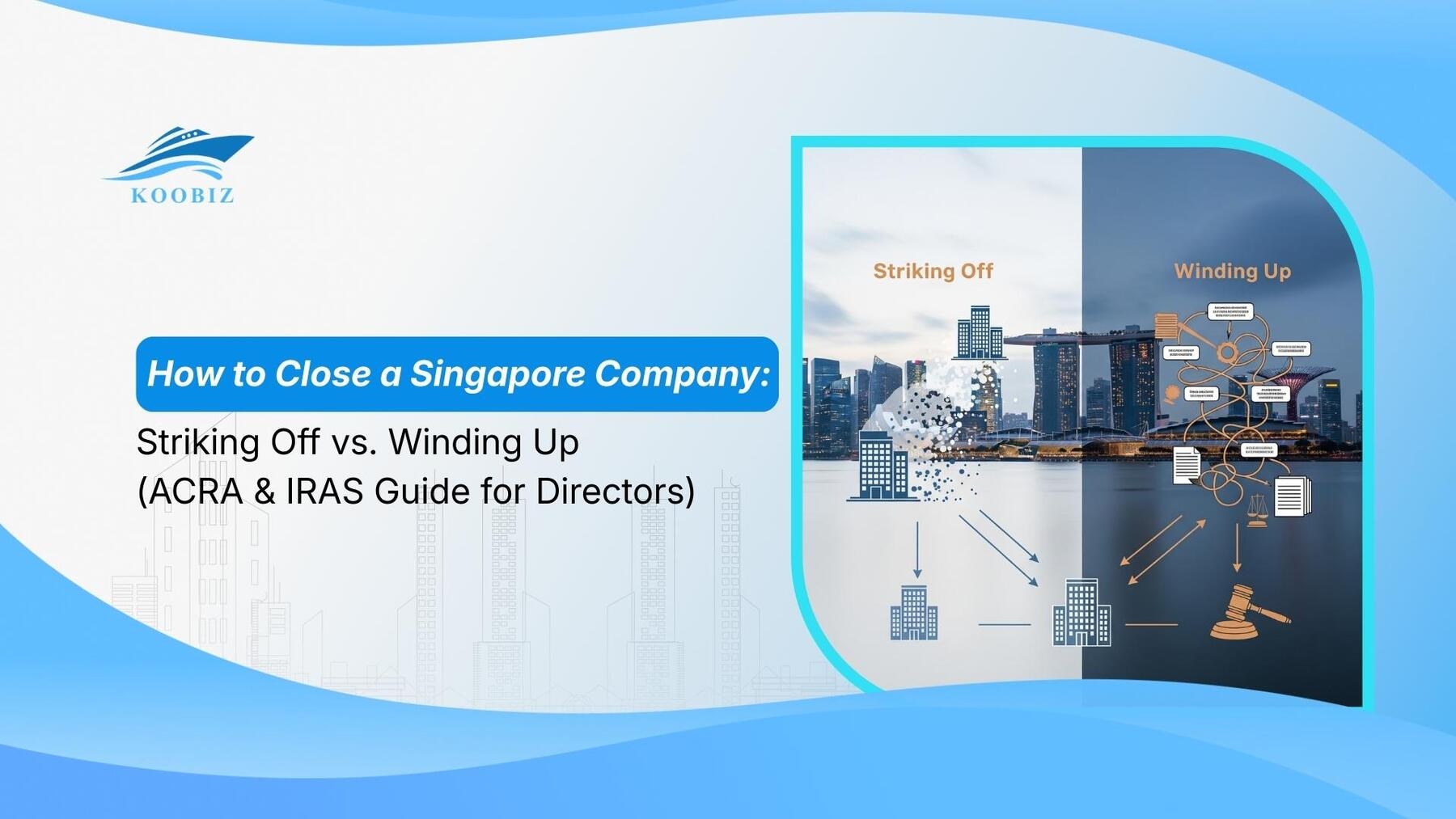
Deciding to cease business operations in Singapore requires careful legal and regulatory planning to avoid penalties and director exposure. Knowing how to close a Singapore company correctly is crucial. At Koobiz, we simplify the complex ACRA and IRAS regulations for directors. This guide compares Striking Off vs. Winding Up, helping directors choose the correct exit strategy in compliance with ACRA and IRAS requirements.
What Does It Mean to Close a Company in Singapore?
Closing vs Dissolving a Singapore company (ACRA)
Closing a company in Singapore is the formal legal process of terminating a business entity’s existence and removing it from the Official Register maintained by ACRA. This process ensures all corporate matters are properly settled, assets are distributed, and the company permanently ceases to exist as a legal entity.
To avoid penalties, directors must understand the difference between simply stopping work and a legal exit:
Ceasing Operations: You stop doing business, but the company still exists. You remain legally liable for filing Annual Returns and holding AGMs, even if the company is dormant.
Legal Closure (Striking Off/Winding Up): The company is dissolved. This is the only way to permanently end your statutory obligations and liabilities.
Important: Until a company is formally struck off or wound up, ACRA continues to treat it as an active entity. Directors who ignore ongoing obligations because “business has stopped” often face avoidable fines and court summonses.
2 Main Ways to Close a Company: Striking Off vs. Winding Up
There are two legally recognised methods to close a Singapore company: Striking Off and Winding Up. The appropriate path depends on the company’s financial position and operational status.
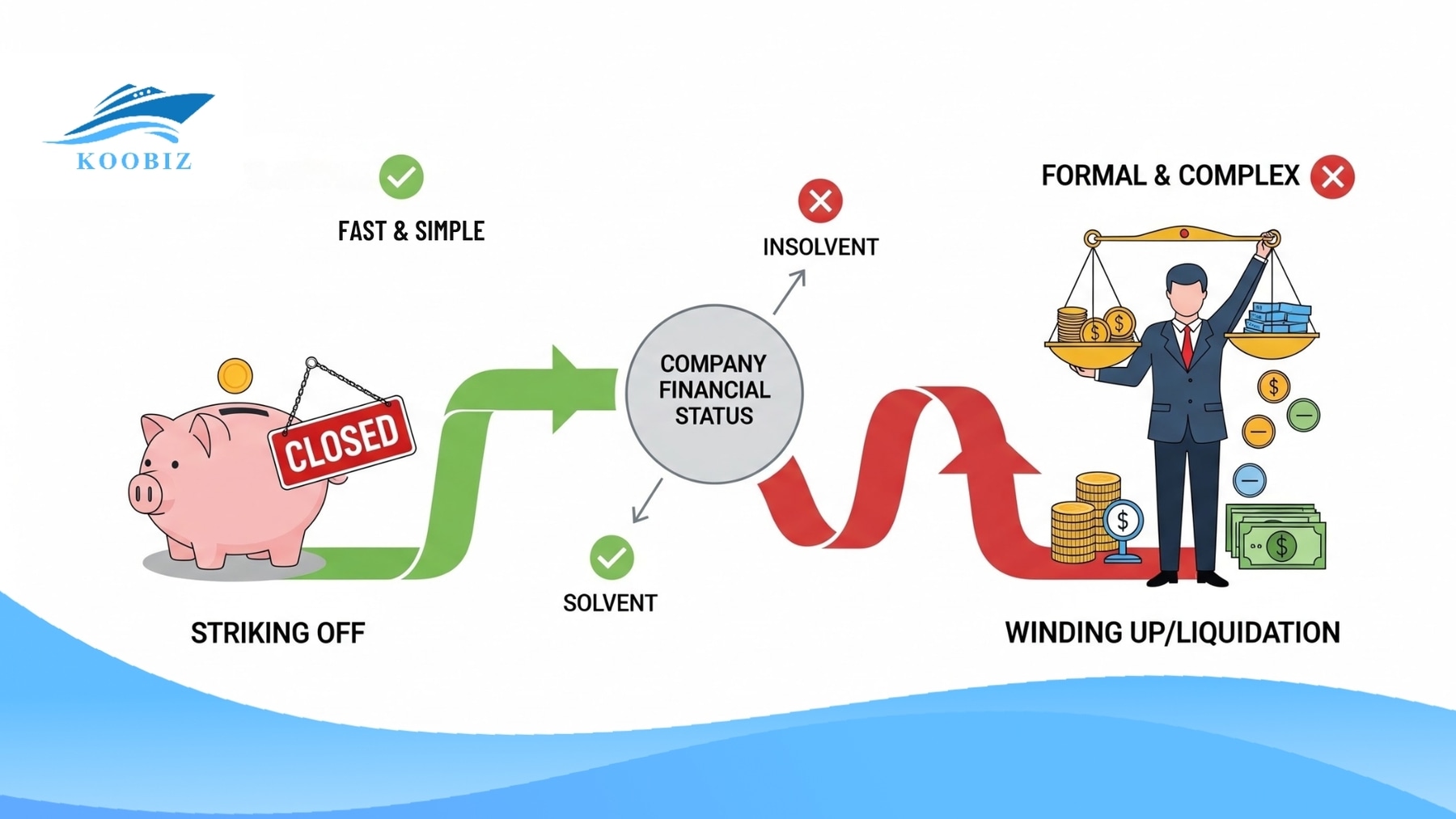
To determine which option applies to your situation, directors can follow the decision logic below:
Scenario A: Clean and straightforward exit
If the company has ceased operations and has no assets and no liabilities,
Then choose Striking Off. This is the administrative “fast track” suitable for dormant or clean companies.
Scenario B: Outstanding assets or liabilities remain
If the company still holds assets (such as cash or property) that require distribution, or has debts it cannot settle, or has debts it cannot pay…
Winding Up (Liquidation) is required. This is a formal process requiring a liquidator to manage the complex distribution of assets and settlement of liabilities.
2 ways to close a Singapore company: Striking Off vs. Winding Up
Method 1: Striking Off a Company (The “Fast Track” Process)
Striking off is the administrative process of removing a company’s name from the official register maintained by ACRA, and is suitable for dormant companies with a clean compliance record. Although commonly described as a fast-track process, directors should note that statutory timelines still apply. In practice, striking off typically takes around four to six months to protect creditors’ interests.
Eligibility Criteria
Before reviewing the timeline, directors must ensure the company meets the eligibility criteria imposed by ACRA. If you fail any of these, the application will be rejected or objected to:
Ceased Trading: The company must have stopped business activities completely.
Zero Assets & Liabilities: The company must not have any assets (bank accounts must be closed) or contingent liabilities.
Clean Record: No outstanding penalties, fines, or summonses with ACRA.
No Tax Issues: No outstanding tax liabilities or unfiled tax returns with IRAS.
No Legal Issues: The company is not involved in any court proceedings (inside or outside Singapore).
Stakeholder Agreement: Although the application is submitted by a director or company secretary, it is best practice to obtain written consent from all directors and shareholders to reduce the risk of objections that may halt the process.
The 4-Stage Roadmap to Striking Off
To manage expectations, the striking-off process can be divided into four statutory stages.While the application itself is quick, the statutory waiting periods are mandatory.
This is the most critical phase, as ACRA may reject the application if the company’s records are not fully in order.
Zero Accounts: Distribute all remaining assets to shareholders, settle all liabilities, and close the corporate bank account.
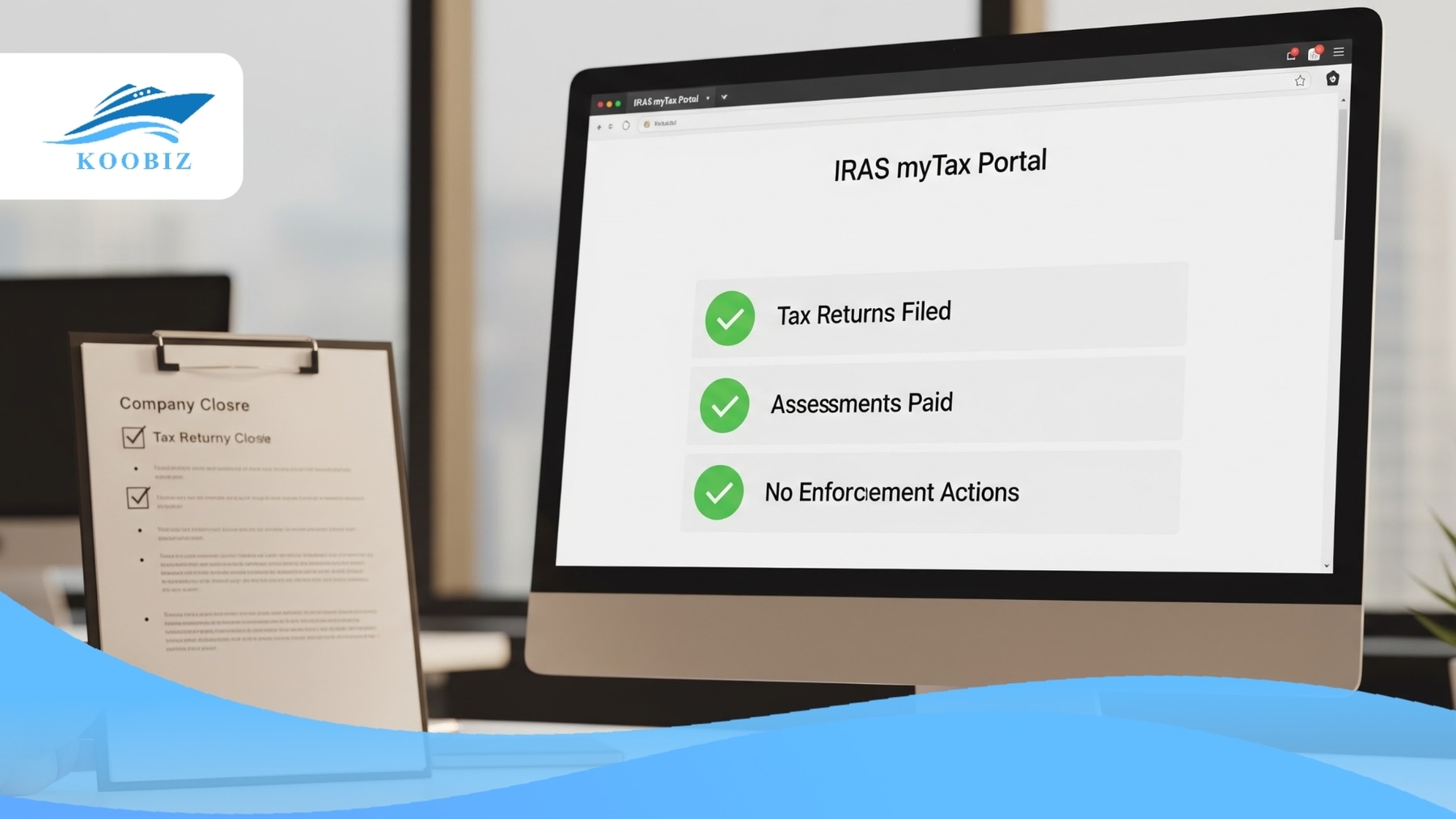
Tax Verification: File all outstanding tax returns (Form C-S/C) and ensure all tax assessments are paid. Singapore does not issue a physical tax clearance letter for strike-offs; verification is conducted through the IRAS myTax Portal.
GST Cancellation: If registered, apply to de-register for GST.
Stage 2: The Application (Week 1)
Once the company’s records are fully compliant, the formal application can be submitted.
Submission: The Company Secretary submits the application via BizFile+.
ACRA Review: ACRA reviews the application, typically within 5–14 days. If approved, a “Striking Off Notice” is sent to the company’s registered address, directors, and shareholders.
Stage 3: The Gazette Period (Month 2–4)
This is a mandatory statutory waiting period designed to protect creditors and the public.
First Gazette Notification: ACRA publishes the company’s name in the Government Gazette.
Objection Period: For the next 60 days, any interested party (e.g., an unpaid vendor or tax authority) can lodge an objection. If a valid objection is received, the entire process stops.
Stage 4: Final Dissolution (Month 5–6)
Final Notification: If no objections are lodged after 60 days, ACRA publishes a second notification in the Gazette.
Strike Off: The company is officially struck off the ACRA Register, and ceases to exist as a legal entity.
Method 2: Winding Up / Liquidation (The Formal Process)
While striking off is an administrative process, Winding Up (Liquidation) is a formal legal procedure for terminating a company. This route is mandatory if your company still holds assets that need distributing or has debts it cannot settle immediately.
Unlike striking off, Winding Up involves appointing a licensed Liquidator who takes control of the company’s affairs to ensure a fair distribution of resources.
The winding-up process splits into two distinct paths based on one critical question: Is your company Solvent?
Path A: Members’ Voluntary Winding Up (MVL) – The Solvent Path (Singapore)
Who this applies to: Companies that are profitable or asset-rich but no longer have a commercial purpose (e.g. director retirement or group restructuring).
In an MVL, the directors formally declare that the company is solvent, meaning it is able to pay all its debts in full within 12 months.
You retain control: As all creditors are paid in full, the winding-up process is initiated and controlled by the directors and shareholders.
The Goal: To realise company assets (e.g. sale of property, collection of receivables) and distribute any surplus to shareholders in a tax-efficient manner.
Key requirement: Directors must lodge a Declaration of Solvency with ACRA. Making such a declaration without reasonable grounds constitutes a serious statutory offence.
Path B: Creditors’ Voluntary Winding Up (CVL) – The Insolvent Path (Singapore)
Who this applies to: Companies facing financial distress and unable to pay debts as they fall due.
In a CVL, the company is insolvent and unable to meet its financial obligations. The directors cannot sign a Declaration of Solvency because the company’s liabilities exceed its assets.
Creditors take priority: The focus shifts from shareholders to creditors, who rank ahead in the distribution of assets. The Liquidator’s primary duty is to recover as much money as possible to pay off the company’s debts.
Loss of Control: Directors’ powers cease upon the appointment of a liquidator, and control of the company passes to the liquidator.The creditors have the right to vote on who acts as the liquidator.
Key Step: The company must convene a meeting of its creditors to explain the financial position.
Key Differences: Striking Off vs. Winding Up
Striking Off is generally more cost-effective and faster, while Winding Up provides a formal legal resolution for complex or insolvency cases. To help directors at Koobiz clients make an informed choice, we have summarized the key differences below.
Feature
Striking Off
Winding Up (Liquidation)
Primary Use Case
Dormant companies with no assets and no liabilities.
Active companies with assets, liabilities, or insolvency.
Cost
Low to none (Government fees + Secretarial fees)
High (liquidator fees and statutory filing costs).
Timeframe
Approx. 4–6 months.
12 months or longer (depending on complexity).
Solvency
Must have Zero assets and liabilities.
Can be Solvent (MVL) or Insolvent (CVL).
Process Owner
Directors / Corporate Secretary.
Licensed Liquidator.
Director Control
High (Directors manage the process).
None/Low (Liquidator takes legal control).
Risk of Restoration
Higher (can be restored within 6 years).
Lower (Dissolution is generally final).
Table: Comparison of Company Closure Methods in Singapore
Critical Requirements Before Closing: Tax and Liabilities
Check the ACRA IRAS “Clean Slate” checklist
Many directors mistakenly believe that ceasing business operations automatically ends tax obligations. This is incorrect. ACRA will reject a striking-off application if IRAS has not cleared the company’s tax position.
To ensure a successful application, the company must be in a fully compliant clean status with no outstanding regulatory or tax issues.
Clarification on Tax Clearance
It is a common misconception that IRAS issues a physical tax clearance letter for striking off. This is not true. Instead, tax “clearance” is confirmed through self-verification on the IRAS myTax Portal. You must log in to the IRAS myTax Portal and confirm that:
All tax returns (Form C-S/C) are filed.
All assessments are paid.
There are no outstanding enforcement actions.
If you apply to ACRA while tax matters are pending, IRAS will lodge an objection, halting your application.
The “Clean Slate” Checklist
Use this checklist to ensure you are ready before our team submits your application:
[ ] Corporate Tax (IRAS): File Income Tax Returns up to the actual date of business cessation. Even if the company had no income, a “Nil” return is required to close the books.
[ ] GST Cancellation: If your company is GST-registered, apply for cancellation of GST registration. You must account for GST on any assets kept or transferred upon closure.
[ ] CPF Accounts: Ensure all Central Provident Fund (CPF) contributions are fully paid and the CPF submission number (CSN) account is formally closed.
[ ] Clear All Debts: The company must not have any outstanding debts to government agencies or private creditors.
Koobiz Pro Tip: Always verify directly via the IRAS myTax Portal that the Statement of Accounts shows a zero balance before instructing a strike-off filing.
Directors’ Responsibilities and Liabilities
Directors have a strict fiduciary duty to ensure the company’s affairs are handled honestly during the closing process. ACRA and the courts take a serious view of directors who use closing procedures to evade debts.
WARNING: The Solvency Trap
Making a Declaration of Solvency in an MVL without reasonable grounds is a criminal offence. If the company later proves insolvent, directors may face fines of up to S$10,000, imprisonment of up to 12 months, or both. Under the Insolvency, Restructuring and Dissolution Act (IRDA), penalties may escalate if fraudulent intent is proven.
When You Become Personally Liable (Piercing the Corporate Veil)
Generally, a company is a separate legal entity. However, in closing scenarios, the law can “pierce the corporate veil,” making directors personally liable for company debts if:
Fraudulent Trading: Business activities were conducted with intent to defraud creditors (e.g. transferring assets at undervalue prior to liquidation).
Negligence: You allowed the company to incur debts knowing there was no reasonable prospect of repayment.
The 5-Year Rule: Record Retention
Your job isn’t done when the company closes. Under the Companies Act, directors must retain all company books and records for at least five years from the date of dissolution.
This requirement ensures that records can be produced if a creditor or tax authority reopens the matter.
Conclusion
Closing one business chapter is often a necessary step before starting the next.While ensuring your company is closed compliantly is vital to avoid liability, your focus should be on what comes next.
At Koobiz, we understand that entrepreneurship is a cycle. We are not just here to help you exit; we are your strategic partner for your next venture. As an established corporate services provider, Koobiz specialises in:
Singapore Company Incorporation: Setting up your new Private Limited company with the optimal structure for growth.
Corporate Banking: Consultation and assistance with opening business bank accounts in Singapore.
Compliance Excellence: Providing top-tier Accounting, Tax, and Audit services to keep your new business in good standing from Day 1.
Whether you are closing a dormant entity to restructure or planning your next big idea, Koobiz provides the foundation for your business success.
Disclaimer: This guide is for informational purposes only and does not constitute legal advice. Laws and regulations regarding company closure in Singapore (including ACRA and IRAS fees) are subject to change. Please consult with a qualified professional or corporate secretary for advice specific to your situation.
A common seal is a metal embossing device historically used as a company’s official signature to execute legal documents such as deeds, contracts, and share certificates in Singapore.
Since the 2017 amendments to the Singapore Companies Act, companies are no longer required to maintain a common seal and may execute documents through authorized signatories instead.
However, the seal is still commonly used in property transactions, physical share certificates, and cross-border dealings where partners or institutions expect a formal company seal.
Companies that wish to discontinue its use must review and amend their Company Constitution through a special resolution filed with ACRA.
Proper safeguards-such as restricted access and maintaining a Seal Register-are recommended to ensure compliant use of the seal.
[/SUMMARIES]
A common seal has traditionally been used as a company’s official stamp to execute legal documents such as contracts, deeds, and share certificates in Singapore. Although the Companies Act no longer requires companies to maintain a common seal, it may still be used for certain formal or high-value transactions, and this guide explains the key legal requirements and compliance considerations in 2026
What Is a Common Seal?
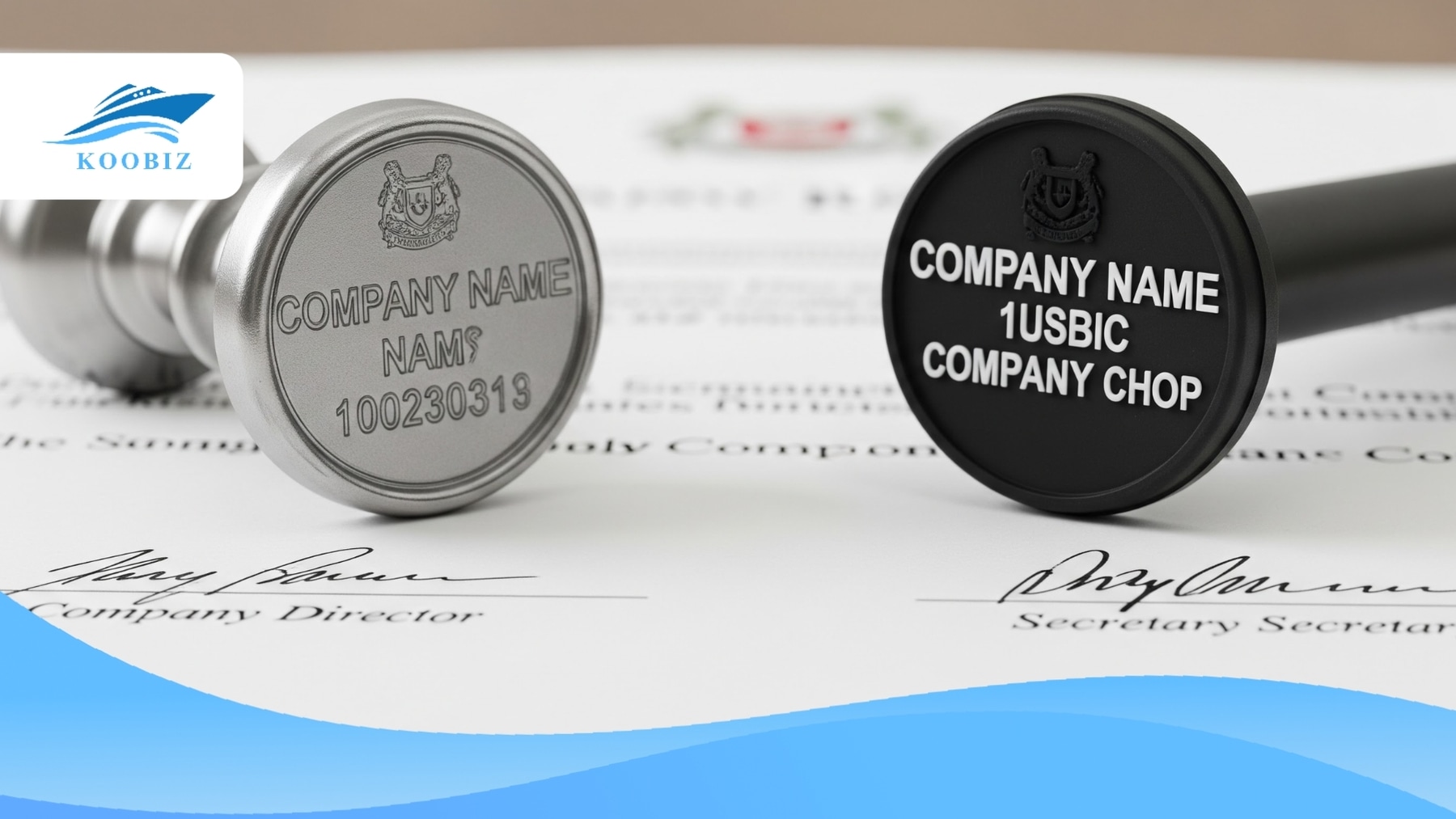
A Common Seal (also known as a corporate seal) is a metal device used to create a raised, embossed impression on documents. It represents the official signature of a company as a legal entity, typically displaying the company’s registered name and Unique Entity Number (UEN).
Key Characteristics
Authentication: Affixing the seal indicates that the document has been formally approved and executed by the company.
Physical Distinction: Unlike rubber stamps, a common seal uses no ink and leaves a permanent embossed mark on paper.
Execution Process: The seal is usually applied in the presence of authorized officers-typically two directors or one director and the company secretary-who sign the document to confirm proper execution.
Symbol of Authority: Although optional since the 2017 amendments to the Singapore Companies Act, the common seal is still used for deeds, high-value contracts, and certain international transactions.
Is a Common Seal Mandatory in Singapore in 2026?
Authorized signatures now legally replace traditional seals for most transactions
No. A common seal is not mandatory for companies in Singapore in 2026.
Following the 2017 amendments to the Singapore Companies Act, companies can execute documents-including deeds-without using a common seal. Under Sections 41A, 41B, and 41C of the Act, documents may instead be signed by authorized individuals, such as company directors or the company secretary.
However, companies should still consider two practical factors:
Company Constitution: If a company’s Constitution requires the use of a common seal for certain transactions, the company must comply with that requirement or amend the Constitution through a special resolution.
Business Practice: Despite the legal flexibility, many companies-especially in industries such as construction, maritime, and real estate-still maintain a common seal. This is often to meet the expectations of overseas partners or financial institutions that require a formal company seal.
In short, while a common seal is no longer legally required, some companies choose to keep one for operational or compliance purposes.
Common Seal vs. Rubber Company Stamp: Key Differences
Distinguishing between the physical common seal and rubber ink stamp
Although both represent a company, a common seal and a rubber company stamp serve different purposes and are not interchangeable.
Feature
Common Seal
Rubber Company Stamp
Physical form
Metal press creating a raised embossed mark
Rubber or self-inking stamp creating a flat ink mark
Legal nature
Official “signature” of the legal entity
Administrative identification tool
Typical use
Legal deeds and share certificates
Invoices, purchase orders, routine correspondence
Authority
Indicates formal company approval
Used for operational paperwork
Visibility
Colorless embossed impression
Usually blue, red, or black ink
Key takeaway
Use the common seal when the law or your company constitution requires a document to be executed as a deed.
Use the rubber company stamp for daily administrative documents, ensuring the company name and UEN are clearly shown on paperwork.
When Is a Common Seal Still Preferred or Necessary?
Although Singapore law no longer requires a common seal, it is still used in certain formal or cross-border situations.
Below are common scenarios where companies may still prefer to maintain a common seal.
Executing Deeds and Property Documents
Under Section 41B of the Companies Act, deeds can be executed through authorized signatures. However, in property transactions or certain legal instruments, some law firms, real estate agencies, or the Singapore Land Authority (SLA) may still expect documents to carry a company seal as an added assurance of authenticity.
Issuing Physical Share Certificates
Many private companies still issue physical share certificates to investors. Affixing a raised common seal adds an extra layer of security and reinforces the official nature of the document.
International Transactions and Banking
Cross-border dealings are one of the most common reasons companies keep a common seal.
Foreign jurisdictions: Some countries-particularly in parts of Asia and the Middle East-still require corporate seals for certain legal documents.
Cross-border banking: Overseas banks may request a sealed board resolution when opening corporate accounts or approving major financing arrangements.
How to Legally Execute Documents Without a Common Seal
Authorized signatories executing a corporate contract without a common seal
Under Section 41B of the Singapore Companies Act, a company can execute a document as a deed without using a common seal. Instead, the document becomes legally binding when it is signed by authorized officers of the company.
Signature by Two Directors
A document may be executed when two company directors sign the document on behalf of the company.
This method is commonly used by companies with multiple directors and provides clear confirmation that the document has been formally authorized by the company.
Signature by a Director and a Company Secretary
Another valid execution method is when one director and the company secretary sign the document together.
This approach is widely accepted because the company secretary plays an official role in ensuring the company complies with corporate governance and regulatory requirements.
Signature by a Director in the Presence of a Witness
If the company has only one director, the document may be executed when:
The sole director signs the document, and
A witness is present to attest the signature
The witness confirms that the document was properly signed.
Key Compliance Requirements
Expressed Intent: The document should clearly state that it is “executed by the company” to avoid ambiguity about the signatory’s authority.
Company Constitution Check: Before using signature-based execution, ensure that the company’s constitution does not specifically require the use of a common seal for that type of document.
How to Phase Out the Common Seal: Amending Your Company Constitution
If your company was incorporated before 31 March 2017, its Constitution (formerly the Memorandum and Articles of Association) may still contain a “Seal Clause” requiring the use of a common seal for executing deeds.
To formally discontinue the seal, the company must amend its Constitution so that document execution can be carried out through authorized signatures.
Step 1: Review the Constitution
Conduct a legal review to identify clauses that require the use of a common seal for executing company documents.
Without amending these provisions, documents signed without a seal could potentially be challenged as non-compliant with the company’s internal rules, even though the Companies Act allows alternative execution methods.
Step 2: Pass a Special Resolution
Amending a company’s Constitution requires a Special Resolution under Section 26 of the Companies Act.
This means:
A formal notice of meeting must be sent to all shareholders
The resolution must be approved by at least 75% of voting shareholders
Step 3: File the Amendment with ACRA
After the Special Resolution is passed, the company must file:
The Notice of Resolution, and
The updated Constitution
with ACRA through the BizFile+ portal, typically within 14 days.
Step 4: Update Internal Corporate Records
Finally, update the company’s minute book and internal registers to reflect that the common seal has been discontinued.
The company may either destroy the physical seal or retain it for historical record, but the amended Constitution will now serve as the legal basis for signature-based document execution.
Safekeeping & Best Practices: Managing Your Common Seal
Professional storage of a corporate common seal in Singapore
Because the common seal carries significant legal authority, companies should implement clear internal controls to prevent unauthorized use. Proper management ensures that sealed documents accurately reflect the company’s formal approval.
Below are recommended best practices for managing a company seal.
Centralized Custody
The common seal should be kept in a secure, locked location, such as a safe or restricted cabinet.
In many Singapore companies, the Company Secretary acts as the designated custodian, responsible for safeguarding the seal and controlling its use.
Restricted Access & Authorization
Access to the seal should be strictly limited to authorized personnel.
The seal should only be affixed to documents that have received formal approval from the board or authorized management, typically through a board resolution or documented approval.
Maintaining a Seal Register
Companies should maintain a Seal Register to create a clear audit trail of seal usage.
The register typically records:
Date of sealing
Description of the document (e.g., Share Certificate No. X, Property Deed for Address Y)
Names of the authorized officers who witnessed the sealing
Periodic Audits
During annual compliance reviews, the board or company secretary should verify that:
The common seal is properly safeguarded, and
The entries in the Seal Register match the company’s approved resolutions and corporate records.
Following these practices helps ensure the common seal is used responsibly and in line with good corporate governance standards.
How to Obtain a Common Seal in Singapore
If your company chooses to maintain a common seal for formal documentation or international transactions, obtaining one is a simple administrative process. Most companies order their seal through corporate secretarial firms or specialized corporate stationers.
Required Information
To ensure legal accuracy, the details engraved on the seal must exactly match the company records registered with ACRA (BizFile+).
You will typically need to provide:
Full Registered Company Name – including the suffix “Pte. Ltd.” or “Limited”
Unique Entity Number (UEN) – the official identification number issued by ACRA
Company Type – to ensure the seal format complies with the company’s legal structure
Ordering Process & Costs
Obtaining a common seal in Singapore is usually fast and straightforward.
Lead Time: Standard production typically takes 1–2 business days, although same-day express services may be available for urgent corporate needs.
Estimated Costs: Prices generally range between SGD 40 and SGD 100, depending on the quality of the metal press and delivery speed.
Procedure: Companies usually submit their ACRA Business Profile to the provider, who will prepare a digital proof of the seal design for approval before engraving the metal die.
How Koobiz Corporate Secretarial Services Can Help
Ensuring proper document execution and corporate compliance is essential for companies operating in Singapore. Whether your business uses a common seal or executes documents through authorized signatures, the correct legal procedures must be followed.
Distinction: A Company Stamp (Chop) is a rubber stamp for daily administrative use, while a Common Seal is a metal embosser for high-level legal documents like deeds.
Legal Requirement: Since March 2017, a Common Seal is no longer mandatory for Singapore companies, provided documents are signed by authorized persons (e.g., two directors).
Mandatory Details: Official documents must display the full Company Name and Unique Entity Number (UEN). A stamp is a convenient way to apply these, though not the only method.
Digital Shift: While physical stamps are traditional, digital signatures are legally recognised for most contracts under the Electronic Transactions Act.
Koobiz Solution: As your corporate service provider, Koobiz ensures your company’s constitution is up to date regarding seal usage and can facilitate the procurement of compliant stamps.
[/SUMMARIES]
Navigating Singapore’s business requirements can be confusing, especially when it comes to understanding the difference between a Company Stamp (commonly called a “chop”) and a Common Seal. While one is used for routine daily documents, the other carries formal legal significance that has evolved under changes to Singapore company law. This Koobiz guide explains current ACRA regulations, clearly separating what is mandatory from what is optional, so you can obtain the right company stamp in Singapore and stay fully compliant.
2026 Update: As of 2026, the Common Seal remains optional for Singapore companies, with no changes to the Companies Act requirements. However, the adoption of digital signing tools (like DocuSign and SingPass) has become the standard for most business contracts, further reducing the reliance on physical seals.
What is a Company Stamp (Chop) in Singapore?
The company’s rubber stamp (chop) on a Singapore document
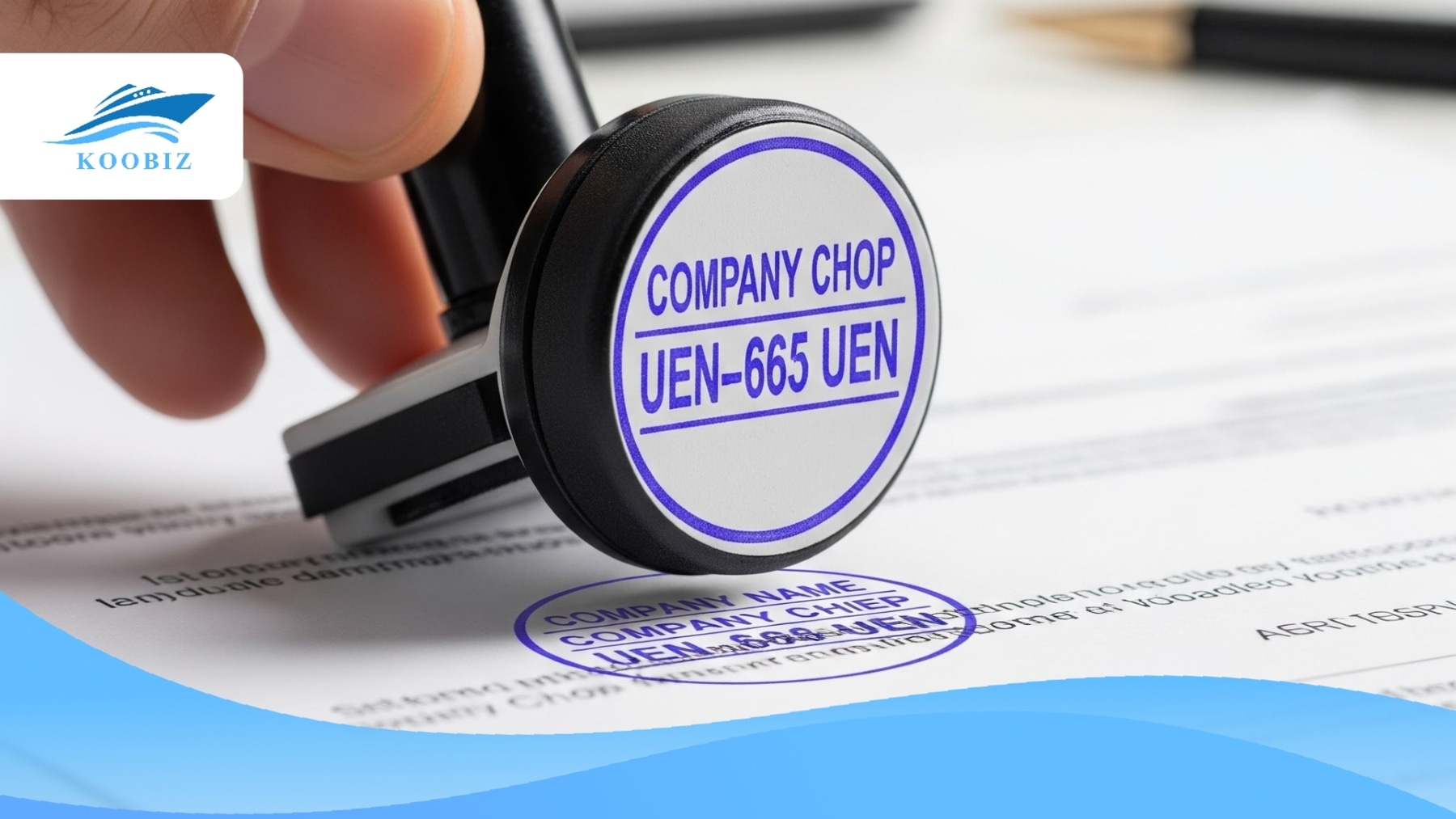
A Company Stamp, widely known locally as a “Rubber Chop,” is a standardised rubber stamp used by Singapore businesses to authenticate documents and indicate official company acknowledgement.
Key Characteristics:
Origin: Derived from the colonial-era Malay and Hindi word “cap”, meaning “stamp.”
Function: Provides visual confirmation that the company entity (not just an individual) acknowledges the transaction.
Appearance: Typically round or rectangular, using blue or purple ink to stand out from black printed text.
Usage: Commonly used for daily operations, although increasingly supplemented by digital signatures and electronic document headers.
For clients incorporating with Koobiz, obtaining a company stamp is typically one of the first post-incorporation steps to support smooth day-to-day operations.
Company Stamp vs Common Seal: What Is the Difference?
While both represent the company on paper, they serve very different legal and operational purposes. Here is the quick breakdown:
Feature
Company Stamp (Rubber Chop)
Common Seal
Material
Rubber (Self-inking)
Metal Embosser (3D Impression)
Legal Role
Administrative / Operational
Ceremonial / Formal “Act of Company”
Frequency
Daily (10+ times/day)
Rare (Once a year or less)
Key Use
Invoices, Delivery Orders, Contracts
Share Certs, Deeds, Real Estate
The Key Takeaway: Using a rubber chop on a document that legally requires execution as a deed may result in the document being challenged or deemed invalid.
Is a Common Seal Still Mandatory for Singapore Companies?
The rules of Company Stamp and Common Seal Singapore
The Short Answer: No.
Since the Companies Act amendment effective 31 March 2017, Singapore companies are no longer required to have a Common Seal.
How to Execute Documents Without a Seal:
Under Sections 41A-C, a document is validly executed if signed by “Authorised Persons”:
Two Directors
One Director + Company Secretary
One Director + A Witness
This means a company can be incorporated and operated in Singapore without purchasing a metal Common Seal. While Koobiz can assist in obtaining a Common Seal for companies that value tradition or formality, it is not legally required for valid incorporation in Singapore.
When Should You Use a Common Seal?
Despite the 2017 amendment, there are still specific situations where the use of a Common Seal is preferred or practically required. Use the seal for high-stakes, one-off events:
Scenario A: Executing Deeds. While signatures by Authorised Persons now suffice legally, some older contracts or land titles may explicitly demand “Signed, Sealed, and Delivered.” In these cases, using a seal avoids ambiguity, though it is strictly no longer required if the correct signature protocols are followed.
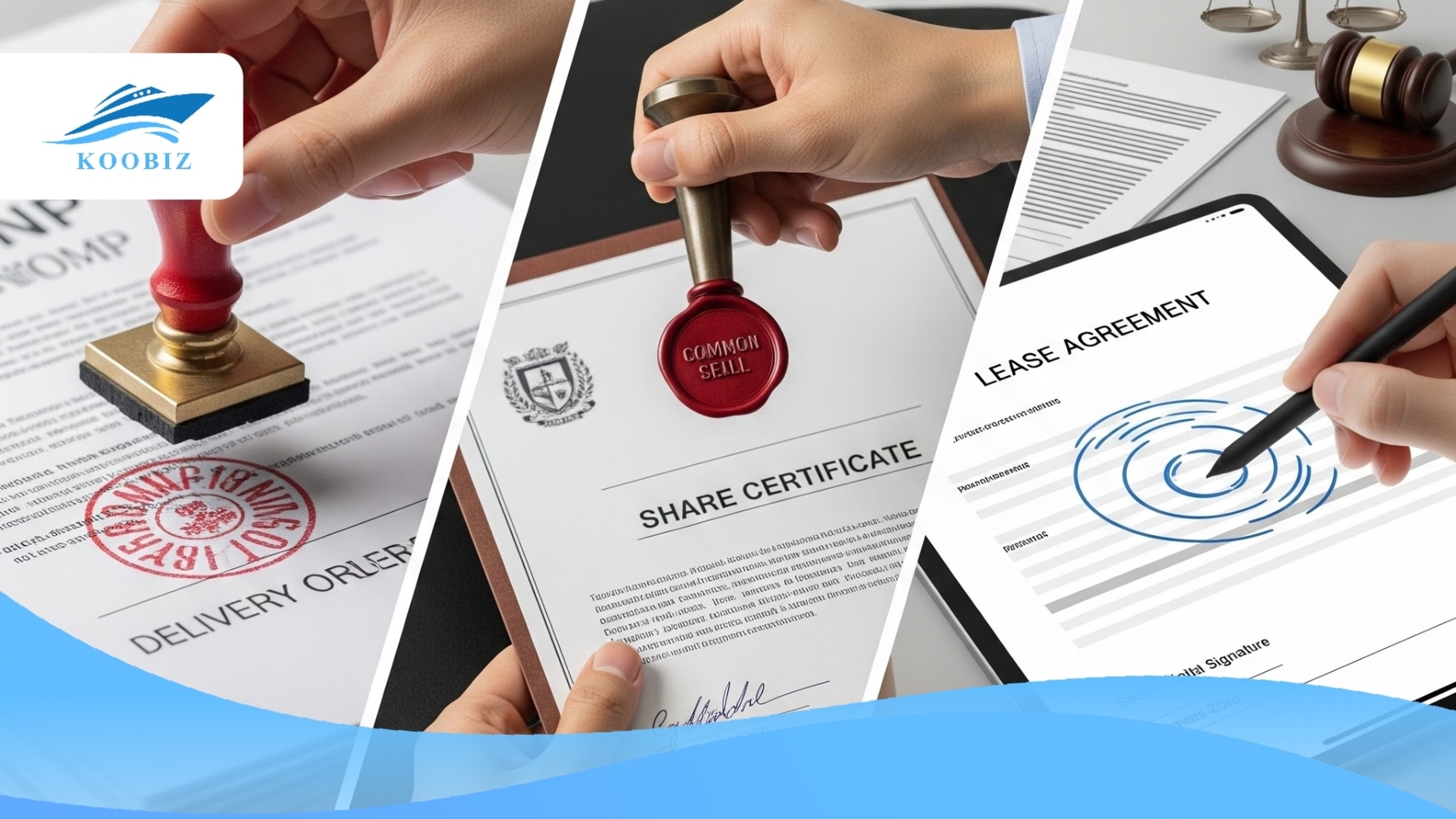
Scenario B: Issuing Share Certificates. Investors often expect the formal embossed Common Seal on share certificates as a sign of authenticity and corporate formality.
Scenario C: International Contracts. In jurisdictions that have not modernised their company laws, counterparties may still require a physical company seal for contracts to be recognised as valid.
Koobiz Tip: Check your Company Constitution. Older constitutions may explicitly require certain documents to be executed under seal. You must follow this internal rule until you amend the Constitution—a service we can assist with.
When Should You Use a Company Stamp (Chop)?
A Company Stamp is used for virtually all routine administrative and commercial interactions. Use the company chop for recurring day-to-day operations, including:
Scenario A: Validating Invoices. Stamping outgoing invoices or receipts to formally acknowledge them for tax and accounting records.
Scenario B: Logistics & Delivery. Acknowledging receipt of goods on Delivery Orders (DOs) as proof that items were received by the company.
Scenario C: Bank & Government Forms. When opening a corporate bank account (a service Koobiz specialises in), the bank will request a specimen of the “authorised chop” used to verify future physical checks.
Koobiz Tip: Always use blue or purple ink for your company chop. This helps distinguish the original “wet ink” stamp from a black-and-white photocopy of the document, reducing the risk of rejected filings.
Real-Life Scenarios: Seal vs. Stamp in Action
Real-life scenarios of Common Seal and Company Stamp
To illustrate how these rules apply in practice, below are four common scenarios faced by a typical Singapore SME (for example, “Koobiz Trading Pte. Ltd.”).
Scenario 1: Receiving Goods (The Daily Routine)
The Situation: A supplier delivers a batch of office furniture. The delivery order needs to be acknowledged.
The Tool:Company Stamp (Chop).
The Action: Administrative staff stamp the delivery order with the round blue company chop and sign it.
Why: This is an administrative act confirming receipt. It does not require a deed.
Scenario 2: Issuing Share Certificates (A Formal Corporate Event)
The Situation: The company brings on a new shareholder who requests a physical share certificate.
The Tool:Common Seal.
The Action: The Company Secretary retrieves the metal seal. Two directors sign the certificate, and the seal is embossed over a red wafer.
Why: While not strictly mandatory if the constitution allows otherwise, using the seal adds the necessary formality and prestige expected by investors for title documents.
Scenario 3: Signing a Bank Deed (The Compliance Trap)
The Situation: The company is taking a loan and must sign a “Deed of Guarantee.”
The Mistake: The Director simply signs and uses the rubber chop.
The Fix: The bank rejects the document. Deeds must be executed either “under seal” or by “Authorised Persons” (for example, signatures of two directors), without relying on a rubber chop.
Scenario 4: Signing a Lease Digitally (Modern Practice in Singapore)
The Situation: The company is renting a new office and the landlord sends a digital tenancy agreement via DocuSign.
The Tool:Digital Signature (No Stamp).
The Action: The Director signs the document online using a secure digital identity such as SingPass.
Why: Under Singapore’s Electronic Transactions Act, digital execution is legally binding, and no physical stamp is required.
Essential Details Required on a Company Stamp
Under the Companies Act, a company’s registered name and UEN must appear on official business documents. A company stamp is simply a practical tool to ensure these mandatory details are consistently displayed.
Detail
Status
Why is it needed?
Company Name
Mandatory
Identifies the legal entity binding the contract.
UEN
Mandatory
Required by ACRA on all official invoices/letters.
Address
Optional
Useful for “return address” stamps, but not for the official round chop.
Logo
Optional
Enhances branding but may reduce legibility if the stamp becomes overcrowded.
We have now covered what company stamps and Common Seals are, their legal status in Singapore, and the information they should contain. Next, we move beyond basic acquisition to practical management considerations—secure handling, digital alternatives, and proper disposal of stamps and seals.
Proper Custody and Legal Use of the Common Seal
Improper use of a Common Seal can lead to unauthorized deeds and potential fraud. Follow these key rules for proper custody:
Strict Authorisation: Never affix the seal without a written Board Resolution approving the specific transaction.
Secure Storage: The seal should be kept under lock and key, ideally in the custody of the Corporate Secretary.
Usage Log: Maintain a “Register of Seal Usage” to record every instance the seal is accessed or used.
Koobiz Protocol: When Koobiz acts as your Company Secretary, we act as a gatekeeper to ensure every use of the Common Seal is supported by a valid board resolution.
Can Digital Signatures Replace Company Stamps in Singapore?
The Legal Reality: Yes. Under Singapore’s Electronic Transactions Act, digital signatures such as DocuSign and SingPass are legally binding for most contracts.
The Business Reality: Business practice often lags behind legal reform.
Banks & Landlords: Many traditional institutions still require a “wet-ink” company chop on physical forms.
Cross-Border: Customs documents or foreign contracts may still require a physical company stamp.
Verdict: Go digital for efficiency, but retain at least one physical company stamp as a compliance backup.
Types of Self-Inking Company Stamps Commonly Used
Most companies typically require two types of stamps to cover common operational needs:
1. The “Signing” Chop (Round, 24mm-26mm)
Purpose: Used primarily to authenticate authorised signatures on documents.
Details: Contains only the Company Name and UEN, and is sized to fit standard signature boxes.
2. The “Address” Stamp (Rectangular)
Purpose: Used for filling out forms and envelopes.
Details: Contains the Company Name, UEN, registered address, and contact number, reducing the need for repeated manual entry.
How Should Old Company Seals and Stamps Be Disposed Of?
When a company is struck off or changes its name, the old tools become a potential security risk. These items should never be discarded intact.
The Destruction Protocol:
Rubber Stamps: Use scissors or a box cutter to cut the rubber text face into unrecognisable fragments.
Common Seals: Use a hammer to deform the metal embossing plates or a heavy file to scratch out the company name.
Why? This prevents fraudsters from retrieving them to create fake invoices or contracts in your company’s name.
Conclusion
Understanding the difference between a Company Stamp and a Common Seal is not merely a stationery decision—it is essential for compliance and legally enforceable business transactions. While the Common Seal is no longer mandatory, the Company Stamp remains a vital tool for daily operations in Singapore.
Koobiz is committed to simplifying the process of doing business in Singapore. From incorporation and opening bank accounts to acting as your Company Secretary and managing your tax and accounting, we ensure ongoing compliance with ACRA requirements at every stage. If you are setting up a new company, we can advise you on your constitution’s seal requirements and help you get started on the right foot.
Visit koobiz.com today to streamline your Singapore business operations.
Disclaimer: This guide provides general information based on the Companies Act and ACRA guidelines as of 2026. It is not legal advice — always verify with ACRA or your professional advisor.
[SUMMARIES]
Mandatory Requirement: Under the Companies Act, every Singapore company must appoint a qualified corporate secretary within six months of being incorporated.
Core Duties: The role involves more than basic paperwork. It includes managing statutory records, preparing board resolutions, and ensuring all ACRA filings are submitted on time.
Severe Penalties: Missing ACRA filing deadlines can result in late fees ranging from $300 to $600, court summons for directors, or even the company being struck off the register.
Smart Solution: Outsourcing secretarial tasks to experts like Koobiz is a cost-effective way for SME owners to stay compliant and enjoy peace of mind.
[/SUMMARIES]
Navigating Singapore’s regulatory requirements can feel overwhelming for small and medium-sized enterprises (SMEs). While the term “secretary” might sound like an administrative role, a corporate secretary is actually a legally recognized position that plays a key part in keeping your company compliant. At Koobiz, we specialise in helping business owners manage the complex requirements of the Accounting and Corporate Regulatory Authority (ACRA). This guide explains what a corporate secretary is, whether the role is legally required, and what the main duties involve. We will also cover the penalties for non-compliance and why many smart SMEs choose to outsource this function to professionals. Let’s get started.
What Is a Corporate Secretary in Singapore?
A Corporate Secretary connects the business with ACRA IRAS
A corporate secretary in Singapore is a senior compliance officer required by the Companies Act. The role exists to support good corporate governance and involves legal responsibilities related to statutory administration—not general clerical work.
To better understand this role and how it differs from that of a typical administrative assistant, it helps to look at three key aspects:
Who they are: A corporate secretary acts as the main link between your SME, its directors and shareholders, and government agencies such as ACRA and the Inland Revenue Authority of Singapore (IRAS). They help protect your company’s legal standing.
What they do: Rather than handling daily office tasks, they focus on advising the board of directors on their legal duties. They also ensure the company follows its own constitution and help maintain the legal separation between the business and its shareholders.
Why you need one: When you work with a professional service like Koobiz, you gain access to a compliance expert who understands Singapore’s corporate laws in detail—helping you avoid costly mistakes before they happen.
By maintaining strong corporate governance, companies can reduce the risk of legal disputes and internal issues related to compliance.
Is Appointing a Company Secretary Mandatory for SG SMEs?
Mandatory Corporate Secretary Requirement for Singapore SMEs
Yes, appointing a corporate secretary is a legal requirement for all Singapore SMEs. To ensure proper governance and accurate ACRA filings, Section 171 of the Companies Act sets out the following rules:
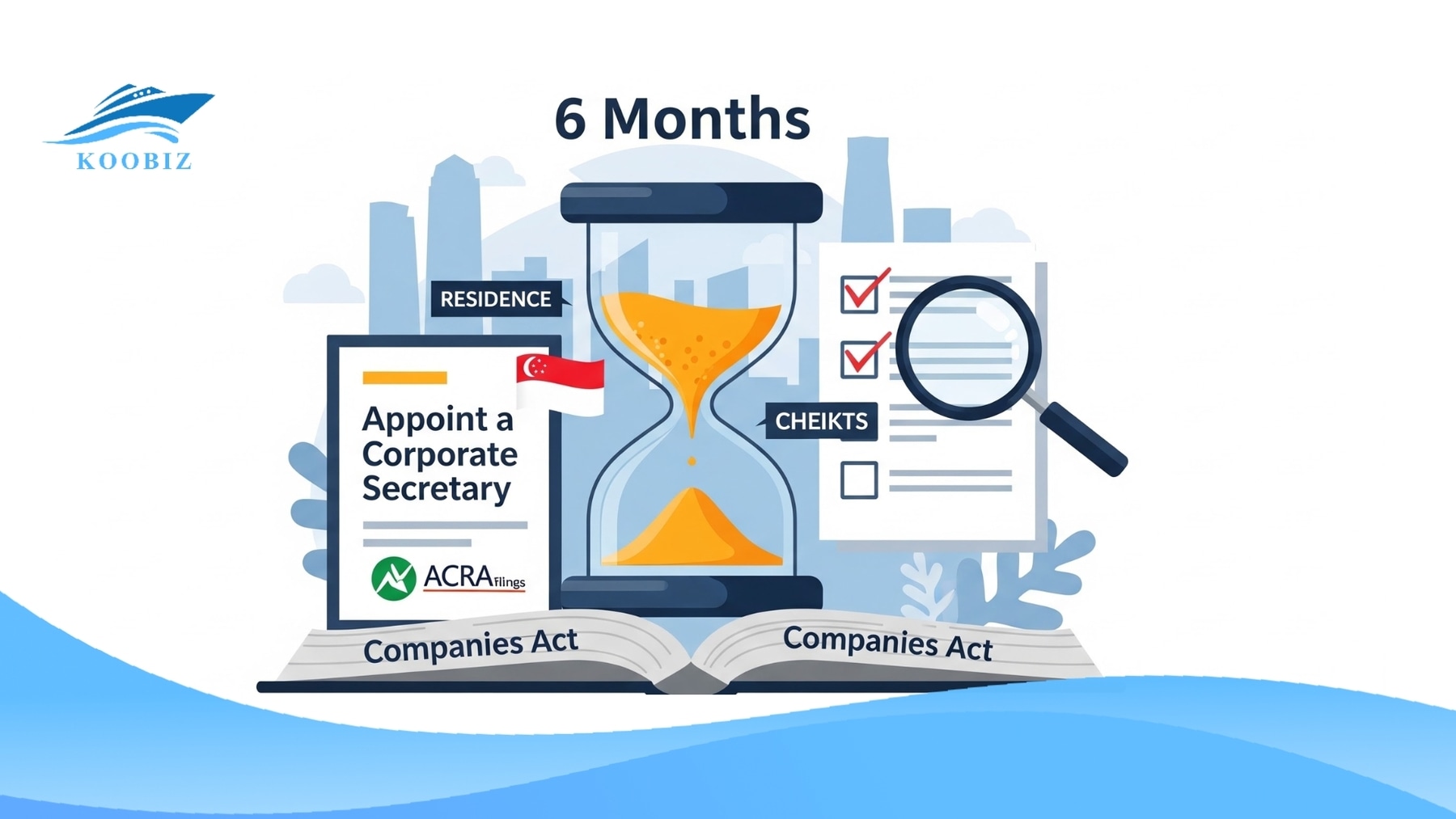
The 6-Month Deadline: Once your company is incorporated, you have exactly six months to appoint a qualified company secretary.
Residency Requirements: The person appointed must live in Singapore—this includes Singapore Citizens, Permanent Residents, or holders of an EntrePass or Employment Pass.
The Sole-Director Restriction: If your SME has only one director, that individual is not allowed to also serve as the company secretary. This rule helps avoid conflicts of interest and ensures a system of checks and balances.
Failing to appoint a secretary within the required timeframe—or leaving the position vacant for more than six months—will likely attract attention from ACRA and may result in penalties.
In practice, most active and compliant SMEs choose to work with third-party professional firms to meet this requirement effectively and avoid structural issues.
What Are the Core Duties of a Corporate Secretary?
Core duties of a corporate secretary
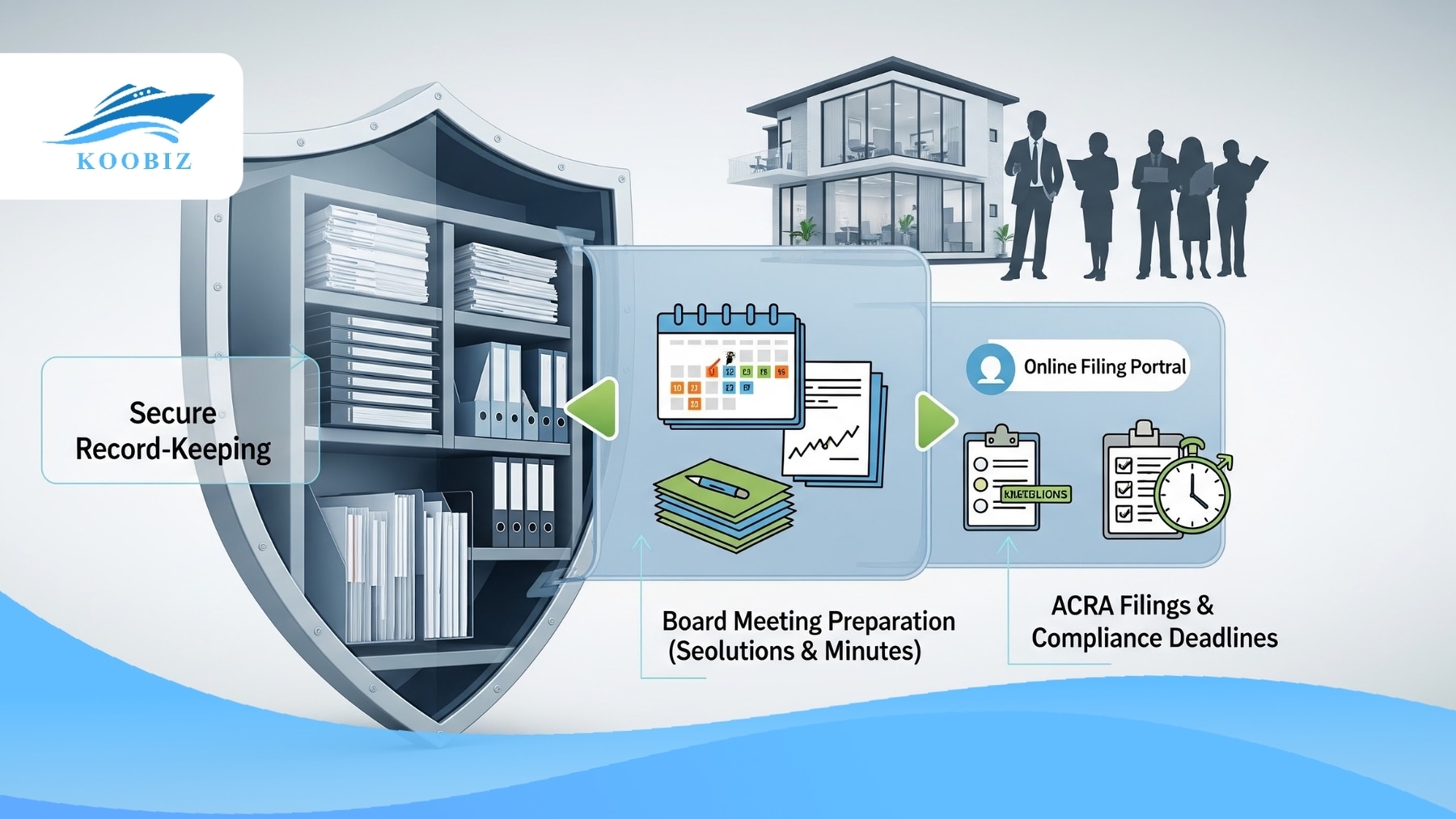
The main duties of a corporate secretary fall into three categories: administrative record-keeping, preparation for board meetings, and handling mandatory ACRA filings—all of which are required for statutory compliance.
To understand the importance of these duties, it helps to see the corporate secretary as someone who builds a safety net for the business. Rather than just responding to government requests, they actively manage the company’s corporate calendar to ensure no legal deadlines are missed. This proactive approach helps maintain the company’s “Good Standing” with the Singapore government—a status that can affect your ability to secure bank loans, attract investors, and hold operating licenses. Let’s take a closer look at each of these responsibilities.
Administrative and Statutory Record-Keeping
The Task: Create, update, and securely store the company’s statutory records. These include the Register of Directors, Register of Shareholders, and the Register of Registrable Controllers (RORC).
The Impact: Proper record-keeping ensures your SME has a clear and auditable history at all times. This helps protect your business from compliance issues and anti-money laundering inquiries whenever internal changes occur.
Board Meetings and AGM Preparations
The Task: Support strategic decision-making by preparing meeting agendas, ensuring legal requirements are met, and recording minutes and resolutions—such as a Directors’ Resolution to open a corporate bank account.
The Impact: This ensures that your Annual General Meeting (AGM) and board meetings follow the timelines and rules set out in the Companies Act. (Note: Private companies may choose not to hold AGMs if all members pass a unanimous resolution—your corporate secretary can guide you through this process if it applies.)
Mandatory ACRA Filings and Annual Compliance
The Task: Submit required documents through ACRA’s BizFile+ portal, including the company’s Annual Return. Also report any major changes—such as updates to the registered address, changes in directors, or share allotments—within 14 days.
The Impact: A Koobiz secretary acts as your compliance partner, making sure the public record always reflects the current state of your SME. This helps you meet your annual obligations without the worry of missed deadlines.
In-House vs. Outsourced Corporate Secretary: Which is Better for SMEs?
An outsourced corporate secretary is generally more cost-effective and offers broader expertise, while an in-house secretary may be suitable for large corporations that require someone physically present full-time.
To compare these two options, it’s useful to look at the financial and operational realities of running an SME in Singapore:
Comparison Criteria
In-House Secretary
Outsourced Firm (e.g., Koobiz)
Cost & Overhead
Highly expensive. Requires full-time salary, benefits, and office space.
Incredibly cost-effective. You pay a fractional cost for expert services.
Level of Expertise
Limited to the knowledge of one single internal employee.
Access to an entire team of highly trained compliance specialists.
Resource Efficiency
Often inefficient, as SMEs rarely have 40 hours of secretarial work weekly.
Highly efficient. Services scale seamlessly with your SME’s actual needs.
Key Person Risk
High risk. If they resign or fall ill, your compliance is severely compromised.
Zero risk. Services continue seamlessly without any interruption.
Based on current trends among corporate service providers, most newly formed SMEs choose outsourced secretarial services in their first year to keep costs low and reduce compliance risks.
What is the Role of a Nominee Secretary for Foreign-Owned SMEs?
Role of a Nominee Secretary for Foreign-Owned SMEs
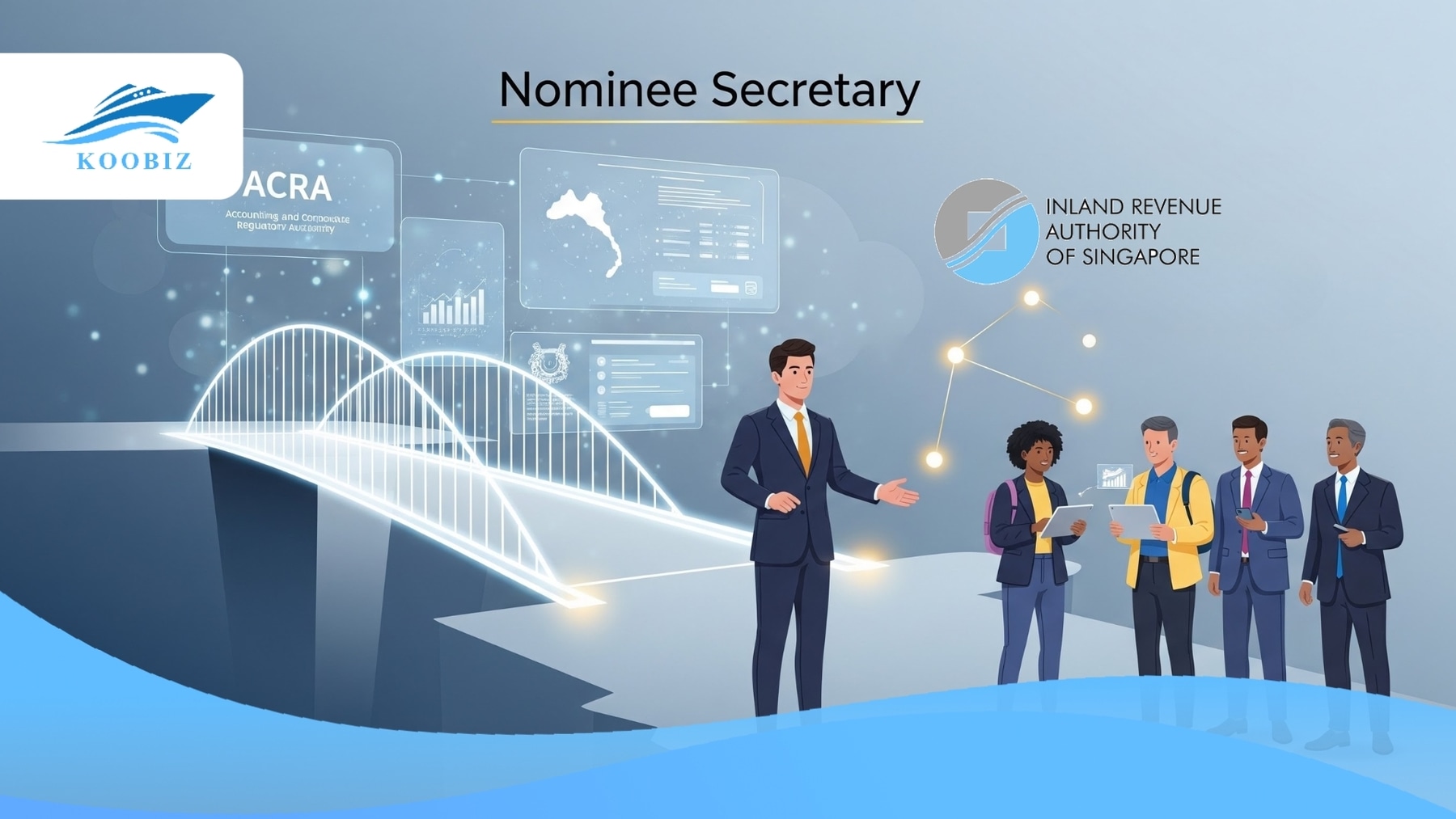
A Nominee Secretary is a locally based representative appointed to meet the residency requirement under the Companies Act. This role allows foreign entrepreneurs to operate legally in Singapore.
Here’s how this service works and the specific challenge it addresses:
The Legal Hurdle: The law requires that a company secretary must live in Singapore. This creates a challenge for SMEs founded by overseas investors or digital nomads who do not hold a local pass or citizenship.
The Koobiz Solution: We offer a Nominee Secretary service. A qualified local professional from our team is officially registered with ACRA as your company secretary.
The Strategic Benefit: This arrangement bridges the geographic gap. It ensures your foreign-owned business remains fully compliant with local rules, allowing you to focus on growing your company globally.
Using a nominee secretary is a common and safe practice that supports foreign investment into the Southeast Asian market.
What Happens If Your SME Misses ACRA Filing Deadlines?
There are three possible consequences if your SME misses ACRA filing deadlines: financial penalties, legal action against directors, and—in serious cases—the company being struck off the register.
It’s important to understand that ACRA enforces strict rules around late filings, especially for the Annual Return and AGM. Here is how penalties typically escalate:
1. Strict Financial Penalties: Missing an Annual Return deadline incurs an immediate late lodging fee imposed by ACRA. The penalties are exact: you will be fined $300 if the lodgment is filed up to 3 months late, and $600 if it is filed more than 3 months late.
2. Direct Legal Action: ACRA can issue court summons to company directors. Directors may face personal fines or be disqualified from holding directorships in the future.
3. Ultimate Striking Off: If a company repeatedly fails to file its returns, ACRA may assume the business is no longer operating and begin the process of striking it off. This removes the company from the official register, freezes its bank accounts, and effectively ends its operations.
Each year, ACRA takes action against thousands of non-compliant companies, resulting in significant fines for late or missed filings.
How to Change Your Company Secretary in Singapore?
Changing your company secretary involves three steps: securing a resignation, passing a board resolution, and updating the appointment via BizFile+ to ensure a smooth legal transition.
To complete the process without any compliance gaps, follow these steps in order:
Step 1: Secure the Formal Resignation: The current company secretary must submit a written notice of resignation to the board of directors.
Step 2: Pass a Board Resolution: The directors meet and pass a resolution to formally accept the resignation and appoint the new secretary—for example, transferring the role to the team at Koobiz.
Step 3: Execute the BizFile+ Update: This step is time-sensitive. The new secretary or a company director must log into ACRA’s BizFile+ system and file the change within 14 days of the effective date.
A smooth transition ensures your company’s compliance record remains intact. Following a clear handover process helps reduce the risk of errors after the change.
Case Study: Escaping ACRA Penalties Through Expert Outsourcing
Illustrative example based on typical client scenarios.
A local tech startup was facing thousands of dollars in ACRA fines and possible court action due to missed Annual Returns. They resolved the situation by urgently outsourcing their compliance to Koobiz’s corporate secretarial team.
Here’s how the situation unfolded:
The Problem: The foreign founders focused entirely on product development and missed the 6-month deadline to appoint a secretary. As a result, they also missed their first AGM and Annual Return filing.
The Escalation: Twelve months later, ACRA imposed late fees and sent a warning letter threatening court action against the directors. Their corporate bank account was also frozen during a compliance review.
The Koobiz Intervention: The startup reached out to Koobiz. Within 48 hours, our team stepped in as the official outsourced corporate secretary. We prepared the required resolutions, reconstructed their statutory records (including the RORC), and filed the overdue returns.
The Result: We helped the company return to “Good Standing” in under a week. They avoided court action, regained access to their bank account, and were able to move forward with their next round of funding.
Reliable Corporate Secretarial Services for Singapore SMEs by Koobiz
Navigating the requirements of the Singapore Companies Act shouldn’t distract you from running and growing your business. As this guide has shown, the role of a corporate secretary is legally required, involves real responsibility, and carries significant risk if not handled properly. That’s where Koobiz comes in.
At Koobiz, we offer more than just basic ACRA filings. We provide a full range of corporate services designed specifically for SMEs, including:
? Seamless Incorporation & Banking: Getting your company registered and helping secure your local corporate bank accounts from day one.
? Comprehensive Tax & Accounting: Keeping your finances optimized and structurally sound with expert tax, accounting, and auditing services.
? Expert Secretarial & ACRA Compliance: Guaranteeing your statutory registers are impeccably maintained, AGMs are organized on time (or legally dispensed with), and every single ACRA deadline is met well in advance.
The Singapore Companies Act 1967 sets out the legal framework governing company incorporation, governance, and ongoing statutory compliance.
It defines key obligations such as appointing resident directors and company secretaries, maintaining statutory registers, and filing Annual Returns with Accounting and Corporate Regulatory Authority (ACRA).
Directors carry personal fiduciary duties and may face fines, disqualification, or prosecution for non-compliance.
Common breaches arise from missed filings, outdated records, and failures to disclose interests or beneficial ownership.
Understanding and following these requirements helps businesses remain “In Good Standing” and avoid regulatory and reputational risk in Singapore.
[/SUMMARIES]
The Singapore Companies Act 1967 is the fundamental legal framework governing every business entity in the Lion City. In 2026, staying compliant with ACRA is more critical than ever, as non-compliance can trigger severe penalties and director liabilities of up to S$20,000. This guide provides a clear roadmap to mastering statutory requirements, from director duties to annual filings. By following these essential provisions, you can safeguard your business and maintain a status of “In Good Standing” in Singapore’s transparent regulatory environment.
What is the Companies Act in Singapore?
The Singapore Companies Act 1967 is the primary legislation governing the lifecycle and operations of all companies incorporated in the Lion City. It establishes the comprehensive legal framework for company formation, corporate governance, financial reporting, and strict regulatory compliance.
Managed and enforced by the Accounting and Corporate Regulatory Authority (ACRA), the Act serves as the “rulebook” for:
Incorporation & Structure: How a company is legally birthed and organized.
Governance: The fiduciary duties of directors and the statutory rights of shareholders.
Transparency: Mandatory financial disclosures and reporting obligations to authorities.
Compliance under the Act is a continuous statutory obligation, not a one-off task. From day-to-day administration to the eventual strike-off or winding up, the Act ensures corporate transparency while protecting the interests of creditors and the public. Failure to adhere to these regulations can lead to heavy composition fines, director disqualification, or criminal prosecution.
Types of Companies Governed by the Companies Act
Select the right legal structure for your Singapore business success
The Singapore Companies Act 1967 provides for various business structures tailored to different commercial needs. While there are several options, more than 90% of businesses in Singapore are incorporated as Private Limited Companies due to their robust liability protection and tax efficiency.
Private Limited Company (Pte Ltd)
A Private Limited Company is the most versatile and common structure. Under the Act, it is limited to a maximum of 50 shareholders. Key characteristics include:
Separate Legal Entity: The company is a distinct legal person from its directors and shareholders.
Limited Liability: Shareholders’ financial exposure is limited to their invested capital.
Tax Optimization: Access to attractive corporate tax incentives and the Exempt Private Company (EPC) status, which simplifies compliance for small-to-medium enterprises (SMEs).
Public Company
A Public Company can have more than 50 shareholders and is permitted to raise capital by offering shares or debentures to the public. These entities are subject to more stringent statutory disclosure and financial reporting standards to protect public investors. This structure is typically reserved for large-scale enterprises or those seeking a listing on the Singapore Exchange (SGX).
Company Limited by Guarantee
Commonly used for non-profit purposes (charities, trade associations, or religious bodies), this entity has no share capital. Instead, members provide a “guarantee” to pay a nominal fixed amount in the event of winding up. All surplus profits are reinvested into the organisation’s mission rather than distributed as dividends.
Foreign Companies (Branch Offices vs. Subsidiaries)
Foreign entities looking to establish a presence must register under the Act. While a Branch Office is considered an extension of the foreign parent company, most international entrepreneurs opt to incorporate a Subsidiary (Pte Ltd). A subsidiary offers stronger ring-fencing of liabilities and is considered a Singapore tax resident, making it eligible for local tax treaties.
How the Companies Act Affects Foreign Entrepreneurs
Compliance with the Companies Act ensures seamless operations
The Singapore Companies Act 1967 provides a clear legal framework for foreign investors but imposes a mandatory requirement: every company must appoint at least one Resident Director under Section 145.
This director must be:
A Singapore Citizen or Permanent Resident; or
A valid Employment Pass (EP) or EntrePass holder with a local address, subject to approval by the Ministry of Manpower (MOM).
As a result, foreign founders cannot manage a Singapore company entirely from overseas without a qualified local director. In the 2026 regulatory environment, companies must disclose any Nominee Director arrangement to ACRA, and this information appears on the public Business Profile.
To ensure full compliance, many founders use professional Nominee Director services. Professional corporate service providers such as Koobiz allow foreign entrepreneurs to meet the local director requirement without affecting ownership or operational control, while reducing exposure to regulatory penalties of up to S$20,000 (effective April 2026).
The Act therefore sets strict conditions for foreign entrepreneurs, but also offers a lawful pathway to establish and operate a business in Singapore when properly structured.
Key Provisions of the Companies Act 1967
Essential statutory framework governing all Singapore-incorporated companies
The Singapore Companies Act 1967 sets out the statutory framework companies must comply with to remain in good standing with ACRA.
1. Company Incorporation Requirements
To obtain separate legal personality, a company must appoint at least one shareholder and one locally resident director, maintain a registered office in Singapore, and appoint a qualified company secretary within six months of incorporation.
2. Statutory Registers and Records
Companies must maintain accurate and up-to-date statutory registers at their registered office. Under the current 2026 enforcement framework, this includes the Registers of Nominee Directors and Nominee Shareholders (ROND/RONS) – a mandatory requirement introduced to enhance corporate transparency.
Key maintenance requirements include:
General Registers: Accurate records of members, directors, and secretaries.
Corporate Actions: Proper records of all board and shareholder resolutions (Minutes).
ROND/RONS & RORC: Companies must maintain registers of Nominee Directors, Nominee Shareholders, and Registrable Controllers.
Filing Deadlines: Updates to the Register of Registrable Controllers (RORC) and Nominee registers must be filed with ACRA within two business days to avoid immediate statutory penalties.
3. Financial Reporting and Filing Obligations
Companies must keep proper accounting records in compliance with Singapore Financial Reporting Standards (SFRS), hold Annual General Meetings unless exempted, and lodge Annual Returns within the prescribed deadlines. Failure to comply may result in fines or regulatory action.
4. Disclosure of Interests
Directors are required to disclose any personal interests in company transactions, and companies must identify individuals exercising significant control to ensure transparency and prevent misuse of corporate structures.
Director Fiduciary Duties and Personal Liabilities
Protect your leadership with expert guidance on director liabilities
Under the Singapore Companies Act 1967 (especially Section 157), a director holds a position of legal trust. These duties are personal and cannot be fully transferred or ignored, even when daily tasks are delegated.
Directors must:
Act honestly and in good faith in the company’s best interests,
Exercise reasonable care, skill, and diligence, and
Avoid conflicts between personal interests and company obligations.
They must also disclose any interest in company transactions (Section 156). Misuse of company information or failure to declare interests is a serious breach of the law.
Personal liability for non-compliance includes:
Filing failures: late or incorrect submission of Annual Returns or Financial Statements,
Record-keeping failures: improper maintenance of statutory registers (including the Register of Registrable Controllers), and
Regulatory breaches: allowing the company to fall out of “In Good Standing” with ACRA.
Possible sanctions (2026):
Fines of up to S$20,000 per offence,
Disqualification from acting as a director for up to five years, and
Criminal prosecution for serious cases involving fraud, dishonesty, or gross negligence.
In short, company compliance is not merely administrative—it is a personal legal responsibility of every director.
Rights and Powers of Shareholders
Under the Singapore Companies Act 1967, shareholders are the legal owners of the company. Although they do not manage daily operations, the Act gives them clear statutory rights to protect their investment and influence how the company is governed.
Core statutory rights
Shareholders mainly exercise their powers through General Meetings. Their key rights include:
Voting rights: approving major decisions such as the appointment or removal of directors and auditors.
Constitutional changes: passing Special Resolutions to amend the company’s Constitution or change the company’s name.
Economic rights: receiving dividends when declared and a share of assets if the company is wound up.
Information rights: receiving notices of meetings and access to audited financial statements and certain statutory registers.
Checks and balances
The Act draws a clear line between ownership and management. Directors run the business, but shareholders retain control through specific “residual powers” if governance breaks down:
Calling meetings: shareholders holding at least 10% of voting rights may requisition a General Meeting.
Removing directors: shareholders can vote to replace directors who breach their duties.
Minority protection: under Section 216, shareholders may seek court relief against “oppressive” or unfair conduct by the board or majority owners.
The Companies Act allows directors to manage the company, while ensuring shareholders keep the ultimate authority to supervise and hold them accountable.
Common Compliance Mistakes Businesses Make
Most breaches of the Singapore Companies Act 1967 are caused by weak internal controls or misunderstanding of statutory deadlines. These “administrative errors” can quickly turn into fines and personal liability for directors. Top compliance pitfalls include:
Confusing tax with statutory filings: Filing taxes with Inland Revenue Authority of Singapore (IRAS) does not replace the duty to file Annual Returns with ACRA. Missing ACRA filings is a separate offence.
Outdated statutory records: Delays in updating changes to directors, shareholders, or the registered office (usually within 14 days) can trigger automatic penalties.
Neglecting the RORC: Failure to keep the Register of Registrable Controllers up to date or to report changes to ACRA within two business days.
AGM and resolution failures: Not holding an AGM within the required timeframe or failing to properly record Board and Shareholder resolutions.
Director disclosure omissions: Not declaring a director’s interest in contracts or transactions (Section 156).
These problems usually arise from the absence of proper corporate secretarial support. Without professional oversight, small and foreign-owned companies often miss complex and changing requirements, leading to avoidable enforcement action.
Common Offences and Penalties under the Companies Act
Understanding statutory obligations to avoid ACRA enforcement actions
In Singapore, corporate compliance operates under a strict liability regime. Under the Companies Act 1967, “administrative oversight” is rarely accepted as a defence. Both the company and its officers may be held liable for statutory breaches.
Common prosecutable offences include
AGM and filing failures: failure to hold an AGM or file Annual Returns within statutory deadlines.
Director duty breaches: failure to exercise reasonable care and diligence in overseeing compliance.
False or misleading information: providing inaccurate data to ACRA.
Transparency failures: neglecting to maintain or update the Register of Registrable Controllers (RORC).
Penalties under the Companies Act
Late filing penalties: S$300 to S$600 late lodgement fees plus composition fines (typically around S$500) for missing AR deadlines.
Serious offences: Fines up to S$20,000 for false statements (Section 401) or severe breaches of director fiduciary duties.
Sanctions and consequences (2026)
Court prosecution: serious or persistent breaches may result in proceedings before the State Courts of Singapore.
Director debarment: directors responsible for multiple non-compliant companies may be barred from taking on new appointments.
Disqualification: prohibition from acting in management roles for up to five years.
Reputational damage: enforcement records appear on public company profiles (BizFile), visible to banks, investors, and business partners.
Most penalties arise from avoidable administrative lapses, but the legal and reputational impact can be severe. Proactive and continuous compliance is essential to protect a company’s long-term position in Singapore.
Practical ACRA Compliance Checklist for Businesses
Below is a practical checklist to help Singapore companies meet their key obligations under the Companies Act and remain compliant with ACRA.
Compliance Area
Key Statutory Requirement
Statutory Deadline
Company Officers
Maintain Resident Director & Company Secretary
Ongoing
Registered Address
Must be a physical, reachable local address
Ongoing
Statutory Registers
Update registers of members, directors, and charges
Within prescribed timelines
RORC Filing
Lodge beneficial ownership data (Register of Controllers)
Promptly as per ACRA rules
Financial Records
Maintain records & prepare SFRS financial statements
Annually
Annual Meetings
Hold AGM or pass resolutions for financial approval
Within required period after FYE
Annual Returns
File Annual Return (AR) via BizFile+
Annually by statutory deadline
Disclosures
Directors disclose interests in transactions
Upon occurrence of conflict
This checklist covers the most common compliance duties but is not exhaustive. Actual obligations may vary depending on a company’s size, structure, and business activities.
Using a structured compliance checklist helps businesses avoid missed deadlines, reduce director liability, and demonstrate sound corporate governance under Singapore law.
How Koobiz Corporate Secretarial Services Keep You 100% Compliant
Under the Singapore Companies Act 1967, appointing a qualified Company Secretary within six months of incorporation is a mandatory statutory requirement. Failure to comply is an offence that triggers penalties from ACRA for both the entity and its directors.
This is where Koobiz Corporate Secretarial Services provide a critical safety net. By appointing Koobiz as your Company Secretary, your business ensures:
Immediate Statutory Compliance: We ensure a qualified professional is appointed within the mandatory 6-month window, satisfying all ACRA requirements from day one.
Automated Filing Management: Koobiz proactively manages your AGMs, Annual Returns, and necessary lodgements, effectively eliminating the risk of late-filing penalties or regulatory actions.
Robust Record-Keeping: We maintain your statutory registers and corporate records with precision, enabling directors to fulfill their fiduciary duties and significantly reducing personal liability risks.
Professional Oversight: For foreign founders, a corporate secretary is not just a legal mandate—it is your local compliance partner.
With Koobiz, you secure continuous professional oversight, ensuring your company remains “In Good Standing” while you focus on scaling your business.
A termination letter is a mandatory written document in Singapore for ending an employment relationship under MOM regulations.
It must clearly state the notice period, last day of service, and final salary arrangements, including unused leave and salary in lieu of notice.
Employers must comply with Employment Act requirements to avoid wrongful dismissal claims handled by TADM and ECT.
Special rules apply to foreign employees, including IR21 tax clearance and withholding of final pay until approval from IRAS.
Using a properly drafted termination letter ensures legal compliance, protects both parties, and reduces dispute risks.
[/SUMMARIES]
A termination letter is a critical document for ending an employment relationship in Singapore. Employers and employees must comply with MOM regulations on notice periods, final salary payments, and fair termination practices. This guide provides a practical overview of termination letters, explains when they are required, and shows how to draft them correctly under Singapore employment law, with ready-to-use templates for common termination scenarios.
What is a Termination Letter?
Basic meaning of a termination letter
A termination letter is a formal written notice issued by an employer or an employee to officially end an employment relationship. In Singapore, it serves as a key employment record confirming important details such as the last day of service, notice period, and final compensation arrangements.
For employers, issuing a termination letter helps ensure compliance with the employment contract and the Employment Act administered by the Ministry of Manpower (MOM). For employees, it provides written proof of their employment history, which may be required for future job applications, work pass cancellations (for foreign employees), or references to the Tripartite Alliance for Dispute Management (TADM) if a dispute arises.
Termination Letter vs Resignation Letter vs Dismissal Letter
Criteria
Termination Letter
Resignation Letter
Dismissal Letter (Summary)
Initiated by
Employer or employee
Employee
Employer
Purpose
To formally end employment
To notify voluntary departure
To end employment due to misconduct
Notice period
Required (unless paid in lieu)
Required under contract or law
Not required
MOM compliance
Must align with the Employment Act
Must meet contractual notice terms
Requires formal inquiry (due process)
Legal risk
Moderate
Low
High (if misconduct is not proven)
Summary
A resignation letter is submitted by the employee to leave voluntarily.
A dismissal letter is issued by the employer, usually for serious misconduct (summary dismissal), and often takes effect immediately without notice.
A termination letter is an umbrella term covering all formal ways of ending an employment relationship, including termination by notice, mutual agreement, or contract expiry.
Is a Termination Letter Required in Singapore?
Legal need for a termination letter
Yes. Under the latest Ministry of Manpower (MOM) regulations, a termination letter is mandatory.
Any notice to end an employment relationship whether initiated by the employer (dismissal) or the employee (resignation) must be given in writing. A verbal notice is not legally sufficient. Without a written letter, the employment relationship may be treated as still ongoing. As a result, the employer may remain liable for salary and CPF contributions, while the employee remains bound by contractual duties.
Beyond legal compliance, a formal termination letter serves three key purposes:
Legal protection: It provides definitive evidence of the last day of service and the official reason for termination.
Financial record: It confirms the final payout, including salary in lieu of notice and encashment of unused annual leave.
Welfare access: Under the SkillsFuture Jobseeker Support (SJS) Scheme, displaced workers must present an official termination letter to apply for financial assistance of up to $6,000.
MOM’s Employment Act on Termination Notices
The Employment Act sets out a clear framework for ending an employment contract. Either party may terminate the contract by serving the notice period stated in the employment agreement.
If the contract is silent on notice duration, the following statutory minimum notice periods apply based on length of service:
Length of Service
Minimum Notice Period
Less than 26 weeks
1 day
26 weeks to < 2 years
1 week
2 years to < 5 years
2 weeks
5 years and above
4 weeks
Risks of Wrongful Dismissal Claims (TADM & ECT)
Issuing a termination letter without just cause or without following due process may expose employers to wrongful dismissal claims. Such cases are first handled by the Tripartite Alliance for Dispute Management (TADM) and may be escalated to the Employment Claims Tribunals (ECT).
Common high-risk scenarios include:
Discrimination: Termination based on age, race, gender, religion, or pregnancy.
Deprivation of benefits: Dismissing an employee to avoid paying maternity benefits, bonuses, or retrenchment compensation.
Retaliation: Termination following complaints about unpaid salary or unsafe working conditions.
Lack of inquiry: For summary dismissal due to misconduct, employers must conduct a formal inquiry. During this period, the employee may be suspended for up to one week with at least half pay. Immediate dismissal without inquiry or written explanation is a major trigger for TADM claims.
If the Employment Claims Tribunals (ECT) determines that a dismissal is wrongful, the employer may be ordered to either reinstate the employee with back pay or pay financial compensation.
To avoid these risks, businesses in Singapore should always issue a formal termination letter that clearly states and supports the reason for dismissal such as misconduct, poor performance, or redundancy and strictly complies with the required notice period. Doing so helps protect the company from legal disputes, financial penalties, and reputational damage.
Understanding Notice Period and Salary in Lieu
Key terms on notice and pay in lieu
In Singapore, the notice period is the advance notice required before an employment contract ends. It is usually stated in the employment contract; if not, the statutory minimum under the Employment Act applies. The notice period allows both parties to prepare for termination, such as handing over duties and arranging replacements.
Salary in lieu of notice allows either party to terminate employment immediately without serving the notice period, by paying the equivalent salary for that period.
Employee-initiated: An employee who leaves immediately without serving notice must pay the employer the equivalent salary.
Employer-initiated: An employer may terminate employment immediately by paying the required salary in lieu of notice.
Key financial points:
Gross rate of pay: Calculated based on gross salary, excluding bonuses and variable allowances.
CPF contributions: Not required for salary in lieu of notice.
Unused leave: Any unused annual leave must be encashed separately and included in the final payment.
A termination letter should clearly state whether the notice period will be served or salary in lieu will be paid. This ensures clarity on the last working day and compliance with Singapore employment laws.
What Should Be Included in a Termination Letter?
To be legally robust, a termination letter in Singapore must be clear, professional, and compliant with the Employment Act. It serves as a formal record of the cessation of employment and the fulfilment of contractual obligations.
Essential Elements
A standard, professional termination letter should include:
Personal Particulars: Employee’s full name, NRIC/FIN, and job title
Key Dates: Date of issuance, last day of service, and official termination date
Notice Terms: Whether the contractual notice period is served or salary in lieu of notice is paid
Return of Company Assets: Requirement to return laptops, access cards, and confidential documents
Final Compensation: Breakdown of final salary, overtime, commissions, and unconsumed annual leave encashment
Authorised Signature: Signed by HR or an authorised management representative
Final Salary Payment & Tax Clearance (IR21)
MOM Salary Payment Deadline: In cases of dismissal, the final salary must be paid on the last day of service or within 3 working days thereafter.
Unconsumed Leave Encashment: Any outstanding annual leave must be encashed and included in the final payment.
Withholding Salary for IR21 (Tax Clearance): For non-Singapore Citizen or non-PR employees, employers must submit Form IR21 to IRAS at least one month before the employee’s departure. The employer is legally required to withhold the employee’s final salary until tax clearance is issued by IRAS.
Optional but Recommended Clauses
Confidentiality & Non-Compete Obligations
Return of Documents and Company Equipment
Full and Final Settlement of All Claims
Reference or Certificate of Service (if applicable)
SkillsFuture Support Contact: Provide a contact point to assist displaced employees with support scheme applications
Including these clauses helps reduce legal risk, prevent disputes, and ensure a smooth and compliant exit process.
Common Types of Termination Letters in Singapore
Typical termination letter types in Singapore
Different termination scenarios require different types of termination letters. In Singapore, the most common forms are classified based on how and why the employment relationship ends.
Termination with Notice (Contractual Termination)
This letter is issued when either party terminates the employment contract by serving the required notice period stated in the contract or by paying salary in lieu of notice. It confirms the last day of service and the applicable notice arrangement. This is the most common and lowest-risk form of termination when properly executed.
Summary Dismissal (Misconduct)
This letter is used when an employee is dismissed with immediate effect due to serious misconduct, such as theft, fraud, or dishonesty. It must only be issued after a proper inquiry and sufficient evidence has been established. Improper use of summary dismissal carries a high risk of wrongful dismissal claims.
Acceptance of Resignation Letter
This letter is issued by the employer to formally acknowledge and accept an employee’s resignation. It confirms the notice period served and the employee’s last working day. It helps formalise the resignation process and reduces the risk of future disputes.
Termination by Mutual Agreement
This letter is used when both the employer and employee agree to end the employment relationship amicably. It records the agreed termination date and any settlement terms. This method is commonly adopted during restructuring exercises or negotiated exits.
Downloadable Termination Letter Templates (Singapore)
Using standardised templates ensures legal clarity and consistent documentation. Each template below is tailored to a specific termination scenario under Singapore employment practice.
Employer-Initiated Termination Letter
Employer-Initiated Termination Letter is used when the employer terminates employment by serving notice or paying salary in lieu of notice.
It typically includes:
Termination date and last day of service
Notice period served or salary in lieu of notice
Final salary and unconsumed annual leave encashment
Instructions for the return of company property
This template is suitable for contractual termination and redundancy situations.
[Company Letterhead]
Date: [DD/MM/YYYY]
To: [Employee’s Full Name] NRIC/FIN No.: [SXXXXXXX] Job Title: [Designation]
RE: NOTICE OF TERMINATION OF EMPLOYMENT
Dear [Employee’s Name],
We regret to inform you that [Company Name] has decided to terminate your employment as [Job Title], effective from [Date of Issuance].
1. Last Day of Service
Your final day of employment with the Company will be [Last Working Day, DD/MM/YYYY].
2. Notice Period and Compensation
[Option A: If serving notice] You are required to serve a notice period of [Number] weeks/months. Your last day of service will remain as stated above.
[Option B: If paying in lieu] The Company has decided to terminate your services with immediate effect. In lieu of the notice period, you will be paid a sum of S$[Amount], equivalent to [Number] months of your gross rate of pay. Please note that CPF contributions are not applicable to this payment in lieu of notice.
3. Final Salary and Benefits
Your final salary payment will be processed by [Date – must be within 3 days of last day]. This payment will include:
Your prorated salary for the current month.
Encashment of [Number] days of unconsumed annual leave.
Any outstanding eligible expenses or reimbursements.
[For Foreign Employees] Please note that as per IRAS regulations, the Company will withhold your final payment pending Tax Clearance (Form IR21).
4. Return of Company Property
By your last day of service, please return all company property, including but not limited to:
Company laptop and accessories.
Office keys and security access cards.
Corporate credit cards and confidential documents.
5. Post-Employment Obligations
We would like to remind you of your ongoing obligations regarding Confidentiality and Non-Disclosure, as stipulated in your employment contract signed on [Date].
6. Support and Inquiries
If you have any questions regarding your final settlement, please contact [Name/Department] at [Email/Phone]. For assistance with job transition or support applications such as the SkillsFuture Jobseeker Support (SJS) Scheme, you may reach out to our HR point of contact: [HR Contact Name].
We thank you for your contributions to [Company Name] and wish you the best in your future endeavors.
Yours sincerely,
[Signature]
[Name of Authorized Representative][Job Title][Company Name]
Employee Resignation Acceptance Letter
Employee Resignation Acceptance Letter is used to formally acknowledge and accept an employee’s resignation.It typically confirms:
Acceptance of the resignation
Last day of service
Notice period served
Final salary payment arrangements
It provides written evidence that the resignation has been properly recorded and accepted by the employer.
[Company Letterhead]
Date: [DD/MM/YYYY]
To: [Employee’s Full Name] Job Title: [Designation]
RE: ACCEPTANCE OF RESIGNATION
Dear [Employee’s Name],
We acknowledge receipt of your resignation letter dated [Date of Resignation Letter], notifying us of your intention to resign from your position as [Job Title].
We wish to inform you that your resignation has been formally accepted.
1. Last Day of Service
In accordance with your contractual notice period of [Number] weeks/months, your last day of employment with [Company Name] will be [Last Working Day, DD/MM/YYYY].
2. Handover of Responsibilities
To ensure a smooth transition, you are expected to complete the handover of all your current projects and responsibilities to [Name of Successor/Manager] by your last working day. Please ensure that all company files, passwords, and documents are properly organized and transferred.
3. Final Settlement and Benefits
Your final salary, including encashment of any unconsumed annual leave (if applicable), will be paid on [Date – within 7 days of last day as per MOM]. [For Foreign Employees] As a reminder, the Company will withhold your final payment pending Tax Clearance (Form IR21) as required by IRAS.
4. Return of Company Property
Please arrange to return all company-issued items, such as your laptop, access card, and corporate credit cards, to the HR Department on or before your last day.
5. Post-Employment Obligations
We would like to remind you that certain contractual obligations, specifically regarding Confidentiality, Non-Solicitation, and Intellectual Property, remain in effect after your departure.
On behalf of [Company Name], I would like to thank you for your service and contributions during your time with us. We wish you every success in your future career.
Yours sincerely,
[Signature]
[Name of Authorized Representative][Job Title][Company Name]
Common Mistakes When Issuing a Termination Letter
Frequent errors in termination letters
Even when a termination is legally valid, errors in the termination letter can lead to disputes and regulatory non-compliance. Employers should avoid common mistakes that affect an employee’s final entitlements and increase legal exposure.
Failing to Encash Unconsumed Annual Leave
One of the most frequent mistakes is failing to encash an employee’s unconsumed annual leave upon termination. In Singapore, unused annual leave must be encashed unless the employment contract expressly provides otherwise.
If this item is omitted from the termination letter, disputes may arise over the final salary amount and outstanding benefits. This may result in complaints to MOM or claims for unpaid wages. To mitigate this risk, the termination letter should clearly state:
Whether unconsumed annual leave will be encashed
How the encashment will be calculated as part of the final salary payment.
Missing Payment Deadlines
Failing to pay the final salary within MOM’s prescribed timeline within 3 working days for dismissal, or on the last day of service for resignation with notice.
Incorrect CPF Application
Wrongly making CPF contributions on salary in lieu of notice, which is legally exempt from CPF contributions.
Overlooking Tax Clearance (IR21)
Failing to withhold the final salary of foreign employees until IRAS tax clearance is issued, exposing the employer to liability for unpaid taxes.
Vague Post-Employment Obligations
Failing to remind the employee of ongoing confidentiality and non-compete obligations, increasing the risk of data leakage and intellectual property misuse.
Get Professional Support from Koobiz for Termination Letters in Singapore
Koobiz supports employers at every stage of the termination process by ensuring:
Full compliance with MOM and IRAS requirements
Accurate application of notice periods and final salary payments
Proper handling of IR21 tax clearance for foreign employees
Reduced exposure to disputes and wrongful dismissal claims
This gives businesses a reliable and compliant way to issue termination letters in Singapore with confidence.
Multiple Verification Channels: You can track your application instantly on the Ministry of Manpower (MOM) website or the SGWorkPass mobile app using your FIN or Passport number.
Decoding Statuses: Knowing what terms like “Pending Input,” “IPA (Approved),” and “Rejected” mean is key to knowing what to do next.
Variable Timelines: Employment Pass (EP) applications typically take 10 business days to 8 weeks, while S Pass applications usually take 3 to 8 weeks.
Appeal Strategy: A rejection isn’t final. You have a 3-month window to appeal with new information.
Koobiz Support: As your corporate services partner, Koobiz helps with company incorporation and provides advice on navigating complex work pass regulations.
[/SUMMARIES]
For both companies and foreign professionals, waiting for a work visa can be a time of uncertainty. Whether you’re starting a new company in Singapore with Koobiz or hiring international talent, knowing how to track Singapore Work Pass application status accurately is essential for your business plans. This guide explains step-by-step how to check your status, understand the results from the Ministry of Manpower (MOM), know the processing times for EP and S Pass, and what to do if an application is delayed or rejected.
How to Check Singapore Work Pass Application Status?
2 ways to check Singapore Work Pass
There are two main official ways to check your work pass status: using the Ministry of Manpower (MOM) online portal or the SGWorkPass mobile app.
For the most current information, it’s best to use these digital tools instead of calling MOM, as the systems are updated in real-time. Both employers and candidates can use these platforms 24/7 to monitor an application’s progress.
Checking via MOM Online Website (EP Online)
The most direct method is through the MOM “Check work pass and application status” e-service. This tool only needs specific identification details and does not require a Singpass login.
Follow these steps to check online:
Access the Portal: Visit the official MOM [Check work pass and application status] page.
Enter Personal Details: Input the candidate’s Date of Birth.
Provide Identification: Enter either the Foreign Identification Number (FIN) or the Passport Number used in the application.
View Results: Click “Submit” to see the current status, expiry date (if the pass is issued), and pass type.
Using the SGWorkPass Mobile App
For those who need to check status often or verify a physical card’s validity, the SGWorkPass app is the ideal tool. This is especially useful for landlords or telecom companies checking a tenant’s or customer’s status.
How to use the app:
Download: Install SGWorkPass from the Apple App Store or Google Play Store.
Setup: Open the app. You can set it up by scanning the QR code on the back of a work pass card or by entering details manually.
Verify: Use the “Scan QR Code” feature to scan a physical card to see if it is still valid.
Check Status: You can also search using the FIN and Date of Birth to see the latest status from MOM’s database.
Checking Status for Dependents (DP & LTVP)
It’s important to know that the status of Dependant’s Passes (DP) and Long-Term Visit Passes (LTVP) is directly connected to the main work pass holder.
You check their status the same way – use the main applicant’s details or the dependent’s passport details in the MOM online tool (Method 1). Typically, when the main EP or S Pass is approved, the dependent passes will start processing or be approved soon after. So, monitoring the main pass is the best way to track overall progress.
What Do the Application Status Codes Mean?
These are standard terms used by MOM to show the current stage or final result of a work pass application. Understanding them is important because they tell you what action is needed next. For example, mistaking a “Pending Input” status for a simple “Pending” status could cause unnecessary delays.
The meaning of MOM’s Work Pass application status codes
Pending and Pending Input
What it means:
Pending: Your application is being reviewed by MOM officers. This is a waiting period while they check documents and qualifications.
Pending Input: This is an important alert. It means MOM has paused processing because they need more documents or clarification from you – for example, to verify educational certificates or salary details.
Koobiz Advice:If you see “Pending Input,” the processing clock has stopped. You must respond to these requests immediately. We strongly advise responding within 7 days to avoid your application being automatically cancelled.
Approved (In-Principle Approval – IPA)
What it means:Success! An “Approved” status means an In-Principle Approval (IPA) letter will be issued. This letter serves as a temporary entry visa and signals that the relocation process can begin.
Koobiz Advice:The IPA is valid for a set period (usually 6 months for an EP). Use this time to bring the candidate to Singapore and complete any required medical checks. Remember, the IPA is not the final pass; it’s the approval to come and complete the final formalities.
Rejected or Unsuccessful
What it means:The application did not meet the qualifying criteria, which are based on the COMPASS framework or other MOM requirements. Due to privacy policies, MOM typically does not give the specific reason for rejection directly to the candidate.
Koobiz Advice:Don’t panic. The reason is only available to the employer or authorised agent via EP Online. Common issues include salary problems or not meeting the Singaporean Core requirements. Do not simply re-apply immediately; a well-planned appeal is often the better approach.
Withdrawn or Invalid
What it means:
Withdrawn: The employer has voluntarily cancelled the application.
Invalid: The pass has expired or has been cancelled by MOM.
Koobiz Advice:This status is final. Unlike a rejection, which can be appealed, a withdrawn application cannot be reactivated. If you still want to hire the person, you must submit a completely new application.
EP and S Pass Processing Time: How Long Does it Take?
Processing times vary depending on the pass type and if extra checks are needed. Here is a comparison of typical and extended timelines to help you plan.
Employer’s Quota Balance, Levy Eligibility, Verification of Qualifications
These are official guidelines, but actual timeframes can change based on application volume and how complete your submitted documents are.
EP and S Pass processing time, delay factors
Understanding the Timelines
For Employment Pass (EP):
Most online EP applications are processed within 10 business days. However, since the COMPASS framework was introduced, MOM scrutinises educational qualifications and company-related attributes more closely. This detailed checking, which may involve third-party screening agencies, is why a simple 10-day process can sometimes take months.
For S Pass:
S Pass applications generally take about 3 weeks. Unlike the EP, the S Pass is strictly limited by a quota based on the company’s industry and its number of local employees. MOM needs time to confirm the employer has enough “quota” available before approving the pass.
Why Is My Application Delayed?
Delays usually happen because of specific checks or inconsistencies in the data. If your application takes longer than the standard time, it’s likely due to one of these reasons:
Verification Checks: MOM is verifying educational qualifications with overseas institutions or background screening agencies.
Inconsistent Data: There are mismatches between the details in the application form and the supporting documents provided.
Security Vetting: The application is going through additional security vetting by other government agencies.
Missed Requests: The employer may have missed an email from MOM asking for more information.
Koobiz Pro Tip: Is your application stuck?
First, check your Spam/Junk folder for missed emails from MOM—this is the #1 cause of “stalled” applications. Second, log in to EP Online to ensure the status isn’t “Pending Input”, which means MOM is waiting for you to take action.
What to Do If Your Work Pass Application Is Rejected?
Getting a rejection can be stressful, but it’s not necessarily the final outcome.Yes, you can appeal, but only if you can address the specific reasons MOM gave for the rejection.
Instead of rushing to submit a new application, follow this step-by-step plan to improve your chances of success.
Step-by-Step Recovery Plan
Log in to EP Online: The specific reason for rejection is not sent to the candidate. The employer or authorised agent must log in to the MOM portal to read the official rejection letter.
Analyze the Gap: Identify the specific reason for rejection. Was the salary too low? Does the company need more local employees? Or were the qualifications not verifiable?
Gather New Information: This is the most important step. You must provide new evidence to address the reason for rejection. Using the same documents will not work.
Submit the Appeal: You have a strict 3-month window from the date of rejection to file an appeal. Once submitted, processing typically takes at least 3 weeks.
The Golden Rule of Appeals
Never appeal without new information.
Simply asking MOM to “reconsider” with the same documents will likely lead to another rejection. If the rejection was due to salary, you must submit a revised contract with a higher salary. If it was due to qualifications, you need to provide independent verification of the degree.
Common Reasons for EP and S Pass Rejection
To fix the issue, you must first understand the root cause. The most frequent grounds for rejection include:
Failed COMPASS Framework (EP): The candidate did not score the required 40 points on the Complementarity Assessment Framework. Fix: Improve firm-level attributes or increase salary.
Weak Singapore Core (S Pass): The company does not have enough local employees to support the S Pass quota. Fix: Hire more locals before re-applying.
Unverified Qualifications: The educational institution is not on MOM’s standard list. Fix: Use a background screening agency to verify the degree.
For new companies, rejection can also happen if the paid-up capital seems too low to support the promised salary, or if there’s no clear proof of active business operations. Koobiz often advises clients on setting up their company correctly from the beginning – with sufficient capital and clear business plans – to reduce these risks when they start hiring.
Is Your Work Pass Valid? Understanding Pass Validity
“Pass validity” refers to the current status of an issued work pass. It confirms that the holder is legally allowed to work and live in Singapore at this moment.
This is different from “Application Status.” Validity is about ensuring current employees remain compliant and are not working illegally.
Difference Between Active and Cancelled Status
Employers must verify the specific validity status of their foreign employees to avoid severe penalties under the Employment of Foreign Manpower Act (EFMA).
Status
Can they work?
Employer Action Required
Active
YES
Continue paying salary & CPF (if applicable). Ensure medical insurance is valid.
Cancelled
NO
Stop work immediately. The employee is effectively on a Short Term Visit Pass (STVP) and must prepare to leave Singapore.
Expired
NO
This is a serious offense. You may face fines or be barred from hiring foreign workers.
Koobiz Critical Compliance Alert
The “Payroll Rule”: Always check a worker’s pass validity before processing your monthly payroll. Paying someone with a cancelled pass is a punishable offence.
The “6-Month Rule”: Don’t wait for MOM’s reminder. Apply for a pass renewal as early as 6 months before it expires. This ensures continuous validity and prevents accidental overstaying.
About Koobiz
Navigating Singapore’s regulatory landscape requires more than just filling out forms; it demands a strategic partner. Koobiz specializes in comprehensive corporate services, from Singapore company incorporation to ongoing company secretarial support, tax filing, and accounting.
While we ensure your business entity is compliant and optimized for growth, we also provide essential guidance on manpower regulations. Whether you are a foreign entrepreneur seeking an Employment Pass to run your new Singapore company, or a local firm struggling with S Pass quotas, Koobiz offers the expertise to streamline your operations.
Visit Koobiz.com today to start your business journey in Singapore with confidence.
Eligibility Check: Ensure the worker’s passport is valid for at least 25 months for a full renewal.
The Golden Window: Always renew between 7 to 12 weeks before the permit expires to avoid penalties.
Mandatory Requirements: You must purchase a Security Bond and Medical Insurance (min. $60,000 coverage with new 2025 standards) before logging in.
Processing Time: Most online renewals are approved immediately or within 1 working day.
Late Renewal: Missing the deadline incurs overstaying fines ($100/day) and requires a valid reason for a short-term extension.
2026 Update: The maximum employment period limit has been removed. Workers can now generally be employed up to age 63, provided they meet quota and levy requirements.
[/SUMMARIES]
Full compliance with Ministry of Manpower (MOM) regulations is essential. Missing a work permit renewal deadline can result in additional levies, penalties, or even the repatriation of workers. At Koobiz, we know that managing Singapore’s regulatory requirements, from company incorporation to employment compliance, demands careful attention to detail. This guide simplifies the entire MOM process, covering everything from the crucial 7–12 week timeline to using WP Online effectively, so you can steer clear of common mistakes and keep your business fully compliant.
Is Your Worker Eligible for Work Permit Renewal?
Checklist for Singapore Work Permit Renewal
Yes, a foreign worker is eligible for renewal if they have a valid passport, the employer has sufficient quota, and there are no compliance breaches.
Before purchasing insurance or security bonds, it’s best to run through this quick checklist to confirm eligibility. The MOM requires all of the following conditions to be met:
Passport Validity: Ideally, the passport should be valid for at least 25 months.
Note: If validity is less than 25 months (but at least 7 months), you can still renew, but the Work Permit duration will be capped at 1 month before the passport expiry date, rather than the full 2 years.
Quota Balance: Your company must have sufficient Foreign Worker Quota (Dependency Ratio Ceiling).
Levy Status: You must have no outstanding Foreign Worker Levy payments or fines. The renewal button will be disabled if levies are in default.
Age & Employment Period: The worker must be below 60 years old (or 63 years old for renewals in specific sectors effective 2026). The previous maximum employment period limits (14–26 years) have been removed.
In addition, MOM regulations require employers to ensure that the worker remains medically fit and has complied with all work pass conditions throughout the previous employment period.
When Should You Start the Renewal Process?
Checklist for Singapore Work Permit Renewal timeline: Green (7-12), Yellow (3-6), Red (<2 weeks)
The recommended and required period to begin a Work Permit renewal is 7 to 12 weeks before the permit’s expiry date.
In Singapore, compliance hinges heavily on timing. MOM typically permits renewals only after the official renewal notice is issued, making it essential to follow the “Traffic Light” timeline below to prevent delays, penalties, or compliance issues.
Green Zone (7 to 12 Weeks Before Expiry): Optimal Window. This is the safest time to act. You have ample time to resolve discrepancies (e.g., passport details) and ensure the Security Bond is processed by the bank.
Yellow Zone (3 to 6 Weeks Before Expiry): Urgent Action Required. You risk delays if the bank takes longer than 3 days to transmit bond data or if MOM requires additional manual verification.
Red Zone (Less than 2 Weeks): Critical Risk. You are in the danger zone. There is a high chance the permit will expire before approval, resulting in “overstaying” status, fines, and potential repatriation.
Renewal applications submitted earlier than 12 weeks are typically rejected unless there are exceptional circumstances. On the other hand, allowing the Work Permit to lapse exposes employers to overstaying penalties, while foreign worker levies will continue to accrue.
Compliance data indicates that employers who begin the renewal process within the Green Zone are 95% more likely to resolve documentation issues without incurring late fees, compared to those who delay until the final weeks before expiry.
What Documents and Requirements are Needed?
Three key requirements must be in place before you log in: a valid passport, medical insurance, and a security bond.
Even before accessing the WP Online portal, these external documents need to be obtained and digitised. This preparatory stage is where many employers encounter delays. Refer to the table below to confirm that all required actions for each document have been completed.
Document
Requirement
Critical Action
Passport
Valid for at least 25 months (recommended)
Update details in MOM system first if recently renewed. Scan the bio-data page clearly. If <25 months, permit duration will be shorter.
Medical Insurance
Min. SGD 60,000/year
Must meet July 2025 enhanced standards: standardized exclusions, age-differentiated premiums, and direct insurer payments. Co-pay applies for claims >$15k.
Security Bond
SGD 5,000 Guarantee (Non-Malaysians)
Buy 3 days in advance. Must be valid for at least 26 months for a full 2-year permit.
Primary Care Plan (PCP)
For CMP sectors or Dorm Residents
Must be purchased and declared on WP Online before renewal.
Step-by-Step Guide: How to Renew Work Permit via WP Online
The renewal process consists of three main steps: accessing WP Online through Singpass, uploading the necessary scanned documents, and paying the $35 processing fee.
With all prerequisites in place, the online submission is straightforward. Follow the standard operating procedure (SOP) below to complete the renewal successfully.
Step 0: Pre-Renewal Actions (Mandatory)
Register Address: Use the Online Foreign Workers Address Service (OFWAS) to register the worker’s mobile number and residential address at least 1 hour before logging in to renew.
Update Passport: If the worker has a new passport, update the details in MOM’s system before starting the renewal.
Step 1: Log in via Singpass
Access the MOM Work Permit (WP) Online portal using your corporate Singpass.
Navigate to the “Renew” function on the left-hand menu.
The system will display a list of workers eligible for renewal. Select the specific worker you wish to process.
Step 2: Verification & Upload
Verify Data: Check that the Security Bond and Medical Insurance details are reflected correctly in the system. Note: If the bond status is not “Transmitted,” the system will block you from proceeding.
Upload Documents: If prompted, upload scanned copies of the worker’s passport (bio-data page).
Format Check: Ensure the file size is within the limit (usually <2MB) and the image is clear.
Step 3: Declaration & Payment
Declarations: Confirm details regarding the worker’s health, conduct, and PCP purchase (if applicable).
Payment: Pay the SGD 35 fee via GIRO, VISA, MasterCard, or eNETS.
Koobiz Tip: Print the “Acknowledgement Letter” immediately after payment. This serves as proof that the renewal is in process, which is vital if the permit expires while you are waiting for the card.
Upon successful submission, the status usually changes to “Approved” almost instantly or within one working day.
What are the Renewal Fees and Processing Time?
WP Renewal Fee: SGD 35, processed immediately or within 1 working day
The renewal fee is set at SGD 35 per Work Permit, with processing usually completed immediately or within one working day.
To assist with budgeting and planning, the cost structure and expected timeline for the renewal process are outlined below.
The Cost
Fee: SGD 35 per renewal application.
Payment Methods: GIRO, VISA, MasterCard, or eNETS.
Important Note: This administrative fee is strictly non-refundable, even if you withdraw the application or if the renewal is rejected.
The Speed
MOM’s digital system is designed for efficiency, resulting in one of the fastest processing times in the region.
Scenario A (Standard): Immediate Approval. If your Security Bond is transmitted and Quota is clear, the system usually auto-approves the application instantly.
Scenario B (Manual): 1 Working Day. If the system flags the passport or photo for manual verification, the outcome will be ready the next working day.
Upon approval, an in-principle approval (IPA) notification will be issued. In most cases, there is no need to request a new Work Permit card unless the worker is changing job roles or the existing card is damaged or lost, as the renewal automatically updates the expiry date in the backend system reflected in the SGWorkPass app.
Troubleshooting Common Renewal Issues and Errors
Even with a well-structured process, exceptions can still arise. The section below highlights the most common challenges Koobiz clients face when managing foreign worker renewals.
Typical issues include missed expiry deadlines, delays in Security Bond submission, and inadequate insurance coverage.
While the “Happy Path” outlined earlier applies to around 90% of renewals, the remaining 10% involve issues that require prompt action. Refer to the matrix below to pinpoint the specific problem and apply the appropriate immediate solution.
Issue / Error Message
Likely Cause
Immediate Solution
“Renew” button is disabled
Outstanding Levy or Fines
Pay immediately via CPF EZPay. The system updates within 1 working day.
“Quota not available”
Dependency Ratio Ceiling reached
You cannot renew. You must increase your local workforce or cancel the permit.
“Security Bond not found”
Bank transmission delay
Wait. Do not panic. It takes up to 3 working days for the bank to update MOM.
“Passport expiry date invalid”
Passport < 7 months validity
Renew passport first, then update details in MOM system via “Update Worker Details”.
System Error / Technical Glitch
Browser issue
Clear cache or try Incognito mode. If persistent, contact MOM technical support.
What Happens if You Miss the Renewal Deadline?
If you miss the deadline, the worker is considered an overstayer, attracting fines, levy penalties, and potential prosecution.
This is a critical situation. If a Work Permit expires, the worker is technically in Singapore illegally. Do not attempt to renew as normal; follow this recovery plan:
The Consequences
Status: Illegal Overstayer.
Financial: Overstaying fines are imposed immediately (approx. $100 per day). The Foreign Worker Levy continues to accumulate until the worker is repatriated or the pass is regularized.
The Recovery Plan
Immediate Action: Apply for a Special Pass to legalize the worker’s stay while the permit is sorted.
Next Step: Submit an appeal for reinstatement via MOM’s portal. Note that reinstatement is subject to MOM’s strict discretion and valid reasons.
How to Request a Short-Term Extension?
To get an extension, you must submit a specific request via WP Online explaining valid reasons like passport renewal delays or travel restrictions.
Sometimes, you cannot renew on time due to external factors. In this case, use the extension feature rather than letting the pass expire.
Use this when: You are waiting for a new passport, need time to cancel the permit, or have travel complications.
The Process:
Log in: Access WP Online and select “Request for Extension” on the left menu.
Upload: Attach proof (e.g., Embassy receipt for passport renewal or flight ticket).
Outcome: If successful, you receive a 1-month validity extension to finalize the main renewal.
Understanding the Security Bond and Medical Insurance Requirements
The Security Bond is a binding pledge of SGD 5,000, while Medical Insurance must cover at least SGD 60,000 per year for inpatient bills.
Many employers confuse these two financial instruments. Use this table to understand the critical differences.
Feature
Security Bond ($5,000)
Medical Insurance ($60k+)
Purpose
Guarantees that you will repatriate the worker and ensure they do not break the law.
Covers the worker’s hospital bills and day surgery costs.
Critical Rule
Must be valid until after the work permit expiry date (typically 26 months total).
Must cover the full renewal duration.
Result of Failure
Bond is forfeited ($5,000 loss).
Employer is liable for unlimited medical bills.
Comparison: Renewing Work Permit vs. S Pass
Work Permit renewal relies heavily on quotas and security bonds, whereas S Pass renewal focuses on meeting the qualifying salary threshold.
For companies managed by Koobiz that employ a mix of staff, understanding the difference is vital for planning.
Feature
Work Permit (WP)
S Pass
Key Requirement
Security Bond (Essential)
Fixed Monthly Salary
Salary Threshold
N/A
Min SGD 3,300+ (renewals expiring from Sep 2026)
Levy & Quota
Sector-specific Dependency Ratio
Sub-Quota (Much tighter limits)
Processing Time
Fast (Immediate – 1 Day)
Slower (~3 Weeks due to assessment)
Duration
Up to 2 years
Up to 3 years
Real-World Scenarios: Renewal Success vs. Failure
To understand the importance of the 7-12 week window, here are three real-world case studies based on common client experiences.
These scenarios highlight how small administrative decisions can lead to vastly different outcomes for your business.
Case Study 1: The “Smooth Operator” (Construction Sector)
Situation: ABC Construction Pte Ltd receives a renewal notice for 5 workers. The HR Manager logs in 10 weeks before expiry (Green Zone).
Action: She verifies the quota and notices one worker’s passport is expiring in 8 months. She instructs the worker to renew the passport immediately. Once the new passport arrives (2 weeks later), she updates MOM, purchases the Security Bonds, and waits 3 days for bank transmission.
Outcome: All 5 renewals are submitted and approved instantly. No stress, no penalties.
Case Study 2: The “Overlooked Deadline” (F&B Sector)
Situation: A restaurant owner is busy with daily operations and misses the renewal notice email. He realizes the permit for his head chef expires in 2 days (Red Zone).
The Mistake: He rushes to buy the Security Bond but forgets that banks take 3 working days to transmit the data to MOM.
Outcome: The permit expires before the bond data reaches MOM. The worker becomes an overstayer. The owner has to pay a $500 fine (5 days x $100), apply for a Special Pass, and appeal for reinstatement, disrupting kitchen operations for 2 weeks.
Case Study 3: The “Passport Trap” (Marine Sector)
Situation: A shipyard wants to renew a welder’s permit for 2 years. The worker’s passport is valid for only 18 months.
The Issue: The employer proceeds without checking validity rules.
Outcome: MOM approves the renewal, but only grants validity up to 1 month before the passport expiry (approx. 17 months total), not the full 2 years. The employer now has to track a non-standard expiry date, increasing administrative risk for the next cycle.
Conclusion
Successfully navigating the renew work permit process in Singapore is a fundamental responsibility for any business employing foreign staff. By adhering to the 7 to 12-week timeline, ensuring your Security Bond and Medical Insurance are active, and utilizing the WP Online portal correctly, you can ensure business continuity and avoid costly penalties.
At Koobiz, we specialize in supporting businesses entering and operating in the Singapore market. From company incorporation and opening corporate bank accounts to handling complex tax, accounting, and audit requirements, our team ensures your back-office operations are compliant and efficient. If you are struggling with manpower regulations or need assistance setting up your business infrastructure in Singapore to hire foreign talent, connect with us today.
Visit us at Koobiz.com for expert corporate services in Singapore.