Category: Taxation & GST

  • Determine Your Singapore Tax Residency: 2026 Guide for Expats & Companies

    Determine Your Singapore Tax Residency: 2026 Guide for Expats & Companies

    Advisory Note: Information is current as of January 2026. Tax regulations are subject to change; always verify with the Inland Revenue Authority of Singapore (IRAS) for the latest updates.

    [SUMMARIES]

    Individual Status: Determined primarily by the 183-day rule, with additional concessions for stays straddling 2 or 3 calendar years.

    Corporate Status: Hinges on the “Control and Management” test, focusing on where the Board of Directors makes strategic decisions.

    Tax Advantages: Residents benefit from progressive tax rates (0–24%), personal tax reliefs, and full access to Singapore’s extensive DTA network.

    Compliance: 2026 updates require stricter economic substance requirements for foreign-owned entities and physical presence for virtual board meetings to maintain residency.

    [/SUMMARIES]

    Determining your tax residency in Singapore is the foundational step for any expat or business owner looking to optimize their fiscal obligations in 2026. Whether you are a professional moving on an Employment Pass or a multinational establishing a regional hub, your residency status dictates your tax rates, eligibility for exemptions, and access to international treaties. Koobiz offers this comprehensive guide to help you navigate the complexities of the Inland Revenue Authority of Singapore (IRAS) regulations, ensuring your financial planning remains both compliant and efficient.

    Next, we must distinguish between the rules governing individuals and those governing corporate entities. To understand better, let’s explore the specific criteria that qualify a person or a company as a Singapore tax resident. Following this, we will dive into the advantages of holding a Certificate of Residence (COR) and how you can apply for one through the expertise of Koobiz.

    What Defines Individual Tax Residency in Singapore for 2026?
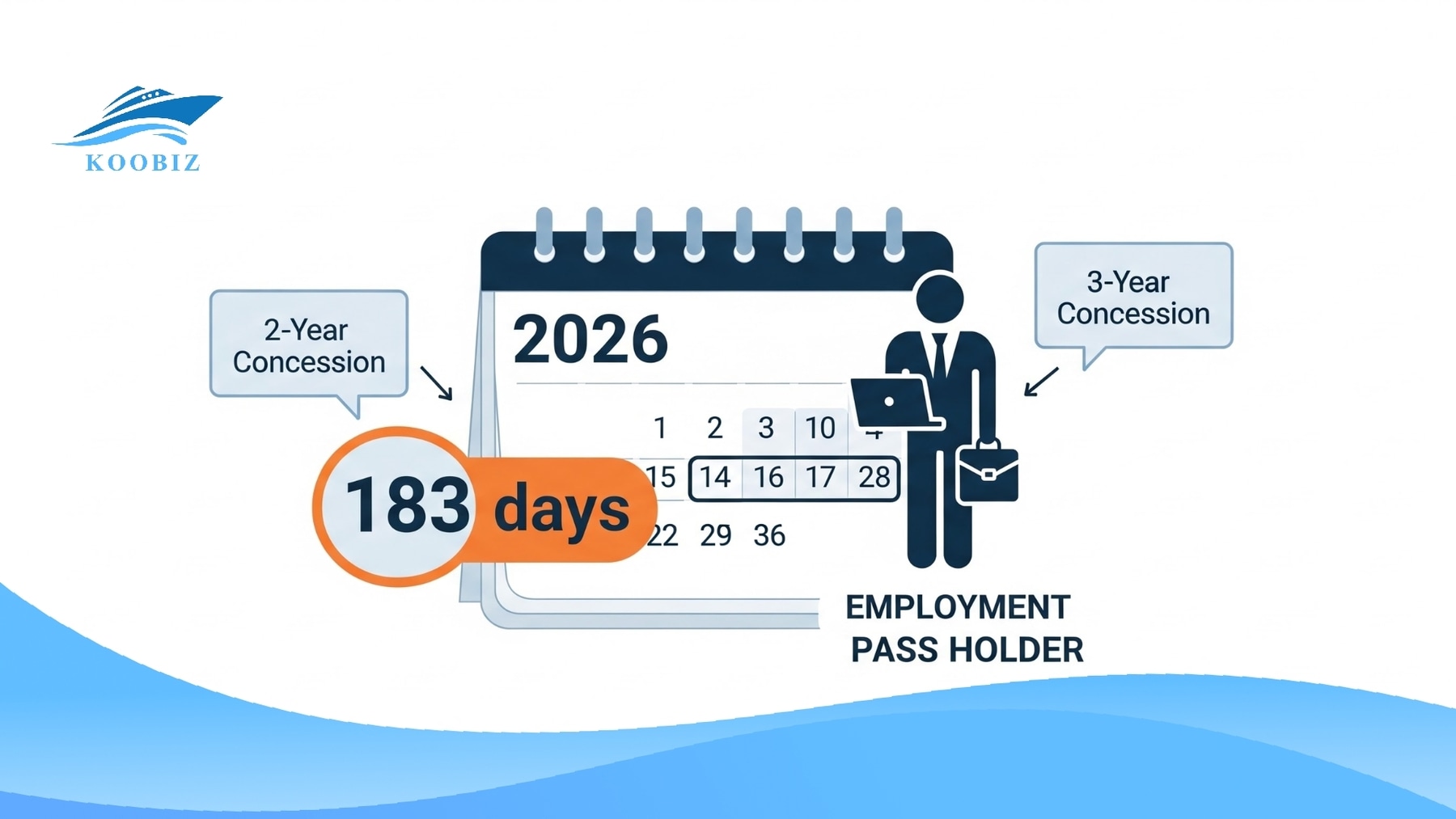
    183-day tax residency rule in Singapore
    183-day tax residency rule in Singapore

    A Singapore tax resident is generally defined as a Singapore Citizen or Permanent Resident who resides in Singapore, or a foreign individual who stays or works in Singapore for at least 183 days in a calendar year.

    Individual tax residency is crucial because it determines whether you are taxed at progressive resident tax rates or a flat non-resident rate. Importantly, tax residency status is reviewed annually and reassessed for each Year of Assessment (YA), as highlighted by Koobiz.

    The 183-Day Rule: Quantitative Presence

    The most common way for foreigners to qualify for Singapore tax residency is by meeting the 183-day quantitative threshold. This rule counts the total number of days you are physically present in the country during a calendar year (January 1 to December 31).

    • Inclusion of partial days: Any stay for even part of a day counts as a full day.
    • Work-related travel: Days spent outside Singapore for business travel or personal leave may still be counted toward the 183 days, provided your primary employment is based in Singapore.
    • Public holidays and weekends: These are fully included in the count.

    According to a 2025 study by the Singapore Tax Academy, over 85% of Employment Pass holders qualify as Singapore tax residents under the 183-day rule, enabling access to lower progressive tax rates.

    Administrative Concessions: The 2-Year and 3-Year Rules

    For individuals whose employment spans across two or three calendar years, IRAS provides specific administrative concessions. These are particularly useful for those who arrive late in the year and do not meet the 183-day requirement for that specific year but remain in Singapore for a significant duration thereafter.

    Concession Qualification Criteria Residency Outcome
    2-Year Concession Stay or work in Singapore for at least 183 days in total over two continuous calendar years. Considered a tax resident for both years.
    3-Year Concession Stay or work in Singapore for three consecutive years, even if the 183-day test is not met in the first or third year. Considered a tax resident for all three years.

    In practice, these concessions are commonly applied to help individuals obtain tax clearance and claim excess tax refunds. More specifically, these rules ensure that short-term assignments do not unfairly penalize foreigners with the higher non-resident flat tax rate.

    Special Considerations: Digital Nomads and Retirees

    As work patterns evolve, IRAS has clarified rules for non-traditional residents. The table below outlines how Singapore tax residency is assessed for these groups:

    Profile Residency Trigger Key Tax Implication
    Digital Nomads Physical presence of 183 days or more in a calendar year while working remotely. Income derived from employment exercised in Singapore is generally considered Singapore-sourced and taxable.
    Retirees Qualitative factors, such as establishing a permanent home or intention to settle. Generally exempt from tax on foreign-sourced income (FSIE) and capital gains, making it tax-efficient.

    Corporate Tax Residency in Singapore: The “Control and Management” Test
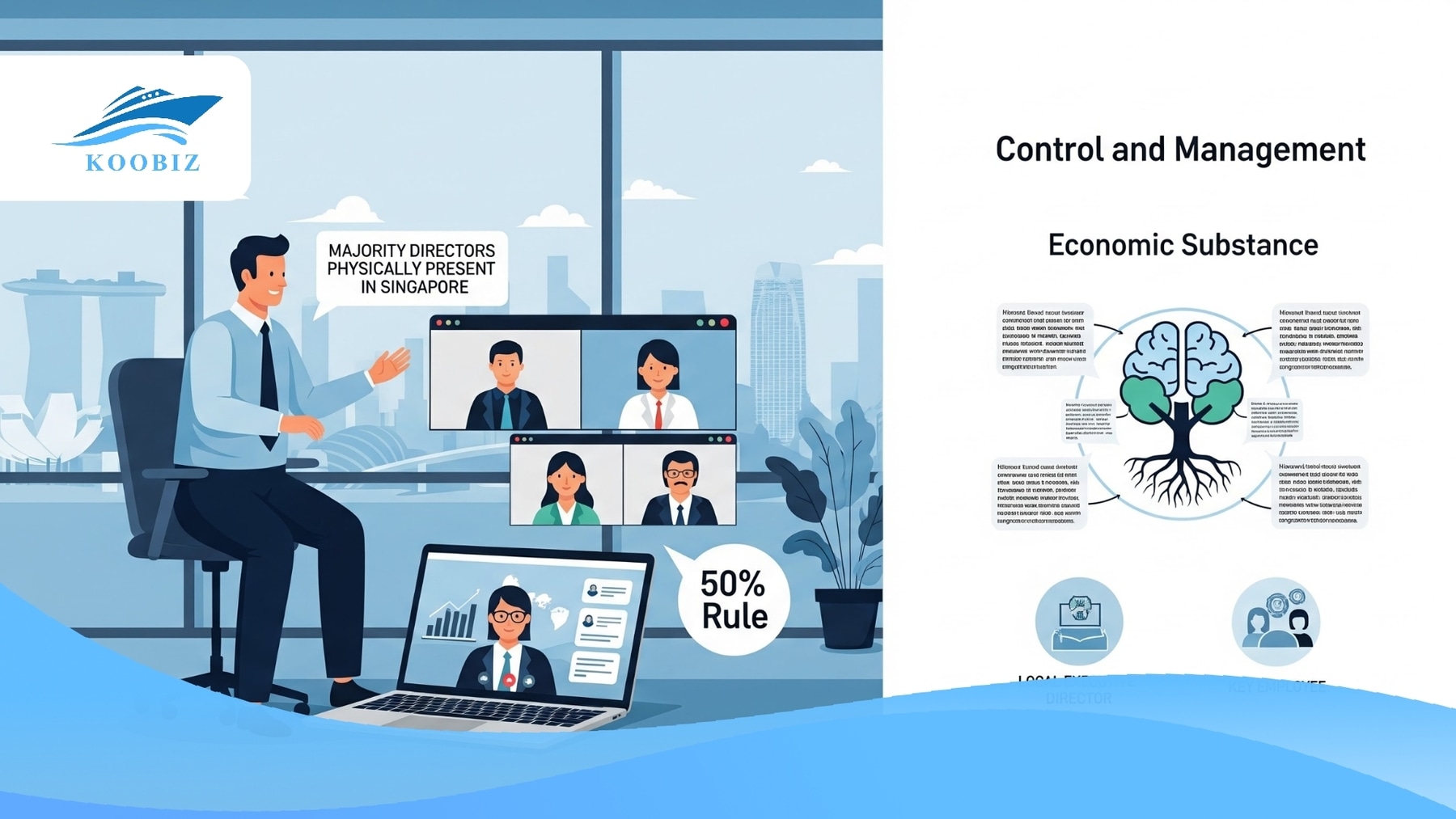
    Corporate tax residency control and management rule in Singapore
    Corporate tax residency control and management rule in Singapore

    A Singapore tax resident company is a corporate entity where the “control and management” of its business is exercised within Singapore. In practice, this refers to where the Board of Directors convenes to make strategic and high-level decisions, rather than where day-to-day operations are carried out.

    Additionally, the residency of a company is not determined solely by its place of incorporation. As a result, a company incorporated in Singapore may still be treated as a non-resident if its strategic decisions are made outside Singapore, for example, at a foreign parent company’s headquarters.

    Virtual Board Meetings: 2026 Physical Presence Rules

    From 2026 onward, IRAS has clarified its position on the impact of virtual board meetings on corporate tax residency. While digital meetings are permitted, tax residency in Singapore is only maintained if a significant portion of the decision-making process remains anchored in the city-state.

    • The 50% Rule: According to explicit IRAS Guidance, at least 50% of the voting directors must be physically present in Singapore during the virtual meeting to validate that strategic decisions are made locally.
    • Chairman’s Location: Alternatively, the Chairman of the Board must be physically in Singapore to lead the strategic discussion.
    • Local Quorum: A Singapore-based quorum must be established to demonstrate that the company’s “nerve centre” is located in Singapore.

    Stricter Rules for Foreign-Owned Investment Holding Companies

    For foreign-owned investment holding companies, the bar for residency is higher. IRAS requires these entities to demonstrate “Economic Substance” to prevent the use of Singapore as a mere conduit for tax avoidance.

    In practice, for a holding company to be granted a Certificate of Residence (COR), it is generally expected to employ at least one Singapore-resident executive director and one local key employee, such as a CFO or senior manager. According to a 2026 compliance report by the Ministry of Finance, these substance requirements have been tightened to align with global BEPS 2.0 standards, ensuring that only genuine business operations benefit from Singapore’s tax treaties.

    Comparison: Singapore Tax Resident vs. Non-Resident Tax Treatment (YA 2026)

    Singapore tax resident status offers access to progressive tax rates and a wide range of reliefs, while non-resident taxation is generally based on flat rates with limited exemptions.

    To illustrate the financial impact of your status, we must compare the specific tax liabilities for the 2026 Year of Assessment. The table below summarizes how residency status directly affects an individual’s tax exposure.

    Feature Tax Resident (2026) Non-Resident (2026)
    Employment Income Progressive (0% – 24%) Flat 15% or Resident Rate (Whichever is higher)
    Director’s Fees Progressive (0% – 24%) Flat 24%
    Personal Tax Reliefs Eligible (CPF, SRS, Life Insurance) Not Eligible
    Tax Rebates (e.g., SG60) Tax Resident (YA 2026) Non-Resident (YA 2026)
    Withholding Tax Generally not applicable Applicable to certain income types
    Foreign Sourced Income Exempt (with conditions) Generally exempt

    For example, a tax resident earning $100,000 may face an effective tax rate of approximately 5.6%, whereas a non-resident would be taxed at a flat 15% ($15,000).This drastic difference highlights why tax residency is highly sought after by high-earning professionals and business owners. Furthermore, residents can claim a wide range of reliefs, such as the Earned Income Relief and Spouse Relief, which further reduce the taxable base.

    According to data from IRAS Budget 2025, the increase of the top marginal tax rate to 24% for income exceeding $1 million affects only the top 1% of resident taxpayers, while the flat 24% rate for non-resident directors applies from the first dollar of income.

    How to Apply for a Singapore Certificate of Residence (COR) in 2026
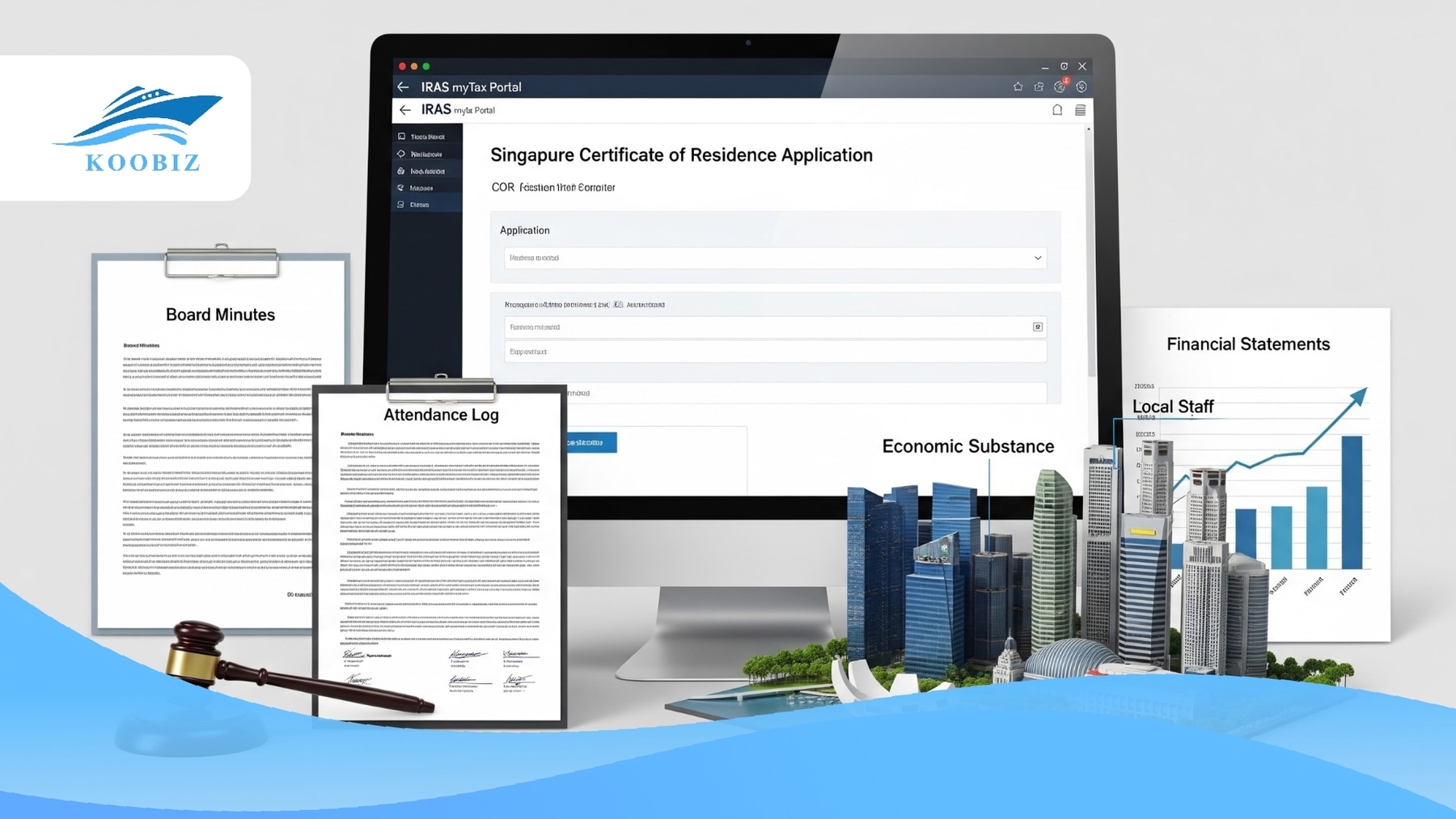
    Required documents to apply for Singapore COR
    Required documents to apply for Singapore COR

    There are two main methods for obtaining a Certificate of Residence (COR), depending on whether you are applying as a business or an individual. Both methods result in an official document confirming tax residency, although the application channels differ.

    1. For Companies: Apply via the IRAS myTax Portal (Corporate Tax).
    2. For Individuals: Apply via the myTax Portal (Individual Income Tax).

    Once tax residency has been established, the next practical step is to apply for a Certificate of Residence. This document is essential for claiming benefits under Singapore’s 90+ Double Taxation Agreements (DTAs).

    Documentation Requirements for Companies

    Applying for a COR as a company requires rigorous documentation to prove that control and management are local. Koobiz typically assists clients in preparing the following supporting documents:

    • Board Minutes: Detailed records showing that strategic decisions were made in Singapore.
    • Attendance Logs: Proof of physical presence of directors during board meetings.
    • Economic Substance Evidence: Employment contracts for local staff and local office rental agreements.
    • Financial Statements: To show that the company is actively engaged in business.

    In summary, while the COR application process is digital, the underlying economic substance ultimately determines approval. According to research by the International Fiscal Association (Singapore Branch) in 2025, COR rejection rates for shell companies increased by 30% due to the lack of local executive directors.

    Emerging Compliance: BEPS 2.0 and Economic Substance in 2026
    Corporate tax compliance in Singapore: BEPS, nominee directors, VCC
    Corporate tax compliance in Singapore: BEPS, nominee directors, VCC

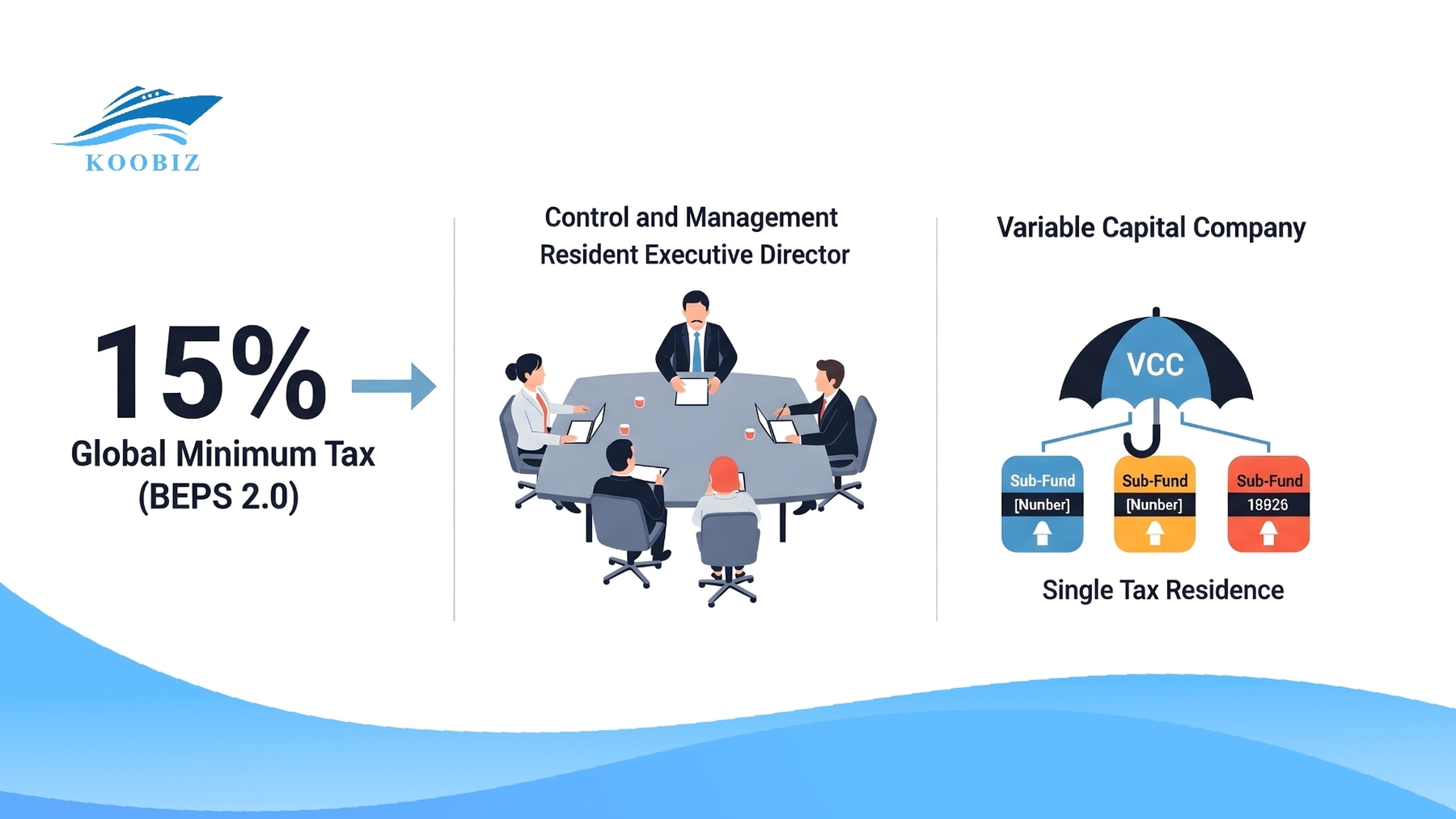
    A company may be subject to the 15% Global Minimum Tax if it belongs to a Multinational Enterprise (MNE) group with consolidated annual revenues exceeding €750 million.

    Regarding the global tax landscape, Singapore has implemented the Domestic Top-up Tax (DTT) and the Income Inclusion Rule (IIR) as part of the BEPS 2.0 Pillar Two framework. As a result, even where Singapore tax residency is established, the effective tax rate may be “topped up” to 15% for entities within large MNE groups.

    The Impact of Nominee Directors on Singapore Tax Residency Status

    A common pitfall for foreign investors is relying solely on a nominee director to satisfy Singapore tax residency requirements. While a nominee director fulfills the legal requirement of the Companies Act, IRAS often views this as insufficient for “Control and Management.”

    In particular, where a nominee director lacks genuine decision-making authority and merely follows instructions from offshore owners, IRAS may deny the issuance of a Certificate of Residence (COR). Koobiz recommends appointing at least one resident Executive Director who is actively involved in the company’s strategic direction to safeguard your tax residency status.

    Singapore Tax Residency for Variable Capital Companies (VCCs)

    The Variable Capital Company (VCC) is a specialised corporate structure commonly used by fund managers and investment vehicles.

    • Single Tax Residence: Even if a VCC has multiple sub-funds, it only needs to satisfy the control and management test once at the umbrella level.
    • Sub-fund Benefits: Once the umbrella VCC is deemed a resident, all its sub-funds can enjoy the benefits of Singapore’s DTA network.

    This structure makes the VCC an incredibly efficient vehicle for regional investment. According to the Monetary Authority of Singapore (MAS) 2025 Year-End Review, the “umbrella-level residency” rule has been a key driver behind the 40% growth in VCC registrations among Asian family offices.

    Common Singapore Tax Residency Myths and FAQs

    There are 4 main myths surrounding tax residency Singapore: the “60-day rule” exemption, the impact of remote work, the status of Singapore citizens abroad, and the permanence of residency status.

    To clarify these misconceptions, it is necessary to examine several common edge cases that frequently cause confusion among taxpayers. The sections below address these scenarios by outlining the relevant characteristics and qualifying factors.

    Myth 1: Working in Singapore for less than 60 days means no tax liability.

    Reality: While you may be exempt from tax on employment income if you work in Singapore for 60 days or less, this does not apply to company directors or public entertainers. In addition, directors’ fees are taxed at a flat rate of 24%, regardless of the number of days spent in Singapore.

    Myth 2: Remote work for a foreign company does not count as Singapore-sourced income.

    Reality: If you are physically located in Singapore while performing your work, that income is generally considered sourced in Singapore. If you remain in Singapore for more than 183 days while working remotely, you are generally treated as a tax resident and may be required to report foreign-sourced income remitted into Singapore, subject to the FSIE rules.

    Myth 3: Singapore citizens are always treated as tax residents.

    Reality: Tax residency is determined based on whether an individual is “ordinarily resident” in Singapore. For example, a Singapore citizen who lives and works permanently in London and visits Singapore only briefly each year would likely be treated as a non-resident for that specific Year of Assessment.

    Myth 4: Once classified as a tax resident, residency status is permanent.

    Reality: Once classified as a tax resident, residency status is permanent. If you move away or your company moves its board meetings to another country, your tax residency in Singapore can be lost in the following year.

    According to a 2025 study by the Tax Governance Institute, nearly 20% of remote workers in Singapore incorrectly assumed they were exempt from local filing, leading to significant penalties during IRAS audits.

    About Koobiz Services

    At Koobiz, we specialise in the intricacies of the Singapore business ecosystem. Our mission is to provide seamless advisory services for entrepreneurs and corporations looking to thrive in one of the world’s most competitive tax environments.

    Our core services include:

    • Company Formation: Expert guidance on setting up your Singapore entity to ensure immediate compliance and optimal structure for tax residency in Singapore.
    • Banking Account Advisory: Strategic support in opening and maintaining corporate bank accounts in Singapore’s leading financial institutions.
    • Tax & Accounting: Comprehensive tax planning, GST filing, and Year of Assessment preparation to maximise your reliefs and minimize liabilities.
    • Audit Services: Ensuring your financial records meet the highest standards of transparency and regulatory requirements.

    For personalised assistance with your Certificate of Residence application or to review your corporate substance requirements for 2026, visit us at koobiz.com.
  • Understand What Is TIN Number in Singapore: NRIC, FIN and UEN Explained

    Understand What Is TIN Number in Singapore: NRIC, FIN and UEN Explained

    [SUMMARIES]

    Unified Identity: In Singapore, your TIN is generally your NRIC (for citizens/PRs), FIN (for foreigners), or UEN (for businesses).

    No Application Needed: Most residents and entities are automatically assigned these numbers upon registration; separate tax numbers are rare.

    Global & Local Use: This number is mandatory for local tax filing, opening bank accounts, and international forms like the US W-8BEN.

    Instant Verification: You can retrieve and verify your TIN securely via the Singpass app or the myTax Portal.

    [/SUMMARIES]

    Navigating local compliance starts with one question: what is tin number? In 2026, the Tax Identification Number (TIN) is the digital DNA of your fiscal identity, used by the Inland Revenue Authority of Singapore (IRAS) to track tax obligations. Whether you are an individual or a business partner of Koobiz, your TIN is the gateway to financial services.

    Singapore streamlines this by using existing IDs—NRIC for locals and UEN for businesses—as the official Tax Reference Number (TRN). Below, we explore the definitions and applications of these numbers to ensure you remain fully compliant.

    What is a TIN Number in the Singapore Context?

    A Tax Identification Number (TIN) is a unique alphanumeric identifier issued by a national tax authority to track tax obligations, income, and government identification for individuals and business entities. In Singapore, the term “TIN” is technically referred to as the Tax Reference Number (TRN), which is used by IRAS for all income tax, GST, and corporate tax matters.

    The TIN is a core identifier for fiscal interactions, ensuring that all transactions—from employment income to corporate distributions—are attributed to the correct legal person. In the 2026 Singapore’s digital economy, your TIN is integrated into the national Singpass ecosystem and functions as a key underlying component of your financial administration.

    Is the TIN different from my NRIC or FIN?

    For the vast majority of individuals residing in the Lion City, the TIN is not a separate number you need to apply for; rather, it is your NRIC (National Registration Identity Card) or FIN (Foreign Identification Number). Singapore citizens and Permanent Residents (PRs) use their NRIC as their default TIN whereas foreign professionals holding Employment Passes or S-Passes use their FIN for tax identification purposes.

    This integrated ID system significantly reduces administrative errors compared to countries that maintain separate social security and tax identification registries, streamlining cross-border verification.

    The Role of TIN in 2026 Financial Transactions

    The TIN functions as the primary identifier for all financial transactions and is relied upon by banks and government agencies. It is required for opening personal bank accounts, making CPF (Central Provident Fund) contributions, and accessing government subsidies such as GST vouchers or the Assurance Package.

    As banking security evolved, the TIN is now verified instantly via real-time API calls to the MyInfo database. This means that when you provide your NRIC or FIN to a financial institution, they are simultaneously verifying your tax residency and identity status to ensure compliance with Anti-Money Laundering (AML) laws.

    Identification of TIN Types: Individual vs. Business

    There are three main types of identification numbers in Singapore categorized by the residency status of the individual or the legal nature of the entity. Identifying which category you fall into is essential because using the wrong format can lead to rejected tax filings or delays in business operations.

    TIN Type Full Name Category Primary Audience
    NRIC National Registration Identity Card Individual Singapore Citizens & Permanent Residents
    FIN Foreign Identification Number Individual Foreigners (EP, S-Pass, Long-term Pass)
    UEN Unique Entity Number Business Registered Companies, LLPs, Societies

    Identifying the correct TIN type is the first thing our consultants at Koobiz verify when assisting clients with company formation or tax advisory. Transitioning from individual status to business ownership requires a shift in which number you use for different fiscal purposes.

    For Singapore Citizens and PRs: The NRIC

    The NRIC is the primary identification number for all Singaporeans, and it follows a specific format that denotes the era of the holder’s birth or registration, followed by seven digits and a final checksum letter (e.g., S1234567A).

    • Prefix S: Used for citizens and PRs born before January 1, 2000.
    • Prefix T: Used for citizens and PRs born on or after January 1, 2000.

    Your NRIC remains your TIN as long as you maintain your citizenship or residency status.

    For Foreign Professionals: The FIN

    The Foreign Identification Number (FIN) is assigned to foreigners who have a long-term pass by the Ministry of Manpower (MOM) or the Immigration and Checkpoints Authority (ICA). The FIN system now utilizes three main prefixes to manage the volume of residents.

    • Prefix F: Issued to foreigners who were granted passes before January 1, 2000.
    • Prefix G: Issued to foreigners who were granted passes between January 1, 2000, and December 31, 2021.
    • Prefix M: The newest series introduced on January 1, 2022, to accommodate the increasing number of foreign professionals in the digital and tech sectors.

    For Corporate Entities: The Unique Entity Number (UEN)

    The Unique Entity Number (UEN) is the 9 or 10-digit identification number for all registered entities in Singapore, including local companies, LLPs, and societies. For businesses, the UEN serves as the single identifier for interactions with ACRA, IRAS, and Singapore Customs.

    How to Find and Verify Your TIN in 2026

    Finding your TIN in Singapore is straightforward regarding your identification status and access to digital government services. For most residents, if you hold a valid identity card or work pass, you already have a TIN. For Koobiz clients, tax information no longer requires manual record searches. The following step-by-step guides are the most efficient ways to retrieve and verify your number.

    Do I Need to Apply for a Separate TIN?

    The answer is No for most individuals and businesses because the TIN is automatically issued upon the successful registration of your identity or entity. However, there are rare exceptions where IRAS may issue an “ASGD” (Assigned) number for specific cases where an individual is not eligible for an NRIC or FIN but has tax obligations in Singapore.

    If you are a non-resident who owns property in Singapore and derives rental income, you may need to apply for an Income Tax Reference Number through the IRAS portal. In summary, if you have a Singpass account, you already have a TIN; if you are an overseas investor without an ID, you must contact IRAS to have a number assigned.

    Step-by-Step Retrieval Guide

    If you need to retrieve your TIN for an official form or banking application, follow the steps below corresponding to your status.

    For Individuals (Using Singpass App)

    1. Launch App: Open the Singpass app on your mobile device.
    2. Access Digital IC: Tap on the Digital IC card located on the home screen.
    3. Authenticate: Use your fingerprint, face ID, or passcode to verify your identity.
    4. Reveal: Tap the “Show details” button or the eye icon next to the masked number. This unmasked NRIC or FIN is your official Tax Reference Number.

    For Businesses (Using myTax Portal)

    1. Visit Portal: Go to mytax.iras.gov.sg.
    2. Log In: Select “Business Tax” and log in using your Singpass (Corppass) credentials.
    3. Select Entity: If you are an authorized officer for multiple entities, select the correct UEN from the dropdown list.
    4. View Dashboard: Your company’s UEN and current tax balance will be displayed clearly at the top of the dashboard.

    For Public Verification (Checking a Vendor)

    1. Visit Directory: Go to uen.gov.sg or bizfile.gov.sg.
    2. Search: Enter the company name in the search bar.
    3. Verify: The system will display the valid UEN and entity status (e.g., “Live”), confirming the business is registered and active.

    Understanding TIN Formats and Checksum Verification

    Comparing TIN formats is essential to distinguish between individual and corporate identifiers and avoid errors in official documentation. While all TINs in Singapore are alphanumeric, the individual format (NRIC/FIN) and the business format (UEN) follow distinct structures that reflect their administrative origins.

    Understanding these formats allows you to manually verify if a number is valid before submitting it for a cross-border transaction. Whereas, at Koobiz, we use automated tools to validate every UEN or FIN provided by our clients.

    Individual Format: #0000000@

    The individual format (NRIC and FIN) always consists of nine characters: one prefix letter, seven digits, and one trailing checksum letter. The seven digits are a unique serial number, while the final letter is calculated based on a mathematical formula to prevent transcription errors.

    To illustrate, an NRIC might look like S1234567A. The trailing letter ‘A’ is not random; it is the result of a specific weightage applied to the digits. This format is recognized worldwide by financial institutions, ensuring that your tax identity is unique and verifiable across international borders.

    Business Format: YYYYNNNNNC vs. NNNNNNNNC

    Older entities (registered before 2009) typically have an 8-digit number followed by a letter, while newer entities use a 10-character string that begins with the year of registration.

    Criteria Old UEN Format Modern UEN Format (Post-2009)
    Length 9 Characters 10 Characters
    Structure NNNNNNNNC (e.g., 12345678A) YYYYNNNNNC (e.g., 202612345G)
    Advantage Simplified for older systems High transparency (Year of birth)

    The modern 10-digit UEN is now the standard for new businesses, immediately identifying them as contemporary entities. Checksum Calculation Basics

    Verifying a TIN often involves a checksum calculation. While the specific algorithms are technical, understanding the logic helps in spotting obvious errors.

    TIN Type Format Example Checksum Logic
    NRIC/FIN S1234567A Weighted sum of digits + prefix offset, Modulo 11 determines the letter.
    UEN (Old) 12345678A Weighted sum of digits, Modulo 11 determines the final letter.
    UEN (New) 202612345G Year prefix + Serial Number + Weighted Modulo 11 check.

    Global Compliance and the 2026 Regional Shift

    In the globalized world of 2026, your Singaporean TIN is not just for local use; it is a critical component of international tax compliance. Specifically, your TIN wins on cross-border transparency, while neighboring countries’ systems are still catching up to the optimal ID Convergence model that Singapore has mastered.

    Let’s look at how the TIN interacts with foreign tax authorities and the emerging trends in Southeast Asia. This transition from a purely local identifier to a global compliance tool of a firm like Koobiz becomes invaluable for expat entrepreneurs and multinational corporations.

    Using your Singapore TIN for US Tax (Form W-8BEN)

    For Singapore-based freelancers or investors receiving income from the United States, providing your NRIC or FIN as a “Foreign Tax Identifying Number” on Form W-8BEN is mandatory. This allows you to claim tax treaty benefits (if applicable) and prevents the US Internal Revenue Service (IRS) from withholding the standard 30% of your income.

    Providing your UEN as the TIN is recommended as a Business Entity. Following the implementation of enhanced reporting standards, failure to provide a valid TIN often results in an automatic freeze of US-sourced payments until the identity is verified.

    Regional Trend: Vietnam’s PIN Transition (2025-2026)

    One of the most significant shifts in the region is the Vietnam PIN Transition, which officially replaced dedicated tax codes with a 12-digit Personal Identification Number (PIN) starting July 1, 2025. By 2026, this system will be fully implemented, mirroring Singapore’s model of using a single ID for all government interactions.

    As of 2026, this streamlined system is easing the administrative burden on cross-border business setups and facilitating faster entity verification across the region.

    TIN and the Common Reporting Standard (CRS)

    The TIN is the primary data point exchanged under the Common Reporting Standard (CRS), a global framework for the automatic exchange of financial account information. Singapore along with over 100 other jurisdictions uses the TIN to ensure all residents with offshore accounts are accurately reporting their income to their home tax authority.

    In summary, your TIN is the link that connects your bank accounts worldwide to your tax residency in Singapore. In reality, tax authorities increasingly use data matching algorithms to flag discrepancies between global account balances and reported income using the TIN as the primary search key.

    About Koobiz Services

    At Koobiz, we understand that navigating tax identification and compliance is the backbone of a successful business. Our team of specialists provides end-to-end support for entrepreneurs and corporations looking to establish or optimize their presence in Singapore and beyond.

    Our core services include:

    • Company Formation: Seamless incorporation in Singapore, including immediate UEN/TIN issuance. Learn more at koobiz.com
    • Banking Account Advisory: Assistance in opening corporate bank accounts in Singapore with full KYC and TIN documentation support.
    • Tax and Accounting: Comprehensive tax filing services for individuals and businesses, ensuring you leverage all available deductions.
    • Audit and Compliance: Keeping your entity in good standing with IRAS and ACRA through professional audit services.

    Visit koobiz.com to schedule a consultation with our Contextual Flow specialists today.

    Disclaimer: This article is for general informational purposes only and does not constitute professional legal or tax advice. Regulations and tax laws are subject to change. Please consult with the Inland Revenue Authority of Singapore (IRAS) or a qualified tax professional at Koobiz for advice specific to your situation. Last updated: January 2026.

  • Singapore Tax Bracket 2026: Latest Personal Income Tax Rates

    Singapore Tax Bracket 2026: Latest Personal Income Tax Rates

    [SUMMARIES]

    Singapore utilizes a progressive tax system for residents with rates ranging from 0% to 24%, while non-residents are subject to flat rates or higher tax liabilities.

    Tax residency determines eligibility for tax reliefs and is generally established by staying or working in Singapore for at least 183 days in a calendar year.

    Filings must be submitted by mid-April annually, and failure to comply can result in financial penalties, estimated assessments, or legal enforcement.

    [/SUMMARIES]

    Understanding Singapore tax brackets is key to knowing how much tax you really pay. This 2026 guide explains the latest personal income tax rates, how the progressive system works, and what they mean for residents and non-residents.

    What Is a Singapore Tax Bracket?

    A Singapore tax bracket is a range of income taxed at a specific rate under Singapore’s progressive personal income tax system. Instead of taxing your entire income at one rate, Singapore applies higher tax rates only to higher portions of income.
    This means lower-income portions are taxed at lower rates, while income above certain thresholds is taxed at higher rates. The system mainly applies to tax residents, while non-residents are subject to different tax rules and rates.

    Overall, Singapore’s tax bracket system is simple, transparent, and taxpayer-friendly, helping keep personal income tax relatively low for most individuals.

    How Singapore’s Progressive Income Tax System Works

    Understanding Progressive Taxation in Singapore
    Understanding Progressive Taxation in Singapore

    Singapore uses a progressive income tax system, meaning your tax rate increases as your income increases. However, the higher tax rates apply only to the portion of income within each tax bracket, not to your entire income.

    Each level of income is taxed separately, starting from the lowest rate and moving upward. As a result, even high-income earners continue to enjoy lower tax rates on the first portions of their income.

    This system helps balance fairness and efficiency: lower- and middle-income earners face a lighter tax burden, while higher-income individuals contribute more in absolute terms. It also ensures that Singapore’s personal income tax system remains predictable, transparent, and competitive by global standards.

    The exact tax rates and income thresholds depend on whether you are classified as a tax resident or non-resident, which is explained in the next sections.

    Singapore Personal Income Tax Brackets 2026 (Latest Update)

    Singapore Tax Brackets for Tax Residents

    For tax residents in Singapore, personal income tax is charged at progressive rates that increase with chargeable income. As of the Year of Assessment (YA), resident tax rates range from 0% to 24%.

    Below is an overview of the Singapore resident tax brackets:

    Chargeable Income Income Tax Rate (%) Gross Tax Payable ($)
    First $20,000 0 0
    Next $10,000 2 200
    First $30,000 200
    Next $10,000 3.5 350
    First $40,000 550
    Next $40,000 7 2,800
    First $80,000 3,350
    Next $40,000 11.5 4,600
    First $120,000 7,950
    Next $40,000 15 6,000
    First $160,000 13,950
    Next $40,000 18 7,200
    First $200,000 21,150
    Next $40,000 19 7,600
    First $240,000 28,750
    Next $40,000 19.5 7,800
    First $280,000 36,550
    Next $40,000 20 8,000
    First $320,000 44,550
    Next $180,000 22 39,600
    First $500,000 84,150
    Next $500,000 23 115,000
    First $1,000,000 199,150
    In excess of $1,000,000 24

    Singapore Tax Rates for Non-Residents

    For non-residents, personal income tax is applied differently than for tax residents:

    • Employment Income: Taxed at a flat rate of 15% or the progressive resident tax rates, whichever results in a higher tax amount.
    • Other Income: Income such as director’s fees, consultancy fees, and rental income is generally taxed at a flat rate of 24% (from YA 2024 onwards), unless a reduced withholding tax rate applies under a tax treaty.
    • Withholding Tax: Certain payments to non-residents are subject to withholding tax, with rates depending on the nature of the income and the specific Year of Assessment.

    Additionally, non-residents are ineligible for personal tax reliefs. Consequently, their chargeable income is often higher than that of residents, as fewer deductions can be claimed to offset the total amount.

    How to Determine Your Tax Residency Status

    Your tax residency status in Singapore determines the applicable tax rates and your eligibility for personal tax reliefs. This status is primarily based on the duration of your stay or employment within a calendar year.

    How Tax Residency Is Determined in Singapore
    How Tax Residency Is Determined in Singapore

    You are generally treated as a tax resident if:

    • You are a Singapore Citizen or Permanent Resident who resides in Singapore.
    • You are a foreigner who has stayed or worked in Singapore for at least 183 days in a calendar year.
    • You work in Singapore for a continuous period spanning three consecutive calendar years, even if your stay is less than 183 days in the first or third year.
    • You work in Singapore across two calendar years with a total stay of at least 183 days (including time immediately before and after employment). Note: This administrative concession applies to employees and excludes directors, public entertainers, and professionals.

    If none of the above conditions are met, you will be classified as a non-resident, and different tax rules and rates will apply.

    How to Reduce Your Taxable Income (Legal Tax Reliefs)

    Singapore offers various legal tax reliefs to help reduce your chargeable income and overall tax payable. These reliefs mainly apply to tax residents and are deducted before income tax is calculated.

    Common tax reliefs include:

    • Earned Income Relief for employed and self-employed individuals
    • CPF Relief for mandatory and voluntary CPF contributions
    • Family Reliefs (Parent, Spouse, and Child Reliefs) for supporting eligible dependants
    • Course Fees Relief for approved, career-related training and education
    • Life Insurance Relief, subject to qualifying conditions

    Each relief has specific eligibility requirements and caps. In addition, total personal income tax relief is capped at $80,000 per Year of Assessment, ensuring fair and reasonable claims.

    Filing Your Taxes: Deadlines & Penalties

    In Singapore, personal income tax returns must be filed annually with the Inland Revenue Authority of Singapore (IRAS). The statutory deadlines are 15 April for paper submissions and 18 April for e-filing.

    If you are placed under the No-Filing Service (NFS) scheme, you are not required to file a return. However, it remains your responsibility to verify the accuracy of your auto-generated tax assessment and inform IRAS of any discrepancies.

    Failure to file on time may lead to:

    • Late filing penalties and composition fees.
    • Estimated tax assessments issued by IRAS, which may be higher than your actual liability.
    • Legal or enforcement actions for persistent non-compliance.

    To avoid these consequences, ensure you file early and verify your income details. Promptly responding to IRAS notices will help ensure a seamless process and prevent avoidable financial penalties.

    Example: How Income Tax Is Calculated Under Singapore Tax Brackets

    Sample Income Tax Calculation in Singapore
    Sample Income Tax Calculation in Singapore

    To illustrate how Singapore’s progressive income tax system works, let’s walk through a step-by-step example for a tax resident.

    Step 1: Determine Your Chargeable Income

    Assume an individual earns an annual salary of SGD 80,000 and qualifies for SGD 10,000 in personal tax reliefs.

    • Gross annual income: SGD 80,000
    • Less: personal tax reliefs: SGD 10,000
    • Chargeable income: SGD 70,000

    Step 2: Apply Progressive Tax Rates

    Singapore taxes income in “slices,” with each portion taxed at a different rate:

    • First SGD 20,000: 0% → SGD 0
    • Next SGD 10,000: 2% → SGD 200
    • Next SGD 10,000: 3.5% → SGD 350
    • Remaining SGD 30,000: 7% → SGD 2,100

    Step 3: Calculate Total Tax Payable

    Add the tax from each bracket:

    • SGD 0 + 200 + 350 + 2,100 = SGD 2,650
    • Total income tax payable: SGD 2,650

    Step 4: Understand the Effective Tax Rate

    Although the highest marginal tax rate applied is 7%, the individual’s effective tax rate is much lower:

    SGD 2,650 ÷ SGD 80,000 ≈ 3.3%

    Key takeaway

    Under Singapore’s progressive tax brackets, higher tax rates apply only to higher portions of income, not your entire salary. This keeps the overall tax burden low, fair, and competitive, even as income increases.

    Simplify Your Singapore Tax Filing with Koobiz

    Navigating Singapore’s personal income tax rules can be time-consuming, especially if you have multiple income sources, cross-border arrangements, or changing residency status. That’s where Koobiz can help.

    Koobiz provides end-to-end personal tax support, including:

    • Assessing your tax residency status accurately
    • Reviewing income sources and identifying eligible tax reliefs
    • Preparing and filing your tax return in line with IRAS requirements
    • Advising on tax optimisation strategies while staying fully compliant

    Whether you are a local resident, expatriate, or foreign professional, Koobiz helps ensure your tax filing is accurate, timely, and stress-free—so you can focus on work and life in Singapore with confidence.

    If you want a smoother tax experience and peace of mind during tax season, professional support can make all the difference.

  • How to Register for GST in Singapore: A Step-by-Step Guide (Updated for 2026)

    How to Register for GST in Singapore: A Step-by-Step Guide (Updated for 2026)

    [SUMMARIES]

    Mandatory Threshold: Registration is required if your business’s taxable turnover exceeds S$1 million. This is assessed either by looking back at the past calendar year or by forecasting the next 12 months.

    Voluntary Option: Businesses below the threshold can register voluntarily to reclaim GST on expenses. This requires a two-year commitment and the use of InvoiceNow-compatible software.

    Digital Process: Applications are submitted online through the myTax Portal using CorpPass. You’ll need documents like your ACRA business profile and bank details.

    Pre-Registration Claims: You may reclaim GST paid on certain business costs incurred up to 6 months before your registration date.

    Strict Compliance: Once registered, you must show prices inclusive of GST, file returns on time, and set up GIRO for payments (mandatory for voluntary registrants) to avoid penalties.

    [/SUMMARIES]

    Successfully registering for Goods and Services Tax (GST) is a key step for growing businesses in Singapore. The process can seem complex due to strict rules and compliance needs. At Koobiz, we understand that whether you are scaling up to meet the mandatory S$1 million turnover requirement or strategically opting for voluntary registration to optimize your tax position, getting the registration right is paramount.

    To help you manage this transition smoothly, this guide provides a comprehensive walkthrough on how to register for GST in Singapore, covering the latest 2026 updates including the InvoiceNow mandate and annual assessment rules.

    IMPORTANT UPDATES FOR 2026

    Before proceeding, be aware of two critical changes to the GST regime:

    InvoiceNow Mandate for Voluntary Registration:

    • From 1 November 2025: New companies (applying within 6 months of setup) that register voluntarily must use InvoiceNow-ready software to send invoice data to IRAS.
    • From 1 April 2026: All new voluntary registrants must use InvoiceNow solutions. Applications may be rejected without this.

    Grace Period for Prospective Registration: For registration liabilities arising on or after 1 July 2025, IRAS offers a 2-month grace period for the registration effective date, giving you more time to prepare.

    Do You Need to Register for GST?

    Financial report exceeding the S$1 million threshold
    Financial report exceeding the S$1 million threshold

    Yes, you must register for GST if your business’s taxable turnover exceeds S$1 million under either the retrospective or prospective view.

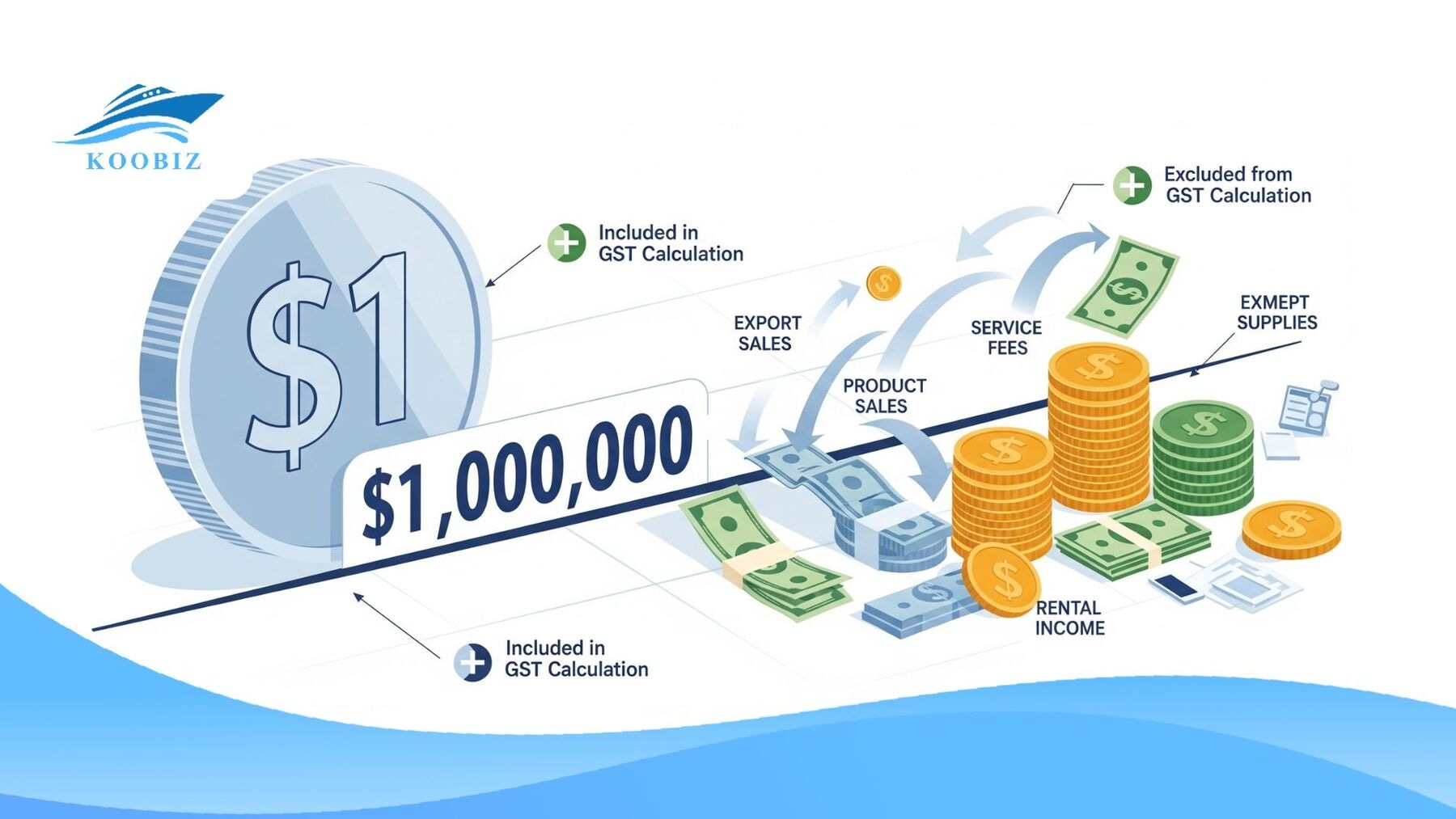
    Accurate liability assessment requires calculating your “Taxable Turnover,” not merely reviewing total bank deposits. This figure is defined by the specific inclusion of certain revenue streams and the exclusion of others.

    What Counts Towards Taxable Turnover?

    IRAS requires you to sum up the following income sources to see if you hit the S$1 million threshold:

    • Standard-Rated Supplies (9%): Most local sales of goods and services in Singapore (for example, retail purchases and consultancy fees).
    • Zero-Rated Supplies (0%): Goods exported overseas and international services provided to foreign clients.

    What is EXCLUDED from Taxable Turnover?

    Do not include these when calculating your S$1 million turnover:

    • Exempt Supplies: Financial services (such as interest income or share issues) and the sale or lease of residential properties.
    • Out-of-Scope Supplies: Sales where goods are delivered from outside Singapore to another place outside Singapore (third-country sales).
    • Sale of Capital Assets: Proceeds from selling major business assets like machinery or furniture.

    To determine whether you’ve crossed the S$1 million mark, you need precise calculations of these revenue streams. At Koobiz, we frequently help clients audit their revenue sources to avoid accidentally triggering a GST registration requirement.

    Why that registration matters: Failing to register when required is a serious offense in Singapore (penalty up to S$10,000 and 10% additional penalty). If you’re liable but don’t apply, IRAS may backdate your registration, forcing you to pay GST on past sales out of your own pocket.

    Compulsory vs. Voluntary Registration

    Compulsory registration is mandated by law based on revenue milestones, whereas voluntary registration is a strategic choice for businesses earning under the threshold.

    To help you decide or determine your obligation, here is a direct comparison of the two paths:

    Feature Compulsory Registration Voluntary Registration
    Who is it for? Businesses with taxable turnover > S$1 million. Businesses with taxable turnover < S$1 million.
    Trigger Mandated by law under the Retrospective (Annual) or Prospective view. Strategic choice by the business owner.
    Key Benefit Compliance with the law (avoids penalties). Ability to claim input tax (refunds) on business expenses.
    Key Obligation Must register within 30 days of liability notification date. Must commit to remaining registered for at least 2 years.
    New Requirement Must be ready to charge GST. Must use InvoiceNow solutions (phased implementation).
    Risk Late registration attracts backdated taxes and fines. Administrative costs and GIRO requirement.

    Retrospective View vs. Prospective View (Compulsory)

    If you’re under the compulsory regime, you use one of these tests to determine when to register:

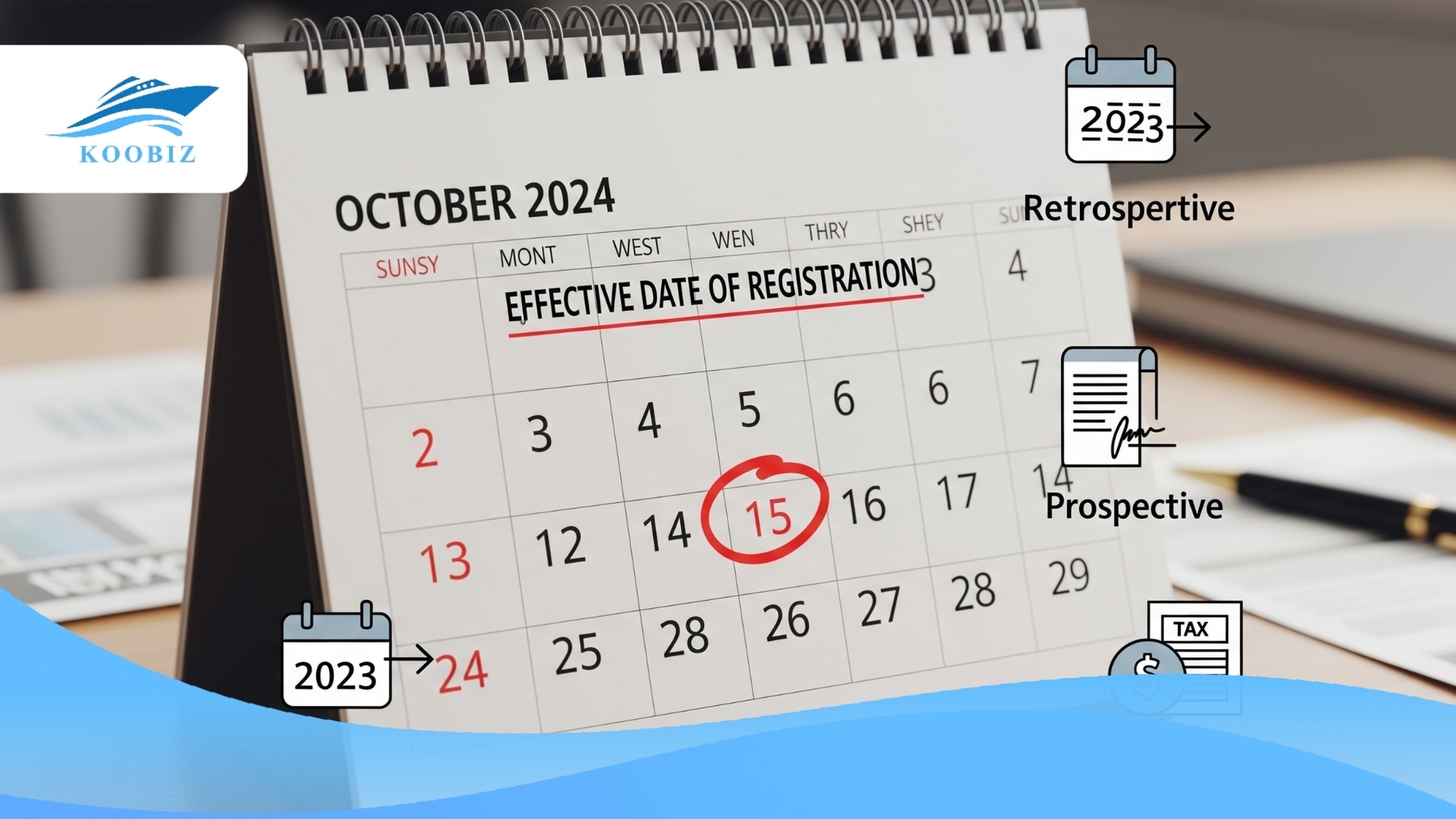
    1. Retrospective View (Annual Assessment): You must register if your taxable turnover for the calendar year (1 Jan to 31 Dec) exceeds S$1 million.
      • Deadline: You have until 30 January of the following year to apply.
      • Effective Date: You will be registered for GST on 1 March of that year.
    2. Prospective View: You must register if you reasonably expect your taxable turnover to exceed S$1 million in the next 12 months. This typically applies if you have signed a large sales contract.
      • Deadline: You must apply within 30 days of the date of your forecast/signed contract.

    Businesses can now monitor compliance more easily by reviewing the past calendar year (retrospective). For future-looking assessments (prospective), IRAS requires formal documentation like purchase orders or signed contracts to support your forecasted figures.

    Voluntary Registration Considerations

    If you’re not required to register, the decision often comes down to cost versus benefit. Voluntary registration is especially advantageous for exporters (who sell zero-rated goods but incur GST on local costs) or start-ups with significant upfront capex.

    However, voluntary registration comes with conditions: you must stay GST-registered for at least two years, comply with all filing requirements, and set up GIRO payments for taxes and refunds. Also, with the InvoiceNow mandate starting November 2025 for new companies, you’ll need a compatible accounting system to transmit invoice data to IRAS as part of your application.

    Practical Case Studies: Determining Your Liability

    Applying the abstract rules of registration to concrete business scenarios helps clarify exactly when you need to act.

    To help you visualize whether your business falls under the mandatory or voluntary brackets, let’s examine three updated scenarios based on 2026 rules.

    Scenario 1: The Retrospective Trigger (Mandatory)

    Situation: TechFlow Solutions, a software consultancy, had steady revenue. By 31 December 2025, their accumulated revenue for the calendar year reached S$1.2 million.

    Verdict: They have triggered the Retrospective View.

    Action: TechFlow must apply for GST registration by 30 January 2026. Their GST registration will be effective from 1 March 2026.

    Note: They do not need to check their turnover at the end of every quarter, only at the end of the calendar year.

    Scenario 2: The Prospective Trigger (Mandatory)

    Situation: BuildStrong Construction is a new company. On 15 July 2025, they secure a confirmed contract worth S$1.5 million.

    Verdict: They have triggered the Prospective View.

    Action: They must apply within 30 days. Under the new rules for liabilities arising after 1 July 2025, IRAS allows a grace period. While they apply in August, their effective date might be set to 1 October 2025 (approx. 2 months later), giving them time to set up their invoicing systems.

    Scenario 3: The Strategic Choice (Voluntary)

    Situation: PureExport Trading (incorporated in Jan 2026) buys goods locally and exports them to Europe. Their annual turnover is only S$800,000.

    Verdict: They are not required to register.

    Action: However, they choose Voluntary Registration in April 2026 to claim input tax refunds. Because they are applying after 1 April 2026, they must adopt an InvoiceNow-ready solution to transmit invoice data to IRAS as part of their application approval conditions.

    Prerequisites for GST Registration

    Prerequisites for GST Registration Singapore
    Prerequisites for GST Registration Singapore

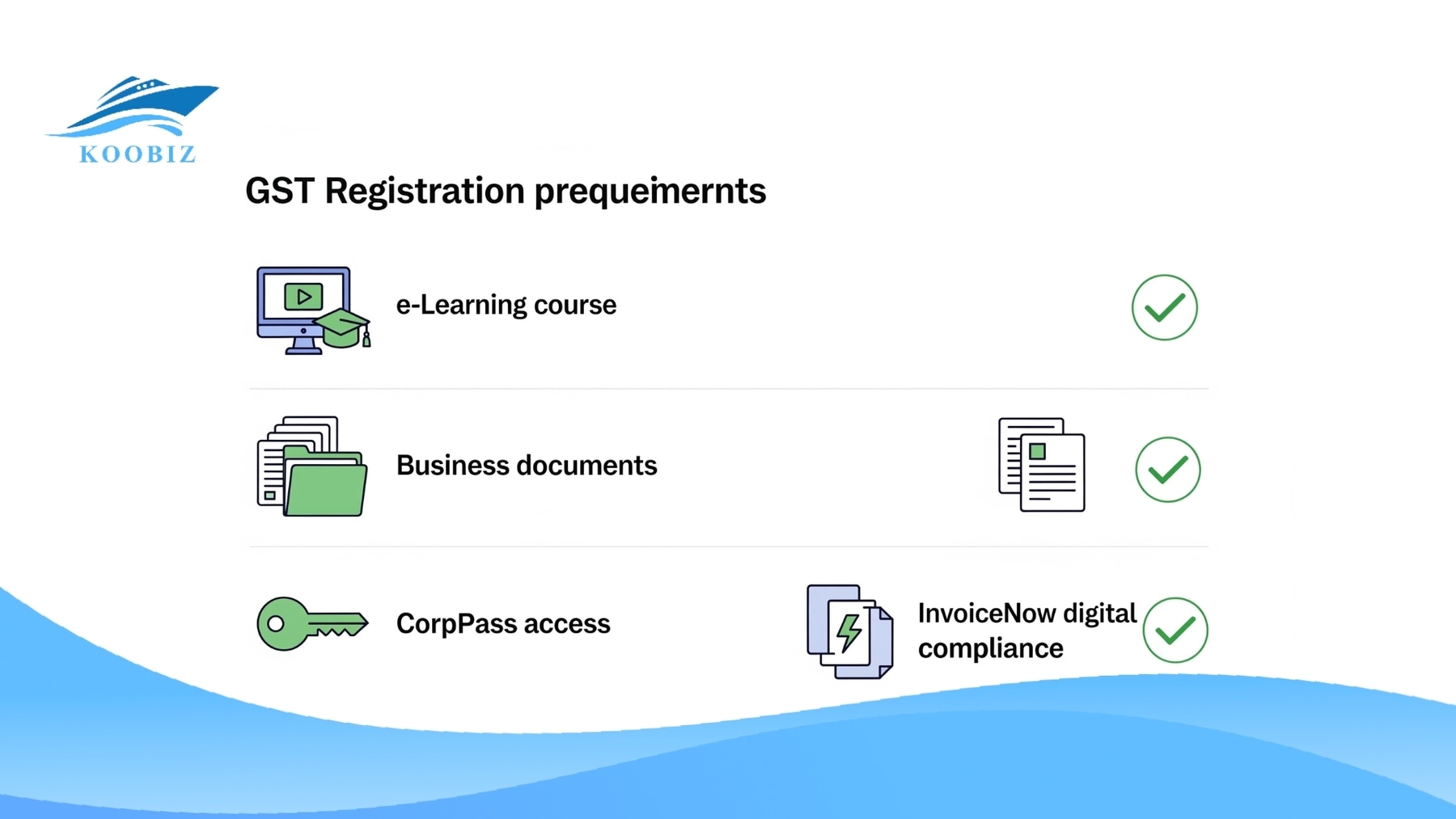
    There are three main categories of prerequisites: administrative access, business documentation, and educational requirements.

    Before logging into the portal, ensuring you have these elements ready will streamline the application process and prevent session timeouts.

    The e-Learning Course Requirement

    The most overlooked prerequisite is the “Overview of GST” e-Learning course. Business owners (sole proprietors, partners, or directors) applying under the Voluntary Registration scheme are generally required to complete this course.

    Exemptions apply if:

    • Your director/partner has already managed other GST-registered businesses, or
    • You engage a professional tax agent (like Koobiz) to handle your GST matters. Our affiliation can reassure IRAS of your compliance.

    Additional Voluntary Requirements (2026)

    • GIRO Account: You must have a GIRO application form processed or pending.
    • InvoiceNow: You must be prepared to declare your InvoiceNow-ready software details.

    By preparing your CorpPass (with “IRAS Digital Services” authorized), your ACRA Business Profile, and your bank account details for GIRO setup beforehand, you ensure a frictionless application experience.

    How to Submit Your Application via myTax Portal

    The standard method involves a digital submission via the myTax Portal, which typically takes about 15 to 20 minutes to complete if all documents are prepared.

    To guide you through the technical interface, here is the exact workflow you will encounter.

    Step 1: Logging in with CorpPass

    To begin, visit the IRAS myTax Portal (mytax.iras.gov.sg) and select “Business Tax.” You must log in using your CorpPass credentials.

    Specifically, ensure that the person logging in has been assigned the “Approver” or “Preparer” role for GST (Filing and Applications) within the CorpPass system. Without this authorization, the relevant menus will not appear. Once logged in, navigate to the menu bar, select “GST”, and then click on “Apply for GST Registration”.

    Step 2: Completing Form GST F1

    Once inside the module, you will likely be filling out Form GST F1 (Application for GST Registration). The form acts as a dynamic interview, asking for details regarding your financial year-end, turnover figures, and business activities.

    Detailed inputs required include:

    • Turnover Details: You must declare your taxable turnover.
    • Financial Year End (FYE): This determines your filing cycle (usually quarterly).
    • Industry Code (SSIC): Ensure this matches your ACRA profile.

    If you are a professional service provider or a consultant, be precise about your business description. For Koobiz clients, we handle this data entry meticulously to prevent discrepancies that could trigger an IRAS audit query.

    Step 3: Processing Time and Notification

    After submission, the standard processing time is approximately 10 working days.

    During this period, IRAS may contact you for additional information or clarification regarding your business model. Upon approval, you will receive a notification via the portal and a physical letter containing your GST Registration Number and the effective date. It is crucial to monitor your email and portal inbox during this window so you do not miss the approval notice.

    What is the Effective Date of Registration?

    Prerequisites for GST Registration and timelines
    Prerequisites for GST Registration and timelines

    The Effective Date of Registration is the specific date from which you become a taxable person and must strictly start charging GST.

    This date is legally binding and marks the boundary between your non-GST and GST eras.

    • Retrospective: Usually 1 March following the end of the calendar year.
    • Prospective: Typically the date requested, or approximately 2 months after the liability trigger date (post-July 2025 rules).
    • Voluntary: Typically the date requested or a date assigned by IRAS upon approval.

    From this exact date onwards, you must charge GST (currently 9%) on your standard-rated supplies. If you issue an invoice on the effective date without GST, you will have to absorb that tax amount yourself and pay it to IRAS.

    Claiming Pre-registration Input Tax

    GST-registered businesses can claim input tax on qualifying expenses incurred before their effective registration date.

    IRAS allows claims on:

    • Goods: Held on hand at the effective date (e.g., inventory).
    • Services: Purchased within 6 months prior to the effective date (e.g., consultancy, renovation).

    Strict documentation is required, including original tax invoices. Koobiz assists clients with these retrospective audits to maximize refunds, provided the goods haven’t been sold or consumed prior to registration.

    Special Registration Cases

    Specialized schemes exist for specific business models to simplify compliance.

    Exemption from Registration

    If your turnover exceeds S$1 million but supplies are wholly (or substantially) zero-rated (exports), you may apply for exemption. This saves administrative effort but disqualifies you from claiming input tax refunds.

    Overseas Vendor Registration (OVR)

    Overseas suppliers with global turnover >S$1 million selling >S$100,000 of digital services to Singapore consumers must register under this simplified pay-only regime.

    GST Group Registration

    Related companies can register as a single taxable group. This eliminates the need to account for GST on intra-group transactions, significantly reducing paperwork and cash flow constraints.

    Responsibilities After Registration

    Compliance involves immediate operational adjustments regarding pricing and payments.

    GST-Inclusive Pricing

    All public price displays (tags, menus, websites) must be GST-inclusive (e.g., S$109, not S$100++). Showing the breakdown is optional, but the final payable price must be clear.

    GIRO Payment Setup

    IRAS mandates GIRO for GST payments and refunds for all voluntary registrants, and strongly recommends it for compulsory registrants. Failure to set up GIRO when required can lead to penalties or cancellation of voluntary registration. Koobiz handles this setup immediately upon registration.

    Conclusion

    Registering for GST in Singapore is more than ticking a box. It’s a transition to a stricter regulatory environment that requires precise bookkeeping and timely compliance. Whether you’re compelled to register due to growing revenue or choosing voluntary registration to optimize your tax position, accuracy is essential.

    At Koobiz, we specialize in simplifying Singapore’s corporate landscape for entrepreneurs. From determining your exact liability to handling the Form GST F1 submission and managing ongoing quarterly filings, our team ensures your business remains compliant while you focus on growth.

    Ready to streamline your GST application? Visit Koobiz.com today to consult with our tax specialists about your Singapore incorporation and GST registration needs.

    Disclaimer: This guide is based on IRAS regulations as of January 2026. Tax laws are subject to change. Readers are advised to consult with professional tax advisors or refer to the latest IRAS publications before taking action.

  • Understanding “Subject to Prevailing GST” Meaning: Singapore Tax Guide (2026)

    Understanding “Subject to Prevailing GST” Meaning: Singapore Tax Guide (2026)

    [SUMMARIES]

    Definition: “Subject to prevailing GST” means the advertised price excludes tax; the 9% Goods and Services Tax is added at the final bill.

    Current Rate: The GST rate in Singapore is stable at 9% for 2026, based on current government announcements.

    Calculation Logic: For F&B “++” pricing, GST is calculated on the sum of the base price plus the 10% service charge.

    Business Rationale: Companies use this clause in contracts to “future-proof” agreements against potential policy changes without renegotiation.

    [/SUMMARIES]

    The phrase “subject to prevailing GST” on Singapore invoices or menus simply means the listed price excludes tax, with the current 9% Goods and Services Tax added at payment. Whether you are calculating a “++” restaurant bill or drafting future-proof contracts, understanding this term is key to accurate costing. Koobiz, your trusted partner for Singapore incorporation and tax services, explains its meaning, the stable 2026 rate, and the correct calculation methods.

    What Does “Subject to Prevailing GST” Mean?

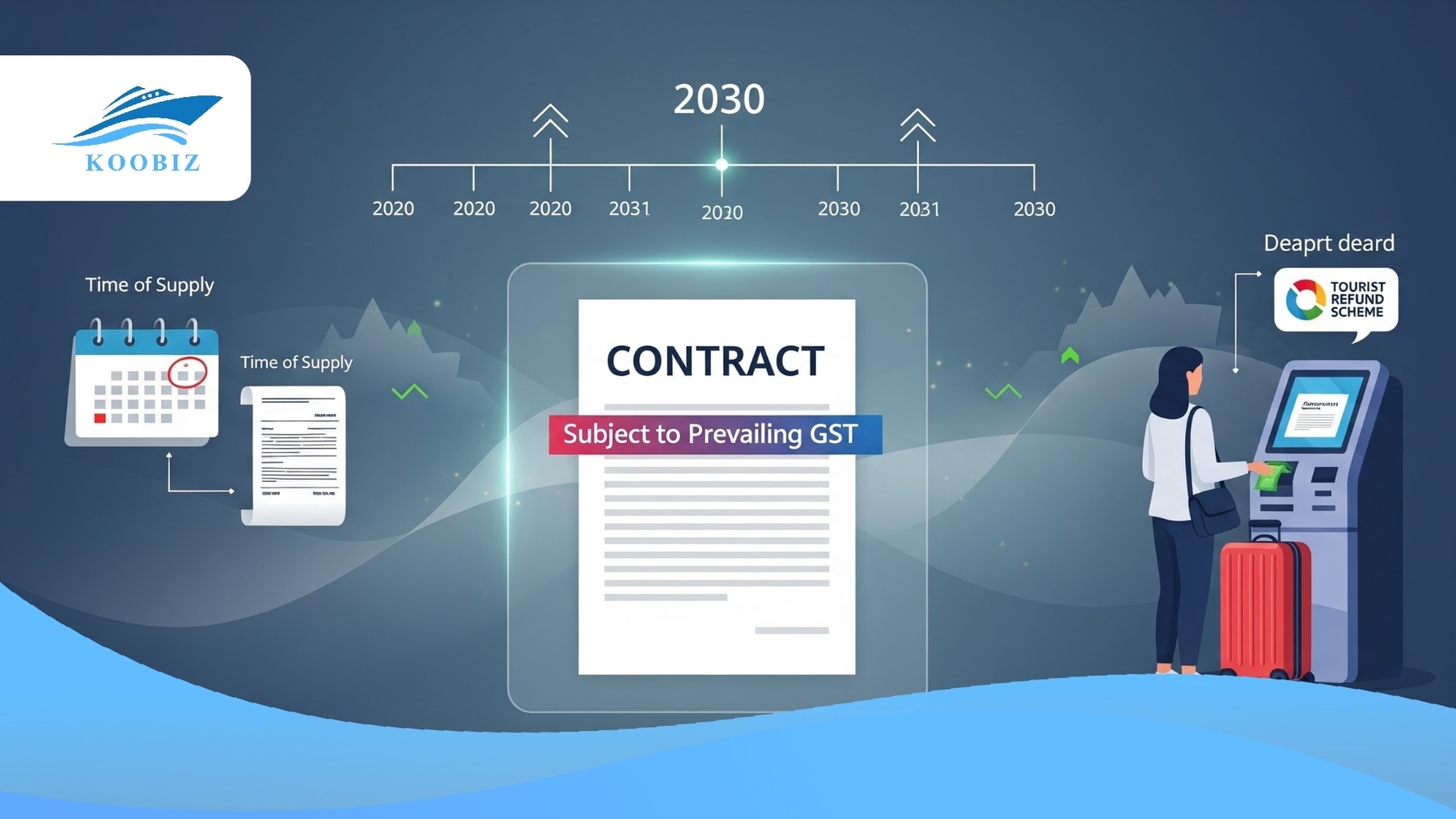
    GST: The original price of $100 increases to $109.90 after tax
    GST: The original price of $100 increases to $109.90 after tax

    “Subject to prevailing GST” is a pricing condition defining that the listed cost is exclusive of tax, and the final payable amount will include the Goods and Services Tax rate effective at the specific time of supply.

    Key features include: the GST rate applied is the one effective when the transaction is completed or invoiced; the tax liability is determined at payment rather than contract date; and any future GST increase is passed to the buyer, not absorbed by the seller. This pricing model is commonly used by hotels, higher-end restaurants, and professional service providers.

    This differs from “nett” pricing-typical in hawker centres and retail – where the displayed price is final. For international entrepreneurs working with Koobiz, understanding this distinction is fundamental to accurate and compliant financial planning in Singapore.

    The current GST rate in 2026: Is it still 9%?

    Yes, the prevailing GST rate in Singapore remains stable at 9% throughout 2026, maintaining the ceiling established after the final scheduled hike in 2024.

    To provide context, here is the timeline of recent and projected GST rate adjustments:

    Period GST Rate Status
    Before 2023 7% Historical Rate
    Jan 1, 2023 8% 1st Stage Increase
    Jan 1, 2024 9% 2nd Stage Increase
    2025 – 2030 9% Current & Stable*

    *Note: Stability is based on current government projections and is subject to economic conditions.

    Although “prevailing” suggests variability, the GST rate for 2026 is effectively fixed. Current government guidance indicates no further GST increases are expected before 2030, though policy changes may still arise through future Budgets or major economic developments.

    This stability provides a reliable planning baseline and removes the uncertainty seen during the 2023–2024 transition. Nonetheless, invoices and contracts will continue to reference the “prevailing rate” for legal accuracy. For Koobiz clients, our accounting team ensures all invoices correctly apply the 9% GST, keeping you fully compliant with IRAS requirements.

    How to calculate the final bill (The “++” Rule)

    Calculating a $100++ bill: 10% Service Charge, 9% Compounded GST, Total $119.90
    Calculating a $100++ bill: 10% Service Charge, 9% Compounded GST

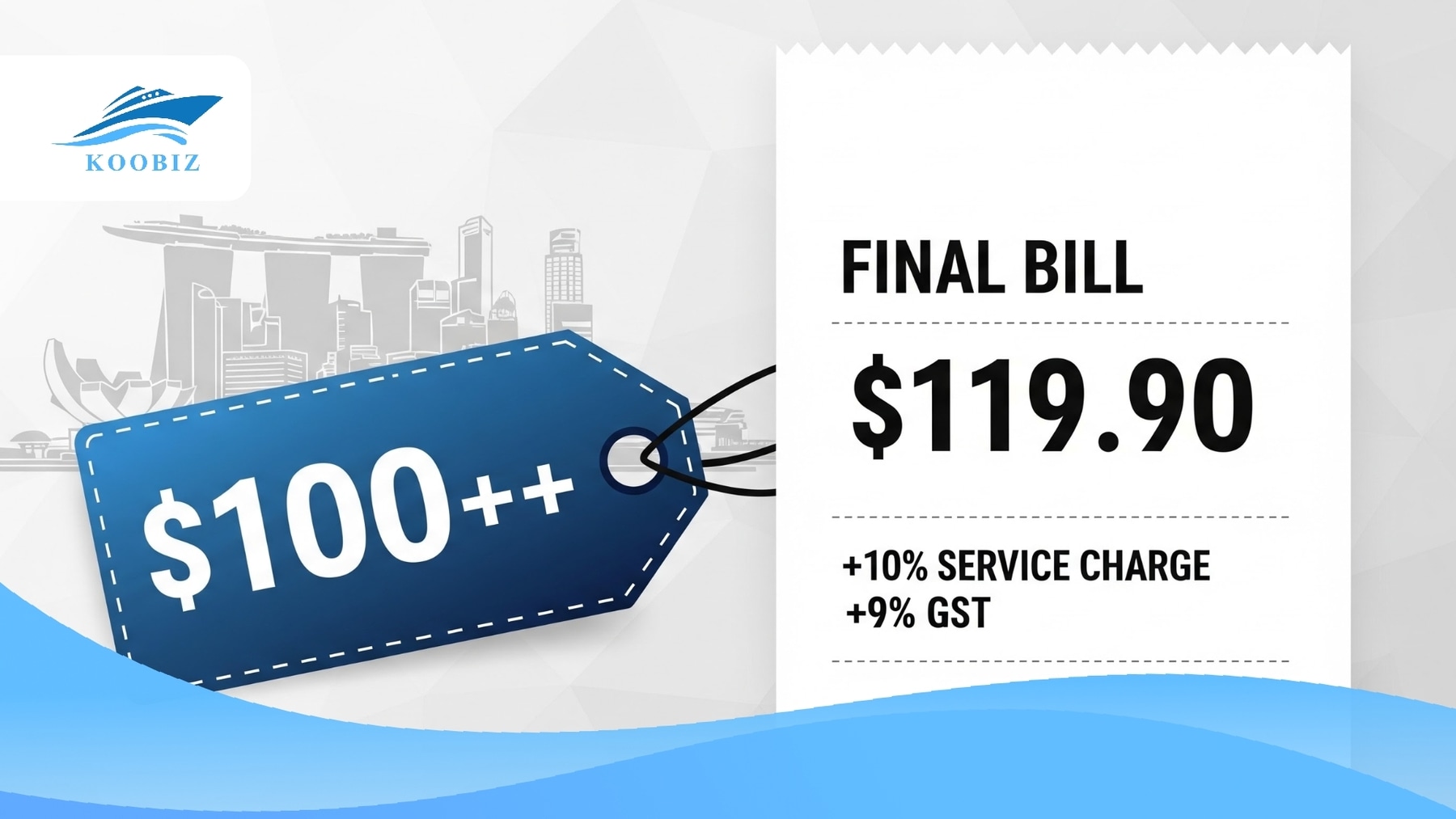
    To calculate the final bill under the “++” (Plus Plus) pricing model, you must first apply the 10% service charge to the base price, and then calculate the 9% GST on that combined total.

    Many consumers and even some new business owners make the mistake of calculating the 10% service charge and the 9% GST separately on the base price. This is incorrect. In Singapore’s F&B and hotel sectors, GST is a tax on the value of the service provided, and the service charge is considered part of that value. Therefore, the tax is compounded.

    The Breakdown of “++”:

    1. First “+” (Service Charge): 10% of the menu price.
    2. Second “+” (GST): 9% of the (Menu Price + Service Charge).

    Mathematical Formula:

    Final Bill = (Base Price x 1.10) x 1.09

    Let’s illustrate this with a concrete example for 2026.

    If you order a meal listed at SGD 100++:

    • Step 1: Calculate Service Charge: $100 x 10% = $10.
      • Subtotal: $110.
    • Step 2: Calculate Prevailing GST (9%) on the Subtotal: $110 x 9% = $9.90.
    • Final Payable Amount: $100 + $10 + $9.90 = $119.90.

    If you simply added 10% and 9% to the base ($19 total), you would calculate a final bill of $119.00, which is short by $0.90. While small on a single meal, for businesses processing thousands of transactions, this calculation error can lead to significant tax filing discrepancies. Koobiz advises all F&B clients to configure their Point-of-Sale (POS) systems to adhere strictly to this compounding logic to satisfy IRAS audit requirements.

    “GST Inclusive” vs. “Subject to GST”: Visual Comparison

    “GST-inclusive” pricing shows the final amount payable upfront, while “subject to GST” displays a base price that increases at payment. This is not merely a pricing choice but an IRAS-regulated requirement.

    In general, retailers such as supermarkets and fashion stores must display GST-inclusive prices, while the “subject to GST” model is permitted mainly in the F&B and hotel sectors where service charges apply.

    Feature GST Inclusive (Nett) Subject to Prevailing GST (++)
    Industry Retail, Hawkers, Transport Hotels, Restaurants, B2B Services
    Transparency High: What you see is what you pay Low: Final price is higher than listed
    Psychology “Honest” pricing “Optical” pricing (appears cheaper)
    Calculation Price includes the 9% tax component Tax added on top of the price

    For instance, shoes priced at $109 nett generate $100 in revenue, with $9 remitted as GST. By contrast, a $100 fee quoted “subject to GST” results in a total charge of $109 to the client.

    This distinction is critical for cash flow management. For Koobiz retail clients, we ensure price displays comply with GST-inclusive rules to avoid consumer protection breaches. For B2B clients, quoting fees “subject to GST” remains the standard approach to safeguard margins.

    Why do contracts still use “Prevailing Rate” if the rate is stable?

    Contracts use 'prevailing GST' to safeguard against tax hikes after 2030
    Contracts use ‘prevailing GST’ to safeguard against tax hikes after 2030

    Businesses retain the “prevailing GST” clause in long-term contracts to future-proof agreements against post-2030 legislative changes without renegotiation. While the rate is stable at 9% in 2026, leases or service retainers often span many years.

    If a contract were to state “plus 9% GST” and the rate later increased, the supplier could be forced to absorb the difference. Using “subject to prevailing GST” allows the contract to automatically reflect the legally applicable rate at invoicing, protecting margins. At Koobiz, we routinely review for this clause when drafting or vetting contracts to safeguard clients from future tax exposure.

    Time of supply rules (General application)

    The “Time of Supply” rules determine which prevailing GST rate applies, based on the earlier of the invoice date or the payment date. This tax point is decisive, regardless of when a contract was signed or work commenced.

    For example, a contract signed in December 2025 but invoiced in January 2026 is subject to the January 2026 rate of 9%. For high-volume businesses, errors in identifying the Time of Supply can result in under-declared GST. Koobiz accounting services help audit these timelines to ensure accurate and compliant GST returns.

    Tourist refunds & export exceptions

    The “subject to prevailing GST” rule mainly applies to domestic consumption, but international visitors can offset this cost through the Tourist Refund Scheme (TRS). Tourists may reclaim the 9% GST (less a handling fee) on eligible purchases above $100 from participating retailers when goods are taken out of Singapore – an important mechanism for the retail and luxury sectors.

    Likewise, B2B exports are zero-rated, meaning exported goods are subject to 0% GST. Understanding these exceptions can deliver significant savings for both businesses and visitors.

    Real-World Case Studies: Putting It All Together

    To help you visualize how “Subject to Prevailing GST” applies in daily life and business, here are three common scenarios you might encounter in Singapore.

    Case Study 1: The Company Annual Dinner (F&B “++”)

    Scenario: You are hosting a company dinner at a hotel restaurant. The menu price is listed as $1,000++.

    The Confusion: You budget $1,190, assuming you just add 10% and 9% ($190) to the bill.

    The Reality: The restaurant charges the 10% Service Charge first ($100), creating a subtotal of $1,100. The 9% GST is then applied to this $1,100, which is $99 (not $90).

    Final Bill: $1,199.00.

    Lesson: Always account for the compounding effect when budgeting for corporate events.

    Case Study 2: The 5-Year Office Lease (Contract Clauses)

    Scenario: A startup signs a 5-year office rental agreement in 2026. The monthly rent is stated as “$5,000 subject to prevailing GST.”

    The Logic: The landlord uses this clause even though the rate is stable at 9%. If the government unexpectedly raises the GST to 10% in 2029, the startup will automatically pay $5,500 (Rent + 10%) starting that month.

    Lesson: The clause protects the landlord from absorbing future tax hikes. As a tenant, this means your costs could theoretically rise if tax laws change, without the lease being renegotiated.

    Case Study 3: The Cross-Year Consultant (Time of Supply)

    Scenario: A consultant completes a project in December 2025 but issues the invoice in January 2026.

    The Application: Even though the work was finished in 2025, the Time of Supply is triggered by the invoice date (January 2026). Therefore, the GST rate applicable is the one prevailing in January 2026.

    Lesson: While the rate is 9% in both years, this rule is critical for accurate tax filing. The consultant must declare this revenue in their 2026 GST return, not 2025.

    Conclusion

    Understanding the phrase “Subject to Prevailing GST” is more than just a math exercise; it is about navigating the legal and financial norms of Singapore’s vibrant economy. In 2026, while the rate is stable at 9%, the implications of calculation methods and contractual phrasing remain vital for financial health. Whether you are calculating the cost of a business dinner or drafting a ten-year lease agreement, clarity on these terms prevents unexpected costs and ensures compliance.

    About Koobiz

    Navigating Singapore’s tax and corporate landscape can be complex, but you don’t have to do it alone. Koobiz is your premier partner for Singapore company incorporation, corporate secretary services, and opening corporate bank accounts in Singapore. Our team of experts also provides comprehensive accounting, tax, and auditing services to ensuring your business stays compliant with IRAS regulations while optimizing your tax position.

    Ready to start or grow your business in Singapore? Visit koobiz.com today for a consultation.

    Disclaimer: This guide is provided for general informational purposes only and does not constitute professional legal or tax advice. While all information is accurate based on IRAS announcements as of January 2026, tax regulations are subject to change. Readers should consult with IRAS or a qualified tax professional at Koobiz for advice specific to their business situation.

  • Maximizing Progressive Wage Credit Scheme (PWCS) Payouts: 2026 Guide

    Maximizing Progressive Wage Credit Scheme (PWCS) Payouts: 2026 Guide

    [SUMMARIES]

    Single-Tier Support: For 2026, PWCS has been streamlined to a Single Tier covering gross monthly wages up to $3,000 at a flat 20% co-funding rate.

    Automatic Payouts: Payouts are automatic, calculated by IRAS using your CPF data.

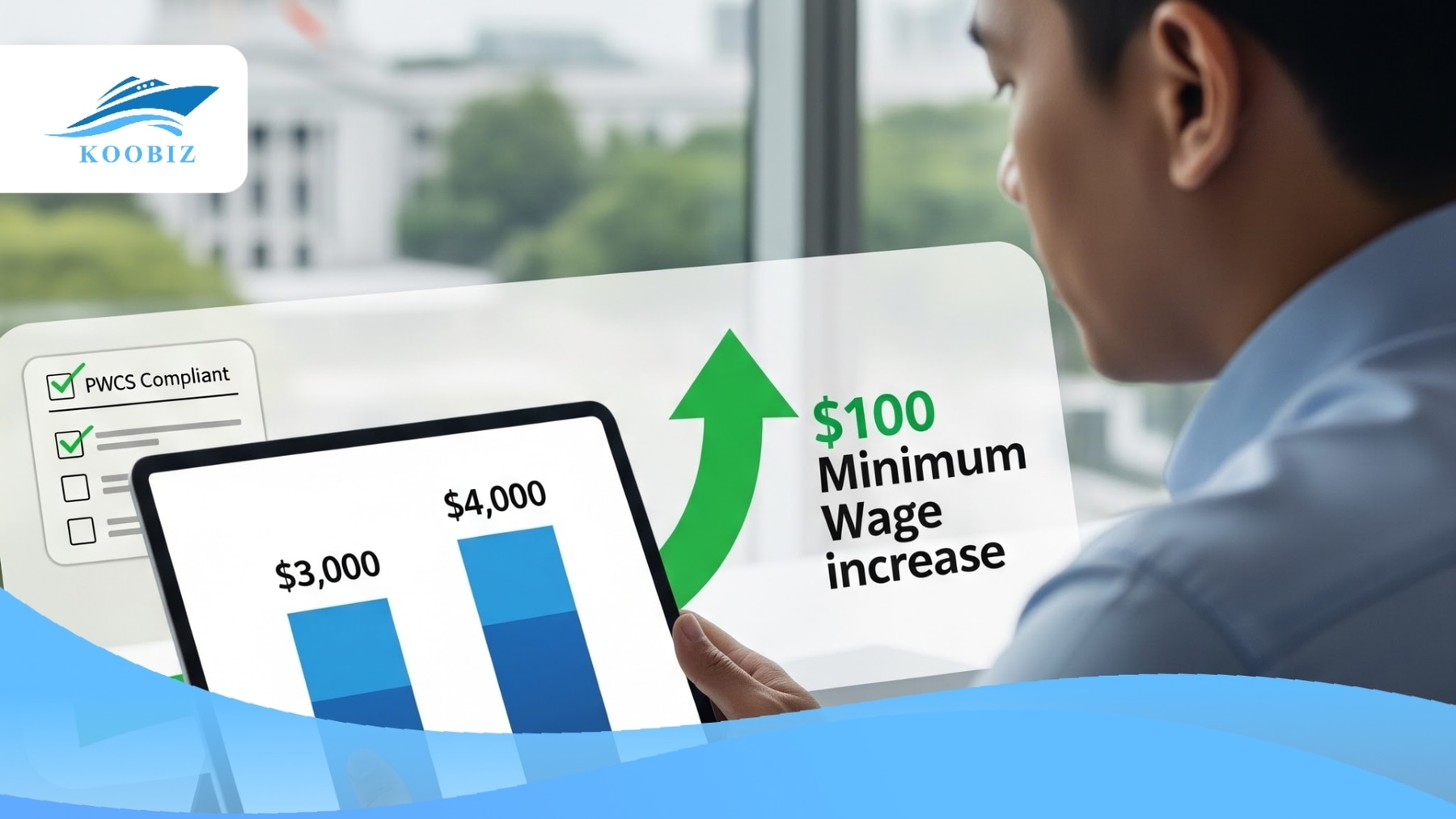
    Wage Cap Rule: To qualify, the employee’s post-increase average gross monthly wage must be below $4,000. If the wage falls between $3,000 and $4,000, co-funding is capped at the $3,000 portion.

    Qualifying Criteria: Only Singapore Citizens and PRs with a minimum average gross wage increase of $100 qualify. Employees generally must be existing staff with a baseline wage in 2025.

    Compliance is Key: Increases must be genuine and sustained to avoid penalties.

    [/SUMMARIES]

    Rising manpower costs remain a top challenge for Singapore SMEs. The Progressive Wage Credit Scheme (PWCS) offers a vital solution, providing government co-funding to offset wage increases. For 2026, understanding this final year of the scheme is key to getting the most support.

    At Koobiz, we help businesses navigate complex grant rules so you don’t leave money on the table. This guide explains the 2026 PWCS in simple terms—how it works, who qualifies, and how to ensure you receive your full payout without any issues, covering the Single Tier rate. What is the Progressive Wage Credit Scheme (PWCS) in 2026?

    PWCS 2026 Wage Support: Salary up to 3K SGD, 20% co-funding
    PWCS 2026 Wage Support: Salary up to 3K SGD, 20% co-funding

    The Progressive Wage Credit Scheme (PWCS) is a transitional wage support mechanism introduced by the Singapore government to co-fund wage increases for lower-to-middle income employees.

    This scheme serves as a financial cushion for employers as they transition to the mandatory Progressive Wage Model (PWM) across different sectors. Unlike broader past schemes, PWCS is highly targeted. In 2026, its defining feature is a focus on lifting the income bands up to $3,000, incentivizing employers to share productivity gains with their workers.

    Key Highlights for 2026:

    • Targeted Support: Co-funds wage increases for employees earning up to a gross monthly wage of $3,000.
    • Single Tier Rate: Offers a consolidated support rate of 20% for the 2026 qualifying year.
    • Automatic & Final: Payouts are auto-calculated and sent to you. As of now, 2026 is the last year of the scheme.

    The scheme enables the government to co-fund a substantial share of the wage increases for eligible employees. For employers, this means that for every dollar you raise a worker’s salary (within the qualifying limits), the government reimburses a portion of that increase, thereby reducing the overall cost of retaining staff.

    Which Employees Qualify for PWCS Payouts?

    PWCS Eligibility Criteria in Singapore
    PWCS Eligibility Criteria in Singapore

    To qualify, employees must meet strict Citizenship, CPF, and Wage Threshold criteria, including a specific cap on post-increase wages.

    At Koobiz, we frequently observe clients losing out on claims due to administrative oversights—such as delays or errors in updating PR status or CPF payment deadlines. To help your business capture every eligible dollar, please verify your workforce against this detailed checklist:

    1. Singapore Citizen or Permanent Resident (PR): The employee must be a Singapore Citizen or PR.
    2. Valid CPF History (Existing Baseline): Should have worked for you and received CPF contributions for at least 3 calendar months in the preceding year (2025). (It’s for retaining staff, not new hires).
    3. Mandatory CPF Contributions: You must have paid the mandatory CPF contributions for the employee by the stipulated deadline (usually 14th January of the following year). Late payments can disqualify the employee for the entire qualifying year.
    4. Wage Ceilings (The “Cliff” vs. The “Cap”):
      • Co-Funding Ceiling ($3,000): The government only co-funds the portion of the wage up to $3,000.
      • Eligibility Cap ($4,000): The employee’s average wage after the increase must be below $4,000. This is the most important rule.
      • If their new wage is between $3,000 and $4,000, they are still eligible, but only on the portion up to $3,000.
      • If their new wage hits $4,000 or above, they do not qualify at all.
    5. Minimum Wage Increase: Must have received an average gross monthly wage increase of at least $100 in 2026 compared to 2025.

    What is “Average Gross Monthly Wage”?

    It is not just the basic salary. It is calculated as the total annual wages (including basic salary, overtime, and bonuses, but excluding employer CPF) divided by the number of months CPF contributions were paid.

    2026 Co-Funding Rates: Consolidated Wage Support

    For the 2026 qualifying year, the government has streamlined the scheme into a Single Tier of support, covering all eligible employees earning up to $3,000.

    Unlike 2024, which distinguished between Tier 1 ($2,500) and Tier 2 ($3,000), the 2026 framework applies a unified co-funding rate for the entire qualifying income band.

    Table: PWCS Co-Funding Levels (Historical & Current)

    Qualifying Year Wage Tier Gross Monthly Wage Ceiling Co-Funding Rate
    2026 Single Tier Up to $3,000 20%
    2025 Single Tier Up to $3,000 40%
    2024 Tier 1 Up to $2,500 50%
    Tier 2 > $2,500 to $3,000 30%

    Understanding the Transition:

    • Single Tier (2026): All eligible employees earning up to $3,000 attract the 20% co-funding rate on their qualifying wage increase.
    • Historical Context: The table illustrates the shift from the multi-tiered approach in 2024 to the consolidated single tier in 2025 and 2026. This simplifies calculations for employers.

    The “Compounding” Effect:

    It is important to note that PWCS supports sustained wage increases. This means if you gave a wage increase in 2025 (which attracted 40% co-funding), that same increase is co-funded again in 2026 at the 20% rate, provided the wage increase is sustained.

    How is the PWCS Payout Calculated?

    The PWCS payout is calculated by multiplying the Qualifying Wage Increase by the applicable Co-Funding Rate, prorated for the number of months CPF was paid.

    IRAS uses a fair method based on Average Gross Monthly Wage (AGMW), not just one month’s salary.. Follow this step-by-step breakdown to estimate your 2026 payout:

    Step 1: Determine the Average Gross Monthly Wage (AGMW)

    • AGMW 2025: Total Wages in 2025 ÷ Months of CPF in 2025.
    • AGMW 2026: Total Wages in 2026 ÷ Months of CPF in 2026.

    Step 2: Calculate the Qualifying Wage Increase

    • Formula: AGMW 2026 – AGMW 2025.
    • Condition: This result must be ≥ $100.

    Step 3: Apply the 2026 Co-Funding Rate

    Multiply the qualifying increase by the 2026 Single Tier rate of 20%.

    • Note: If AGMW 2026 > $3,000, cap the wage at $3,000 for calculation purposes.
    • Calculation: (Capped Wage – AGMW 2025) x 20% = Support per month.

    Step 4: Calculate the Total Annual Payout

    Multiply the monthly support by the number of months CPF contributions were paid in the qualifying year (2026).

    Step 5: Account for Sustained Increases

    If you gave an increase in 2025 that was sustained into 2026, you may receive additional co-funding on that historical increase at the 2026 rate (20%), further boosting your total payout.

    Real-World Case Studies: Calculating Your 2026 Payout

    To help you visualize the potential returns, here are four scenarios illustrating how the 2026 Single Tier rates apply to different employee profiles.

    Disclaimer: These calculations assume full-year employment. For partial years or variable wages, the “Average Gross Monthly Wage” formula applies.

    Case Study 1: The Standard Increase

    • Situation: Employee A had an average wage of $2,500 in 2025. In 2026, you increased this to $2,800.
    • Qualifying Increase: $300 (Formula: $2,800 – $2,500).
    • Calculation: $300 (Increase) x 20% (2026 Rate) = $60 per month.
    • Total Annual Payout: $60 x 12 months = $720.

    Case Study 2: The “Sustained” Boost

    • Situation: Employee B received a raise in 2025, moving from $2,000 (in 2024) to $2,200 (in 2025). In 2026, their salary remains at $2,200 (no new increase).
    • Qualifying Increase: $200 (The increase from 2024 to 2025 is “sustained”).
    • Calculation: $200 (Sustained Increase) x 20% (2026 Rate) = $40 per month.
    • Total Annual Payout: $40 x 12 months = $480.

    Case Study 3: The “In-Between” Earner (Partial Coverage)

    • Situation: Employee C earned $2,800 in 2025. You give a raise to $3,200 in 2026.
    • Eligibility Check: The post-increase wage ($3,200) is below the $4,000 cap, so the employee is Eligible.
    • Wage Cap Application: Since the new wage exceeds the $3,000 co-funding ceiling, you only calculate the increase up to $3,000.
    • Qualifying Increase: $3,000 (Cap) – $2,800 (Baseline) = $200 (not the full $400 actual increase).
    • Calculation: $200 x 20% = $40 per month.
    • Total Annual Payout: $40 x 12 months = $480.

    Case Study 4: The Ineligible High Earner (The $4,000 Cap)

    • Situation: Employee D earned $3,500 in 2025. You give a significant raise to $4,100 in 2026.
    • Outcome: Even though the increase is >$100, the post-increase average wage ($4,100) exceeds the $4,000 eligibility cap.
    • Total Payout: $0. The employee is ineligible for PWCS.

    Is Application Required for PWCS?

    PWCS automatically pays out according to IRAS CPF data
    PWCS automatically pays out according to IRAS CPF data

    No, employers do not need to apply for PWCS; the payouts are computed automatically by the Inland Revenue Authority of Singapore (IRAS) based on CPF contribution data.

    This automation reduces administrative friction, letting business owners concentrate on operations instead of paperwork. However, “automatic” does not mean “effortless.” There are prerequisites you must have in place to ensure the funds actually reach your bank account.

    Key Requirements for Automatic Payout:

    • GIRO or PayNow Corporate: Ensure you have a valid GIRO or PayNow Corporate account linked to your business UEN. IRAS no longer issues cheques for these grants. If you haven’t set this up, Koobiz can assist with opening the necessary corporate banking accounts and linking them to government agencies..
    • Timely CPF: As noted earlier, CPF contributions must be paid on time. Retroactive payments made after the deadline typically do not qualify for the scheme.

    Payout Timeline:

    Eligible employers will receive a notification from IRAS (usually via letter or the myTax Portal) detailing the payout amount. Payouts for the 2026 qualifying year are expected to be disbursed by Q1 2027.

    Strategic Considerations & Compliance for Employers

    Employers must balance the pursuit of maximum payouts with strict adherence to “genuine wage increase” principles to avoid audits and penalties.

    Navigating compliance is critical. Below are the key areas to watch:

    1. Key Exclusions

    Not all employees qualify. To prevent conflicts of interest, the following are excluded:

    • Business Owners & Directors: Sole proprietors, partners, and directors who are also shareholders.
    • Related Parties: Family members of owners are scrutinized. Unless their employment and salary are at “arm’s length” (market rate for genuine work), they are excluded.
    • Shell Companies: Entities without active trade in Singapore.

    2. Interaction with Other Schemes (JGI & SEC)

    PWCS works alongside the Jobs Growth Incentive (JGI) and Senior Employment Credit (SEC), but you cannot “double dip.” The government applies a Net Benefit Rule, capping total support across schemes. Overpayments from one scheme may be offset against your PWCS payout.

    3. Avoiding “Wage Jumping”

    IRAS uses analytics to detect “wage jumping”—artificially inflating wages to claim subsidies and dropping them later.

    • Red Flags: Drastic, short-term hikes or salaries inconsistent with market rates.
    • Consequences: Denial of payouts, clawbacks, and penalties up to 400% or imprisonment.

    4. Handling Disputes

    If your payout is lower than expected, you have a two-month window to appeal via the myTax Portal. Ensure you verify your CPF data and check for exclusions (like the $4,000 cap or related party status) before submitting employment contracts and payslips as proof.

    Conclusion

    The Progressive Wage Credit Scheme (PWCS) represents a significant opportunity for Singapore businesses to offset the costs of talent retention in 2026. By understanding the Single Tier structure, verifying eligibility against the $4,000 cap, and maintaining strict compliance, you can turn a mandatory cost increase into a strategic advantage.

    At Koobiz, we specialize in helping businesses navigate the complexities of the Singaporean corporate environment. Whether you need assistance with company incorporation, opening a corporate bank account, or managing your tax and accounting to ensure full compliance with grant requirements, our team is ready to support you. Don’t let administrative hurdles stop you from maximizing your benefits.

    Contact Koobiz today to streamline your corporate operations and ensure you never miss a government incentive.

  • Maximize Your Self Employed CPF Contribution: Mandatory MediSave & Tax Relief for Freelancers

    Maximize Your Self Employed CPF Contribution: Mandatory MediSave & Tax Relief for Freelancers

    [SUMMARIES]

    Mandatory Obligation: If you’re a Singapore Citizen or PR and your Net Trade Income (NTI) exceeds S$6,000 per year, you are required by law to contribute a percentage to your CPF MediSave Account (MA). This secures your basic healthcare coverage.

    Tax Efficiency: You can choose to contribute more money to all three of your CPF accounts (Ordinary, Special, and MediSave). This is optional but highly strategic—it boosts your retirement savings, can help you qualify for a housing loan, and offers significant tax benefits. The relief is capped at the CPF Annual Limit (SGD 37,740) or 37% of NTI. Note: RSTU tax relief (up to SGD 16,000) is separate.

    Contribution Rates: The percentage you pay to MediSave depends on your age and income. It ranges from 4% to 10.5% of your NTI. Generally, the older you are, the higher the rate.. For 2025, The maximum income used to calculate your contributions has increased to S$88,800 per year.

    Payment Flexibility: While lump-sum payments are standard, GIRO instalment plans are available to manage cash flow.

    Strategic Planning: Differentiating between mandatory MediSave (healthcare only) and voluntary 3-account contributions (housing/retirement) is key to utilizing CPF as an asset class.

    [/SUMMARIES]

    Managing your Self-Employed CPF Contribution is important for staying legal and saving money in Singapore. For freelancers and sole proprietors, CPF is not just a rule—it’s a smart move to lower taxes and earn safe interest. At Koobiz, we make this process easy, helping you turn rules into financial benefits.

    This guide explains your Mandatory MediSave obligations for 2025 and practical steps to use CPF for the best Tax Relief. It covers how to calculate Net Trade Income and how to optimize voluntary top-ups, giving you a clear plan to secure your financial future while remaining compliant.

    Are You Required to Pay CPF as a Self-Employed Person?

    Yes, you are required to pay CPF contributions specifically to your MediSave Account if you are a Singapore Citizen or Permanent Resident and earn an annual Net Trade Income (NTI) exceeding SGD 6,000.

    To figure out your obligation, there are three key conditions:

    • Citizenship: Foreigners working as freelancers on an Employment Pass or S-Pass are not covered by this scheme.
    • Income: The NTI must be exactly SGD 6,000 or more. If it’s below 6,000, the contribution is voluntary.
    • Self-employment: You must run your own trade, business, profession, or vocation. This is different from being an employee, where your employer handles CPF.

    If you don’t meet these rules, you could face penalties. Koobiz urges all clients to avoid penalties by checking these requirements on time.

    Illustration of self-employed: designer, driver, stall owner
    Illustration of self-employed: designer, driver, stall owner

    A Self-Employed Person (SEP) is defined broadly and includes:

    • Freelancers (writers, designers, consultants)
    • Hawkers and stall owners
    • Taxi drivers and private-hire car drivers
    • Commission agents (like property or insurance agents)
    • Private tutors and coaches

    What Is the Mandatory MediSave Contribution Rate for 2025?

    The Mandatory MediSave Contribution Rate for 2025 is a tiered percentage of your Net Trade Income, ranging from 4% to 10.5%, determined by your age group and income band.

    Understanding these rates matters because SEPs (self-employed people) don’t have fixed rates like employees. SEP rates are progressive, meaning they go up with age and with income. Older individuals need more healthcare savings, so the rate increases as you get older, and the rate also rises with higher NTI.

    Important Update for 2025: The contribution percentages stay the same, but the maximum annual income used to calculate contributions has risen to SGD 88,800 (up from the previous cap of SGD 6,800 per month).

    Here is the general breakdown of the contribution rates for SEPs based on age and income (assuming NTI > SGD 18,000 for maximum tier):

    1. Age 35 and below: Capped at 8% of NTI.
    2. Age 35 to 45: Capped at 9% of NTI.
    3. Age 45 to 50: Capped at 10% of NTI.
    4. Age 50 and above: Capped at 10.5% of NTI.

    Note: For NTI between SGD 6,000 and SGD 18,000, lower phase-in rates apply.

    How to Calculate and Declare Your Net Trade Income (NTI)

    The method to calculate and declare NTI involves three key steps: deducting allowable business expenses from your gross revenue, filing your income tax return with IRAS, and awaiting the Notice of Computation (NOC).

    This process is the basic workflow that links your business activity to the CPF Board. If you don’t declare your NTI correctly, the CPF Board can’t determine how much you must pay into MediSave, which could lead to penalties or missed tax relief opportunities.

    Step 1: Calculate Net Trade Income

    Your NTI is simply your Gross Trade Income minus Allowable Business Expenses.

    • Gross Trade Income: The total amount earned from your business or vocation.
    • Allowable Business Expenses: Costs incurred strictly for earning income (e.g., equipment, rental, transport). Alternatively, qualifying SEPs can opt for the Fixed Expense Deduction Ratio (FEDR) to simplify claims.

    Step 2: File with IRAS

    You must declare your NTI to the Inland Revenue Authority of Singapore (IRAS) during the annual tax filing exercise (typically between March and April).

    • Log in to the myTax Portal using Singpass.
    • Fill in Form B (for business owners) or Form B1.
    • Koobiz Tip: Ensure your classification code is correct to avoid administrative errors.

    Step 3: Receive Notice of Computation (NOC)

    Once IRAS assesses your income, they will transmit the NTI data to the CPF Board.

    • The CPF Board will then send you a Notice of Computation (NOC) stating the exact amount of MediSave payable.
    • You generally have 30 days from the date of the NOC to make the payment.

    Comparison: Mandatory MediSave vs. Voluntary CPF Top-Ups

    Mandatory MediSave focuses strictly on basic healthcare security, whereas Voluntary CPF Top-Ups allow you to allocate funds to all three accounts (OA, SA, MA) to optimize interest accumulation and housing eligibility.

    While following the rules only requires the MediSave contribution, improving your financial health usually means going beyond the minimum. The comparison below shows why many successful freelancers choose to contribute more than what’s required.

    Feature Mandatory MediSave Voluntary CPF Contribution (VC)
    Destination 100% goes into the MediSave Account (MA). Split between Ordinary (OA), Special (SA), and MediSave (MA) accounts.
    Purpose Hospitalization, approved medical insurance (MediShield Life). Housing (OA), Retirement (SA), and Healthcare (MA).
    Interest Rate (2025) 4.0% p.a. (Floor rate). Blended. OA earns 2.5%, while SA and MA earn 4.0%.
    Flexibility / Advantage Low. Funds are strictly locked for medical use. High. Crucial for SEPs who want to buy an HDB flat or invest using CPF OA funds.

    However, you must be aware of the Annual Limit. The total mandatory + voluntary contributions cannot exceed the CPF Annual Limit (currently SGD 37,740 per year). Exceeding this will result in the refund of the excess amount without interest.

    How Does CPF Contribution Reduce Your Income Tax?

    Reduce income tax from CPF, limited to 37% of NTI or SGD 37,740
    Reduce income tax from CPF, limited to 37% of NTI or SGD 37,740

    CPF Contribution reduces your income tax by lowering your chargeable income dollar-for-dollar, subject to a relief cap of SGD 37,740 or 37% of your Net Trade Income, whichever is lower.

    Tax relief is arguably the most immediate financial incentive for making CPF contributions. For high-earning freelancers, the progressive tax rates in Singapore can be steep, and CPF Relief is one of the most effective tools to mitigate this tax bill.

    To illustrate, the relief works in two ways:

    1. Mandatory MediSave Relief: Any amount you contribute to your MediSave account under the mandatory scheme is automatically tax-deductible.
    2. Voluntary Contribution (VC) Relief: If you make voluntary cash top-ups to your 3 accounts (OA, SA, MA), these are also tax-deductible, provided you stay within the limit.

    The “37% Rule” & Separate Limits:

    • VC Limit: The total tax relief for your CPF contributions (Mandatory + Voluntary) is capped at 37% of your NTI or the Annual Limit of SGD 37,740.
    • RSTU Limit: This is separate from the limit above. You can claim additional relief of up to SGD 8,000 for top-ups to your own Special/Retirement Account and another SGD 8,000 for loved ones (Total SGD 16,000).

    Therefore, strategic planning involves calculating your NTI early in the year and making voluntary contributions that maximize this 37% limit without trapping liquidity unnecessarily.

    Case Study: Real-Life Tax Optimization Scenario (YA 2026)

    Strategic tax planning can reduce your final tax bill by over 70%, as demonstrated in the scenario of “Sarah,” a 30-year-old freelance Graphic Designer.

    To clearly illustrate the financial impact, let’s examine Sarah’s situation using Year of Assessment 2026 tax rates.

    Profile:

    • Job: Freelance Graphic Designer
    • Net Trade Income (NTI): SGD 60,000
    • Mandatory MediSave (8%): SGD 4,800
    • Relief Cap (37% of NTI): SGD 22,200

    Scenario A vs. Scenario B Comparison:

    Financial Detail Scenario A: Mandatory Only Scenario B: Maximized Contribution
    Mandatory MediSave SGD 4,800 SGD 4,800
    Voluntary Top-Up $0 SGD 17,400 (Top up to 37% Cap)
    Total CPF Relief SGD 4,800 SGD 22,200
    Chargeable Income SGD 55,200 SGD 37,800
    Estimated Tax Payable ~SGD 1,614 ~SGD 473
    Total Cash Saved $0 SGD 1,141 (Tax Savings)

    The Analysis:

    In Scenario A, Sarah pays taxes on SGD 55,200. Based on progressive tax rates (0% on first $20k, 2% on next $10k, 3.5% on next $10k, 7% on excess), her bill is roughly SGD 1,614.

    In Scenario B, Sarah tops up SGD 17,400 to hit her 37% relief cap. Her taxable income drops to SGD 37,800. Her new tax bill is only SGD 473.

    • Result: She saves SGD 1,141 in taxes.
    • Asset Growth: The SGD 17,400 she contributed is not an expense; it is now an asset in her CPF accounts growing at 2.5% – 4.0% interest.

    Managing Payment Difficulties and Compliance Issues

    Management of payment and compliance for the self-employed
    Management of payment and compliance for the self-employed

    Managing payment difficulties involves prioritizing compliance to avoid compounding penalties, utilizing instalment plans like GIRO, and understanding the legal implications of non-payment.

    For many self-employed people, income isn’t steady. But ignoring the Notice of Computation is a terrible idea. Dealing with these issues ahead of time helps you stay in good standing with the government, which is important for renewing your licenses.

    What Happens If You Miss the CPF Contribution Deadline?

    Missing the CPF contribution deadline results in a late payment penalty of 1.5% interest per month (approx. 18% p.a.) on the outstanding amount, along with potential fines.

    The enforcement is strict because MediSave is considered a social safety net.

    • Step 1: Reminder Letter: You will receive a reminder to pay.
    • Step 2: Late Payment Interest: Interest of 1.5% per month starts accruing immediately after the deadline.
    • Step 3: Enforcement: Continued non-payment can lead to fines up to SGD 5,000 for first-time offenders, court action, or the refusal of license renewal for certain trades.

    Can You Apply for GIRO Instalments for MediSave?

    Yes, you can apply for a GIRO instalment plan to split your mandatory MediSave payable into monthly deductions, significantly easing cash flow pressure.

    This is a highly recommended approach for freelancers.

    • Eligibility: Generally available to all SEPs with a local bank account.
    • How to Apply: Submit the GIRO application via the CPF website or your bank’s internet banking portal.
    • Benefit: As long as the instalment plan is active and payments are being made, you are considered compliant.

    How Does CPF Contribution Affect Your HDB Housing Loan?

    CPF contributions directly affect your HDB housing loan eligibility because only funds in the Ordinary Account (OA) can be used for down payments and monthly mortgage installments.

    This is a common pitfall for new freelancers.

    • The Problem: Mandatory SEP contributions go 100% into MediSave. This means your OA balance remains $0 if you rely solely on mandatory payments.
    • The Consequence: You cannot service a housing loan using CPF, forcing you to pay cash for your mortgage.
    • The Solution: You must make Voluntary Contributions to the 3 accounts. This will channel a portion of your contribution into the OA (roughly 60% for younger members).

    Is Voluntary Contribution Refundable?

    No, Voluntary Contributions to your CPF accounts are generally irrevocable and non-refundable, meaning the liquidity is locked until you reach the withdrawal age or meet specific payout criteria.

    • Liquidity Risk: Once money is transferred to CPF, it cannot be withdrawn for business emergencies.
    • Planning: Only contribute funds that you are certain you will not need for short-term working capital.
    • Exception: The only exception is if you have accidentally contributed above the CPF Annual Limit (SGD 37,740). The excess amount will be refunded to you without interest.

    Conclusion

    For the self-employed in Singapore, CPF is much more than a rule to follow. By strategically managing your contributions, you can:

    ✅ Ensure your healthcare needs are covered (via MediSave).

    ✅ Build a robust, low-risk retirement fund.

    ✅ Substantially reduce your yearly income tax.

    ✅ Potentially qualify for housing financing.

    By mastering your CPF strategy, you transform a mandatory requirement into a cornerstone of your personal financial growth.

    At Koobiz, we specialize in helping entrepreneurs and self-employed professionals navigate the complexities of Singapore’s corporate and financial landscape. From company incorporation to tax filing and accounting services, our team ensures you remain compliant while optimizing your financial efficiency. If you need assistance with your NTI declaration or setting up a tax-efficient structure for your business, visit Koobiz.com to explore our services today.

    Disclaimer: The information in this guide is based on policies as of December 2025. CPF and tax regulations are subject to change. We recommend consulting a qualified tax advisor or visiting the official CPF and IRAS websites for the most current information.

  • Share Transfer Stamp Duty Singapore: Calculate Rates, File with IRAS & Exemptions Guide

    Share Transfer Stamp Duty Singapore: Calculate Rates, File with IRAS & Exemptions Guide

    [SUMMARIES]

    Mandatory Requirement: Stamp Duty is payable on all share transfers in Singapore private companies at a rate of 0.2%.

    Calculation Basis: The duty is calculated based on the higher of the purchase price (consideration) or the Market Value (often based on Net Asset Value) of the shares.

    Filing Deadline: You must stamp the document within 14 days of signing (if signed in Singapore) or 30 days (if signed overseas) to avoid penalties.

    Exemptions: Group Relief and Section 15 Relief are available for associated companies, subject to strict shareholding thresholds (75% or 90%) and IRAS adjudication.

    Koobiz Tip: Always prepare a “Working Copy” of the valuation and keep it for 5 years in case of an IRAS audit.

    [/SUMMARIES]

    Transferring ownership of a Singapore Private Limited company is not merely a commercial transaction, it is a regulated act that triggers stamp duty obligations. Whether you’re an owner selling equity, an investor buying a stake, or a company secretary overseeing compliance, a clear grasp of Share Transfer Stamp Duty is essential to ensure the transfer is legally effective. Getting the stamping wrong can render the documents unenforceable and expose you to substantial penalties. At Koobiz we guide Singapore businesses through these regulatory steps from incorporation to complex compliance and in this guide we explain how to calculate the 0.2% duty, how to file with IRAS, and which exemptions may reduce your liability.

    Is Stamp Duty Payable on Share Transfers in Singapore?

    Singapore Share Transfer Stamp Duty
    Singapore Share Transfer Stamp Duty

    Yes. Stamp Duty applies to share transfers in Singapore because it is imposed on the Share Transfer Document (formerly known as the Instrument of Transfer) under the Stamp Duties Act. The document must be stamped and validated by IRAS for the transfer to be legally effective.

    This obligation arises from the legal framework governing corporate documentation in Singapore. For private companies, a share transfer has no legal effect until the relevant document, whether executed physically or electronically is duly stamped. This differs from listed shares traded on the SGX, which are typically scriptless and settled electronically, and therefore do not follow the same stamping mechanics.

    Importantly, stamp duty is triggered at the point of execution. The liability arises the moment the share transfer document is signed. Whether the shares are sold for consideration or transferred as a gift (where the consideration is nominal or nil), IRAS treats the transaction as a dutiable event based on the value of the shares being transferred.

    How to calculate Share Transfer Stamp Duty Rates

    How to calculate Share Transfer Stamp Duty Singapore
    How to calculate Share Transfer Stamp Duty Singapore

    Stamp duty on a share transfer is calculated using one of two valuation bases: the Purchase Price (consideration) or the Market Value of the shares. The applicable duty is charged at a flat rate of 0.2% on whichever value is higher.

    While IRAS formally uses the term “Market Value,” in practice, for most private companies that do not hold significant property assets, Net Asset Value (NAV) is commonly accepted as the market value proxy.

    To avoid underpayment and potential penalties, it is essential to compare both figures and apply the 0.2% rate to the higher amount. Although full financial statements are not always required at the point of e-Stamping, IRAS expects taxpayers to retain a working copy of the valuation to substantiate the calculation if queried during a review or audit.

    The 0.2% Rate Formula Explained

    The calculation formula for Share Transfer Stamp Duty is simple: identify the higher of the consideration or the market value, apply the 0.2% rate, and round the resulting amount down to the nearest dollar.

    Minimum Duty: Regardless of how small the computed amount may be, the minimum stamp duty payable is SGD 1.

    For instance, where shares are transferred at a value of SGD 100,000, the duty is calculated as follows: 100,000 × 0.2% = SGD 200

    That said, the key technical point lies in the rounding treatment. While the final duty payable is rounded down to the nearest dollar, the underlying share valuation must remain accurate and defensible. If the computed duty amounts to SGD 150.80, IRAS will typically assess the payable duty as SGD 150. Although the rate is relatively low, it can still translate into a meaningful tax cost for large-value share transfers running into the millions.

    Net Asset Value (NAV) vs. Consideration Price

    When assessing stamp duty, the starting point is to compare the Consideration Price (the amount paid by the buyer) with the Market Value of the shares, commonly reflected by the company’s Net Asset Value (NAV) – calculated as total assets less liabilities.

    In practice, Koobiz advises clients that using NAV serves as a protective benchmark for IRAS, helping to prevent share transfers from being structured at artificially low values. As shown in the table below, the stamp duty is always computed based on the higher of these two figures, in line with IRAS requirements.

    Comparison Factor Scenario A (Standard Sale) Scenario B (Nominal/Gift)
    Consideration Price $50,000 $1
    Net Asset Value (NAV) $20,000 $1,000,000
    Duty Base Used $50,000 (Price is higher) $1,000,000 (NAV is higher)
    Duty Payable (0.2%) $100 $2,000

    To calculate NAV, you typically use the company’s latest management accounts or audited financial statements. If the company owns property, the NAV generally must be adjusted to reflect the open market value of that property, rather than just its book value, to satisfy IRAS requirements.

    Real-World Case Studies: Calculation Examples

    To make these rules easier to digest, let’s look at three practical scenarios that Singapore business owners commonly face.

    Case Study 1: The High-Valuation Startup (Price > NAV)

    Scenario: “TechGenius Pte Ltd” is a startup with few physical assets (low NAV) but high future potential. An investor buys 10% of the shares for SGD 500,000. The proportionate NAV of those shares is only SGD 50,000.

    • Analysis: The Purchase Price ($500k) is significantly higher than the NAV ($50k).
    • Calculation: $500,000 × 0.2% = SGD 1,000.
    • Outcome: Stamp duty is payable on the full purchase price.

    Case Study 2: The “Nominal” Family Transfer (NAV > Price)

    Scenario: Mr. Tan wants to transfer his business to his son. To keep it simple, he sells the shares for a nominal sum of SGD 1. However, the company is profitable and has a Net Asset Value of SGD 1,000,000.

    • Analysis: Even though the “price” is $1, IRAS looks at the market value.
    • Calculation: $1,000,000 × 0.2% = SGD 2,000.
    • Outcome: Mr. Tan must pay $2,000 in stamp duty, not $0. This is a common pitfall for family transfers.

    Case Study 3: The Property Holding Entity (The “ACD” Trap)

    Scenario: An investor buys 100% of “LandHoldings Pte Ltd” for SGD 2,000,000. The company’s primary asset is a residential bungalow in Sentosa.

    • Analysis: Because the company is “property-rich” (assets are >50% residential property), it is classified as a Property Holding Entity (PHE).
    • Outcome: The investor does not just pay the standard 0.2% ($4,000). They are likely liable for Additional Conveyance Duties (ACD).
      • 2025 Context: With recent property cooling measures, ACD rates mirror the Additional Buyer’s Stamp Duty (ABSD). For entities or foreign buyers, this can now exceed 60% of the property value, treating the share transfer essentially as a direct property purchase.

    Koobiz Tip: Always check if the target company holds residential property before signing.

    Step-by-Step Guide to Filing Stamp Duty with IRAS

    The stamping process is carried out fully online via the government portal, having replaced the former practice of using physical adhesive stamps. The following workflow should be followed to ensure the document is properly stamped and legally validated:

    1. Login to the Portal: Access the IRAS e-Stamping Portal (mytax.iras.gov.sg) using your CorpPass (for corporate representatives) or SingPass (for individuals/Business Users).
    2. Select Document Type: Navigate to the main dashboard and select “Share Transfer” from the list of stampable documents.
    3. Enter Transaction Details: Input the required information into the digital form, including:
      • Transferor (Seller) & Transferee (Buyer) details.
      • Number of Shares being transferred.
      • Consideration Price and the calculated Net Asset Value (NAV).
    4. Declare Property Status: You must declare if the company is a Property Holding Entity (PHE). This step is crucial for determining if ACD applies.
    5. Make Payment: Complete the stamp duty payment via GIRO, PayNow, or AXS.
    6. Download Certificate: Once payment is successful, a Stamp Certificate is generated immediately. Download this and attach it to your Share Transfer Document. Without this certificate, the Company Secretary cannot update the Electronic Register of Members (EROM) with ACRA via BizFile+.

    Time Limits and Deadlines for Stamping

    Strict statutory timelines apply. A share transfer document must be stamped within 14 days if it is executed in Singapore, or within 30 days if it is signed overseas.

    This distinction is particularly important for cross-border transactions. For example, where a transfer form is sent to a director in London for execution, the 30-day period runs from the date the document is signed abroad, not from the date it is returned to Singapore. Conversely, where the document is signed digitally or physically in Singapore, the 14-day deadline applies. Failure to meet these timelines results in automatic late-stamping penalties, which are addressed in the supplementary section.

    Common Stamp Duty Exemptions and Reliefs

    Exemptions and Reliefs for Share Transfer Stamp Duty
    Exemptions and Reliefs for Share Transfer Stamp Duty

    Certain stamp duty reliefs are available, mainly for transactions where beneficial ownership remains unchanged or where the transfer occurs as part of a corporate group restructuring.

    Although stamp duty applies as a default rule, careful structuring can take advantage of these statutory reliefs to reduce or eliminate the tax exposure, particularly in the context of internal group reorganisations.

    Relief for Associated Permitted Entities & Section 15

    Corporate groups can often waive stamp duty during internal restructuring to streamline operations. The two most common reliefs are:

    1. Associated Permitted Entities Relief: Requires the companies to be associated by at least 75% in voting capital and power.
    2. Section 15 (Reconstruction & Amalgamation): A stricter relief typically requiring 90% ownership and often stipulates that the consideration be paid primarily in shares of the transferee company.

    Important Conditions:

    • Retention Period: The companies must typically remain associated for at least two years post-transfer.
    • Intent: The transfer must be for genuine restructuring/rationalization, not for tax avoidance.
    • Adjudication: These reliefs are not automatic. You must apply to IRAS for adjudication before the duty payment deadline to claim the waiver.

    Transfer of Shares as a Gift

    Transferring shares as a Gift (Voluntary Conveyance inter vivos) does not exempt you from stamp duty; instead, the duty is calculated strictly on the Market Value (NAV) since there is no purchase price.

    Many business owners mistakenly believe that “giving” shares to a family member or partner for $0 implies $0 tax. This is incorrect. In a gift scenario, IRAS treats the market value as the dutiable amount.

    • Comparison:
      • Sale: Duty on Higher of Price vs. NAV.
      • Gift: Duty on NAV (since Price is $0).

    Therefore, gifting shares of a highly valuable company will still result in a significant stamp duty bill.

    Handling Penalties, Refunds, and Special Share Scenarios

    Managing share transfers goes beyond routine e-Stamping. It also involves addressing late-stamping penalties, navigating Additional Conveyance Duties (ACD) for property-holding entities, and handling transactions that are subsequently aborted.

    In practice, business owners must be ready for atypical scenarios that can complicate stamp duty assessments. At Koobiz, we regularly support clients who have missed statutory deadlines or need assistance rectifying prior filings.

    Late Payment Penalties and Appeals

    IRAS imposes a tiered penalty structure for late stamping, which can be up to 4 times the original duty amount depending on the duration of the delay.

    • Delay ≤ 3 Months: $10 penalty or an amount equal to the duty payable (whichever is greater).
    • Delay > 3 Months: $25 penalty or 4 times the duty payable (whichever is greater).

    For example, if the unpaid duty was $1,000 and you are 4 months late, you could owe $1,000 (Duty) + $4,000 (Penalty) = $5,000 total. You can submit an appeal via the IRAS portal if there was a genuine oversight, but waivers are not guaranteed.

    Additional Conveyance Duties (ACD) for Property Holding Entities

    Where the target company qualifies as a Property Holding Entity (PHE), the share transfer may expose the buyer to Additional Conveyance Duties (ACD), which can far exceed the standard 0.2% stamp duty.

    • A company is generally regarded as a PHE if 50% or more of its total tangible assets comprise prescribed immovable properties, namely residential real estate situated in Singapore.
    • 2025 update: ACD was introduced to close a tax arbitrage gap. With ABSD rates for entities and foreign buyers rising sharply in recent years in some cases reaching 60–65% ACD rates have been aligned accordingly. As a result, acquiring shares in a property-holding company can now attract a tax burden broadly comparable to purchasing the underlying residential property outright.

    Stamp Duty on Shares in Foreign Currency

    When shares are denominated in a foreign currency (e.g., USD), the value must be converted to Singapore Dollars (SGD) using the exchange rates published by MAS or IRAS on the date of the document execution.

    You cannot simply use the USD value to calculate the duty. The sequence is:

    1. Determine Value in Foreign Currency.
    2. Convert to SGD using the spot rate on the date of signing.
    3. Apply 0.2% rate to the SGD figure.

    Applying for a Refund for Aborted Transfers

    Where a share transfer is subsequently rescinded or set aside after stamp duty has already been paid, an application for a refund may be made to IRAS within six months from the date of the instrument or its execution.

    To support a successful refund claim, it must be clearly demonstrated that the transaction was effectively aborted and that legal ownership of the shares did not pass to the buyer. This typically requires documentary evidence such as a Rescission Agreement and confirmation that the company’s register of members was never updated.

    Conclusion

    Navigating Share Transfer Stamp Duty in Singapore requires attention to detail from calculating the market value correctly to ensuring the e-Stamping is completed within the 14-day window. While the 0.2% rate seems low, mistakes in valuation or identifying Property Holding Entities can lead to costly penalties or Additional Conveyance Duties.

    At Koobiz, we simplify corporate compliance for entrepreneurs and businesses. Whether you need assistance with company incorporation, Company Secretary services to draft your Share Transfer Document, or guidance on opening a corporate bank account in Singapore, our team is ready to support your growth.

    Ready to streamline your share transfer process?

    Visit Koobiz.com to consult with our experts today.

  • 7 Best Accounting Software Singapore (2025): Top IRAS-Compliant Picks for SMEs

    7 Best Accounting Software Singapore (2025): Top IRAS-Compliant Picks for SMEs

    [SUMMARIES]

    Top Contender: Xero remains the market leader for Singapore SMEs because of its ecosystem and reliable bank feeds; QuickBooks competes strongly with frequent promotions.

    Compliance matters: Pick software listed on IRAS’s ASR+ register and confirm the integration level you need (Corporate tax, GST returns, InvoiceNow).

    Funding Available: Eligible firms can apply for the Productivity Solutions Grant (PSG) to subsidize approved solutions.

    Beyond Bookkeeping: Leading platforms offer AI-driven insights and native e-invoicing (InvoiceNow/Peppol).

    Scalability Matters: Zoho Books is great for automation at low cost; NetSuite is better for enterprise/ERP needs.

    [/SUMMARIES]

    Managing finances in Singapore goes beyond spreadsheets. You need tools that automate routine work, ensure IRAS/ACRA compliance, and scale as your business grows. At Koobiz, we help businesses choose and implement the right accounting stack – from incorporation and chart-of-accounts setup to PSG applications and annual tax/audit support – so your accounting becomes a growth enabler rather than a manual burden.

    What defines the best accounting software for Singapore SMEs?

    The best accounting software for Singapore SMEs is a cloud-native ecosystem that automates core financial reporting while strictly adhering to local regulatory standards set by IRAS and ACRA.

    The ideal solution for 2025 is cloud-native, automates core financial reporting, and is locally compliant. Focus on three attributes: Automation, Local compliance, and Accessibility. Practical capabilities include automatic bank feeds (DBS, OCBC, UOB), real-time P&L reporting, secure access via CorpPass, InvoiceNow (Peppol) support, and smooth GST handling. Koobiz advises choosing software with these local integrations – otherwise you’ll pay in manual work and compliance risk.

    Is your software IRAS-compliant? Understanding ASR+

    Yes, ensuring your chosen platform is listed on the IRAS Accounting Software Register Plus (ASR+) is absolutely crucial to avoid tax filing errors and streamline your statutory obligations.

    Always verify that a product appears on IRAS’s Accounting Software Register Plus (ASR+). ASR+ level (often called tiers) indicates how tightly the software integrates with IRAS systems:

    • Tier 1 (Core): Supports corporate tax submissions (e.g., Form C-S) where applicable.
    • Tier 2 (GST-ready): Adds GST return submission (Forms F5/F8).
    • Tier 3 (Digital ecosystem): Includes InvoiceNow/Peppol e-invoicing along with tax/GST submission.

    Note: For the most current list of valid software, always refer directly to the IRAS ASR+ Listing.

    Choosing non-compliant software means you will have to manually extract data and key it into the IRAS tax portal, a process prone to human error. According to IRAS, businesses using ASR+ software reduce their tax filing time significantly, ensuring accuracy and peace of mind.

    The 7 best accounting platforms in Singapore (2025 Ranked List)

    There are 7 standout accounting platforms dominating the Singapore market in 2025: Xero, QuickBooks Online, Zoho Books, Oracle NetSuite, MYOB (ABSS), Odoo, and Aspire.

    Here is a detailed breakdown of each platform, including pros and cons, to help you find your perfect match.

    Xero

    Xero
    Xero

    Xero stands out as the premier cloud accounting solution for Singaporean SMEs, renowned for its user-friendly interface and massive ecosystem of over 1,000 third-party app integrations.

    • Core Strength: Its “beautiful business” dashboard provides a real-time view of cash flow. Xero excels in bank reconciliation, automatically matching transactions from major Singapore banks.
    • Compliance: Fully IRAS-compliant (ASR+ Tier 2/3 depending on add-ons).
    • Koobiz Verdict: Recommended for 90% of our clients due to scalability.

    Pros:

    • Extensive ecosystem (Integrates with almost everything).
    • Excellent bank feed stability in Singapore.
    • Strong support for accountants and bookkeepers.

    Cons:

    • Price: Generally higher monthly cost; multi-currency requires the “Premium” plan.
    • Limits: The entry-level “Starter” plan has very restrictive invoice limits.

    QuickBooks Online

    QuickBooks Online
    QuickBooks Online

    QuickBooks Online is a global heavyweight offering an intuitive and affordable entry point, often featuring aggressive discounts (e.g. up to 50-70% depending on offers).

    • Core Strength: Unbeatable mobile app functionality and aggressive pricing promotions. Great for freelancers needing to snap receipts on the go.
    • Compliance: Fully localized for Singapore with GST tracking.

    Pros:

    • Promotions: Frequently offers significant discounts for new users.
    • Mobile App: Best-in-class mobile experience.
    • Ease of Use: Very intuitive for non-accountants.

    Cons:

    • Ecosystem: Smaller library of Asian-specific integrations compared to Xero.
    • Support: Direct local support can sometimes be harder to access than dedicated local partners.

    Zoho Books

    Zoho Books
    Zoho Books

    Zoho Books is the best choice for businesses already invested in the Zoho ecosystem (CRM, Mail, Inventory), offering unparalleled automation.

    • Core Strength: Automation workflows. You can trigger tasks based on accounting events (e.g., auto-emailing clients upon payment).
    • Value: Highly competitive pricing, often bundling features that others charge extra for.

    Pros:

    • Automation: Powerful scripting and workflow rules.
    • Value: Feature-rich even at lower price points.
    • Ecosystem: Seamless if you use Zoho CRM.

    Cons:

    • Learning Curve: The interface can be overwhelming for users who just want simple bookkeeping.
    • Integrations: Integration with non-Zoho apps can be trickier than with Xero.

    Oracle NetSuite

    Oracle NetSuite
    Oracle NetSuite

    Oracle NetSuite represents the gold standard for rapidly scaling startups and established enterprises requiring a full ERP system.

    • Core Strength: Unified database for Accounting, CRM, Inventory, and E-commerce. Handles multi-subsidiary consolidation effortlessly.
    • Target Audience: Mid-to-large sized companies.

    Pros:

    • Scalability: You will never outgrow it.
    • Depth: Handles complex supply chain and manufacturing needs.
    • Consolidation: Perfect for HQs managing regional branches.

    Cons:

    • Cost: Significant investment (often five-to-six figures annually).
    • Complexity: Long implementation time (months, not days).

    MYOB (ABSS)

    MYOB (ABSS)
    MYOB (ABSS)

    MYOB, now known in Asia as ABSS, remains a trusted choice for traditional trading businesses.

    • Core Strength: Stability and robust inventory management. Many older accounting firms are deeply familiar with it.
    • Deployment: Offers desktop/hybrid models.

    Pros:

    • Inventory: Very strong stock handling capabilities.
    • Familiarity: Long-standing presence in the Singapore market.
    • Licensing: Perpetual license options available (pay once).

    Cons:

    • Legacy: Lacks the “work from anywhere” agility of true cloud native apps.
    • UI: Interface feels dated compared to modern SaaS tools.

    Odoo

    Odoo
    Odoo

    Odoo is a highly modular, open-source platform allowing businesses to “stack” apps (HR, POS, Manufacturing).

    • Core Strength: Modularity. Start with accounting, then add modules as you grow.
    • Flexibility: Open-source nature allows for deep customization.

    Pros:

    • Customizable: Can be tailored to exact workflows.
    • All-in-One potential: Can replace multiple disparate software tools.

    Cons:

    • Technical Setup: implementation can be complex and may require developer support.
    • Cost Creep: Adding many modules can increase costs unexpectedly.

    Aspire

    Aspire
    Aspire

    Aspire is technically a fintech operating system, not a traditional general ledger. It serves as a powerful complement to Xero/QuickBooks rather than a total replacement for complex accounting needs.

    • Core Strength: Integrated business account, corporate cards, and spend management. It syncs data seamlessly to accounting software.
    • Best For: Digital startups wanting an “all-in-one” finance dashboard.

    Pros:

    • Efficiency: Automates expense categorization and receipt matching.
    • Speed: fast account opening and card issuance.
    • Cost: No monthly subscription fees for the core account.

    Cons:

    • Not a full GL: Lacks deep accounting features like depreciation schedules or complex audit trails (best paired with Xero).

    Comparison of Key Features: Price vs. Functionality

    Xero wins on ecosystem depth, QuickBooks on entry-level pricing/promos, and NetSuite on enterprise power.

    To make an informed decision, you must weigh the current market pricing against functionality.

    Note: Prices below are indicative. Always check vendor websites for live promotions (e.g., “70% off for 6 months”).

    Software Pricing Model Multi-Currency User Limits Ideal For
    QuickBooks Subscription (Check for Promos) Available Flexible Micro-businesses
    Zoho Books Tiered Subscription Mid-tier Plans Flexible Budget-conscious Automation
    Xero Tiered Subscription Premium Plan Only Flexible Scaling SMEs
    MYOB (ABSS) License / Subscription Version Dependent License-based Traditional Trading
    NetSuite Custom Quote Native Per User Fee Large Enterprises
    Odoo Free / Per App Fee Enterprise Version Per App/User Tech-savvy / Custom Needs
    Aspire Free (FX/Trans. Fees apply) Native (FX focused) Unlimited Digital Startups (Fintech)

    At Koobiz, we advise clients to look at the “Total Cost of Ownership,” including the cost of add-ons and the potential need for a migration consultant.

    Having identified the top players in the market, it is essential to look beyond the software features themselves. The next logical step for a Singaporean business owner is to understand how to fund this investment and how to handle the technical transition.

    How to Offset Costs with the Productivity Solutions Grant (PSG)

    • Eligible Singapore SMEs may get up to 50% support for approved IT solutions via PSG. Key points: your business must be registered and operating in Singapore with minimum local shareholding requirements; apply on the Business Grants Portal and receive approval before purchasing; not every vendor/partner is PSG-eligible. Koobiz can help identify PSG-approved vendors and prepare the application.

    Cloud vs. Desktop Accounting: Which Suits Your Business Model?

    Cloud accounting offers real-time accessibility and automatic backups, whereas desktop software provides offline security.

    • Cloud (The Modern Standard): Tools like Xero and QuickBooks allow you to run your business from anywhere. This is essential for utilizing the InvoiceNow network.
    • Desktop (The Traditionalist): Solutions like older versions of MYOB reside on your office hard drive. This appeals to businesses with specific data sovereignty requirements or poor connectivity, though these are becoming rarer in Singapore.

    The Rise of AI in Accounting: Automated Forecasting & Cash Flow

    The latest frontier in 2025 is the integration of Artificial Intelligence (AI), moving accounting from retrospective reporting to proactive insights.

    • Xero JAX-style assistants let you query finances with natural language.
    • Anomaly detection flags suspicious transactions automatically.
    • These AI features give SMEs early warnings on cash flow and help reduce routine manual checks.

    Switching Accounting Software: A Migration Checklist

    Switching accounting software requires a disciplined migration strategy.

    1. Cut-off Date: Choose a clean break point (e.g., financial year-end).
    2. Chart of Accounts: Map your old codes to the new system.
    3. Opening Balances: Accurately enter balances for all accounts as of the cut-off date.
    4. Parallel Run: Koobiz Tip: Run both systems for one month to ensure P&L parity before full switch-over.

    Navigating the landscape of accounting software in Singapore can be daunting, but making the right choice is foundational to your company’s compliance and efficiency. Whether you choose Xero for its ecosystem or NetSuite for its power, the goal remains the same: clarity and control over your finances.

    At Koobiz, we guide you from incorporation to a production-ready finance stack: company setup, choosing ASR+ software, PSG applications, data migration, and ongoing tax and audit support. Our approach reduces implementation risk and keeps you compliant from day one.

    Ready to discuss options for your business? Visit Koobiz.com to schedule a consultation — we’ll assess your needs and recommend a tailored, cost-effective accounting setup.

  • Accounting for Sundry Expenses: Miscellaneous Examples for Small Business

    Accounting for Sundry Expenses: Miscellaneous Examples for Small Business

    [SUMMARIES]

    Definition: Sundry expenses are small, infrequent costs that don’t fit into a standard spending category (e.g., a one-time donation or a minor repair).

    Recording: To avoid clutter, these small items are grouped together under a single line in your accounts, often called “Sundry” or “Miscellaneous.”

    Differentiation: Unlike regular operating expenses (which are predictable, like utilities), sundry expenses are uncommon and irregular.

    Compliance: These costs are usually tax-deductible, but because the category is broad, it’s important not to mix in personal spending. Keeping receipts is crucial.

    Materiality: If a certain type of small expense happens often or involves a significant amount, it should get its own category in your books for better transparency.

    [/SUMMARIES]

    Running a small business means keeping track of all kinds of spending—from your biggest bills to those small, surprising costs that occasionally arise. While regular expenses like rent and supplies are straightforward, what about the one-off purchase of a get-well gift for a team member or a single, unexpected bank fee? These are called sundry expenses.

    Handling these minor costs correctly is key to keeping your financial records clear and ready for tax season. At Koobiz, we know that for Singaporean small business owners, simple bookkeeping is the foundation of good financial management and peace of mind.

    This guide will explain sundry expenses in plain English. We’ll cover what they are, provide everyday examples, show how they differ from your regular bills, and walk you through the simple steps to record them properly.

    What Are Sundry Expenses in Small Business Accounting?

    Core tools and sundry items in the box
    Core tools and sundry items in the box

    Sundry expenses are a category of miscellaneous costs that originate from irregular operational activities and are characterized by their small value and infrequent occurrence.

    Think of your business expenses like items in a toolbox. Major costs like rent or salaries are your core tools, each with its own dedicated spot. Sundry expenses are the occasional odd items—like a specific screwdriver used once a year—that don’t need their own permanent space.

    In accounting, the “Sundry” account acts as this practical, organized “catch-all” drawer. It’s the designated place for those legitimate, minor business costs that don’t belong to any other regular category.

    Here’s why this approach is so useful, especially for keeping clear financial records: if you created a separate account for every tiny, one-off expense—such as “Client Flowers” or “Emergency Office Key”—your financial reports would quickly become overcrowded and hard to understand.

    Grouping these occasional items under a single “Sundry Expenses” label keeps your bookkeeping clean and efficient. It’s important to remember, however, that this drawer is for business-use items only. It should not become a place for unclear or personal transactions, as maintaining accurate records is key for compliance and clarity.

    10 Common Examples of Sundry Expenses for SMEs

    There are typically three main groups of sundry expenses—Administrative, Financial, and Social—classified based on the nature of the incidental cost.

    Correctly identifying these minor costs saves your bookkeeper valuable time that would otherwise be spent tracking down the details of a small, one-off receipt.

    Below are 10 common examples that Koobiz frequently encounters when managing accounts for small businesses:

    1. One-off Bank Service Charges: A one-time charge, like a fee for ordering a new checkbook or for an unexpected international transfer, separate from your regular monthly account fees.
    2. Small Charitable Donations: A modest, one-off donation to a local fundraiser or charity that isn’t part of a formal company program.
    3. Office Decor or Minor Repairs: Purchasing a single lightbulb, a holiday decoration for reception, or a small amount of paint for a quick touch-up.
    4. Flowers or Gifts for Employees: Occasional purchases for special moments, such as get-well flowers or a small farewell present for a departing colleague.
    5. Courier or Postage Fees: A rare need to send a physical document via express mail when the business usually operates digitally..
    6. Incidental Travel Costs: A parking fee or toll charge incurred during an unusual business errand, separate from regular travel allowances.
    7. Subscriptions (One-time): Purchasing a single-use access pass to a premium article or a stock image, rather than a recurring software subscription.
    8. Refreshments for Ad-hoc Meetings: Buying coffee and donuts for an unplanned client visit, distinct from regular pantry supplies.
    9. Replacement of Low-Value Tools: Buying a new stapler or a pair of scissors to replace a broken one.
    10. Training Materials (Minor): Purchasing a specific book or guide for a one-off project reference.

    Koobiz Tip: While these examples are common, consistency is key. If “Postage Fees” become a weekly occurrence, they cease to be sundry and require their own category.

    Sundry Expenses vs. General Expenses: What is the Difference?

    Sundry Expenses vs. General Expenses
    Sundry Expenses vs. General Expenses

    Sundry expenses excel at handling the unpredictable and rare, whereas General Expenses are optimized for the regular, recurring, and significant operational costs of a business.

    Understanding the difference between these two types of costs is essential for creating accurate budgets and analyzing your finances.

    Even though both show up as costs on your profit and loss statement, they tell very different stories:

    General Expenses (often listed as “General & Administrative”) are your core operating costs. Think of them as the predictable expenses of running your business day-to-day—like rent, electricity, insurance, and regular salaries. Because they are steady, you can reliably forecast and budget for them each year.

    Sundry Expenses, on the other hand, are the small, unpredictable surprises. By their nature, they are almost impossible to budget for precisely. For instance, you can plan for your monthly internet bill, but you can’t plan for the one-time cost of replacing office keys after a lock change.

    In short, general expenses are your planned “cost of doing business,” while sundry expenses are the unplanned, minor costs that pop up along the way.

    The table below highlights the key differences between the two categories:

    Feature Sundry Expenses General Expenses
    Frequency Occur sporadically or rarely Occur regularly (monthly/quarterly)
    Value Typically immaterial (low value) Often carry material (significant) value
    Predictability Entirely random Fixed or variable within a known range
    Examples One-off gifts, bank fees, minor repairs Rent, salaries, utilities, insurance

    According to standard accounting practices, keeping these separate prevents the distortion of financial ratios. If you lump huge general expenses into “Sundry,” you hide critical cost drivers from management view.

    How to Record Sundry Expenses in the General Ledger

    How to record sundry expenses in the general ledger
    How to record sundry expenses in the general ledger

    Recording sundry expenses involves a standard accounting method that requires identifying the transaction source, verifying the amount, and posting a journal entry that debits the expense and credits the payment account.

    This practice guarantees that every transaction, no matter how minor, is properly tracked and keeps your financial records complete and reliable.

    To help you handle these expenses consistently, we recommend following three simple steps:

    Step 1: Check What the Expense Is For

    First, make sure the purchase is a valid business cost and not a personal one. Also, double-check that it doesn’t naturally fit into an existing category. For example, a shipping fee should go to a ‘Shipping’ account if you have one, not to sundry.

    Step 2: Keep Your Receipt

    Always secure a receipt, invoice, or other proof of purchase—even for small amounts. Having this digital or physical paper trail is crucial for your records and in case of any future questions or reviews.

    Step 3: Record the Transaction

    Finally, enter the expense into your books. You will record it by adding the amount to your “Sundry Expenses” account and showing the corresponding decrease in where the money came from, such as your “Bank” or “Cash” account.

    Creating a Sundry Expense Journal Entry

    General ledger, receipts, calculator, and cash box
    General ledger, receipts, calculator, and cash box

    Recording a miscellaneous expense in your books is straightforward. The basic idea is that you add the cost to your “Sundry Expenses” account and show the corresponding reduction in your cash or bank balance.

    For instance, suppose your business spends $50 from petty cash for a one-time cleaning service to address a spill. The entry you make would be:

    • Debit: Sundry Expenses — $50
    • Credit: Cash / Petty Cash — $50
    • Description: One-off cleaning fee for spill.

    This simple entry clearly explains where the money went. At Koobiz, we strongly advise always adding a short, clear note for every entry like this. This creates a “digital paper trail” that is incredibly helpful when preparing for tax filing or during any financial review.

    When to Create a New Ledger Account Instead of Using Sundry

    There is a tipping point where a cost transitions from being “sundry” to requiring its own dedicated account. This transition happens when the expense becomes recurring, predictable, or exceeds a specific materiality threshold set by the company.

    A good rule of thumb is to create a new account if you’re recording the same type of expense in the sundry category more than a few times a month, or if the total annual cost for that item becomes substantial (for example, exceeding $500).

    Why does this matter? If you start using a courier service every week but keep recording it under “sundry,” you’ll lose sight of your true shipping costs. By creating a dedicated “Courier & Postage” account, you can clearly see that expense, which may help you make smarter decisions—like negotiating a better contract with your delivery company.

    Case Study: Real-World Scenarios at “Lion City Trading”

    To see these rules in action, let’s follow a typical month at “Lion City Trading Pte Ltd,” a fictional local business.

    Scenario A: The Farewell Gift (Sundry)

    The Situation: A long-time employee is leaving, and the manager buys a farewell gift hamper for $80 using petty cash.

    The Decision: The accountant records this as a Sundry Expense.

    The Reasoning: This is a one-off event. It is not part of the regular payroll or employee benefits scheme, and the amount is immaterial relative to the company’s revenue.

    Scenario B: The New Zoom Subscription (Not Sundry)

    The Situation: The sales team signs up for a Zoom Pro account at $20/month to host client calls.

    The Decision: The accountant creates a new sub-account under “Software Subscriptions” or “Telecommunications.”

    The Reasoning: Although $20 is a small amount, it is a recurring monthly cost. If placed in Sundry, it would appear 12 times a year, cluttering the account. Separating it helps track software costs accurately.

    Scenario C: The Parking Fine (Not Sundry – Non-Deductible)

    The Situation: A delivery driver receives a $50 parking ticket while making a delivery.

    The Decision: This is recorded under “Fines & Penalties” (a non-deductible expense account), not Sundry.

    The Reasoning: While it is a rare and small expense, classifying it as “Sundry” is dangerous. Fines are strictly non-tax-deductible in Singapore. Burying it in Sundry increases the risk of accidentally claiming it as a deduction during tax filing, which could lead to penalties from IRAS.

    Managing Tax and Compliance for Sundry Expenses

    Is handling sundry expenses risky? Yes, because tax authorities often view the “Miscellaneous” account as a hiding place for non-deductible personal expenses, requiring businesses to maintain impeccable documentation. They want to ensure that businesses aren’t hiding personal or non-deductible expenses in this “miscellaneous” category. That’s why keeping clear records for every item is essential for compliance.

    At Koobiz, our tax specialists often review clients’ sundry accounts first because that is exactly where auditors look. A bloated sundry account raises immediate red flags.

    Are Sundry Expenses Tax Deductible?

    Yes, sundry expenses are generally tax-deductible provided they are “wholly and exclusively” incurred in the production of income and are not capital in nature. However, the “sundry” label itself doesn’t make something deductible. Each cost must be reviewed on its own.

    Deductible Example: A one-time bank fee for a business transaction.

    Non-Deductible Example: A traffic fine or a personal meal.

    Partially Deductible: Certain gifts or entertainment expenses may have caps or specific criteria under Singapore tax law.

    It is crucial to scrutinize every item. You cannot claim tax relief on a “Sundry” total of $10,000 if $2,000 of that is for private family dinners.

    The Concept of Materiality: When is an Expense “Too Big” for Sundry?

    The concept of materiality dictates that an item is material if its omission or misstatement could influence the economic decisions of users taken on the basis of the financial statements. In simpler terms, you should never hide a large asset purchase in the sundry expenses account.

    A common mistake small businesses make is expensing a piece of equipment, like a $2,000 laptop, under “Sundry Expenses” because it was a one-time purchase. This is incorrect. A laptop is a fixed asset (Capital Expenditure or CapEx) and should be capitalized and depreciated over time. Recording it as a sundry expense (Operating Expense or OpEx) distorts the profit immediately and violates accounting principles.

    Audit Red Flags: Why You Should Limit the Sundry Account

    Auditors view large balances in the sundry expense account as a high-risk area because it often indicates lazy bookkeeping or an attempt to conceal sensitive payments.

    If your “Sundry Expenses” line item constitutes a significant percentage (e.g., more than 5-10%) of your total expenses, it suggests poor classification. Auditors will almost certainly ask for a breakdown of this account. If you cannot provide receipts for these aggregated costs, or if the breakdown reveals questionable items, you could face penalties or disallowed deductions.

    To maintain “audit-proof” books:

    1. Review the Sundry account monthly.
    2. Reclassify recurring items to specific accounts.
    3. Ensure every transaction, no matter how small, has a corresponding receipt or invoice attached in your accounting software.

    According to financial best practices observed by audit firms, keeping the sundry account balance below 1-2% of total revenue is a good benchmark for a healthy set of accounts.

    Conclusion

    Handling sundry expenses properly is a key part of maintaining clear, compliant, and insightful financial records for your business. By categorizing these small costs correctly and keeping meticulous records, you not only simplify tax filing and reduce audit risk but also gain a more accurate picture of where your money is going.

    If navigating Singapore’s accounting standards feels overwhelming, or if you need help setting up a clear and compliant bookkeeping system, Koobiz is here to support you.

    About Koobiz

    Koobiz (koobiz.com) is your trusted partner for business growth in Singapore. We provide a full suite of corporate services, including Company Incorporation, Corporate Secretary support, Tax Filing, Accounting & Auditing, and assistance for international clients opening business bank accounts in Singapore. Let our experts manage the complexities of compliance, so you can focus on running and growing your business.