Category: Company Formation

  • Singapore GST Registration Requirements: Mandatory vs. Voluntary Guide

    Singapore GST Registration Requirements: Mandatory vs. Voluntary Guide

    [SUMMARIES]

    Mandatory Threshold: You must register for GST if your taxable turnover exceeds SGD 1 million, using either the Retrospective or Prospective view.

    Voluntary Option: If you’re below the threshold, you can choose to register voluntarily to claim input tax, but you’ll need to stay registered for at least two years and start using InvoiceNow.

    Calculation Matters: Taxable turnover includes standard-rated and zero-rated supplies, but excludes exempt and out-of-scope supplies.

    Special Schemes: Overseas vendors (OVR) and group registration have their own rules to keep things fair and compliant.

    Penalty Risks: Late registration can lead to fines and penalties, so it’s important to act promptly.

    [/SUMMARIES]

    Understanding Singapore’s tax landscape is essential for operating legally. This guide explains the Singapore GST registration requirements, focusing on the SGD 1 million threshold, how turnover is calculated, and the choice between mandatory and voluntary registration. We also cover special scenarios like the Overseas Vendor Registration regime to help you stay compliant while optimizing your tax position.

    Is GST Registration Mandatory for Your Singapore Business?

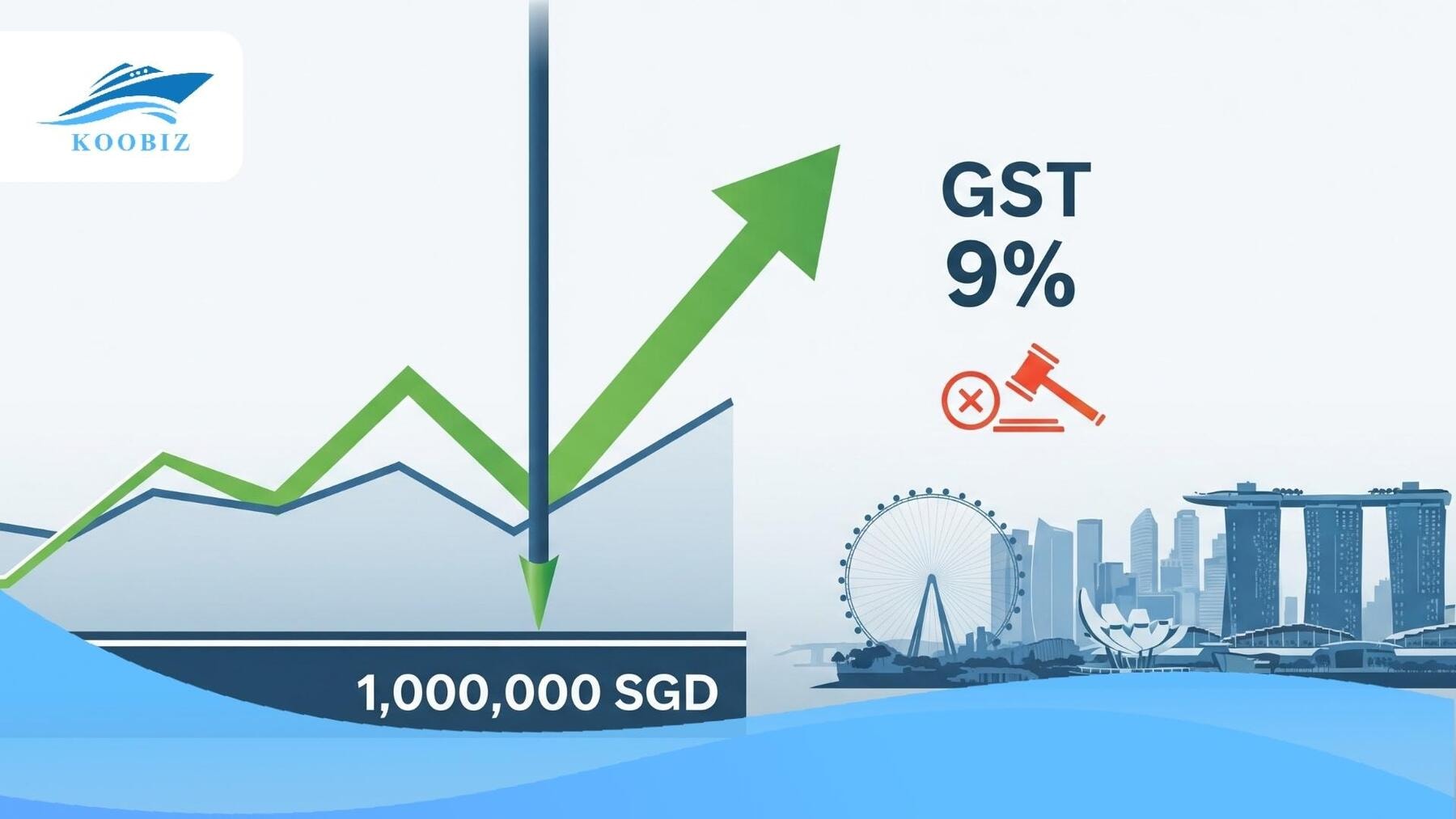
    Yes. You must register for GST if your taxable turnover exceeds SGD 1 million.
    Singapore GST Registration, SGD 1M Threshold, Mandatory Voluntary
    Singapore GST Registration, SGD 1M Threshold, Mandatory Voluntary

    This is not optional. Once you hit the threshold, IRAS rules apply. Quick facts:

    • Threshold: > SGD 1 million (Taxable Turnover).
    • Current Rate: 9% on goods and services.
    • Basis: Liability is based on Revenue, not Profit.
    • Risk: Failing to register can lead to significant penalties

    Crossing the SGD 1 million mark is a big milestone. It also means you need to calculate turnover accurately to stay compliant.

    Understanding the $1 Million Taxable Turnover Threshold

    Taxable turnover is the total value of all standard-rated and zero-rated supplies made in Singapore, and it excludes exempt and out-of-scope supplies.

    There are two ways IRAS requires you to look at turnover. It’s important to know what counts and what doesn’t:

    • Standard-rated supplies: Goods and services sold in Singapore (taxed at 9%).
    • Zero-rated supplies: Exports and international services (0%), which still count toward the threshold even though no tax is collected.
    • Exempt supplies: Some financial services, sale/lease of residential properties, and certain metals are exempt.
    • Out-of-scope supplies: Sales from outside Singapore to outside Singapore (third-country sales) are not counted.

    To ensure you are compliant, you must apply the following two views.
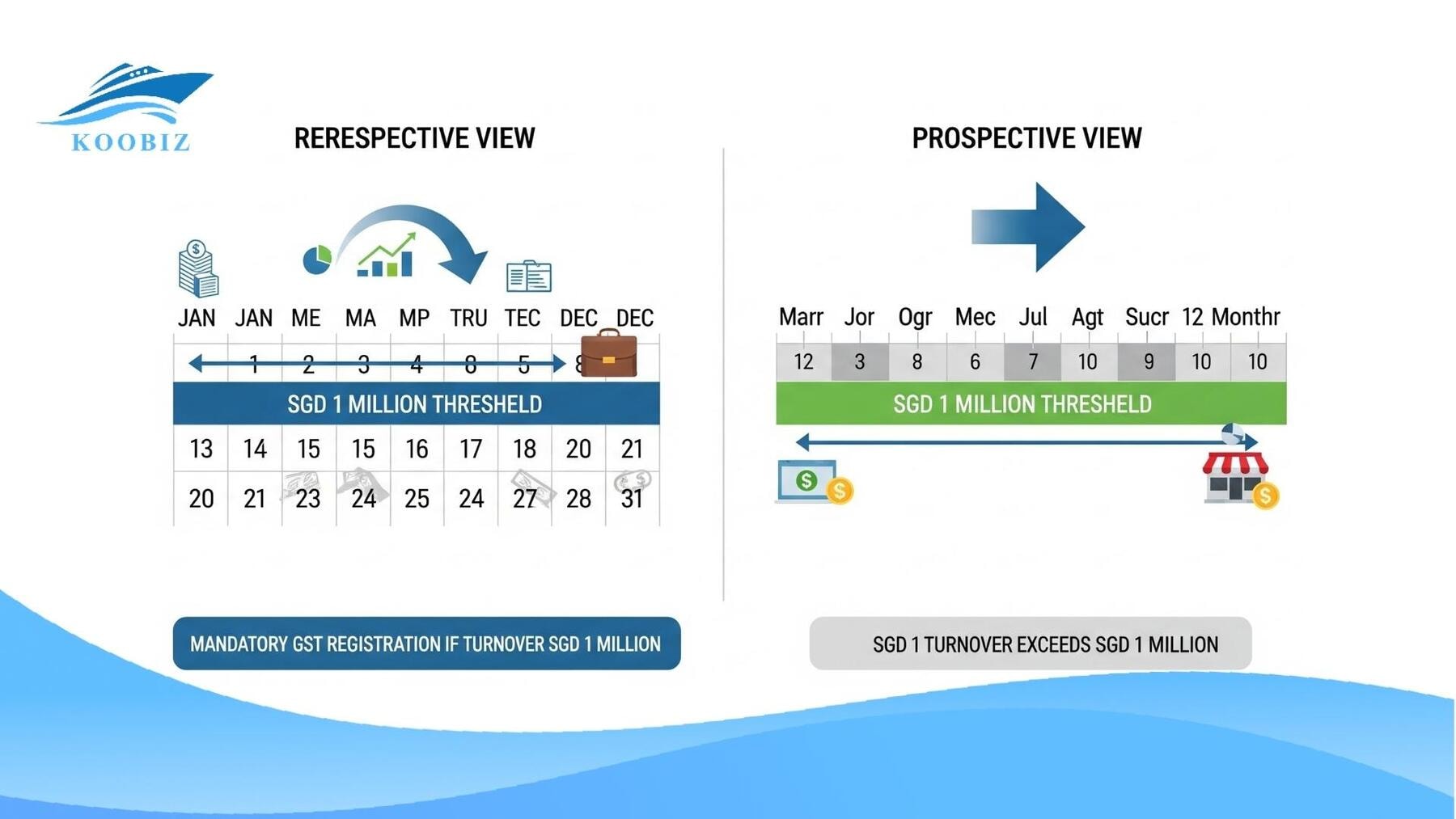
    Singapore GST $1M Threshold: Retrospective and Prospective Views
    Singapore GST $1M Threshold: Retrospective and Prospective Views

    The Retrospective View (End of Calendar Year)

    The Retrospective View requires you to assess your turnover strictly at the end of the calendar year (31 December).

    You must sum up your taxable turnover for the calendar year (1 Jan to 31 Dec). If the total exceeds SGD 1 million, you must register.

    • Check Date: 31 December.
    • Deadline: You must apply by 30 January of the following year.
    • Effective Date: You will be registered on 1 March of that year.

    Note: While the mandatory check is annual, we recommend monitoring your turnover quarterly to anticipate this liability.

    The Prospective View (Next 12 Months)

    The Prospective View mandates registration if there is reasonable certainty that your taxable turnover will exceed SGD 1 million in the next 12 months.

    This method looks forward and is often triggered by large contracts or business restructuring. “Reasonable certainty” usually means you have signed sales contracts or confirmed purchase orders. It is not based on vague sales targets or optimistic projections.

    • Deadline: You must apply strictly within 30 days of the date on which your forecast indicates you will exceed the threshold.
    • Effective Date: Registration usually starts two months from the date of your forecast (for liabilities arising on or after 1 July 2025). This extended grace period provides ample time to set up your accounting systems.

    According to data from IRAS, failing to apply the prospective view is a common error for rapidly scaling startups. If you sign a contract worth SGD 1.2 million today, you must register immediately, even if you haven’t issued a single invoice yet.

    Voluntary GST Registration: Benefits and Responsibilities

    Voluntary registration lets you claim input tax on your purchases, but it comes with ongoing obligations.

    Why Choose Voluntary Registration? (Pros)

    The primary advantage of voluntary registration is the ability to claim input tax incurred on business purchases and the enhancement of corporate image.

    Specifically, choosing to register voluntarily offers the following Benefits:

    • Recover Input Tax: You can reclaim GST paid on business expenses (rent, imports, vendor fees, etc.).
    • Enhance Corporate Image: Being GST-registered can signal stability to suppliers and lenders.
    • Neutral Impact on B2B: If most clients are GST-registered, charging GST is straightforward for them.

    Cons and Obligations of Voluntary Registration

    The drawbacks include a compulsory lock-in period, heightened administrative and compliance expenses, and stringent payment obligations. Before submitting an application, businesses must be ready to assume the following Responsibilities:

    • Mandatory InvoiceNow Adoption: For voluntary registration applications submitted on or after 1 November 2025 (for newly incorporated companies) or 1 April 2026 (for all other entities), businesses are required to employ InvoiceNow-compatible software to directly transmit invoice data to IRAS.
    • 2-Year Lock-in Period: Upon registration, the business must maintain its GST-registered status for a minimum of two years. Deregistration is not permitted merely due to administrative burden.
    • Mandatory GIRO: IRAS typically mandates voluntary registrants to enrol in GIRO for automated tax deductions, ensuring payment security.
    • Strict Filing & Record Keeping: GST returns must be filed punctually (generally on a quarterly basis), and all accounting records must be maintained for at least five years.
    • Additional Compliance Costs: For smaller enterprises, the administrative workload or the expense of engaging professional accounting services may occasionally exceed the recoverable input tax.

    Koobiz often conducts a Cost-Benefit Analysis for clients to see if the recoverable tax covers the cost of hiring professional accounting services.

    Comparison: Mandatory vs. Voluntary Registration

    Mandatory registration is a legal requirement triggered by specific turnover thresholds, accompanied by immediate and rigid deadlines. In contrast, voluntary registration is a strategic business decision offering a flexible application timeline but entailing a long-term commitment. Grasping these distinctions is vital for effective strategic planning. The following table outlines key differences essential for business owners in Singapore.

    Feature Mandatory Registration Voluntary Registration
    Trigger Taxable turnover > SGD 1M (Past or Future). Strategic decision by business owner.
    Application Timeline By 30 Jan (Retrospective) or within 30 days (Prospective). Anytime, provided the business is active.
    De-registration Only when turnover drops < SGD 1M or business ceases. Minimum 2-year lock-in period required.
    Compliance Risk High penalty for late registration. Risk of rejection if business intent is unclear.
    Primary Benefit Legal compliance (avoiding jail/fines). Recovering input tax (cost savings).

    Unsure if you’ve hit the threshold? Contact Koobiz for a free eligibility assessment.

    Case Studies: Real-World Scenarios

    To illustrate how these regulations are applied, consider the following common scenarios, which highlight specific deadlines and effective dates.

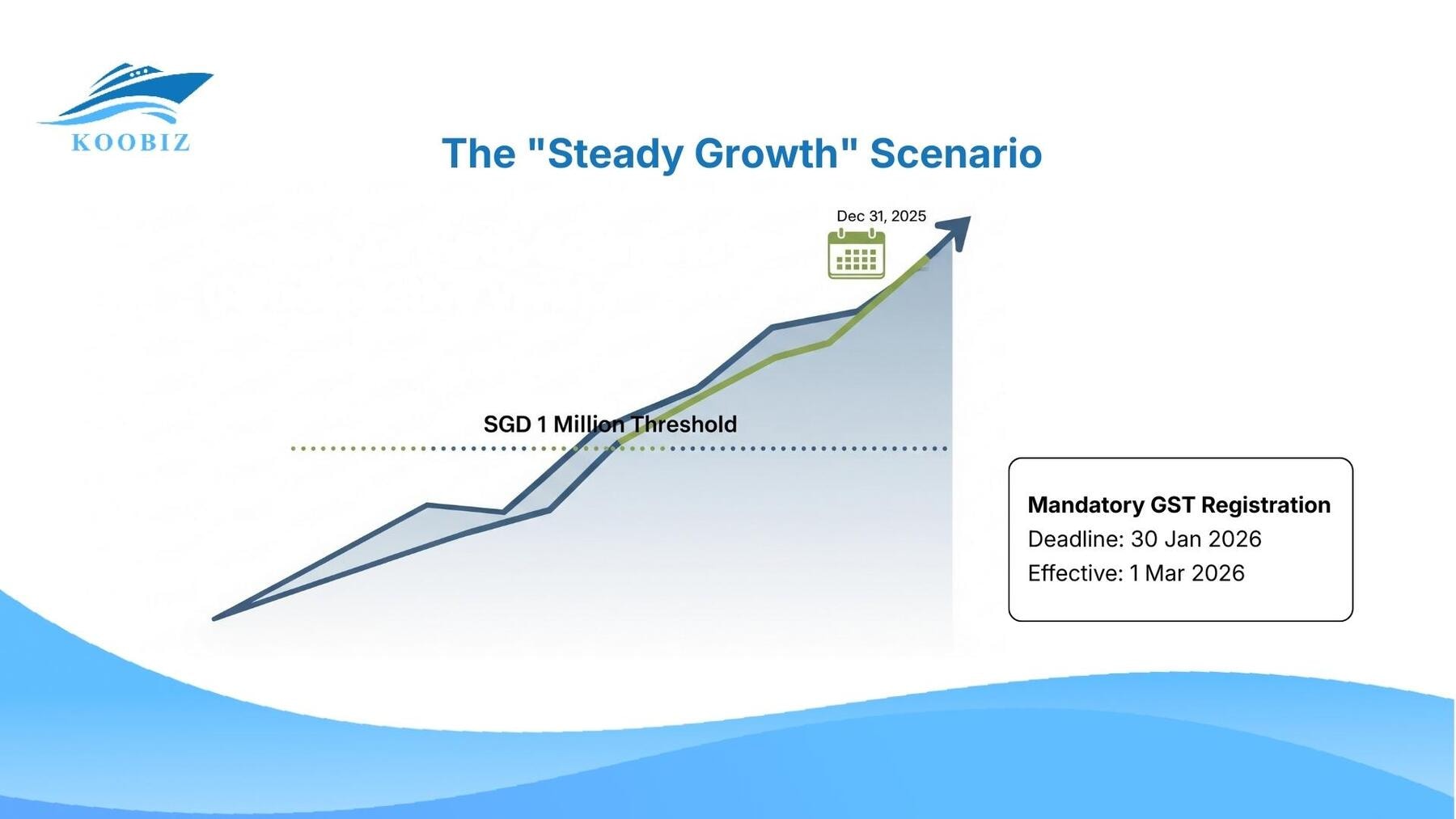
    Case 1: The “Steady Growth” Scenario (Retrospective View)
    The
    The “Steady Growth” Scenario

    Situation: “TechGadgets Pte Ltd” reviews its accounts on 31 December 2025. They realize their total taxable turnover for the calendar year (Jan–Dec 2025) was SGD 1.2 million.

    • Verdict: They are liable to register.
    • Deadline to Apply: They must submit the application by 30 January 2026.
    • Effective Date: They will become a GST-registered business on 1 March 2026.

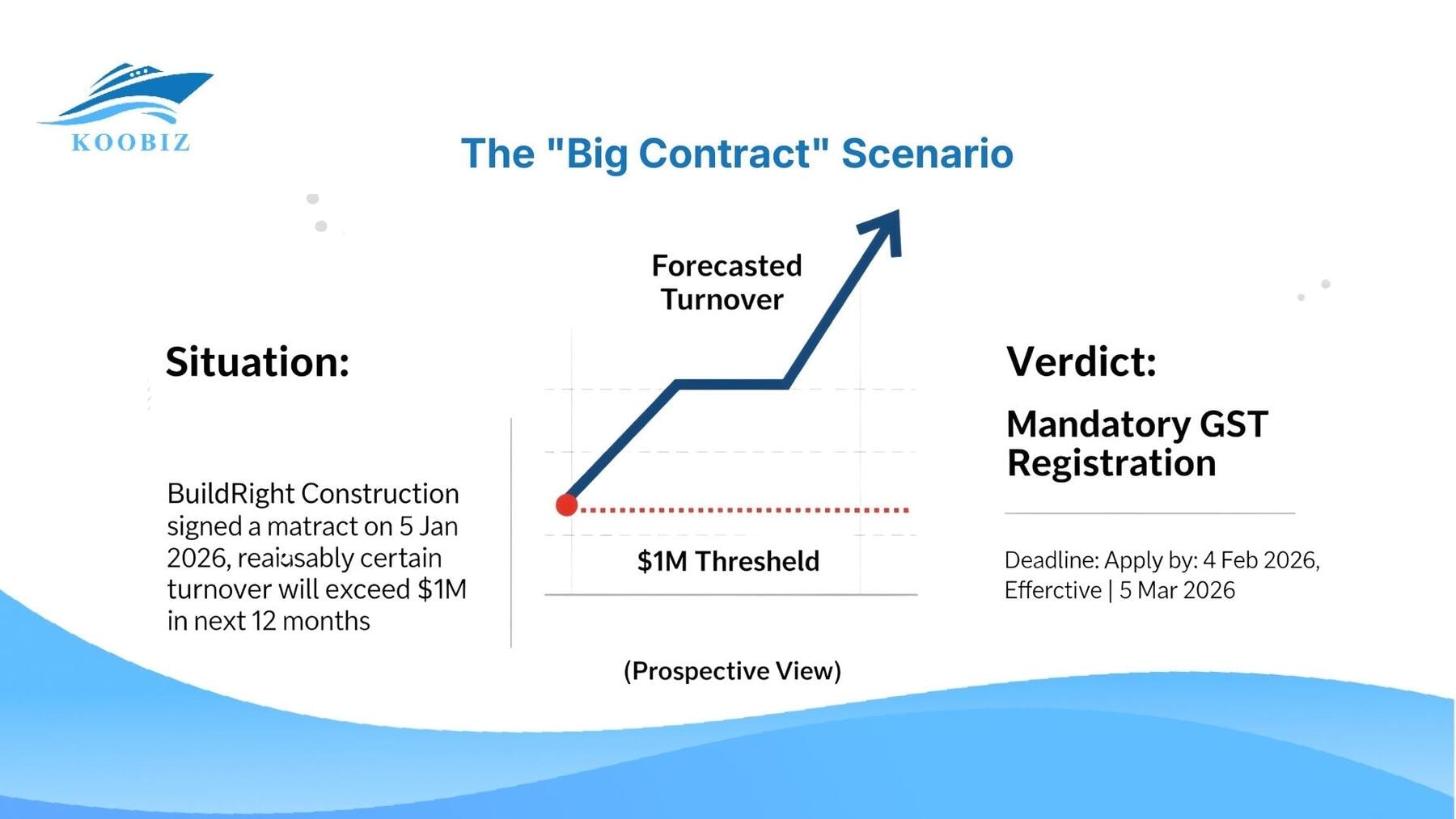
    Case 2: The “Big Contract” Scenario (Prospective View)
    The
    The “Big Contract” Scenario

    Situation: “BuildRight Construction” signs a major contract on 5 January 2026.

    • Verdict: Even though they haven’t issued a single invoice yet, they are “reasonably certain” turnover will exceed $1M in the next 12 months.
    • Deadline to Apply: They must apply by 4 February 2026 (within 30 days of the forecast date).
    • Effective Date: Under the rules for liabilities arising after 1 July 2025, their registration will be effective on 5 March 2026 (strictly two months from the forecast date).

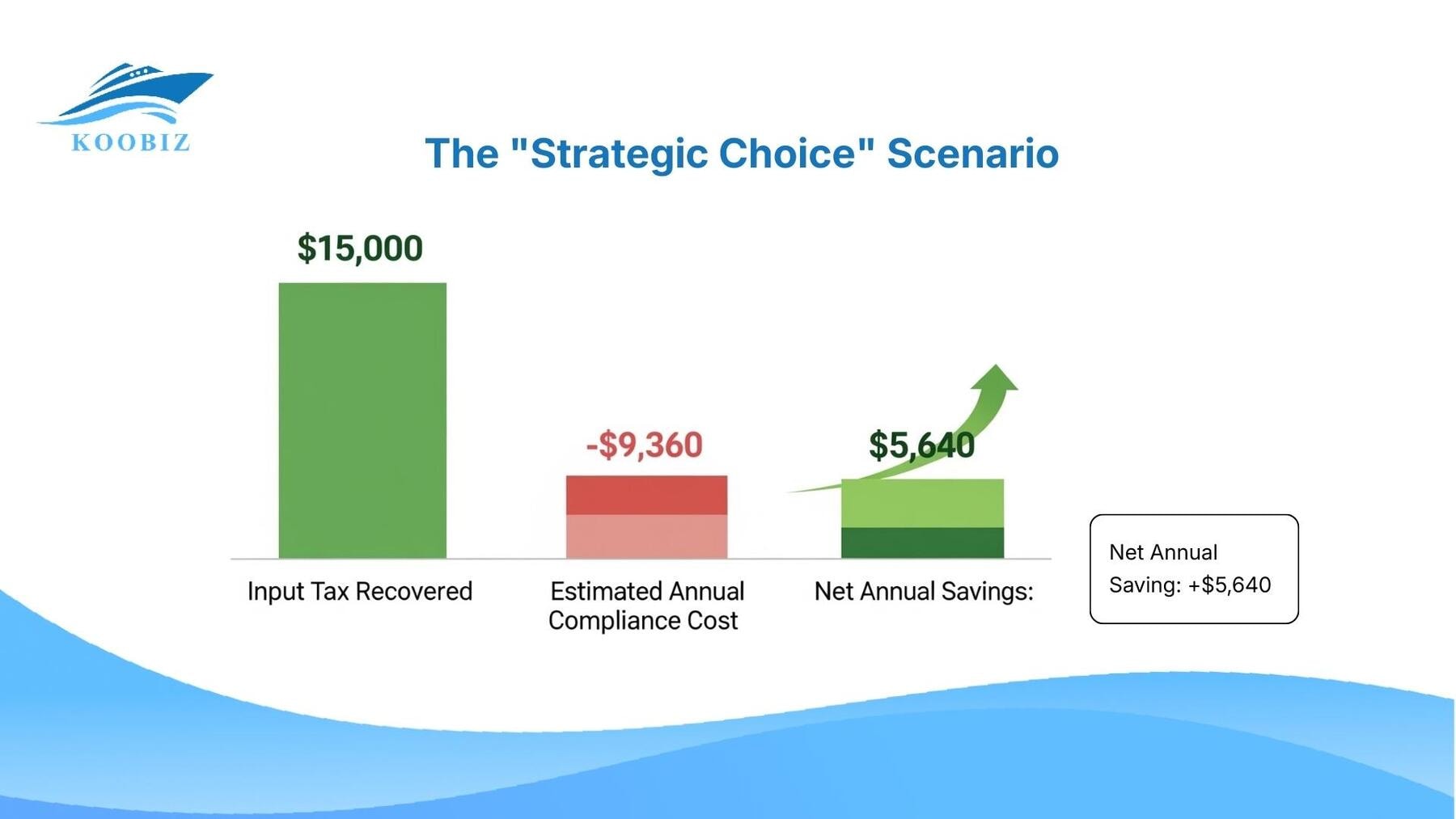
    Case 3: The “Strategic Choice” Scenario (Voluntary Registration)
    The
    The “Strategic Choice” Scenario

    Situation: “CreativeDesign Studio” has a revenue of SGD 400,000. They are renting a fancy office in CBD and paying SGD 8,000 per month + 9% GST. They are not required to register.

    • Analysis: They pay SGD 720 in GST every month (SGD 8,640/year) which they currently cannot claim back.
    • Decision: They choose Voluntary Registration.
    • Net Benefit Calculation:
      • Input Tax Recovered: +$8,640
      • Estimated Annual Compliance Cost: -$3,000
      • Net Annual Savings: +$5,640
    • Outcome: It is financially beneficial to register, provided they commit to the 2-year lock-in period and adoption of InvoiceNow.

    Special GST Registration Scenarios and Exemptions

    Standard rules cover most businesses, but specific scenarios exist for unique models. These exceptions extend the scope of Singapore GST registration requirements to international providers and complex corporate structures.

    Applying for Exemption from Registration

    Businesses with taxable turnover exceeding SGD 1 million, derived wholly or primarily from zero-rated supplies (e.g., export trading), may apply for an exemption. This spares them from filing returns but also forfeits any input tax claims.

    Overseas Vendor Registration (OVR) Regime

    The OVR regime mandates GST registration for foreign digital service providers if Global Turnover exceeds SGD 1 million AND Local B2C Supplies exceed SGD 100,000. This ensures a level playing field for the digital economy (e.g., streaming, software). Under this simplified ‘pay-only’ regime, vendors account for GST on B2C supplies but generally cannot claim input tax.

    GST Group Registration for Related Companies

    Related companies under common control (e.g., >50% shareholding) may register as a single GST entity. This streamlines administration by allowing a consolidated return and disregards intra-group transactions for GST, mitigating related cash flow issues.

    Late Registration and Penalties

    Failure to register on time can result in fines up to SGD 10,000 and additional penalties (usually 5% of tax due plus 2% per month for continued non-payment). IRAS will backdate the registration, requiring the business to pay all due GST on past sales from its own funds if not collected from customers.

    Conclusion

    Navigating Singapore GST registration requirements demands a clear understanding of your financial data and future business contracts. Whether you are compelled to register due to the $1 million threshold or are considering voluntary registration for its fiscal benefits, accuracy is paramount. Errors in calculation or delays in application can lead to costly penalties that hinder your business growth.

    At Koobiz, we specialize in simplifying corporate services for businesses in Singapore. From company incorporation to opening bank accounts and managing complex tax and accounting frameworks, our team ensures you remain compliant while you focus on expansion.

    Disclaimer: This guide is for informational purposes only and does not constitute professional tax advice. Regulations are subject to change; businesses should consult IRAS or a qualified tax advisor for their specific circumstances. Information current as of January 2026.

  • Government Grants for Startups in Singapore: The 2026 Guide

    Government Grants for Startups in Singapore: The 2026 Guide

    [SUMMARIES]

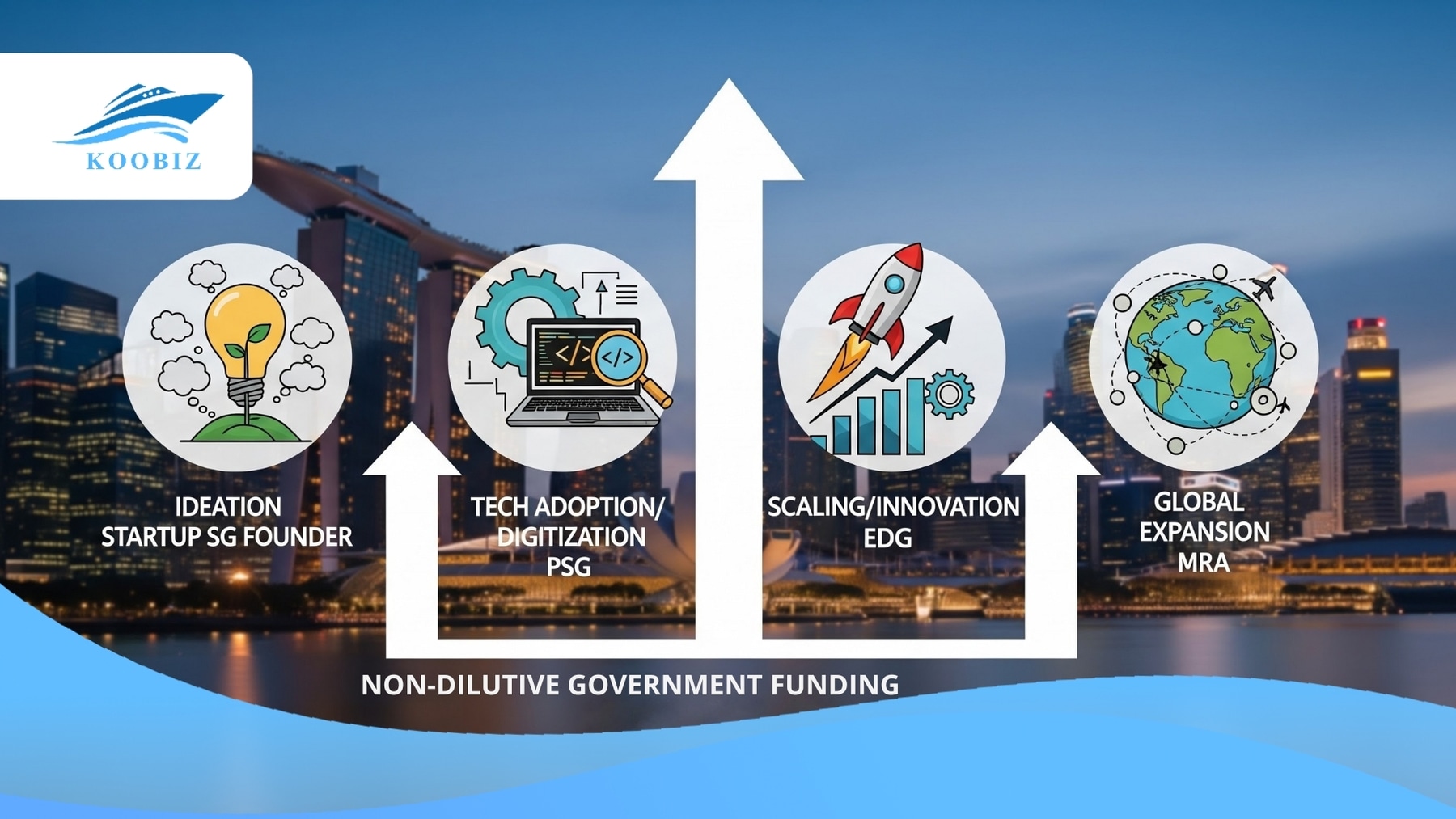
    Diverse Ecosystem: Singapore offers tiered grants like Startup SG (for new founders), PSG (for tech adoption), and EDG (for scaling).

    Strict Eligibility: SME grants typically require at least 30% local shareholding and local registration; foreign founders often need corporate structuring advice or specific founder-focused schemes.

    Reimbursement Model: Unlike “free money” upfront, most Singapore grants operate on a reimbursement basis, requiring solid cash flow management to pay vendors first.

    Strategic Application: Success depends on aligning your project proposal with Singapore’s core economic goals, such as innovation, digitization, and sustainability.

    Holistic Support: Beyond cash, many grants connect founders to the ecosystem. For example, Startup SG provides mentorship, while PSG focuses on transactional efficiency.

    [/SUMMARIES]

    Securing capital is the lifeblood of any new venture, and for entrepreneurs in Southeast Asia, Singapore stands out as a premier hub offering robust financial support through government grants for startups. Unlike traditional bank loans or venture capital funding, these grants are non-dilutive, allowing founders to grow without sacrificing equity. That said, the range of schemes administered by Enterprise Singapore can be complex and difficult to navigate without proper guidance.

    At Koobiz, we know that building a successful business requires more than a strong idea, it starts with the right corporate and financial foundation. From structuring your company to meet grant requirements to opening a compliant corporate bank account for fund disbursement, we support founders at every stage. In this guide, we outline the key government grants available in 2026, explain eligibility requirements, and walk you through the application process to help you secure funding with confidence.

    What Are Government Grants for Startups in Singapore?

    Startup funding: non-dilutive, reimbursement-based
    Startup funding: non-dilutive, reimbursement-based

    Government grants for startups in Singapore are non-dilutive financial assistance schemes provided by agencies like Enterprise Singapore to support business capabilities, innovation, and market expansion.

    To understand the ecosystem fully, it is essential to recognize that these are not “handouts” but strategic investments. Here are the core characteristics you need to know:

    • Non-Dilutive Funding: Unlike venture capital, you do not give up any equity or ownership shares to investors.
    • No Repayment Required: Unlike standard business loans, these funds do not need to be paid back.
    • Reimbursement Basis: Grants almost always operate on a reimbursement model. You must have the cash flow to pay for project costs upfront (e.g., hiring consultants, buying software) and claim the money back later.
    • Co-Funding Principle: The government rarely covers 100% of the cost. Typically, they support 50% to 70% of qualifying costs, meaning the startup shares the financial risk. Note: Enhanced support rates (e.g., up to 70% for sustainability projects under EDG) are subject to specific timelines, such as the March 31, 2026 deadline.

    This framework is designed to ensure that only committed and financially viable businesses participate. For foreign founders in particular, it underscores the importance of having a properly incorporated Singapore entity. Koobiz helps startups overcome these early barriers by ensuring their company structure is fully compliant with ACRA requirements, an essential first step to accessing Singapore’s government grant ecosystem.

    Top Government Grants for Startups in 2026

    In 2026, Singapore’s startup funding landscape is anchored by four major government grant schemes: Startup SG Founder, Productivity Solutions Grant (PSG), Enterprise Development Grant (EDG), and Market Readiness Assistance (MRA). Each is tailored to a different stage of business growth and strategic objective.

    To help you identify the right funding stream, we have grouped these grants based on their specific objectives and target attributes.

    4 Singapore government grants in 2026
    4 Singapore government grants in 2026

    Startup SG Founder (For First-Time Entrepreneurs)

    Designed specifically for first-time entrepreneurs with innovative business ideas, this grant provides mentorship and capital.

    • Funding Amount: Up to S$50,000.
    • Mechanism: This is not a direct match of funds raised. Instead, successful applicants must commit S$10,000 in paid-up capital to the business. The grant is then disbursed in tranches based on the achievement of pre-agreed milestones.
    • Key Requirement: You must be a first-time founder and apply through an Accredited Mentor Partner (AMP). The mentorship component is mandatory. Note: Foreign applicants generally need to commit to obtaining Singapore Permanent Residency or Citizenship as part of the scheme’s requirements.

    Productivity Solutions Grant (PSG) (For Tech Adoption)

    PSG is the most accessible grant for SMEs looking to digitize their operations quickly using pre-scoped solutions.

    • Scope: Covers the purchase of off-the-shelf IT solutions (e.g., accounting software like Xero, HR systems, customer relationship management tools) and equipment.
    • Funding Support: Up to 50% of qualifying costs, with a grant cap of S$30,000 per financial year.
    • Efficiency: Because the vendors and solutions are pre-approved by IMDA, the approval process is faster than other grants.

    Enterprise Development Grant (EDG) (For Scaling & Innovation)

    This is a heavyweight grant intended for companies ready to upgrade their business, innovate, or venture overseas.

    • Scope: Projects under EDG fall into three pillars: Core Capabilities (HR, Finance), Innovation and Productivity (R&D, Automation), and Market Access (Overseas expansion).
    • Funding Support: Typically up to 50% for SMEs. Note: Sustainability-related projects may enjoy up to 70% support until March 31, 2026.
    • Requirements: Requires a detailed project proposal and often necessitates hiring third-party management consultants.

    Market Readiness Assistance (MRA) (For Global Expansion)

    For startups ready to take their product out of Singapore and into the region (e.g., Vietnam, Indonesia).

    • Funding Amount: Up to 50% of eligible costs, capped at S$100,000 per company per lifetime.
    • Coverage: Supports costs related to overseas market promotion (PR, trade fairs), business development (matching partners), and market set-up (legal/tax advisory).

    According to recent data from Enterprise Singapore, thousands of enterprises have utilized these schemes to pivot and grow. Choosing the right one depends entirely on whether you are at the “ideation” stage (Startup SG) or the “expansion” stage (EDG/MRA).

    Are You Eligible for Government Funding?

    The eligibility criteria for Singapore government grants
    The eligibility criteria for Singapore government grants

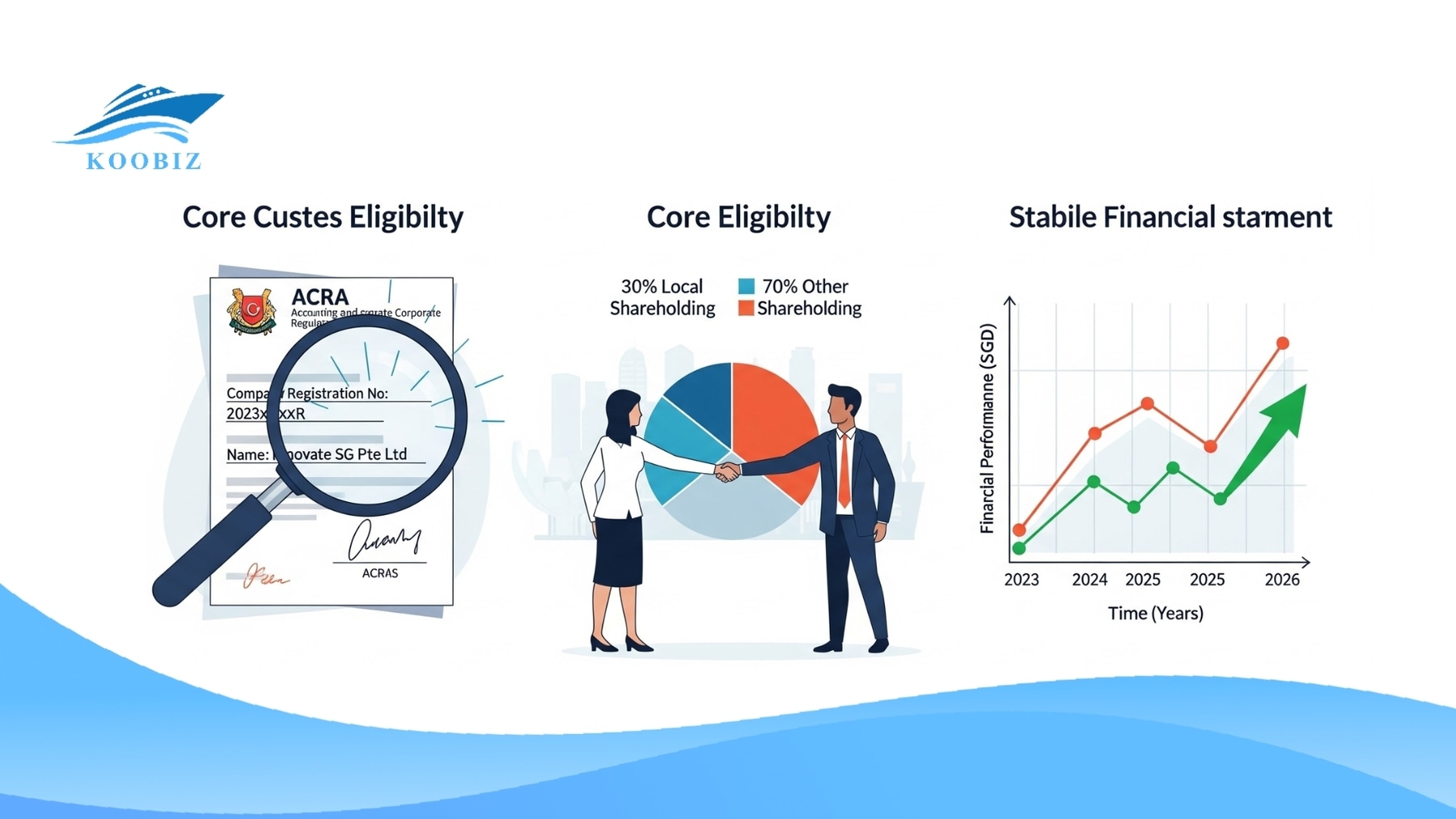
    Yes, you are eligible for most Singapore government funding if you meet three core criteria: registering as a business entity in Singapore, meeting shareholding requirements, and ensuring the business is financially viable.

    That said, eligibility is rarely as simple as it looks on paper, especially for foreign founders. Many applications fail due to misunderstandings around these core requirements. Below are the key yes/no checkpoints that grant agencies use to assess eligibility.

    1. Is your business registered in Singapore?

    You must have a valid Unique Entity Number (UEN) issued by ACRA. You cannot apply for grants as a foreign entity or a representative office. This is where Koobiz supports clients; we handle the incorporation process seamlessly, ensuring your standard industrial classification (SSIC) code aligns with the nature of your business.

    2. Do you meet the Shareholding rule?

    • For SMEs (PSG/EDG): There is a strict requirement that at least 30% of the shareholding must be held by Singapore Citizens or Permanent Residents.
    • For Startup SG Founder: The focus is on the founder’s commitment. Foreign founders can apply but must hold key roles and often commit to residency in Singapore.
    • Koobiz Tip: Fully foreign-owned companies targeting SME grants often need to explore alternative structures, such as local partnerships or tailored corporate arrangements.

    3. Is the company solvent and viable?

    Government agencies will check your financial statements. They want to ensure the company isn’t dormant or facing insolvency. You must demonstrate the ability to pay for the project costs upfront before reimbursement.

    How to Apply for Singapore Government Grants

    The application method involves a standardized three-step process: registering for a CorpPass account, preparing a detailed project proposal, and submitting through the Business Grants Portal (BGP).

    To navigate this administrative process efficiently, follow this detailed flow:

    Step 1: Secure Access via CorpPass

    CorpPass is Singapore’s official digital identity system for businesses and is mandatory for accessing all government e-services, including grant applications.

    Only authorized personnel, such as directors, company secretaries, or appointed representatives, can transact on behalf of the company. CorpPass can be set up once incorporation is completed, and Koobiz routinely assists clients in activating this access promptly to avoid delays at the application stage.

    Step 2: Prepare Your Proposal and Financials

    For simple grants like PSG, you just need a quotation from a pre-approved vendor. However, for EDG or Startup SG, you need a comprehensive business plan.

    • The Proposal: Must clearly state the objective, the current state of the business, the proposed solution, and the projected quantitative outcomes (e.g., “Expected revenue increase of 20% over 3 years”).
    • Financials: You will need to upload your latest financial statements. This is why having professional accounting and tax services—like those offered by Koobiz—is crucial. We ensure your books are clean, up-to-date, and ready for scrutiny by Enterprise Singapore.

    Step 3: Submission on the Business Grants Portal (BGP)

    Log in to the Business Grants Portal. Select the specific grant, fill in the project details, and upload your documents.

    • Processing Time: PSG applications can be approved in 4-6 weeks, while EDG proposals may take 8-12 weeks.
    • Claims: It is important to note that grant approval does not mean immediate payout. Most schemes operate on a reimbursement basis. Companies must first pay vendors, then submit a claims application with supporting documents such as invoices, payment proofs, and evidence of project completion.

    Once approved, you will receive a Letter of Offer. You must accept this within the stipulated timeframe. Remember, you cannot start the project or make any payments to vendors before the grant is approved; doing so usually disqualifies the expense.

    Common Challenges and Mistakes When Applying for Grants

    Common reasons for grant rejection include misalignment with government economic goals, lack of innovation, or weak financial projections.

    While the ecosystem is generous, it is also rigorous. Understanding the pitfalls (Antonyms to success) is as important as knowing the rules.

    Grants vs. Equity Financing vs. Business Loans

    It is vital to compare these funding sources to ensure you aren’t misusing a grant for a purpose it wasn’t intended for.

    Funding Source Best Used For Key Characteristics
    Grants Capability Building

    (e.g., buying tech, branding, process redesign)

    Reimbursement model (requires upfront cash); non-dilutive. PSG is fast; EDG is slower.
    Equity Financing

    (VC / Angel)

    Rapid Growth

    (e.g., high burn rate, scaling teams quickly)

    Immediate cash; requires giving up ownership/equity; investor pressure.
    Business Loans Working Capital

    (e.g., inventory, rent, payroll)

    Retain ownership; requires collateral or cash flow history; must be repaid with interest.

    Koobiz often advises clients to use a hybrid approach: Use equity/loans for working capital and grants for specific project upgrades.

    Special Grants for Fintech and Green Tech Startups

    Beyond the general grants, there are “Rare Attribute” grants for specific niches.

    • Fintech: The Monetary Authority of Singapore (MAS) offers the Financial Sector Technology and Innovation (FSTI) scheme, supporting innovation with significant funding pools.
    • Sustainability: The Enterprise Financing Scheme – Green (EFS-Green) is available (until March 31, 2026) to help enterprises access green financing. Additionally, new grants targeting carbon market initiatives are emerging.If your startup operates in these sectors, do not limit yourself to the generic PSG/EDG; investigate these specialized pools of funding.

    Tax Incentives as an Alternative to Grants

    Sometimes, the best funding is tax saving. Even if you don’t qualify for a direct grant, Singapore offers the Tax Exemption Scheme for New Start-Up Companies (SUTE).

    • Benefit: For the first three consecutive YAs (Years of Assessment):
      • 75% exemption on the first S$100,000 of normal chargeable income.
      • 50% exemption on the next S$100,000.
    • Eligibility: Available to most new companies (excluding investment holding and property development companies).
    • Relation: This acts as an indirect grant, preserving your cash flow. Koobiz’s tax specialists can help you model these savings into your financial runway.

    Conclusion

    Navigating the landscape of government grants for startups in Singapore requires more than just an application form; it demands thoughtful planning around corporate structure, financial readiness, and long-term business strategy. While 2026 presents abundant opportunities, they are best leveraged by founders who are properly prepared.

    At Koobiz, we empower entrepreneurs to seize these opportunities. From incorporating your Singapore company to meeting local director requirements and opening your corporate bank account, we build the foundation that makes you grant-ready. Don’t let administrative hurdles stop your innovation.

    Ready to start your business journey in Singapore?

    Visit Koobiz.com today to speak with our specialists about incorporation, tax planning, and banking solutions designed for global founders.

  • Master Transfer Pricing Compliance in Singapore for MNCs: The Arm’s Length Guide

    Master Transfer Pricing Compliance in Singapore for MNCs: The Arm’s Length Guide

    [SUMMARIES]

    Mandatory Compliance: Singapore tax law (Section 34D) requires all related party transactions to strictly adhere to the Arm’s Length Principle.

    Documentation Threshold: Businesses with gross revenue exceeding S$10 million must prepare contemporaneous Transfer Pricing Documentation (TPD).

    3-Step Approach: IRAS mandates a specific three-step process: Comparability Analysis, Method Selection, and Determining Results.

    Penalty Risks: Non-compliance can result in a fine of up to S$10,000 and a 5% surcharge on any tax adjustments made by IRAS.

    Strategic Support: Koobiz assists MNCs in navigating complex TP rules, including the latest 8th Edition guidelines on intercompany loans.

    [/SUMMARIES]

    For Multinational Corporations (MNCs) expanding into Asia, Singapore offers an attractive tax regime, yet it demands rigorous adherence to regulatory standards, particularly regarding cross-border transactions. Transfer Pricing Compliance in Singapore has moved from being a supplementary reporting requirement to a central focus of the Inland Revenue Authority of Singapore (IRAS), especially with the enforcement of the 8th Edition Guidelines.

    At Koobiz, we recognize that the technical requirements under Section 34D of the Income Tax Act can be challenging for both foreign investors and established MNCs. This guide is designed to help you clearly understand and apply the Arm’s Length Principle, assess when transfer pricing documentation becomes mandatory, and navigate the IRAS-mandated three-step approach. Whether you are reviewing intercompany financing arrangements or preparing for a potential tax audit, a solid grasp of these rules is essential to mitigate surcharge risks and protect your company’s standing in Singapore.

    What constitutes Transfer Pricing under Singapore Tax Law?

    Transfer Pricing
    Transfer Pricing

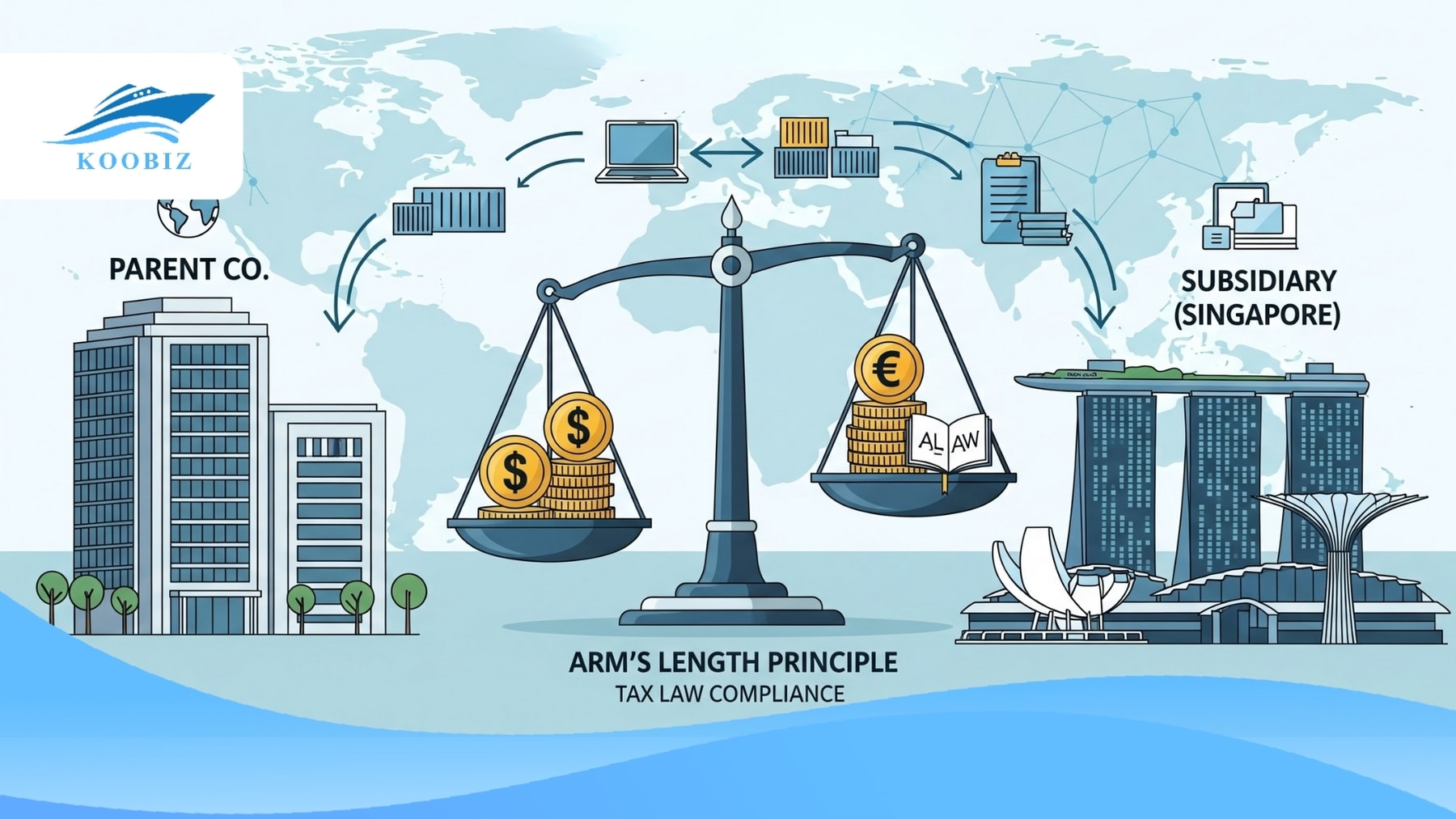
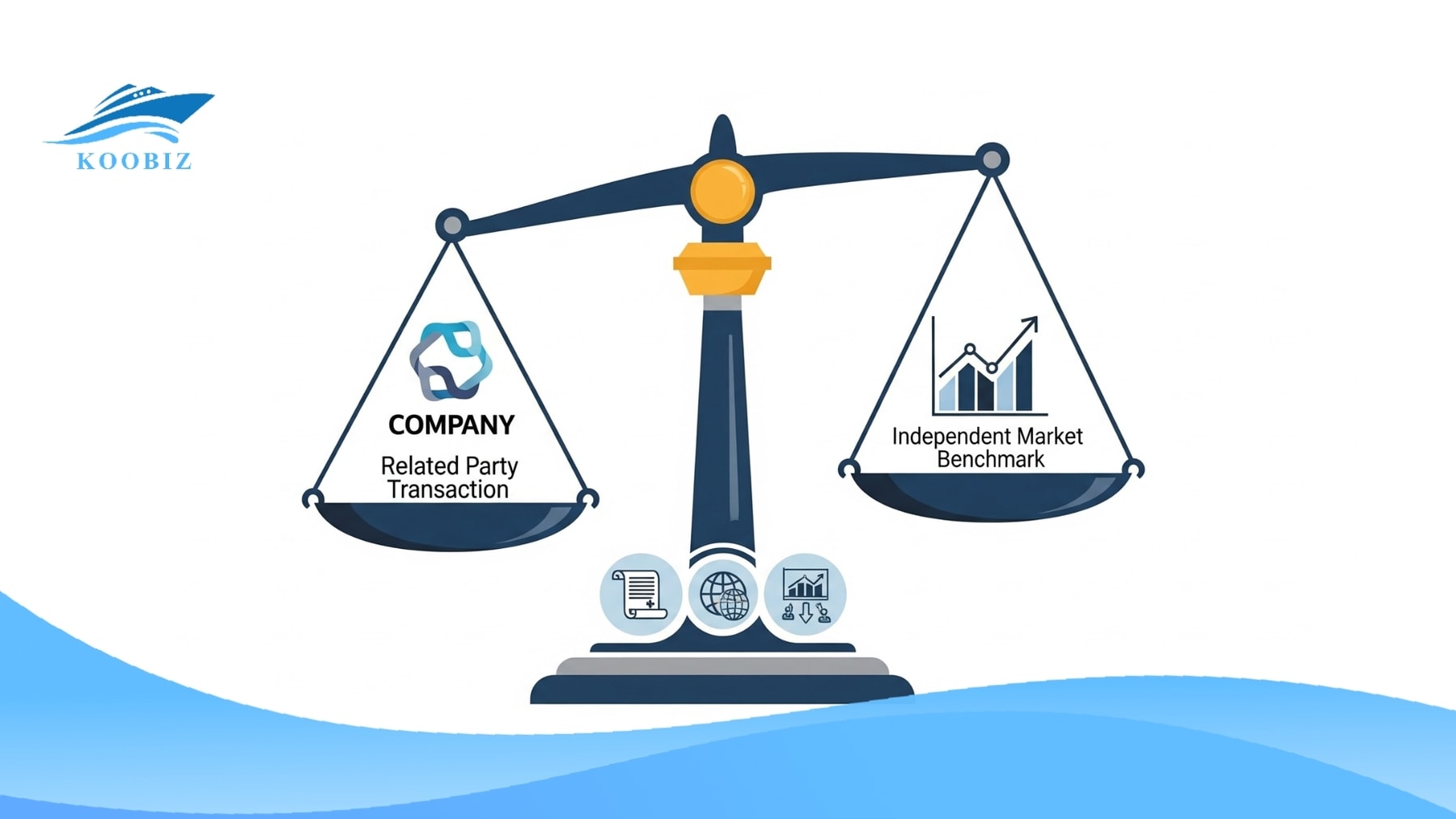
    Transfer Pricing is the pricing mechanism used for transactions between related parties, such as the sale of goods, provision of services, or transfer of intangible assets, which must strictly reflect market conditions.

    To delve deeper, transfer pricing is a neutral accounting term, not an illegal practice. However, under Section 34D of the Income Tax Act, IRAS scrutinizes these prices to prevent profit shifting and ensure profits reflect true economic value in Singapore.

    Defining “Related Party” & Scope

    IRAS defines related parties broadly, generally where there is control, significant influence, or a shared holding company. As a result, the scope of transfer pricing is wide and includes:

    • Operational Activities: Management fees, royalties, and intercompany loans.
    • Audit Scope: Every internal invoice is a potential subject of scrutiny.

    Koobiz Advice: Transparency and consistency in these definitions are your first line of defense against tax adjustments.

    According to IRAS e-Tax Guide (Eighth Edition), the authority explicitly states that taxpayers are expected to apply the arm’s length principle to ensure that their pricing with related parties reflects independent pricing behavior.

    How is Compliance with the Arm’s Length Principle Determined?

    Compliance is achieved when related party pricing matches what independent parties would agree to under similar circumstances. This must be backed by robust documentation and comparable market data.

    To determine compliance, IRAS applies the Arm’s Length Principle (the international standard). If your internal pricing deviates significantly from market rates—either artificially inflating costs or suppressing revenue—IRAS will deem it non-compliant.

    Compliance with ALP: Documentation, Data & 3 Factors
    Compliance with ALP: Documentation, Data & 3 Factors

    The Core Test: “Would independent parties agree?”

    To pass this test, businesses must analyze three key factors:

    • Contractual Terms: Are the terms standard for the industry?
    • Economic Circumstances: Do the prices reflect current market realities?
    • Business Strategies: Is the pricing commercially rational?

    At Koobiz,we assist companies in stress-testing their intercompany pricing against this “independent party” benchmark, identifying exposure early and rectifying gaps before an audit arises.

    Research by the OECD confirms that the Arm’s Length Principle remains the global standard for ensuring fair tax bases across jurisdictions.

    What are the Mandatory Requirements for Transfer Pricing Documentation (TPD)?

    There are two specific mandatory conditions that trigger the requirement for TPD: having gross revenue exceeding S$10 million for the basis period, or being explicitly required by IRAS to prepare such documentation.

    Beyond applying the arm’s length principle in theory, Singapore law imposes strict documentation standards to ensure pricing can be properly substantiated. It is important to distinguish routine bookkeeping from Qualifying Transfer Pricing Documentation, which must meet specific regulatory criteria.

    1. Gross Revenue Threshold: If your company’s gross revenue (not just profit) exceeds S$10 million in the basis period concerned, you are legally required to prepare contemporaneous TPD.
    2. Specific Requirement: Regardless of revenue, if IRAS issues a specific direction to your company to prepare TPD for a previous basis period, you must comply.

    Exemptions from TPD

    Even where the S$10 million revenue threshold is met, IRAS grants transaction-level exemptions to ease the compliance burden for lower-value dealings between related parties.

    • Purchase/Sale of Goods: Exemption applies if the total value is below S$15 million.
    • Loans: Exemption applies if the loan value is below S$15 million (applicable where the IRAS Indicative Margin is applied).
    • Services, Royalties, and Others:
      • For YA 2025 and prior: Exemption applies if the total value is below S$1 million.
      • For YA 2026 onwards: The threshold increases to S$2 million, providing greater relief for businesses.

    TPD must be prepared on a contemporaneous basis, meaning it should be completed before the due date of filing the corporate income tax return. The documentation must cover, among others, the group structure, business activities, intercompany transactions, and a defensible pricing analysis. Failure to produce adequate TPD upon IRAS’ request exposes the company to immediate penalties and potential tax adjustments.

    At Koobiz, we support clients in preparing robust, compliant TPD that aligns with the detailed content requirements set out in the Second Schedule of the Income Tax (Transfer Pricing Documentation) Rules 2018, helping businesses mitigate risk and withstand IRAS scrutiny.

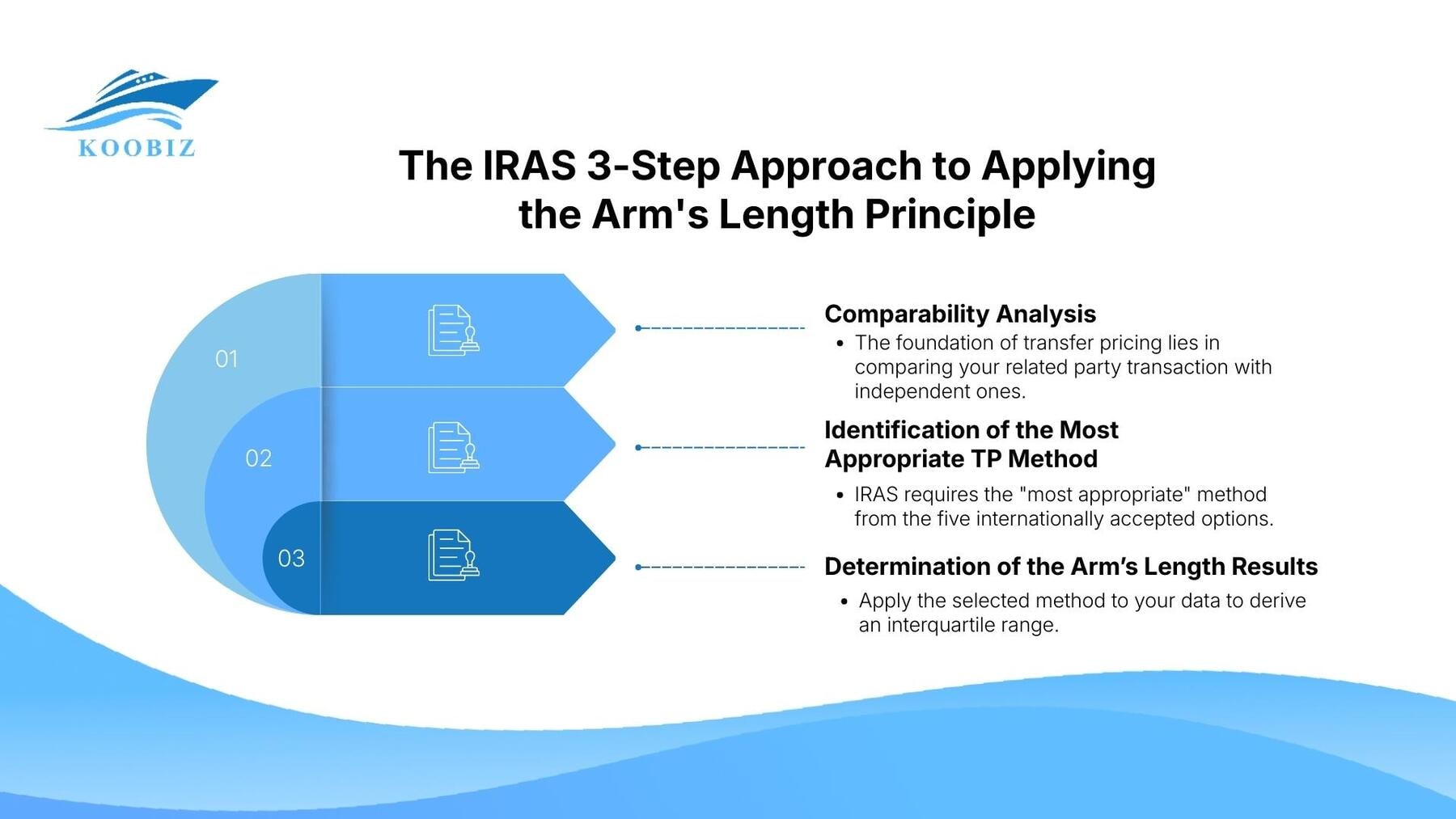
    The IRAS 3-Step Approach to Applying the Arm’s Length Principle

    The IRAS 3-Step Approach to Applying the Arm's Length Principle
    The IRAS 3-Step Approach to Applying the Arm’s Length Principle

    To justify pricing to tax authorities, MNCs are expected to apply a structured three-step methodology prescribed by IRAS. Transfer pricing is not a matter of estimation or intuition; it must be supported by a disciplined and evidence-based approach.

    Step 1: Comparability Analysis

    The foundation of transfer pricing lies in comparing your related party transaction with independent ones. This analysis must examine:

    • Characteristics: What goods or services are being traded?
    • Functional Analysis (FAR): Who performs the Functions, owns the Assets, and assumes the Risks?
    • Economic Circumstances: What are the market conditions?

    Step 2: Identification of the Most Appropriate TP Method

    IRAS requires the “most appropriate” method from the five internationally accepted options:

    • CUP Method: Compares specific prices (ideal for commodities).
    • Resale Price Method: Focuses on gross margins (for distributors).
    • Cost Plus Method: Focuses on mark-ups (for manufacturers/service providers).
    • TNMM: Compares net profit margins (most common for complex operations).
    • Profit Split: Splits profits based on contribution (for highly integrated value chains).

    Step 3: Determination of the Arm’s Length Results

    Apply the selected method to your data to derive an interquartile range.

    • Within Range: Compliant.
    • Outside Range: Adjustment required to the median.

    Real-world Impact: A Koobiz client in logistics used the TNMM to successfully justify their operating margin against competitors, eliminating subjectivity in their IRAS filings.

    Case Studies: Transfer Pricing in Action

    Real-world examples demonstrate the practical application of the Arm’s Length Principle and the potential pitfalls of incorrect pricing.

    To clarify how these rules affect daily operations, consider these two common scenarios that often trigger IRAS scrutiny.

    Scenario A: The Limited Risk Distributor (Tangible Goods)

    • Context: TechGlobal SG is a Singapore subsidiary acting as a distributor for its US parent. It purchases electronic components from the parent at S$80 per unit and resells them to local customers at S$100.
    • The Issue: After deducting local operating expenses (marketing, staff, rent), TechGlobal SG reports a Net Operating Margin of 1%.
    • IRAS Analysis: Using the TNMM (Transactional Net Margin Method),IRAS benchmarks TechGlobal SG against comparable independent distributors operating in Singapore. The benchmarking analysis shows that similar distributors typically earn an arm’s length operating margin of 3% to 5%.
    • Outcome: The adjustment leads to additional taxable income in Singapore, along with a 5% surcharge imposed on the transfer pricing adjustment, highlighting how even routine distribution models can result in costly exposure if pricing is not properly supported.

    Scenario B: Intercompany Management Fees (Services)

    • Context: SingHQ Pte Ltd acts as a regional hub, providing HR and IT support services to its subsidiaries in Vietnam and Thailand. Each subsidiary is charged a flat management fee of S$1 million per year, without detailed invoices or service breakdowns.
    • The Issue: The subsidiaries cannot verify the specific services received or the basis of the cost.
    • IRAS Analysis: IRAS applies the “Benefit Test”. Did the subsidiaries actually need and receive these services? Is the fee based on Cost + Mark-up (e.g., Cost + 5%)?

    IRAS will expect formal intercompany agreements and contemporaneous evidence, such as timesheets, service reports, email correspondence, or cost allocation schedules, to substantiate the charges.

    • Outcome: The deduction may be denied at the subsidiary level, or the income reclassified at SingHQ, potentially triggering double taxation disputes and additional tax exposure across multiple jurisdictions.

    What are the Penalties for Non-Compliance with Transfer Pricing Rules?

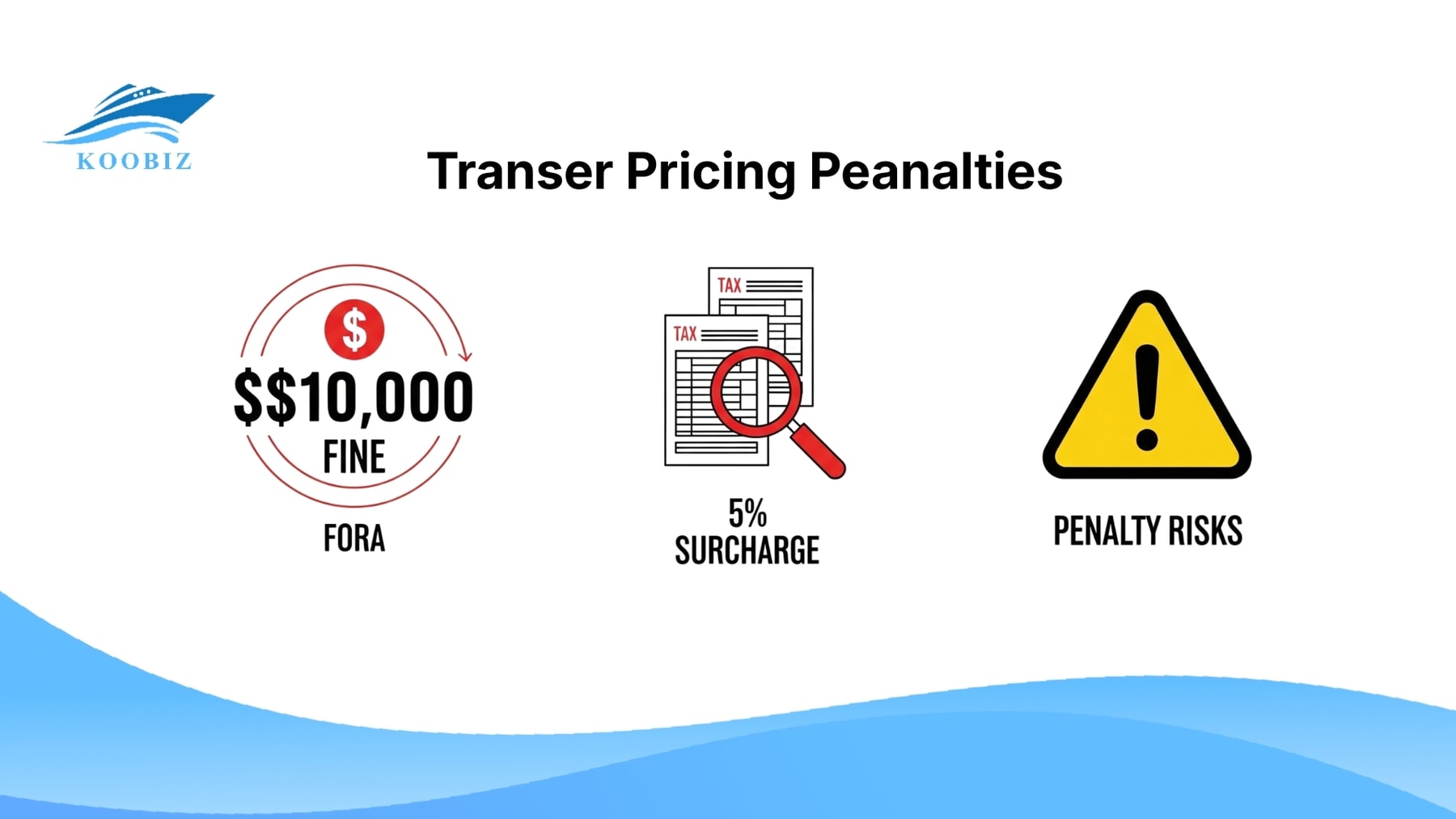
    Non-compliance with Transfer Pricing rules triggers severe financial consequences, including a fine of up to S$10,000, a 5% surcharge on adjustments, and potential interest on underpaid taxes.

    The consequences of ignoring these rules are not just administrative but financially punitive. IRAS has taken a stricter stance on enforcement to deter profit shifting.

    Transfer Pricing Penalties: Fine, 5% Surcharge, No Safe Harbour
    Transfer Pricing Penalties: Fine, 5% Surcharge, No Safe Harbour
    1. Fine for Non-Documentation: Failure to prepare or submit TPD upon request can result in a fine not exceeding S$10,000. This applies even if the pricing itself was correct but the documentation was missing.
    2. 5% Surcharge on Adjustments: If IRAS reviews your accounts and decides to adjust your transfer price (increasing your taxable income), a 5% surcharge is imposed on the amount of the adjustment, regardless of whether there is additional tax payable. This surcharge is not tax-deductible.
    3. No Safe Harbour from Penalties: Unlike some jurisdictions where having documentation provides penalty protection, in Singapore, the 5% surcharge is strictly applied on adjustments.

    Note on Remission: While strict, IRAS may consider remitting part or all of the surcharge in cases where taxpayers are cooperative or voluntarily initiate a retrospective adjustment within two years (provided no audit has commenced). Proactive correction is key.

    Beyond immediate penalties, repeated non-compliance can trigger wider tax audits, including reviews of GST and withholding tax positions, and may result in reputational harm with regulators and counterparties. In practice, investing in robust transfer pricing compliance upfront is significantly more cost-effective than dealing with escalating penalties and enforcement actions later.

    Contextual Border:

    Having covered the “What” (definitions), the “Why” (compliance rationale), and the “Consequences” (penalties), we now turn to the “How.” The next section examines complex, real-world applications, such as intercompany financing arrangements and dispute resolution mechanisms, that sophisticated MNCs commonly encounter as their operations scale.

    Handling Specific Related Party Transactions and Dispute Resolutions

    MNCs face specific compliance requirements for intercompany loans and services, alongside mechanisms for resolving cross-border disputes.

    How are Intercompany Loans Treated under the 8th Edition Guidelines?

    Rule: Loans must be priced using a Base Reference Rate + Arm’s Length Spread or the IRAS Indicative Margin.

    • 8th Edition Update: Benchmarking must strictly match the loan tenure.
    • Domestic Loans (New Jan 2025 Rule): For domestic loans entered into from 1 Jan 2025, if neither party is in the business of lending, taxpayers can choose to apply the IRAS Indicative Margin.
      • Key Benefit: Doing so exempts the transaction from TPD and, crucially, IRAS will not make Section 34D adjustments on these specific loans.
    • Interest-Free Loans: From 2025 onwards, interest-free domestic intercompany loans are generally not acceptable unless supported by strong commercial justification. For cross-border loans, IRAS typically does not adjust interest-free arrangements where the Singapore entity is the lender, largely due to Singapore’s remittance-based taxation system. However, documentation and rationale remain important to mitigate audit risk.

    In practice, intercompany financing has become a high-focus area under the 8th Edition, and structuring loans correctly from inception is critical to avoid unnecessary adjustments and penalties.

    What is the Safe Harbour Rule for Routine Support Services?

    Rule: Taxpayers can apply a fixed 5% cost mark-up on routine support services (e.g., HR, IT listed in Annex C).

    • Benefit: No detailed benchmarking study is required.
    • Condition: Costs must be strictly pooled and correctly allocated.

    What is the Difference Between Advance Pricing Arrangements (APA) and Mutual Agreement Procedures (MAP)?

    APA is proactive; MAP is reactive. Use APAs for certainty and MAPs to resolve double taxation.

    Feature Advance Pricing Arrangement (APA) Mutual Agreement Procedure (MAP)
    Nature Prospective (Forward-looking / Prevention) Reactive (Backward-looking / Cure)
    Primary Purpose Determine pricing for future years (3-5 years). Resolve double taxation after adjustments.
    Benefit Audit immunity on covered transactions. Eliminates double taxation via authority agreement.

    When should MNCs consider a Transfer Pricing Health Check?

    Conduct a health check immediately if you meet any of the following criteria:

    • [ ] Revenue: Gross revenue > S$10 million.
    • [ ] Thresholds: Services/Royalties > S$1 million (S$2 million from YA 2026).
    • [ ] Outdated Data: Benchmarking study > 3 years old.
    • [ ] Losses: Singapore entity is consistently loss-making.
    • [ ] Risks: Interest-free loans exist between related parties.

    Koobiz offers a “traffic light” risk assessment to identify and remediate these exposures.

    About Koobiz

    Managing transfer pricing in Singapore goes beyond technical compliance, it requires commercial insight, regulatory awareness, and hands-on local experience. Koobiz is a trusted corporate services firm supporting businesses at every stage of their Singapore journey.

    We specialize in:

    • Singapore Company Incorporation: Setting up your optimal business structure.
    • Bank Account Opening: Facilitating seamless financial integration in Singapore.
    • Tax & Accounting Services: From Corporate Income Tax filing to Transfer Pricing Documentation preparation.
    • Audit & Assurance: Ensuring full regulatory compliance.

    Transfer pricing risks should never slow down your expansion. With Koobiz, your related party transactions are structured to be compliant, commercially sound, and well-prepared for IRAS scrutiny, so you can focus on growing your business with confidence.

    Explore Koobiz Services

    Disclaimer: This guide is for informational purposes only and does not constitute legal or tax advice. Transfer pricing rules are subject to change. Please consult with a professional advisor or IRAS guidelines for specific business circumstances.

  • How to Issue Compliant Share Certificates in Singapore [ACRA Guide]

    How to Issue Compliant Share Certificates in Singapore [ACRA Guide]

    [SUMMARIES]

    Legal Proof: A share certificate is the primary legal document proving someone owns shares in your company.

    Mandatory Details: It must include the company name, shareholder details, number/class of shares, and the amount paid.

    Execution Flexibility: Companies can now use authorized signatures (e.g., a Director and the Secretary) instead of a physical company seal.

    Issuance Timeline: You must prepare the certificate for delivery within 60 days of issuing the shares.

    Digital Shift: Electronic share certificates are legally accepted and are becoming a popular, efficient choice.

    [/SUMMARIES]

    Issuing a share certificate is a key legal step, not just paperwork. It is the official proof of ownership for anyone holding a stake in your Singapore company. For business owners in Singapore, understanding the nuances of Section 123 of the Companies Act 1967 is essential to avoid governance disputes and ensure full compliance with the Accounting and Corporate Regulatory Authority (ACRA). Whether you are a startup founder distributing initial equity or an established firm managing a share transfer, the validity of this document underpins the trust in your corporate structure.

    At Koobiz, we understand that navigating corporate secretarial duties can be complex. This guide aims to demystify the process, answering exactly what a share certificate is, how to issue it correctly, and how to handle modern exceptions like electronic versions or lost documents. Below, we break down the rigorous standards required to ensure every certificate you issue is fully compliant and legally binding.

    What is a Share Certificate in Singapore Law?

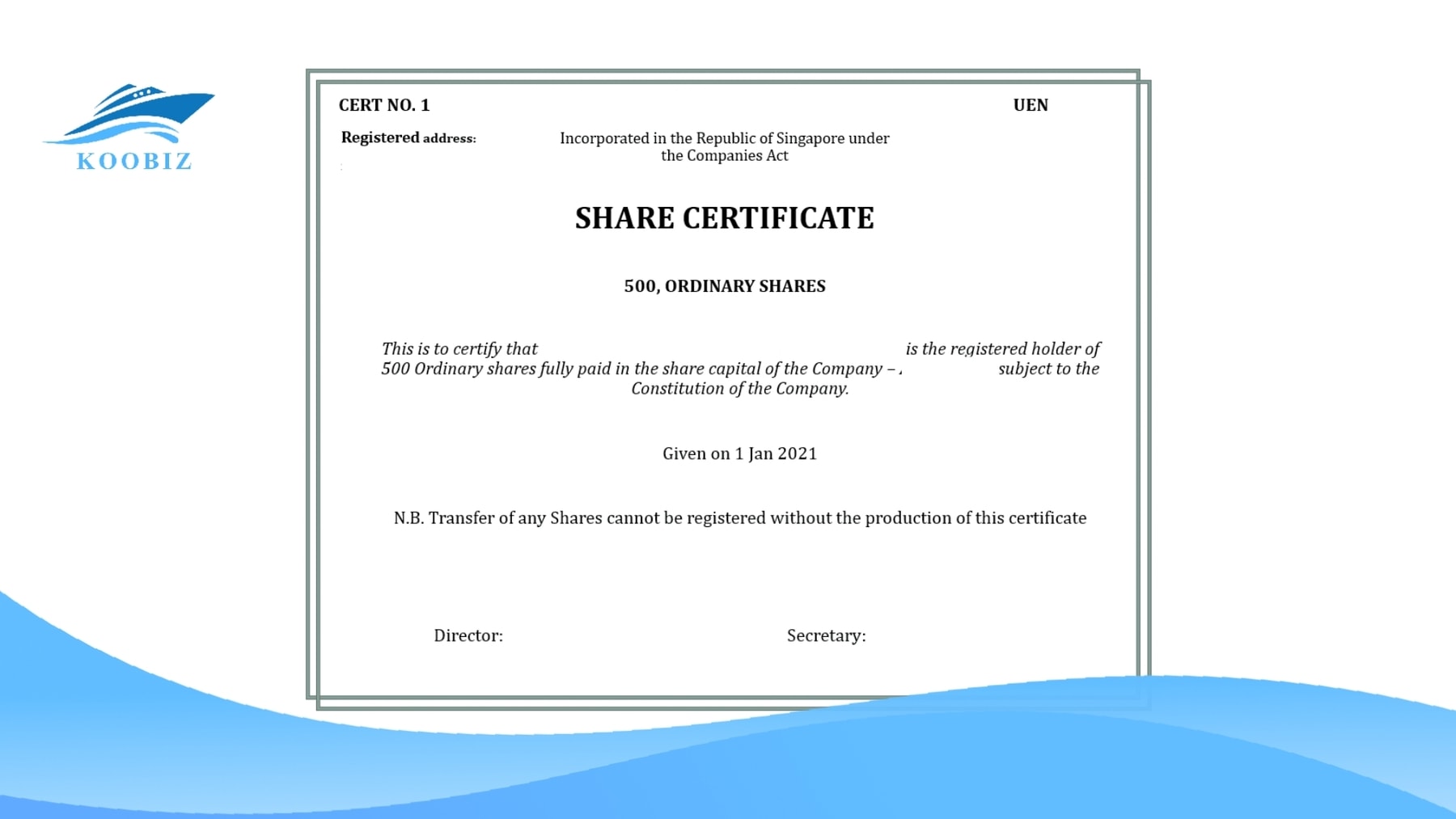
    A share certificate is a legal document that serves as the main proof of ownership for the shares it lists. Singapore law requires companies to prepare and have this document ready for the shareholder within 60 days of issuing new shares or within 30 days after the lodging of a transfer.

    Sample Share Certificate of a Singapore Company
    Sample Share Certificate of a Singapore Company

    Think of it this way: owning a share is like owning a right in the company, and the certificate is the official paper (or digital file) that confirms you hold that right. While the Electronic Register of Members (EROM) hosted by ACRA and updated by the company via BizFile+ is the primary official record, the shareholder keeps the certificate as their personal proof.

    Mandatory Particulars: What Must Be Included in a Share Certificate?

    For the certificate to be legally valid, it must contain specific details.

    Standard elements of a share certificate
    Standard elements of a share certificate

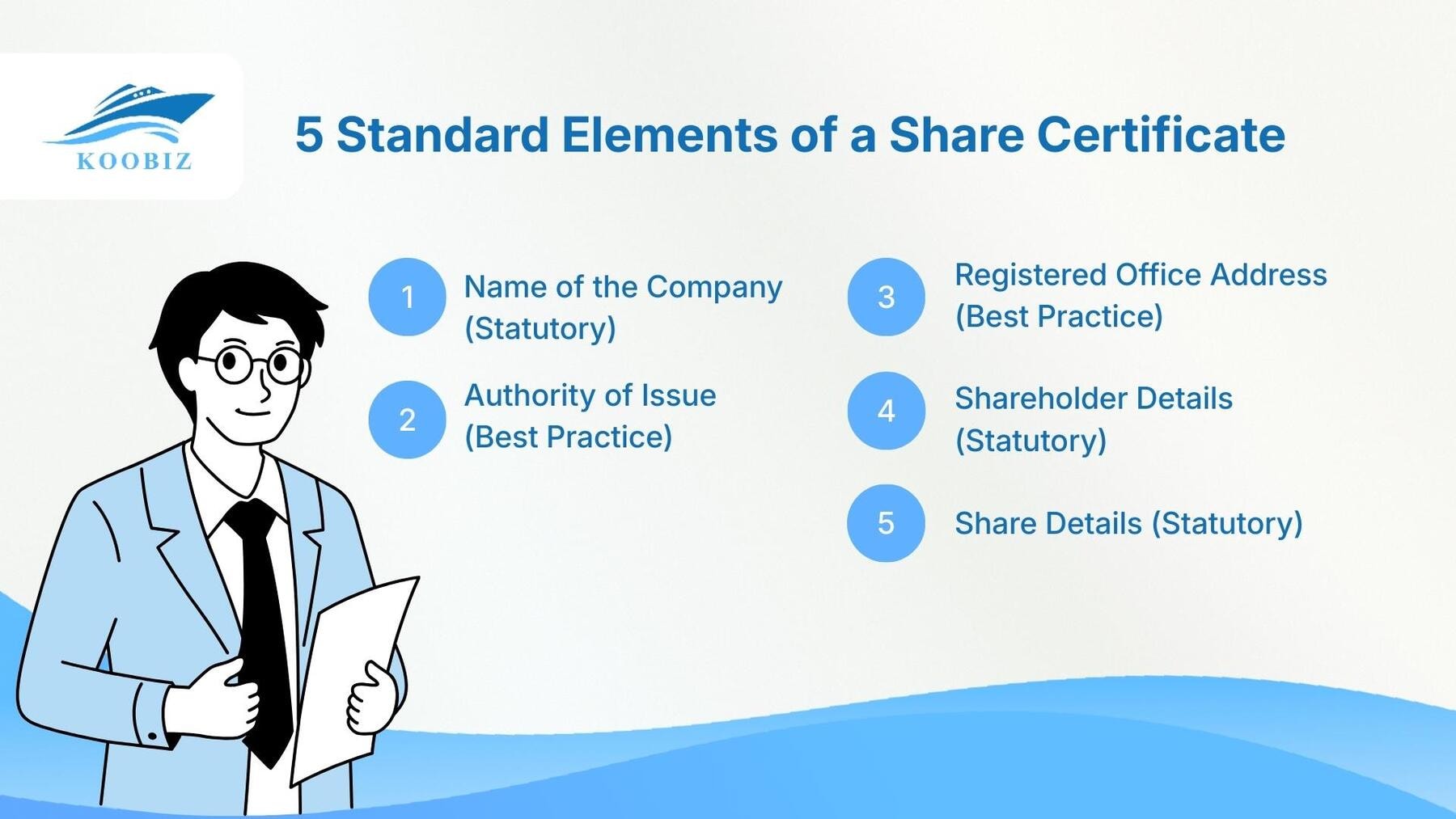
    The five standard elements include:

    1. Name of the Company (Statutory): This must be the exact registered name as it appears in ACRA’s records, including the suffix (e.g., Pte. Ltd.).
    2. Authority of Issue (Best Practice): It is standard practice to state the law under which the company is constituted (usually “Incorporated in the Republic of Singapore under the Companies Act 1967”).
    3. Registered Office Address (Best Practice): Including the current registered address of the company helps identify the entity clearly, though not strictly mandated by the Act itself.
    4. Shareholder Details (Statutory): The full name and address of the registered owner (the member).
    5. Share Details (Statutory): This is the core data required by law, which must specify:
      • The Class of Shares (e.g., Ordinary, Preference).
      • The Number of Shares held.
      • The Amount Paid-up on the shares (or legally deemed to be paid up).

    Ensuring the “amount paid” is accurate is crucial, as it protects the shareholder from being asked for more money later. At Koobiz, we double-check that this information matches your ACRA filings perfectly.

    Step-by-Step Guide to Issuing Share Certificates

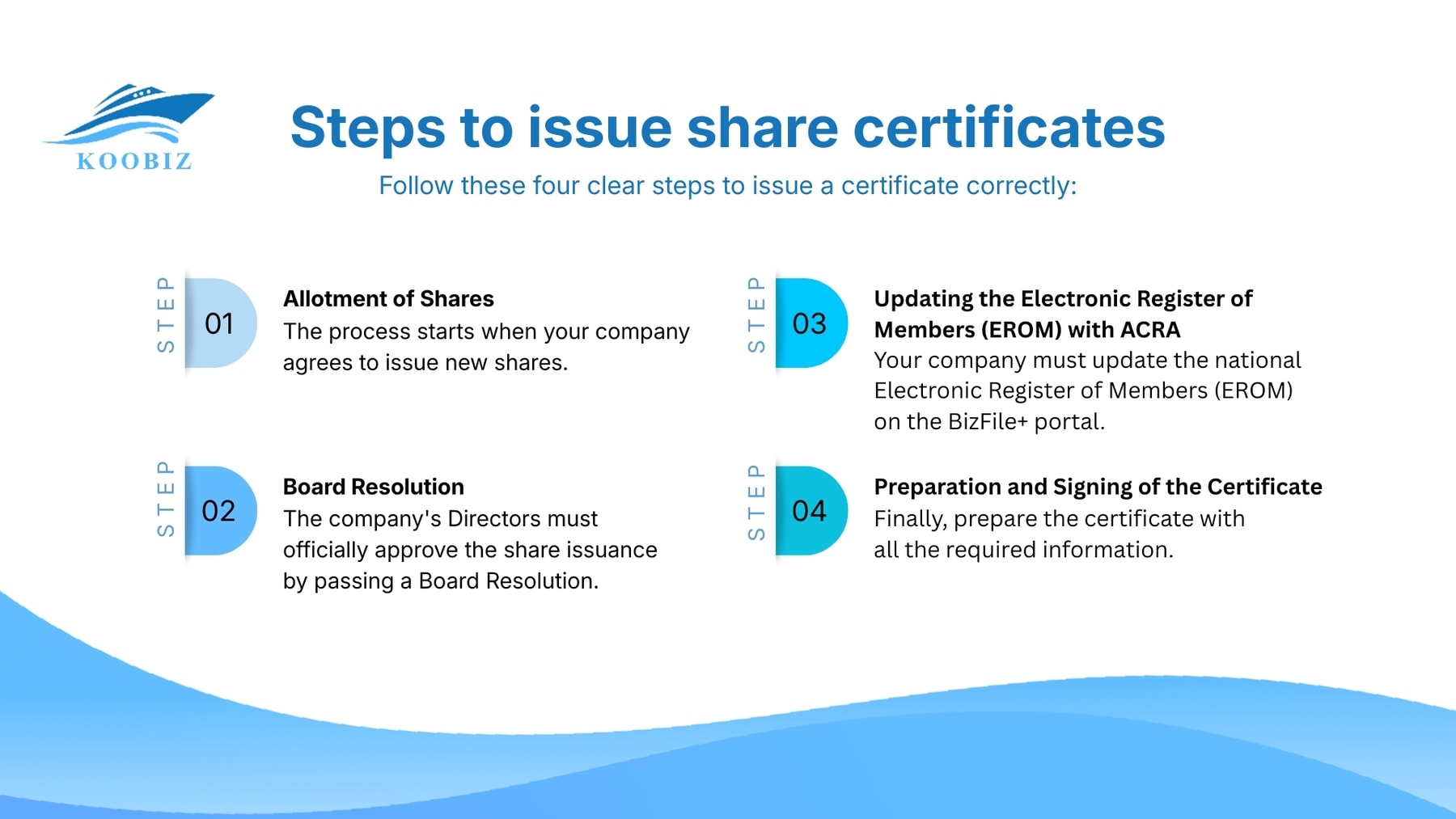
    Follow these four clear steps to issue a certificate correctly:

    Steps to issue share certificates
    Steps to issue share certificates

    Step 1: Allotment of Shares

    The process starts when your company agrees to issue new shares, usually to an investor in exchange for capital. This agreement should be documented.

    Step 2: Board Resolution

    The company’s Directors must officially approve the share issuance by passing a Board Resolution. This resolution authorizes who gets the shares, how many, and approves the creation and signing of the certificates.

    Step 3: Updating the Electronic Register of Members (EROM) with ACRA

    Your company must update the national Electronic Register of Members (EROM) on the BizFile+ portal. This is the official moment the person becomes a shareholder on record. Your Company Secretary typically handles this filing.

    Step 4: Preparation and Signing of the Certificate

    Finally, prepare the certificate with all the required information. It is then signed by the authorized company officers.

    Executing the Document: Common Seal vs. Authorized Signatures

    You have two main options for signing, offering flexibility, especially for companies with overseas directors.

    The table below outlines the key differences and requirements for each method:

    Feature Method 1: Using Common Seal Method 2: Authorized Signatures (No Seal)
    Applicability Mandatory if specified in the Company Constitution. Standard for modern companies (or if Constitution allows).
    Process Physical embossing of the metallic seal onto the paper. Wet ink signatures or secure digital signatures.
    Authorized Signatories • Two Directors

    • One Director + Company Secretary

    • Two Directors

    • One Director + Company Secretary

    • One Director + Witness (attesting the signature)

    Best For Traditional companies preserving formality. Modern companies with international or remote directors.

    This flexibility is particularly beneficial for companies with international directors who may not be physically present in Singapore to apply a physical seal. At Koobiz, we often advise clients on structuring their Constitution to allow for this modernized execution method, facilitating smoother remote operations.

    Practical Example: Issuance of Shares for a New Investor

    Let’s see how this works for a fictional company, “FutureTech Pte. Ltd.”.

    The Scenario:

    FutureTech Pte. Ltd. has secured a new angel investor, Mr. John Tan, who is investing SGD 50,000 in exchange for 10,000 ordinary shares.

    The Execution Workflow:

    Steps for Approval, ACRA Filing, and Certificate Issuance
    Steps for Approval, ACRA Filing, and Certificate Issuance
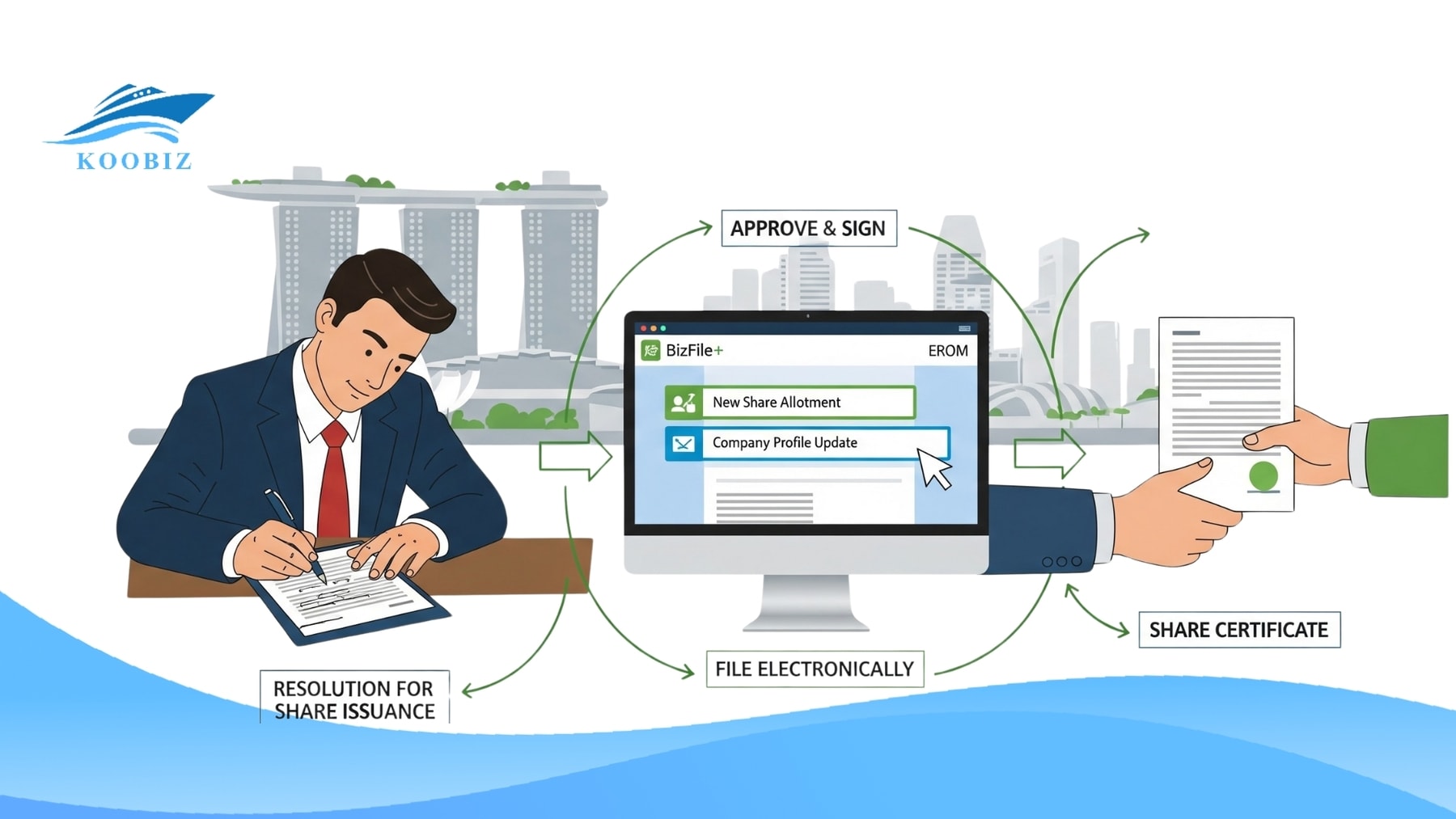
    1. Board Approval: The Directors pass a Board Resolution approving the allotment of 10,000 shares to Mr. Tan. The resolution explicitly authorizes the issuance of Share Certificate No. 005.
    2. ACRA Filing: The Company Secretary logs into BizFile+ and files the “Return of Allotment”. This updates the Electronic Register of Members (EROM) to reflect Mr. Tan’s ownership effective from the filing date.
    3. Certificate Preparation: The Secretary prepares the certificate with the following details:
      • Certificate No: 005
      • Member: Mr. John Tan
      • Shares: 10,000 Ordinary Shares
      • Paid-Up: SGD 50,000 (Fully Paid)
    4. Signing (Modern Method): As FutureTech does not use a common seal, the certificate is signed by one Director and the Company Secretary.
    5. Delivery: The signed certificate is delivered to Mr. Tan within 60 days of the allotment.

    Managing Share Certificate Lifecycle: Digital Requirements & Lost Certificates

    Managing the lifecycle of share certificates involves not just their creation, but also handling modernization trends and unfortunate events like loss or destruction.

    Digital Share Certificate Requirements 2025: Are They Legal?

    Yes, electronic share certificates are fully legal in Singapore if your company’s Constitution allows it. They offer better security and are easier to store and share. Important: A digital certificate isn’t just a scanned PDF. It should be properly executed with secure digital signatures to ensure it can’t be tampered with. Koobiz strongly encourages modern startups to adopt electronic records early, as this simplifies future due diligence processes where investors will ask for a “Data Room” containing all these documents.

    How to Replace a Lost Share Certificate in Singapore

    If a shareholder loses their certificate, the company must follow a secure process to issue a replacement and protect against fraud.

    The replacement process typically requires:

    1. Statutory Declaration: The shareholder must sign a legal declaration confirming the certificate is lost and has not been pledged or sold.
    2. Letter of Indemnity: The shareholder promises to compensate the company for any loss arising from the issuance of the replacement.
    3. Payment of Fees: The company may charge a nominal fee for the replacement (up to SGD 2.00).
    4. Public Notice (Optional but Recommended): In some cases, notice must be given to the public before a replacement is issued to ensure no other party claims title.

    Once these documents are received, the Directors pass a resolution to cancel the old certificate number and authorize the issuance of a new one.

    Is Stamp Duty Required for Issuing New Share Certificates?

    No, stamp duty is generally not required for the issuance of new share certificates during an allotment, but it is applicable for certificates issued pursuant to a transfer of shares.

    It is crucial to distinguish between “Allotment” (New Shares) and “Transfer” (Existing Shares).

    • New Allotment: When a company issues fresh shares to raise capital, there is no transfer of existing interest, so no stamp duty is payable to the Inland Revenue Authority of Singapore (IRAS).
    • Share Transfer: If a certificate is issued because Shareholder A sold shares to Shareholder B, a Share Transfer Deed must be executed, and Stamp Duty (0.2% of the purchase price or market value, whichever is higher) must be paid. The new share certificate for Shareholder B should only be issued after the Stamp Duty has been paid and the transfer is registered.

    Conclusion

    Issuing proper share certificates is a fundamental part of trustworthy corporate governance in Singapore. From ensuring the mandatory particulars are accurate to choosing the right execution method (seal vs. signature), every step reinforces your company’s credibility.

    While the process involves specific legal steps—allotment, resolution, and ACRA updates—it doesn’t have to be a burden. Whether you are moving towards electronic certificates or need to replace a lost document, professional guidance ensures you stay on the right side of the Companies Act.

    About Koobiz

    At Koobiz, we specialize in simplifying business compliance for Singapore companies. From incorporation and Company Secretary services to facilitating bank account opening and managing tax and accounting, we ensure your corporate governance is flawless. Let us handle the complexities of ACRA compliance so you can focus on growing your business.

    Visit Koobiz.com today for expert assistance with your Singapore corporate needs.

  • Understanding EGM Meaning: A Guide to Convening Extraordinary General Meetings vs. AGMs for Singapore Companies

    Understanding EGM Meaning: A Guide to Convening Extraordinary General Meetings vs. AGMs for Singapore Companies

    [SUMMARIES]

    Definition: An EGM is any shareholder meeting other than the mandatory Annual General Meeting (AGM), used for urgent or special business.

    Key Difference: While AGMs are routine and held annually, EGMs are ad-hoc and convened only when specific, urgent decisions are required.

    Procedure: Convening an EGM requires strict adherence to notice periods (14 or 21 days), quorum requirements, and proper voting protocols under the Companies Act.

    Shareholder Rights: Shareholders holding at least 10% of voting rights have the legal power to requisition an EGM if the board refuses to do so.

    Compliance: Failure to follow proper EGM procedures can render resolutions invalid; Koobiz recommends professional secretarial oversight for all corporate proceedings.

    [/SUMMARIES]

    In the dynamic corporate landscape of Singapore, business agility often requires swift decision-making that cannot wait for the annual review cycle. While most business owners are familiar with the Annual General Meeting (AGM), the Extraordinary General Meeting (EGM) plays an equally critical role in corporate governance. The purpose of an EGM goes beyond a simple definition; it involves mastering the strategic legal mechanisms required to approve major transactions, amend constitutions, or restructure leadership.

    For Singapore companies, navigating the procedural nuances of an EGM—from drafting notices to ensuring a valid quorum—is essential to prevent legal disputes. At Koobiz, where we specialize in Singapore company incorporation and corporate secretarial services, we frequently guide clients through the complexities of convening valid meetings. Whether you are a director who needs to approve an urgent decision or a shareholder looking to exercise your rights, this guide will explain the EGM process, showing how it differs from the AGM, and ensure your company remains compliant with the Singapore Companies Act.

    What is an Extraordinary General Meeting (EGM) in Singapore?

    Emergency shareholders' meeting in a corporate setting
    Emergency shareholders’ meeting in a corporate setting

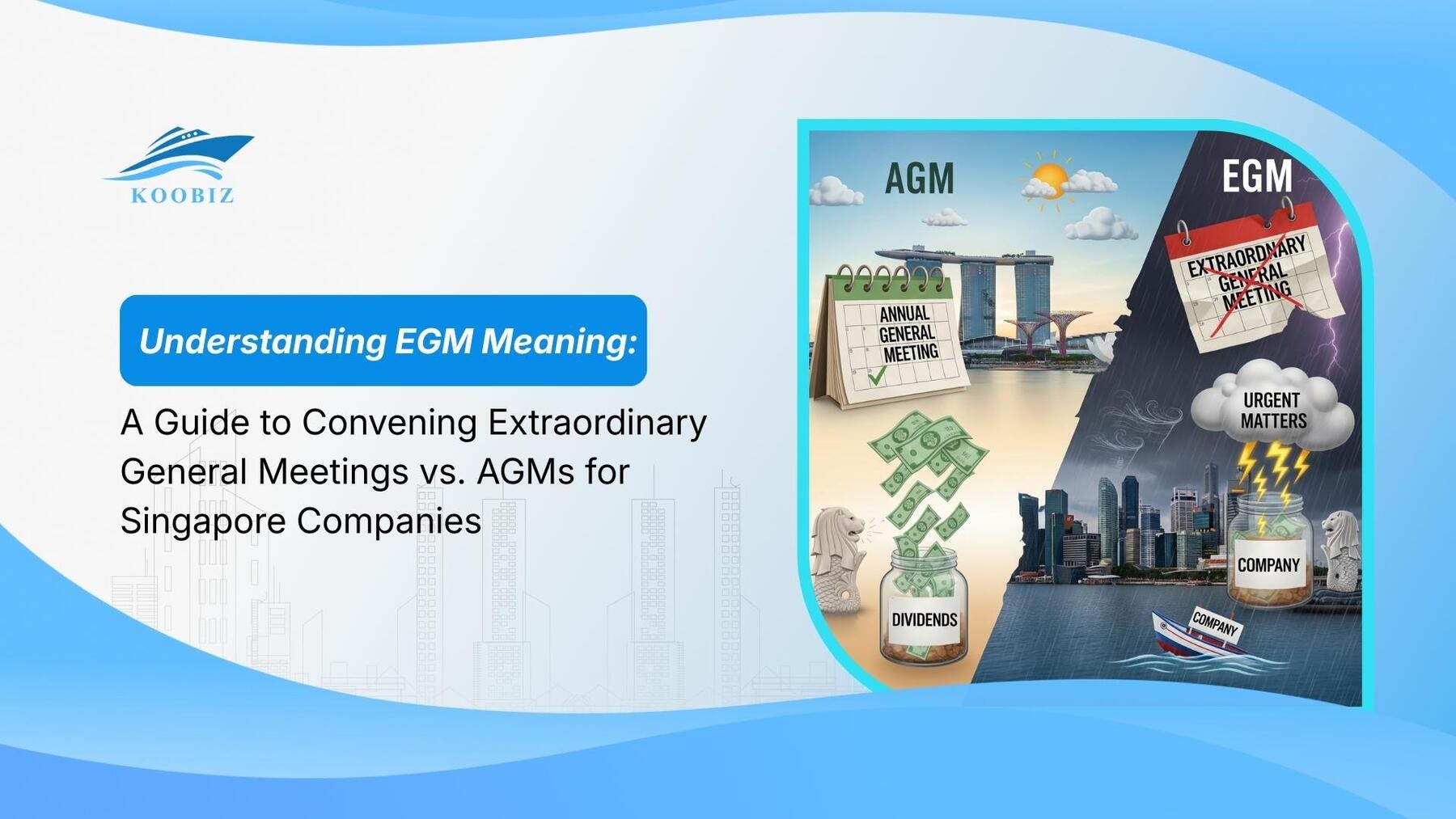
    An Extraordinary General Meeting (EGM) is legally defined as any meeting of a company’s members (shareholders) that is not the mandatory Annual General Meeting (AGM), convened specifically to address urgent matters that arise between AGMs.

    To distinguish an EGM from other corporate gatherings, three main keys define its nature and necessity:

    • Urgency: The matters at hand are time-sensitive and cannot be postponed until the next scheduled AGM.
    • Specificity: It is convened for a specific purpose or “special business,” such as removing a director or amending the constitution, rather than routine annual reviews.
    • Irregularity: There is no statutory deadline to hold an EGM; it is an ad-hoc event triggered only by necessity.

    Unlike the AGM, which follows a predictable yearly schedule to review accounts, the EGM is irregular and “extraordinary” in nature. It is a rapid-response mechanism for the company. Whenever an issue arises that requires shareholder approval—such as removing a director or approving a merger—and that issue is too critical to postpone, an EGM is called.

    Koobiz advises that viewing the EGM as a strategic tool rather than just a compliance hurdle allows directors to manage corporate changes more effectively. Understanding this fundamental definition is the first step, but to truly grasp its operational value, we must distinguish it from its counterpart, the AGM.

    AGM vs. EGM: What is the Difference Between These Key Shareholder Meetings?

    The Annual General Meeting (AGM) serves as the routine health check of a company, whereas the Extraordinary General Meeting (EGM) acts as the emergency surgery room for specific, urgent corporate interventions. To visualize these differences clearly, refer to the comparison table below:

    Feature Annual General Meeting (AGM) Extraordinary General Meeting (EGM)
    Nature & Urgency Routine Health Check. Retrospective; reviews past performance. Emergency Intervention. Prospective; addresses immediate, urgent changes.
    Frequency Mandatory. Must be held once every calendar year. Ad-hoc. No fixed schedule; held only when necessary.
    Timing (Singapore) Within 4 months (listed) or 6 months (non-listed) of FYE. Any time a decision is needed (e.g., funding rounds).
    Business Agenda “Ordinary Business”: Accounts, dividends, director re-elections. “Special Business”: Constitution changes, director removal, mergers.
    • Frequency and Timing: The AGM is a mandatory statutory obligation. In Singapore, listed companies must hold an AGM within four months of their financial year-end, while non-listed companies have six months. In stark contrast, an EGM has no fixed schedule. A dormant company might never hold an EGM, whereas a rapidly expanding startup might hold several in a year.
    • Business Agenda: The AGM deals with “ordinary business,” which is predictable: presenting financial statements, declaring dividends, and re-electing directors retiring by rotation. The EGM deals exclusively with “special business.” This includes anything outside the routine scope, such as altering the company’s constitution or changing the company name.
    • Urgency: AGMs are retrospective, looking back at the past year’s performance. EGMs are prospective and urgent, looking forward to immediate changes required for the company’s survival or growth.

    Understanding this distinction clarifies why an EGM might be necessary, but what specific events trigger the need to convene one?

    When Should a Singapore Company Convene an EGM?

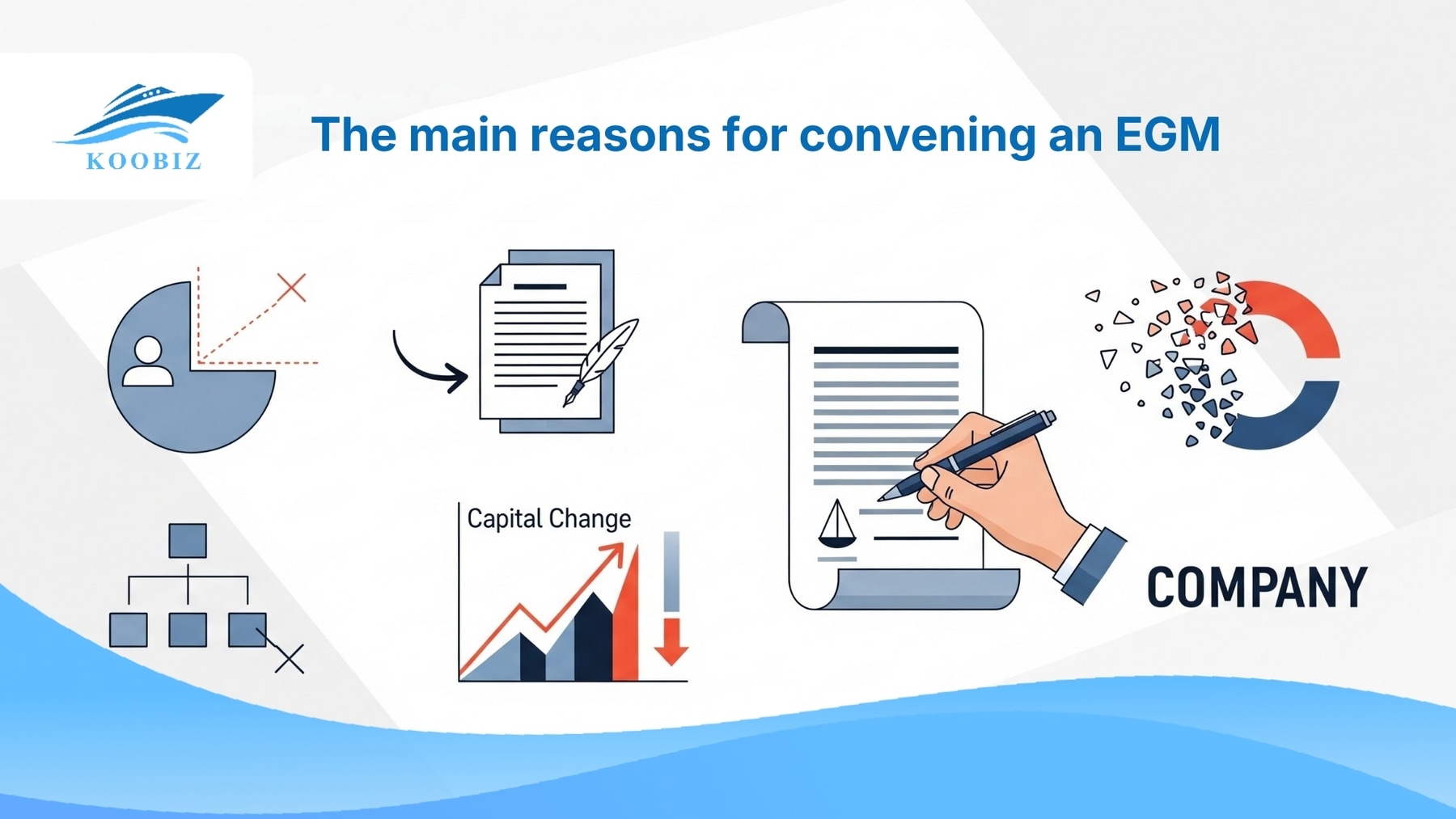
    The main reasons for convening an EGM in Singapore
    The main reasons for convening an EGM in Singapore
    1. Removal of a Director: While the Board can appoint directors, removing a director before their term expires usually requires an Ordinary Resolution passed at a general meeting. This is a common, often contentious, reason for EGMs.
    2. Amendment of Constitution: If a company wishes to update its Constitution (formerly Memorandum and Articles of Association), this requires a Special Resolution. Since the Constitution dictates how the company is run, changes are often urgent.
    3. Changes in Share Capital: Whether it involves the allotment of new shares that exceeds the directors’ mandate, or a reduction of share capital to return cash to shareholders, these actions dilute or alter ownership and thus require owner consent.
    4. Major Transactions: Under Singapore law, specifically Section 160 of the Companies Act, directors cannot dispose of the whole or substantially the whole of the company’s undertaking or property without shareholder approval.
    5. Winding Up: A decision to voluntarily wind up the company requires a Special Resolution passed at an EGM.

    Need to check if your specific situation requires an EGM? Contact Koobiz today for a free compliance checklist.

    How to Convene an EGM in Singapore: The Standard Procedure

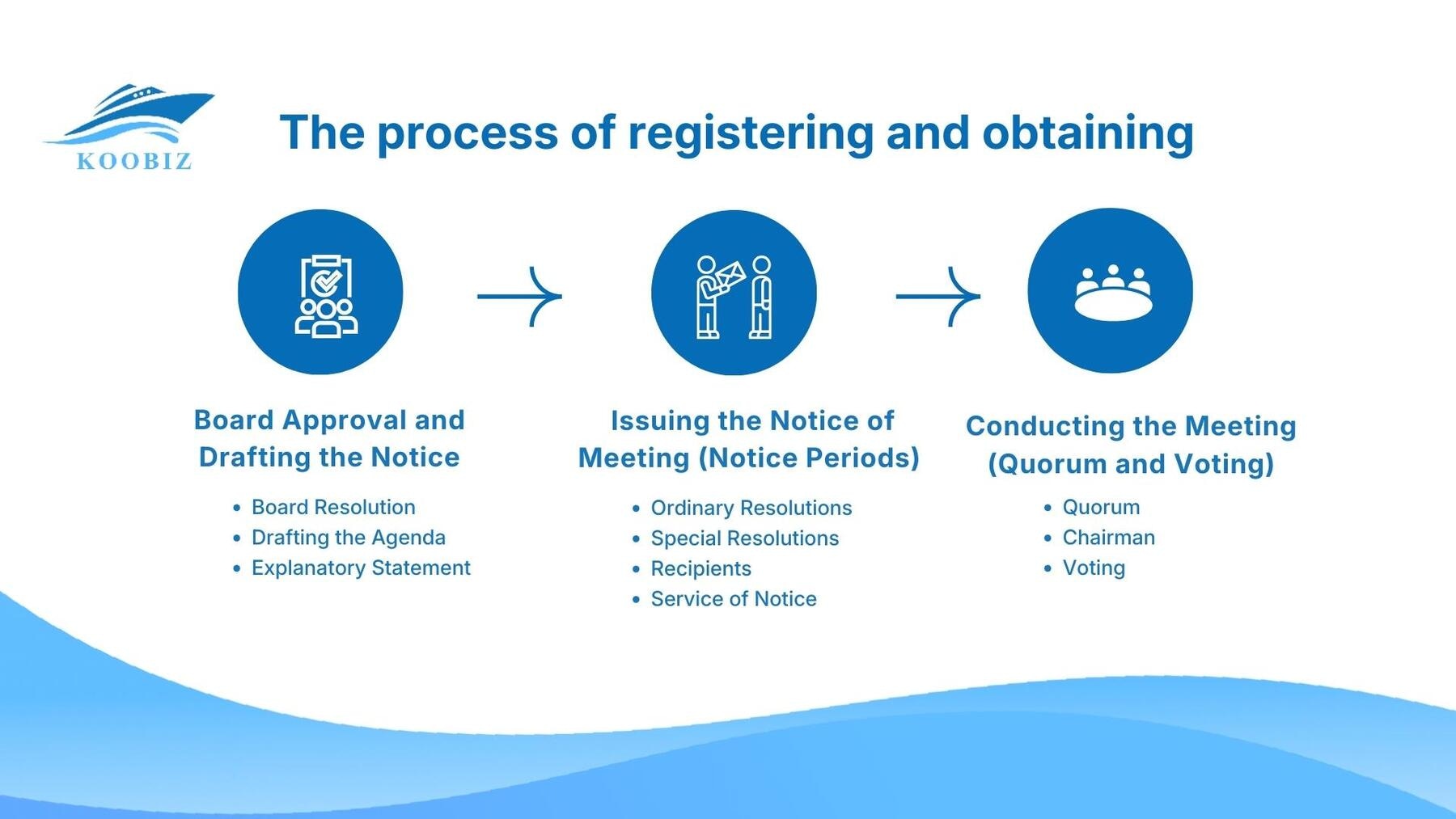
    The standard procedure for convening an EGM
    The standard procedure for convening an EGM

    The standard procedure for convening an EGM involves a strict three-step legal process: Board approval, issuance of compliant notice, and the proper conduct of the meeting itself.

    Step 1: Board Approval and Drafting the Notice

    • Board Resolution:The Directors must pass a Board Resolution to approve the convening of the EGM.
    • Drafting the Agenda: The Board must clearly define the resolutions to be voted on. These must be drafted as either:
      • Ordinary Resolutions: Requiring >50% of the vote.
      • Special Resolutions: Requiring ≥75% of the vote.
    • Explanatory Statement: It is best practice, and often legally required, to include an explanatory statement/circular that provides shareholders with enough information to make an informed decision on the proposed resolutions.

    Step 2: Issuing the Notice of Meeting (Notice Periods)

    • Ordinary Resolutions: If the EGM is only for Ordinary Resolutions, a minimum of 14 days’ written notice is required.
    • Special Resolutions: If the agenda includes any Special Resolution (e.g., changing the company name), a minimum of 21 days’ written notice is mandatory.
    • Recipients: The notice must be sent to all members (shareholders), the auditors of the company, and any other person entitled to receive notice under the constitution.
    • Service of Notice: The notice period excludes the day of service and the day of the meeting. Therefore, purely calculating 14 days on a calendar is often insufficient; a buffer is necessary.

    Note for Public Listed Companies: If your company is listed on the SGX, stricter notice periods may apply under the Listing Manual (e.g., 14 calendar days for Ordinary Resolutions). Always verify against current listing rules.

    Step 3: Conducting the Meeting (Quorum and Voting)

    • Quorum: Before business can commence, a quorum must be present. Unless the company’s constitution says otherwise, the Model Constitution usually sets the quorum at two members present in person or by proxy.
    • Chairman: The meeting is chaired by the Chairman of the Board. If they are absent, members can elect a chairman for the meeting.
    • Voting: Voting is typically done by a show of hands initially. However, a poll can be demanded by the chairman, at least five members, or members representing at least 5% of voting rights.

    Following this standard path ensures a smooth meeting. However, corporate reality is rarely simple, and complex scenarios often arise regarding shareholder rights and notice waivers.

    Navigating Complex EGM Scenarios and Shareholder Rights

    Navigating complex EGM scenarios involves understanding the exception clauses, minority rights, and modern adaptations that exist beyond the standard “Board-convened” meeting structure.

    This section explores the “Unique Attributes” of the EGM ecosystem in Singapore.

    Can Shareholders Force an EGM? (Member’s Right of Requisition)

    Yes, shareholders holding at least 10% of the total paid-up voting shares have the statutory right to force the directors to convene an EGM.

    According to Section 176 of the Companies Act, if members meet the 10% threshold and submit a valid requisition notice, the directors must proceed to convene the meeting within 21 days, to be held no later than two months after the requisition receipt.

    If the directors fail to do so, Section 177 allows the requisitioning shareholders to convene the meeting themselves. Any reasonable expenses incurred by the shareholders in this process must be reimbursed by the company (which, in turn, can deduct this from the defaulting directors’ fees). This is a powerful tool for minority shareholders to hold the board accountable.

    Is it Possible to Hold an EGM at Short Notice?

    Yes, it is possible to hold an EGM with less than the statutory 14 or 21 days’ notice, provided that a specific majority of shareholders agree to it.

    For private companies, an EGM can be held at short notice if members holding at least 95% of the total voting rights agree to it. This “Consent to Short Notice” is incredibly useful for SMEs where all shareholders are also directors or are in close communication. It allows for immediate decision-making without the mandatory waiting period.

    Disclaimer: Always consult the Company Constitution first. While the Companies Act allows this, a specific clause in your Constitution could technically impose stricter requirements.

    Ordinary Resolution vs. Special Resolution: Which One Do You Need?

    The choice between an Ordinary Resolution and a Special Resolution depends entirely on the gravity of the decision being made, dictated by the Companies Act.

    • Ordinary Resolution: Requires a simple majority (more than 50%) of the votes cast. This is used for the removal of a director or the issuance of shares (if authorized).
    • Special Resolution: Requires a supermajority of at least 75% of the votes cast. This is reserved for fundamental changes in the company’s identity or structure, such as amending the Constitution, reducing share capital, or changing the company name.

    Identifying the correct resolution type is critical. Passing a Special Resolution issue via an Ordinary Resolution threshold renders the decision legally void.

    Modern EGM Formats: Virtual and Hybrid Meetings in Singapore

    Effectively from 1 July 2023, the Companies, Business Trusts and Other Bodies (Miscellaneous Amendments) Act 2023 enables companies to conduct general meetings digitally.

    • Virtual Meetings: Fully online meetings are permitted unless the company’s constitution explicitly prohibits them.
    • Hybrid Meetings: Physical meetings with an option for virtual attendance are also standard.

    However, the technology used must ensure that members can vote and ask questions in real-time.

    Can the Court Order an EGM?

    Yes, in rare circumstances where it is “impracticable” to call or conduct a meeting in the usual manner, the Singapore Court has the power to order an EGM.This usually happens in deadlock situations—for example, in a 50-50 shareholder dispute where one party refuses to attend to deny a quorum. The Court can order the meeting and even direct that “one member present in person or by proxy shall be deemed to constitute a meeting,” effectively breaking the deadlock.

    Conclusion

    A well-conducted EGM protects the board and empowers shareholders, while procedural errors can lead to costly disputes.Don’t navigate these complexities alone. Koobiz specializes in company incorporation, corporate secretarial services, and financial compliance in Singapore. We ensure your meetings are valid and your records immaculate.

    For seamless restructuring, bank account opening, or general compliance, visit Koobiz.com today. Let us handle the details while you focus on business growth.

  • Identify Registrable Controllers (Beneficial Owners): RORC Guide for Singapore Directors

    Identify Registrable Controllers (Beneficial Owners): RORC Guide for Singapore Directors

    [SUMMARIES]

    Definition: RORC is a mandatory register of people or entities with over 25% stake or significant control in your company.

    2025 Update: Companies incorporated from 16 June 2025 must file RORC details upon incorporation.

    Timelines:Update your internal register within 7 calendar days of learning new info; file with ACRA within 2 business days after that.

    Ongoing Duty: Directors must now perform an Annual Verification of all controllers’ particulars.

    Risk: Non-compliance can lead to fines (up to SGD $25,000) and legal consequences.

    [/SUMMARIES]

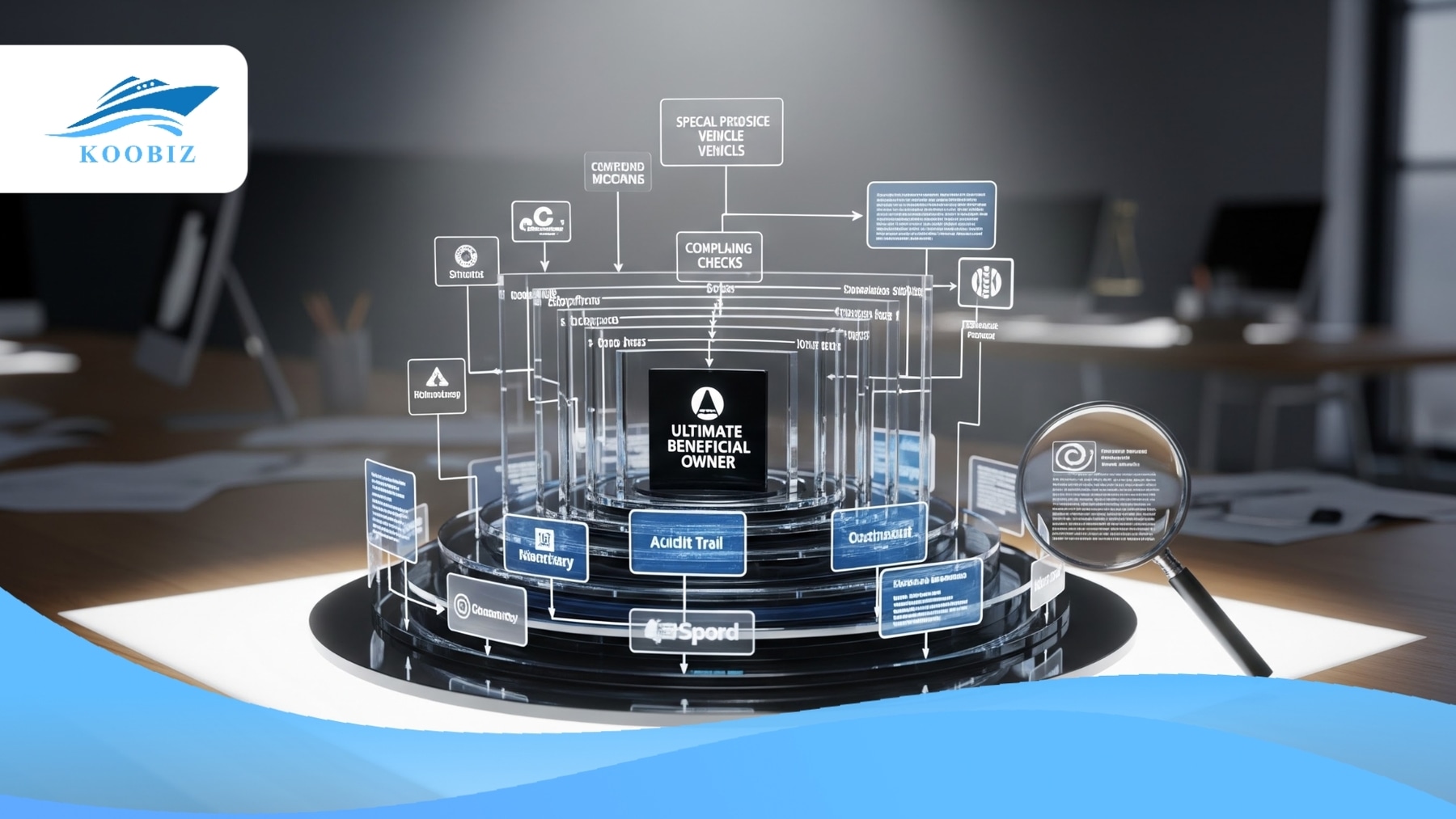
    Running a company in Singapore comes with important transparency duties. One of the most crucial for directors is correctly identifying your company’s Registrable Controllers—often called the ultimate Beneficial Owners.

    The Register of Registrable Controllers (RORC), managed by ACRA, helps prevent financial crime. New rules effective 16 June 2025 have made compliance more urgent.

    At Koobiz, we understand that distinguishing between a shareholder and a “Registrable Controller” is complex. Whether you run a Private Limited Company or an LLP, this guide clarifies the definitions, the 2025 regulatory changes, and the exact steps to ensure full compliance.

    IMPORTANT: 2025 ACRA Regulatory Updates

    Effective 16 June 2025, the Companies and Limited Liability Partnerships (Miscellaneous Amendments) Act 2024 introduced key changes:

    1. Immediate Filing for New Entities: Companies incorporated on or after 16 June 2025 must set up their RORC and lodge information with ACRA on the date of incorporation.
    2. Extended Internal Timeline: The deadline to update the internal register has been extended from 2 business days to 7 calendar days after receiving information.
    3. Annual Verification: Companies must now send an annual notice to every controller to confirm their details are still correct.
    4. New Particulars Required: Controllers must now provide their email address and contact number.

    What is the Register of Registrable Controllers (RORC)?

    Register of Registrable Controllers (RORC)
    Register of Registrable Controllers (RORC)

    The Register of Registrable Controllers (RORC) is a mandatory internal document that records the particulars of a company’s beneficial owners. Its primary goal is ensuring corporate transparency.

    To understand this requirement fully, recognize its key characteristics:

    • Mandatory & Private: You must keep it, but it is not public. It’s held at your registered office or with your corporate secretary (like Koobiz).
    • Dual Obligation: You must keep the register internally and submit the information to ACRA’s private database.
    • Strictly Confidential: Only Singapore government agencies (like the police or tax authority) can access RORC. However, companies must produce the register upon request to ACRA or law enforcement for investigation.
    • Ongoing Duty: It’s not a one-time job. You must keep it current and perform annual checks.

    Who Qualifies as a Registrable Controller?

    A Registrable Controller is someone who, through their influence over the company, meets at least one of these criteria. Directors should look past the share certificate to understand the real relationships. The controller may be the person directing activities behind the scenes or a parent company that owns the local entity.

    Individual vs. Corporate Controllers: Knowing the Difference

    It is vital to distinguish between a natural person and a legal entity when recording information.

    Feature Individual Controller Corporate Controller
    Definition A natural person (human being). A legal entity (Company, LLP, Foreign Corp).
    Role The ultimate “Beneficial Owner”. An intermediate owner in the corporate structure.
    Tracing Requirement The end of the chain. No further tracing needed. You must “look through” this entity to find the individuals behind it.
    Example Mr. Tan owning 30% of shares directly. UK Company B owning 100% of shares.

    Condition 1: Significant Interest (>25% Shares or Voting)

    To have “significant interest,” a controller must meet specific quantitative benchmarks:

    • Owns more than 25% of the company’s shares.
    • Holds more than 25% of the voting rights.
    • Share the right to more than 25% of the capital or profits (for LLPs).

    Note: Exactly 25% does not trigger the requirement; it must be >25%. This applies to both direct interest and “deemed interest” (through nominees).

    Condition 2: Significant Control (Board Appointment & Veto Rights)

    Even without holding a single share, a person is a Registrable Controller if they possess “significant control,” such as:

    • The right to appoint or remove a majority of the directors.
    • The right to exercise, or actually exercising, significant influence or control over the company decisions (e.g., veto rights in a Shareholders’ Agreement).

    Entities Required to Maintain an RORC

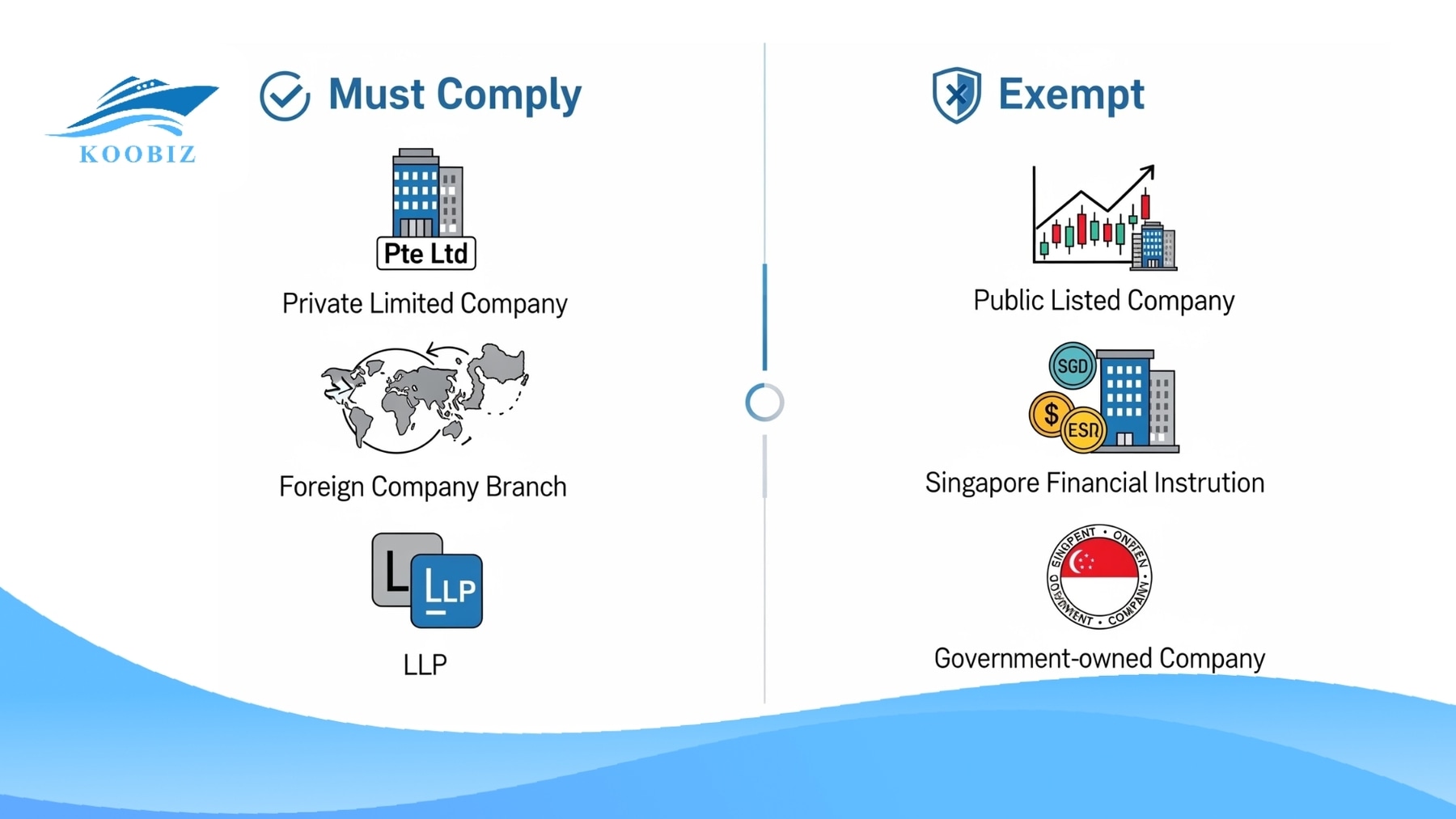
    Entities required to maintain RORC and those that are exempt
    Entities required to maintain RORC and those that are exempt

    The requirement applies to all locally incorporated companies and Limited Liability Partnerships (LLPs) unless specifically exempted.

    Who Must Comply:

    1. Private Limited Companies
    2. Foreign Companies (Singapore Branches)
    3. Limited Liability Partnerships (LLPs)

    Who is Exempt:

    • Public Listed Companies: Listed on SGX.
    • Singapore Financial Institutions: Regulated by MAS.
    • Wholly-Owned Subsidiaries of Exempt Entities: E.g., a subsidiary of a Singapore Public Listed company.
    • Government-owned Companies.

    Update: Exempt companies are now required to declare their exemption category specifically in their Annual Return filings. Note that subsidiaries of foreign listed companies are generally not exempt unless the foreign exchange has disclosure regimes comparable to Singapore’s.

    Practical Case Studies & Tracing Ownership

    Cases of identifying RORC controllers
    Cases of identifying RORC controllers

    Identifying a controller is often straightforward, but complex ownership layers require “tracing.”

    Scenario 1: The Multi-Layered Structure (Indirect/Deemed Interest)

    • Structure: Singapore Company A is 100% owned by Foreign Company B. Foreign Company B is 100% owned by Mr. Smith.
    • Analysis:
      • Foreign Company B is a Corporate Controller (Direct Interest).
      • Mr. Smith has a “Deemed Interest” because he controls Company B.
    • Action: Singapore Company A must register both Foreign Company B and Mr. Smith. Many directors miss this step—you must look through the corporate layers.

    Scenario 2: The “Golden Share” Investor (Control Without Ownership)

    • Structure: An Angel Investor owns 10% equity but holds a contractual right to veto board decisions and appoint the CEO.
    • Analysis: Despite low ownership, the veto power constitutes “Significant Control.”
    • Action: The Angel Investor must be recorded as a Registrable Controller.

    Scenario 3: No Identifiable Controller (The Fallback)

    • Situation: A company has 5 equal shareholders (20% each) with no special voting rights. No one meets the >25% threshold or has significant control.
    • Action:
      1. The company must take reasonable steps to verify no controller exists.
      2. As a mandatory fallback, the company must record the particulars of Directors with Executive Control (e.g., CEO, Managing Director).
      3. Important: You cannot leave the register blank. This entry must also be lodged with ACRA.

    Compliance Workflow: How to Identify and Lodge (2025 Updated)

    The compliance process has evolved. Follow this updated workflow to ensure you meet the new 2025 standards.

    Step 1: Identification & Verification Notices

    Directors must take “reasonable steps” to identify controllers. This includes reviewing the Register of Members and sending notices.

    • Initial Notice: Sent to anyone you know or suspect is a controller.
    • Annual Verification Notice (New): You must now send a notice annually to all controllers in your register to confirm if their particulars have changed.
    • Information to Collect:
    • Full name, ID/Passport number, address, nationality, date of birth, date they became a controller, email, and phone number.

    Step 2: Update Internal Register (New 7-Day Rule)

    • Once you obtain a confirmed response, which must now include a signed declaration from the controller, you are required to update the internal Register of Registrable Controllers (RORC) within 7 calendar days. This is a change from the previous requirement, which allowed for a two-business-day window.
    • For New Companies (those incorporated after June 16, 2025), the internal register must be established on the date of incorporation itself rather than at a later time.

    Step 3: Lodge Data with ACRA

    • Timeline: After the internal register has been updated, you must lodge the relevant information with ACRA via BizFile+ within 2 business days.
    • For New Companies: The filing with ACRA must be completed simultaneously with the incorporation filing, so the information is submitted at the same time as the company’s incorporation.
    • Confidentiality: The lodgment is treated as secure information and is not accessible to the public.

    Penalties for Non-Compliance

    ACRA treats RORC non-compliance as a serious offense.

    • Fines: Up to SGD 25,000 for the company and every officer in default.
    • Criminal Prosecution: For severe cases, such as willfully obstructing an investigation or knowingly providing false/misleading information, officers may face criminal charges and imprisonment.
    • Administrative Roadblocks: Failure to file RORC can prevent the company from completing other essential transactions on BizFile+.

    Shareholder vs. Registrable Controller: The Difference

    A shareholder is the legal name on the share certificate. A controller is the person who ultimately benefits from or controls those shares. They can be different people.

    Feature Shareholder Registrable Controller
    Definition Legal owner of shares (on paper). Ultimate “Beneficial Owner” (in reality).
    Threshold Owns any amount (even 1 share). Must hold >25% interest or have significant control.
    Visibility Public (Business Profile). Private (Lodged with ACRA only).

    Example: Mr. A holds 100% shares as a nominee for Mr. B.

    • Mr. A is the Shareholder.
    • Mr. B is the Registrable Controller. The RORC must reflect Mr. B.

    Conclusion

    Maintaining an accurate RORC is a core part of your directorship duties, ensuring your company operates with integrity. With the June 2025 updates, Directors must be more vigilant than ever—ensuring email addresses are collected, annual verifications are sent, and new entities are compliant from Day 1.

    At Koobiz, we specialize in simplifying these corporate complexities. Our team ensures your RORC is accurate, up-to-date, and fully compliant with the latest ACRA amendments.

    Ready to ensure your company is compliant?

    Contact Koobiz today for a comprehensive RORC health check or assistance with your corporate secretarial needs.

    About Koobiz

    Your trusted partner for business expansion in Singapore, offering:

    • Singapore Company Incorporation (Compliant from Day 1)
    • Corporate Secretarial Services (RORC, Annual Returns)
    • Bank Account Opening & Tax Services